Contact Form

Name

Email *

Message *

Showing posts with label Lithuania. Show all posts

Sunday, July 2, 2017

Countries That Wish To Control Immigration Are Sued By The European Union

  • Many so-called asylum seekers have refused to relocate to Central and Eastern Europe because the financial benefits there are not as generous as in France, Germany or Scandinavia. In addition, hundreds of migrants who have been relocated to Estonia, Latvia and Lithuania, which rank among the poorest EU countries, have since fled to Germany and other wealthier countries in the bloc.
  • "It needs to be said clearly and directly: This is an attack on Europe, on our culture, on our traditions." — Poland's Prime Minister Beata Szydło.
  • "I think we have a right to decide that we do not want a large number of Muslim people in our country. That is a historical experience for us." — Viktor Orbán, Prime Minister of Hungary, referring to Hungary's occupation by the Ottoman Empire from 1541 to 1699.
The European Union has initiated legal action against the Czech Republic, Hungary and Poland for failing to comply with a controversial order to take in thousands of migrants from Africa, Asia and the Middle East.
The so-called infringement procedure, which authorizes the European Commission, the powerful executive arm of the European Union, to sue member states that are considered to be in breach of their obligations under EU law, could lead to massive financial penalties.
The dispute dates back to September 2015, when, at the height of Europe's migration crisis, EU member states narrowly voted to relocate 120,000 "refugees" from Italy and Greece to other parts of the bloc. This number was in addition to a July 2015 plan to redistribute 40,000 migrants from Italy and Greece.
Of the 160,000 migrants to be "shared," nine countries in Central and Eastern Europe were ordered to take in around 15,000 migrants. Although the Czech Republic, Hungary, Romania and Slovakia voted against the agreement, they were still required to comply.
Since then, several Central European EU member states have vehemently refused to accept their assigned quotas of migrants. Poland, for example, has a quota of 6,182 migrants, not one of whom has been admitted. The Czech Republic has a quota of 2,691 migrants, of whom only 12 have been taken. Hungary has a quota of 1,294, none of whom have been admitted.
EU, Many so-called asylum seekers have refused to relocate to Central and Eastern Europe because the financial benefits there are not as generous as in France, Germany or Scandinavia. In addition, hundreds of migrants who have been relocated to Estonia, Latvia and Lithuania, which rank among the poorest countries in the EU, have since fled to Germany and other wealthier countries in the bloc.
Meanwhile, the enforcers of European "unity" have sought to shame the Central European holdouts into compliance by appealing to nebulous concepts such as European "values" and "solidarity." French President Emmanuel Macron, for example, recently warned:
"European countries that do not respect the rules should pay the full political consequences. There is a double betrayal. They decide to abandon EU principles, turn their back on Europe and have a cynical approach to the union which gives them money, without respecting its values."
Leaders in Central and Eastern Europe have held their ground. In Poland, Prime Minister Beata Szydło said her country would not be blackmailed by European Union officials. In a speech to Parliament on May 24, two days after the jihadist attack in Manchester, England, in which a Polish couple was killed, she said:
"We are not going to take part in the madness of the Brussels elite.... Rise from your knees and from your lethargy or you will be crying over your children every day.
"If you cannot see this — if you cannot see that terrorism currently has the potential to hurt every country in Europe, and you think that Poland should not defend itself — you are going hand in hand with those who point this weapon against Europe, against all of us.
"It needs to be said clearly and directly: This is an attack on Europe, on our culture, on our traditions. Do we want strong politicians who can see the danger and can fight against it efficiently?"

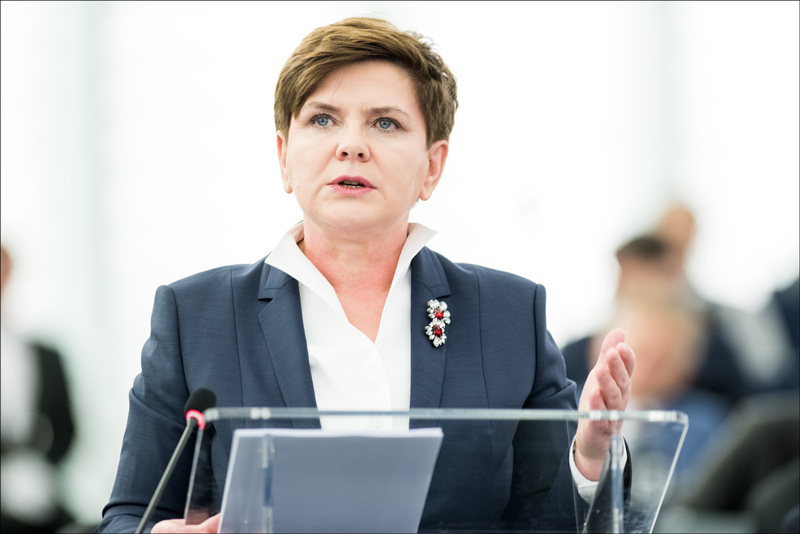
In a May 24 speech, Polish Prime Minister Beata Szydło said her country would not be blackmailed by European Union officials: "We are not going to take part in the madness of the Brussels elite... This is an attack on Europe, on our culture, on our traditions." (Illustrative image source: European Parliament/Flickr)

Polish Interior Minister Mariusz Błaszczak said that agreeing to European Union quotas would "certainly be worse" than any punishment meted out by Brussels:
"We must not forget the terror attacks that have taken place in Western Europe, and how — in the bigger EU countries — these are unfortunately now a fact of life. Remember, that the now very numerous Muslim communities in Western Europe started out as relatively small numbers....
"I tell my counterparts in Western Europe that the relocation strategy only intensifies illegal migration because traffickers get even more customers when would-be migrants hear that people delivered to Europe are being given refuge in EU nations other than Italy and Greece."
Henryk Kowalczyk, a Polish member of parliament, said:
"Poland makes a contribution to the EU.... We are doing what the bloc says, what the treaties say. If the French president was thinking of refugees, well that issue is not mentioned in the treaties and when we joined the European Union we were not taking on that commitment."
Poland's European Affairs Minister Konrad Szymański added: "There is no conflict on values between the Commission and Poland — it is about how to interpret these values."
In the Czech Republic, Prime Minister Bohuslav Sobotka said that "given the deteriorating security situation in Europe and the non-functioning of the quota system, the Czech government will not participate in it." He added: "We are ready to defend our position in the EU and the relevant judicial institutions."
Czech Minister of Foreign Affairs Lubomír Zaorálek said that EU should focus on "economic and social convergence among EU countries, rather than attempts to distribute migrants with forced quotas." He pointed out that in some Eastern European countries, "the most vulnerable inhabitants are often poorer than the incoming migrants themselves."
Zaorálek added that "people who are coming have no real interest in being integrated" and want to live with their "partners from similar cultural, ethnic, religious backgrounds." He said that people in Central and Eastern Europe do not want to "repeat the mistake of the Western countries" which have "neighborhoods full of thousands and thousands of people living in imperfect living conditions" and which are "very risky, not only during the night but also during the day." He pointed out that "there are no suicide bombers among Ukrainians or Vietnamese," two long-established communities in the Czech Republic.
In Slovakia, Prime Minister Robert Fico said that mass migration and forced multiculturalism would change the essence of his country:
"I think it is the duty of politicians to talk about these things very clearly and openly. I do not want to see a Muslim community in Slovakia. I do not want there to be several tens of thousands of Muslims who gradually begin to promote their ideology. We do not want to change the traditions of this country, which are built on the Christian tradition. It has been like this for centuries. Sovereignty and national pride must be part of our ruling coalition."
Fico added that 95% of so-called refugees were actually economic migrants:
"We will not assist in this folly with arms opened wide with the notion that we will accept them all regardless of whether they are economic migrants or not. We must start telling the truth about migration."
In Hungary, Prime Minister Viktor Orbán has warned of the "explosive consequences" of a culture clash between Europe and migrants from the Muslim world:
"To understand what we must do, we need to grasp the true nature of the situation we are facing. Europe is not in the grip of a 'refugee problem' or a 'refugee situation,' but the European continent is threatened by an ever mounting wave of modern-era migration. Movement of people is taking place on an immense scale, and from a European perspective the number of potential future immigrants seems limitless.
"With each passing day we see that hundreds of thousands have been turning up and clamoring at our borders, and there are millions more intending to set out for Europe, driven by economic motives....
"We must acknowledge that the European Union's misguided immigration policy is responsible for this situation. Irresponsibility is the mark of every European politician who holds out the promise of a better life to immigrants and encourages them to leave everything behind and risk their lives in setting out for Europe. If Europe does not return to the path of common sense, it will find itself laid low in a battle for its fate....
"Let us not forget that those arriving have been raised in another religion, and represent a radically different culture. Most of them are not Christians, but Muslims. This is an important question, because Europe and European identity is rooted in Christianity. Is it not worrying in itself that European Christianity is now barely able to keep Europe Christian? If we lose sight of this, the idea of Europe could become a minority interest in its own continent."
Referring to Hungary's occupation by the Ottoman Empire from 1541 to 1699, Orbán said:
"I think we have a right to decide that we do not want a large number of Muslim people in our country. We do not like the consequences of having a large Muslim community that we see in other countries and I do not see any reason for anyone else to force us to create ways of living together in Hungary that we do not want to see. That is a historical experience for us."
Soeren Kern is a Senior Fellow at the New York-based Gatestone Institute. Follow him onFacebook and on Twitter.
© 2017 Gatestone Institute. All rights reserved. The articles printed here do not necessarily reflect the views of the Editors or of Gatestone Institute. No part of the Gatestone website or any of its contents may be reproduced, copied or modified, without the prior written consent of Gatestone Institute.

Friday, January 13, 2017

We Warned Of This A Week Ago! Now Finally It Is Being Announced!

US troops arriving in Poland draw Russian ire

AFP
The US operation has sparked immediate anger from Russia
The US operation has sparked immediate anger from Russia (AFP Photo/NATALIA DOBRYSZYCKA)
Olszyna (Poland) (AFP) - US troops and tanks began arriving in Poland Thursday, part of one of the largest deployments of US forces in Europe since the Cold War that will eventually involve more than 3,000 soldiers.
The Pentagon operation sparked immediate anger from Russia, with the Kremlin describing it as a "threat" on its "doorstep."
The Atlantic Resolve mission will see an armoured brigade with more than 3,000 Amercian soldiers and heavy equipment deployed in Poland and nearby NATO partners Estonia, Latvia, Lithuania, Romania, Bulgaria and Hungary on a rotational basis.
The outgoing Obama administration ordered the deployment in 2014 to reassure eastern allies after Russia's actions in Ukraine.
But the operation comes a week ahead of the inauguration of US President-elect Donald Trump, who has suggested his Republican administration will seek to ease tensions with the Kremlin.
A contingent of US troops entered Poland at the Olszyna border crossing with Germany on Thursday.
Heavy equipment, including 87 Abrams tanks and over 500 personnel carriers including military-equipped Humvees were to follow.
"This operation threatens our interests and our security," Kremlin spokesman Dmitry Peskov said Thursday.
"This is even more pronounced when a third party (the United States) reinforces its military presence on our doorstep in Europe," he added.
Russian deputy foreign minister Alexei Mechkov described the deployment as a "factor destabilising European security."
Last summer, NATO leaders also endorsed plans to rotate troops into Poland and the three Baltic states to reassure them they would not be left in the lurch if Russia was tempted to repeat its 2014 Ukraine intervention.
A separate US-led battalion working within the NATO framework will be stationed near Poland's north-east border with Russia's Kaliningrad exclave.
Moscow has stepped up its presence in the Baltic Sea area over the last two years.
Its jets regularly violate the airspace of smaller ex-Soviet NATO allies like Estonia and in April they even buzzed a US naval destroyer.
Late last year, Poland criticised Moscow's deployment of nuclear-capable Iskander missiles into its Kaliningrad outpost that borders NATO members Poland and Lithuania.

Tuesday, September 15, 2015

China And Russia Make Dramatic Increases In Military Strength While Obama Guts America's

US Air Force: Russia Makes 'Alarming' Strides in Air Power

Image: US Air Force: Russia Makes 'Alarming' Strides in Air Powern this handout image supplied by Host photo agency / RIA Novosti, An Ilyushin Il-78 Midas air force tanker and a Tupolev Tu-95MS Bear strategic bomber during the military parade on May 9, 2015 in Moscow, Russia. (Getty Images)
Monday, 14 Sep 2015 06:42 PM
A U.S. Air Force general on Monday cited what he called "alarming" moves by the Russian military to beef up its air forces in the years since the invasion of Georgia in 2008 and to establish firm defenses around areas like Crimea.General Frank Gorenc, commander of U.S. Air Forces in Europe, told reporters he was concerned about Russia's moves to increase the quantity and quality of its aircraft and field unmanned aircraft.
"The advantage that we had from the air, I can honestly say, is shrinking," Gorenc said at the annual Air Force Association conference.
Gorenc called "alarming" both Russia's investments in modernizing its air force and in building formidable surface-to-air missile defenses. Two examples of the latter are defenses set up around the Crimea region of Ukraine, which Russia annexed in 2014, and Kaliningrad, a Russia enclave between Poland and Lithuania.

U.S. officials often warn of strides by China in developing defenses against U.S. stealth fighters and bombers and more capable surface-to-air missiles, but Gorenc said Russia was making similar moves.
"This is not just a Pacific problem; it is as significant in Europe as it is anywhere else on the planet," he said. "I don't think it's controversial to say they've closed the gap in capability."
Latest News Update
Gorenc said the Air Force needed to develop new training, tactics and procedures to respond to the increased capabilities of its potential adversaries, and maintain the long-standing military edge it has enjoyed for decades while protecting U.S. and allied forces on the ground.
"We just need to be cognizant of it," he said. "We just need to continue to work really hard to make sure that we can provide that."

The U.S. Air Force this week is completing the first deployment of an unmanned MQ-1 Predator drone in Latvia, also the first such deployment in European air space.
He said the move could help pave the way for greater use of drones in Europe, where congested air space and logistical constraints have limited such opportunities thus far.
© 2015 Thomson/Reuters. All rights reserved.


Wednesday, December 31, 2014

Israel Wins Against Palestinian Statehood Bid, This Time. However, France And Luxembourg Voted For It. How Long Will US Stand With Israel?

In Stinging Defeat, UN Rejects Palestinian Bid for Statehood

“Light dawns in the darkness for the upright; he is gracious, merciful, and righteous.” (Psalm 112:4)
The UN Security Council rejected on Tuesday the Palestinian draft resolution calling for the full Israeli withdrawal from East Jerusalem, Judea and Samaria by the end of 2017.
The resolution, which was submitted on Monday by Jordan on behalf of the Palestinian Authority, called for peace negotiations to center around creating a Palestinian state on pre-1967 borders. It also called for a permanent peace agreement within 12 months.
The resolution failed to receive the nine vote minimum by the Security Council. Out of a total of 15 members, eight votes were in favor, two against and five abstentions.
The United States and Australia voted against the measure. Among European nations, France and Luxembourg voted in favor while Britain and Lithuania abstained. Among African nations, Chad voted yes while Rwanda and Nigeria abstained.
France’s vote in favor of the resolution surprised Israel. Hours before the vote, the Israel’s Foreign Ministry was informed that Paris had changed its position and intended to vote yes on what they called a “softer” statehood resolution.
Had the draft received the nine vote minimum, it would have been defeated by a veto from the United States, one of the five veto-wielding permanent members of the Security Council.
US Ambassador to the UN Samantha Power defended her country’s position on voting against the resolution, making clear that it was not a vote against peace between Israel and the Palestinians.
Make a Miracle for a Child in Israel
“The United States every day searches for new ways to take constructive steps to support the parties in making progress toward achieving a negotiated settlement,” she said in a speech to the 15-member council. “The Security Council resolution put before us today is not one of those constructive steps.”
US Ambassador to the UN Samantha Power
“It is deeply imbalanced and contains many elements that are not conducive to negotiations between the parties, including unconstructive deadlines that take no account of Israel’s legitimate security concerns,” Power said, adding that the resolution “was put to a vote without a discussion or due consideration among council members.”
Jordanian Ambassador Dina Kawar expressed her frustration that the resolution was defeated.
“We had hope that the Security Council will adopt today the draft Arab resolution because the council bears both the legal and moral responsibilities to resolve the Israeli-Palestinian conflict,” she said.
Palestinian observer to the UN Riyad Mansour blamed the defeat of the resolution on the result of the recent war between Israel and Hamas. He said it was time to end the “abhorrent Israeli occupation and impunity that has brought our people so much suffering.”
“The result of today’s vote shows that the Security Council as a whole is clearly not ready and willing to shoulder its responsibilities in a way that would…allow us to open the doors to peace,” he stated. “It is thus most regrettable that the Security Council remains paralyzed.”
In a brief statement to the Security Council, Israeli delegate Israel Nitzan said that the Palestinians have used every possible means to avoid direct negotiations and this resulted in a “preposterous unilateral proposal.”
“I have news for the Palestinians – you cannot agitate and provoke your way to a state,” he said.
LISTEN BELOW: Special Report: Resolution for Palestinian State Fails in UN Security Council
VOI UN

Read more at http://www.breakingisraelnews.com/26729/in-stinging-defeat-un-rejects-palestinian-bid-for-statehood-jerusalem/#EtskPuCJmIUtWBY3.99