Contact Form

Name

Email *

Message *

Showing posts with label Pell grants. Show all posts

Monday, May 1, 2017

Republicans Are The Worst Negotiators EVER!

Democrats win spending-bill showdown with TrumpSenate Minority Leader Charles E. Schumer, New York Democrat, could not find any major loss for his party in the $1 trillion plan to fund the government through September. (Associated Press)
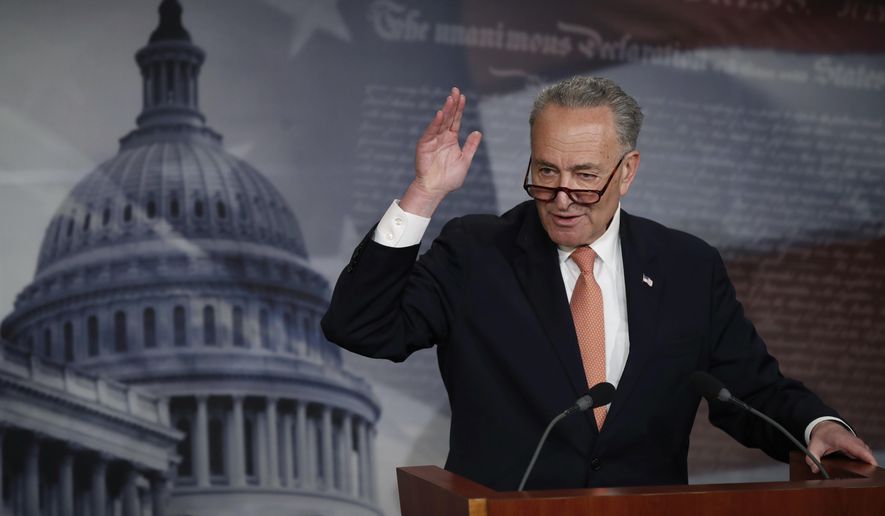


Senate Minority Leader Charles E. Schumer, New York Democrat, could not find any major loss for his party in the $1 trillion plan to fund the government through September. (Associated Press) more >
 - The Washington Times - Monday, May 1, 2017
Democrats won the latest shutdown showdown fight, triumphing over President Trump on
 nearly every major issue in the $1 trillion spending bill negotiators announced early Monday.
Mr. Trump emerged with more money for the Pentagon, but the funds will be tacked onto
the deficit rather than offset by the deep domestic cuts the president sought. Mr. Trump also
failed to get any money for his border wall and was forced to agree to make “unauthorized”
Obamacare payments.
Democrats, meanwhile, struggled to think of a single major fight they lost — and couldn’t
come up with any significant defeat in the bill.
“Overwhelmingly, we were very pleased with the outcome — issue after issue,” said Senate
 Minority Leader Charles E. Schumer, New York Democrat. “I would not say there’s a
major loss in here.”
The bill partially bails out Puerto Rico’s Medicaid program, boosts spending for the
 National Endowment for the Arts, increases the National Institutes of Health budget
by $2 billion, restores year-round access to Pell Grants for college students with financial
 need and keeps the Environmental Protection Agency’s budget intact — fending
off Mr. Trump’s efforts to trim the agency’s operations.
Congress must pass the bill before the end of Friday, which is when funding from a
one-week stopgap bill expires.

SPONSORED CONTENT

The president and his defenders were left to claim victory on a $1.5 billion boost in
 Homeland Security funding and $15 billion extra for the Defense Department — about
half of what the president wanted. The White House said it was the first step in Mr. Trump’s
 promise to rebuild the military.
“I think it’s great that the Democrats like the bill. That’s fantastic. We thought it was a
really good deal for this administration as well,” said Mick MulvaneyMr. Trump’s budget
director.
“Can you imagine how different this bill is from what President Obama would have signed
back in September?” he said.

Democrats, though, said Republicans probably got a worse deal by waiting. They said
 members of both parties were prepared to pass a bill in December but Mr. Trump’s team
asked that the legislation be delayed so he could have a say.
But now, with their party in control of all the levers of government, Republicans were
scared of being blamed for a shutdown. Democrats used that threat to the fullest, forcing
Republicans to back down on nearly every major scuffle.
“We made it clear that if the government shut down, it would be on the Republicans’
backs,” Mr. Schumer said. “That became the general consensus, and that gave us real
leverage, even though we were in the minority.”
He said Democrats forged a partnership with congressional Republicans, who were just
as eager to keep the taxpayer spigot flowing to their own priorities. The two sides agreed
to increase spending overall, rejecting Mr. Trump’s efforts to streamline his administration.
Both sides crowed about more money to combat the opioid epidemic and a $2 billion
 boost to the National Institutes of Health, which Mr. Trump had targeted for trimming.
Mr. Trump’s base felt a familiar twinge of disappointment with the Republican team on
Capitol Hill.
“They’ve allowed the minority to win again. For some reason, with the Republicans it
doesn’t matter what size majority we have; we always lose. The Republicans, without
question, are the world’s worst negotiators and marketers,” said Ken Crow, a national
 tea party leader and editor of Crows Nest Politics website.
“Paul Ryan is an abysmal failure. The conservative grass roots absolutely dislike him with
 a passion,” said Mr. Crow, who backed Mr. Trump in the presidential race. “We feel like
Donald Trump is capitulating to Paul Ryan right now, and we don’t like that. He’s the
 president. He needs to stand up and be a leader.”
Perhaps the biggest failure for Mr. Trump was his inability to win any money for
his border wall.
Instead, the bill spends an additional $1.5 billion on other Homeland Security Department
 programs, envisioning a boost in deportation officers and detention space to hold illegal
 immigrants.
Mr. Mulvaney said border money will pay for repair or construction of roads, bridges,
gates and lighting that he said lays infrastructure for the wall to be built eventually.
He said the money was a signal to Congress.
“This is not just demagoguery. We are serious about securing the border,” he said.
He touted a three-year extension of the D.C. school choice program, which he said
Republicans secured in last-minute haggling in exchange for Democrats’ demands
 for assistance to Puerto Rico. The island territory received $295 million to bail out its
 Medicaid program this year, and the D.C. Opportunity Scholarships Program got $45
million to be spread out over three years.
Mr. Mulvaney said Mr. Trump ran on school choice and the pending deal sent “a
 tremendous message to the school choice community.”
“He’s done exactly what he said he would do,” he said.
Mr. Trump also retreated on the Republican promise to defund Planned Parenthood
Mr. Mulvaney said they sat down with pro-life lawmakers and advocates and came
 to the conclusion that it was a fight best engaged as part of the bill to repeal and
replace Obamacare.
The National Endowment for the Arts, the National Endowment for Humanities and
 the Appalachian Regional Commission all pocket small funding increases. Mr. Trump
wanted to eliminate them.
“One thing [Mr. Trump] learned is people love to spend other people’s money,” said
Jim McLaughlin, a Republican strategist and pollster who previously advised a
 pro-Trump super PAC.
He said the president still deserves credit for altering the direction of the federal government.
“This is a very different budget than you would have gotten with Hillary Clinton as
president,” he said.

Wednesday, February 8, 2017

Another View Of The DeVos Nomination.


The Question Isn't Do You Support Betsy DeVos, It's Whether You Support School Choice

The nominee for secretary of education may be an imperfect vessel but what she represents can't be filibustered forever.


Keith A. Almli, CC, WikimediaKeith A. Almli, CC, WikimediaWith the day-long attempt by Democrats to "hold the floor" of the Senate to delay and disrupt the planned confirmation for the next secretary of education mostly in the rearview mirror, it now seems likely that President Trump's controversial nominee, Betsy DeVos, will squeak by on a 50-50 vote. (Vice President Mike Pence, who presides over the Senate, will get to cast the deciding vote after two GOP senators said they will vote no.)
There are two basic charges against DeVos, and one is more serious than the other.
The less serious, though mostly accurate, one is that she is plainly inexperienced. Like Trump entering the Oval Office, she has never overseen a public office or department, much less than one with nearly 5,000 employees. The Department of Education, founded only in 1979, is the smallest of all cabinet agencies in terms of personnel and budget ("just" $73 billion in 2016). This is to say it's a minor cabinet office that was so unnecessary the country somehow got by without one until the waning years of the Jimmy Carter presidency (in 1980, Ronald Reagan said he would abolish it if he won; instead he just massively increased its budget). DeVos is a billionaire through marriage, to Dick DeVos, the heir to the Amway fortune, and while she invests in a wide range of more or less interesting businesses (including Neurocore, which is trying to use biofeedback to cure depression and other ailments), she doesn't rise to the level of, say, Carly Fiorina in terms of business chops. Similarly, she has never worked at or run a school or district, leaving her devoid of direct experience with education other than as a student and a parent (which isn't nothing, exactly, but still not much).


So that first point is taken: She is inexperienced in running the sort of shop she's about to take over. But then again, if she's a competent administrator, that's really what the job demands. As education analysts such as University of Arkansas' Jay P. Greene and Reason Foundation's Lisa Snell have told me, the education secretary has relatively little to do, as most federal funds are pre-committed through funding formulas that are difficult to monkey with very much. What the secretary can do is set a broad agenda and a tone. And that, not her lack of credentials, is why Democratic senators tried to "hold the floor" against her. DeVos has been very involved in Republican politics at the national and state levels, where she chaired the Michigan Republican Party and has supported all sorts of school-choice plans.
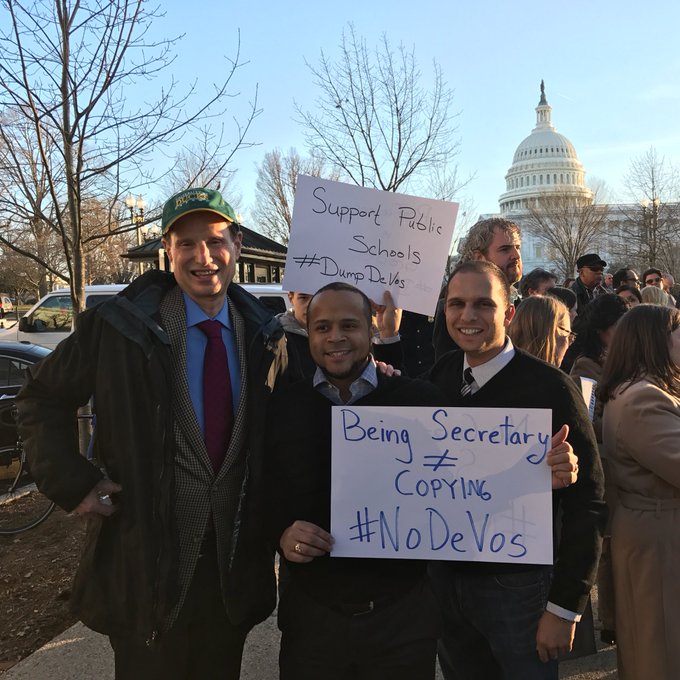
Given that, Senate Democrats and teachers unions are dead-set against her. The DeVos vote isn't ultimately about whether or not a Detroit billionaire runs a program that accounts for only 10 percent of K-12 spending around the country. (The federal government's influence is magnified by the conditions and rules it attaches to schools that receive any federal money.) It's about DeVos's outspoken support for both the general idea of publicly financed school choice and specific plans. Here, for instance, is Oregon Democrat Ron Wyden, tweeting his disapproval:


Making it loud & clear outside the U.S. Capitol today: .

Privatizing public edu. will not give every child the chance to succeed

NAEPNAEPWyden is one of the most reputable people in the Senate—or in Washington politics altogether. Yet he is wrong here, and on multiple counts. The first is that DeVos or Trump is somehow going to "privatize" public education. From a libertarian perspective, that may or may not be a good idea (I know I like the concept of separating the state from education very much; how do you raise truly independent thinkers otherwise?), but nothing like that is on the table. If you argue that "privatization" of public education happens when, say, K-12 students get taxpayer-financed money to go to private schools, your outrage would be better directed to the college-level Pell, student loan, and other financial aid programs that spend $130 billion a year, much of it going to private schools with religious affiliations.
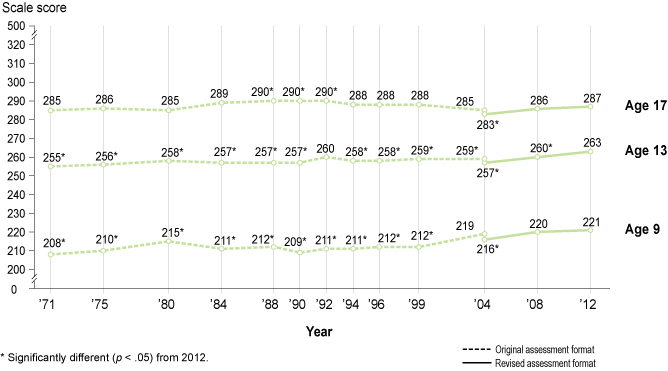
Beyond improperly invoking privatization, Wyden's critique somehow presumes that not privatizing public education—that is, maintaining the status quo—will in fact "give every child the chance to succeed." The fact is that when you look at the long-term assessments of K-12 education, graduating seniors are doing no better now than when the government started collecting data in the early 1970s (at the same time, American kids are scoring lower than they used to in international comparisons).
NAEPNAEPNone of that might matter if, say, we were also spending the same amount of money per pupil that we were in 1973. But of course that's not the case. In terms of total expenditures measured in constant dollars, we are spending about more than twice as much per pupil now as we were in the early 1970s ($6,253 vs. $13,142). And there's no question that "chances to succeed" are distributed unequally throughout the public school system, with better odds closely tracking the children of wealthier, more-educated parents who attend schools that are more responsive to student needs.
To the extent that lower odds of succeeding are concentrated in poorer, urban districts, the very best fix is to introduce all sorts of programs that give students and parents more choices (and let's be clear: Publicly funded charter schools and voucher programs come with oversight, not least of which is that parents can take their kids and the tuition dollars elsewhere; try doing that when you can only attend a school based on your street address). As Arkansas' Greene has written, it's true that on average charter schools have a similar academic-performance profile to public schools. But once you start doing apples-to-apples comparisons to students attending charters and public schools (randomized-control trials or RCTs), something very clear presents itself:
Students in urban areas do significantly better in school if they attend a charter schools than if they attend a traditional public school. These academic benefits of urban charter schools are quite large. In Boston, a team of researchers from MIT, Harvard, Duke, and the University of Michigan, conducted a RCT and found: "The charter school effects reported here are therefore large enough to reduce the black-white reading gap in middle school by two-thirds."
A RCT of charter schools in New York City by a Stanford researcher found an even larger effect: "On average, a student who attended a charter school for all of grades kindergarten through eight would close about 86 percent of the 'Scarsdale-Harlem achievement gap' in math and 66 percent of the achievement gap in English."
The same Stanford researcher conducted an RCT of charter schools in Chicago and found: "students in charter schools outperformed a comparable group of lotteried-out students who remained in regular Chicago public schools by 5 to 6 percentile points in math and about 5 percentile points in reading…. To put the gains in perspective, it may help to know that 5 to 6 percentile points is just under half of the gap between the average disadvantaged, minority student in Chicago public schools and the average middle-income, non-minority student in a suburban district."
And the last RCT was a national study conducted by researchers at Mathematica for the US Department of Education. It found significant gains for disadvantaged students in charter schools but the opposite for wealthy suburban students in charter schools. They could not determine why the benefits of charters were found only in urban, disadvantaged settings, but their findings are consistent with the three other RCTs that found significant achievement gains for charter students in Boston, Chicago, and New York City.
I'm sure that most of the Senate Democrats opposing Betsy DeVos think they are opposing an inexperienced billionaire whose secret dream is to loot public school coffers for...what, exactly? Some sort of bizarre right-wing agenda, I suppose. DeVos' brother did start the company called Blackwater, so maybe her dedication to giving poor kids more options than they would otherwise have is really a way of helping her bro staff his mercenary forces?
Or maybe it's just a more simple misunderstanding, one rooted in special-interest politics. The Democrats are closely allied with teachers unions, who threatened by any and all changes to the educational status quo. So of course they oppose Betsy DeVos and they will use any club on the ground to beat down her chances. But to the extent that DeVos—and Trump, too, who has been outspoken on the need for more school choice—are in favor of giving more students and more parents more choices when it comes educating their kids, they are on the side of the angels. A recent poll found that 68 percent of Americans favor expanding school choice, including 55 percent of self-described Democrats, 75 percent among Latinos, 75 percent among millennials, and 72 percent among blacks. Contemporary politics may not allow partisans to admit that (or even see it), but for those of us who are neither pro-Trump across the board or always anti-Democratic Party, the conversation surrounding the DeVos nomination is everything that's wrong with Washington.
Related Video: A Libertarian Builds Low-Cost Schools for the Masses.


    Nick Gillespie is the editor in chief of Reason.com and Reason TV and the co-author, with Matt Welch, of The Declaration of Independents: How Libertarian Politics Can Fix What's Wrong With America (2011/2012). He is also a columnist for The Daily Beast.

    Monday, October 6, 2014

    Under-employment, Poor Labor Participation Rate -- Both Are Major Drags On The Economy.

    Obama's Economy Is Creating Too Many Low-Paying Jobs

    Monday, 06 Oct 2014 08:33 AM
    Share:
      Comment  |
       Contact Us  |
      Print  
    |  A   A  
    Despite another seemingly good jobs report, President Obama's approval rating is lower than a snake's belly, and Republicans could retake the Senate in November.

    Missteps in the Ukraine, Iraq and elsewhere weigh on voters' minds, but the economy — especially the jobs picture — is not what Obama cracks them up to be.

    The 5.9 percent unemployment rate is a fraud. The percentage of adults working orseeking employment is the lowest since women began entering the labor force in larger numbers in the 1970s.

    Were the labor force participation rate the same today as when Obama took office, unemployment would be about 10 percent. Wages remain stagnant and household incomes are well below pre-crisis levels.

    The earnings of women, especially young women, have fared somewhat better than it has for men, but increasingly women have to support their husbands, sons and boyfriends. One in six men between the ages of 25 and 54 — too old for college and too young to retire — are without jobs. Many have quit looking altogether and sit around the house all day watching ESPN.

    Perhaps that's Hillary Clinton's vision of a better America, but it doesn't sit well where most people live.

    The economy is creating too many low-paying jobs in industries like retailing and hospitality, but industries where men find good-paying jobs are languishing. Since Obama took office, manufacturing has shed 400,000 jobs and construction nearly 500,000.

    New labor-saving technologies are a problem but so are lousy liberal policies.
    American manufacturers continue to cede markets to Chinese imports, but Obama's policy of appeasement toward Beijing precludes taking any meaningful actions against its unfairly subsidized products — actions advocated by Democratic economists like Peterson Institute founder Fred Bergsten and Noble Laureate Paul Krugman.

    The housing industry has not recovered to pre-recession levels, because Millennials want to live closer to their jobs — not in distant suburbs — but cities with excessively burdensome building regulations and bureaucracies, unrealistic minimum-wage laws, heavy taxes and underperforming public schools make building housing affordable for young families awfully difficult.

    The president likes to blame a "do nothing" Congress, but he largely got his head during his first five years — Obamacare, Dodd-Frank, Pell grants and generous student loans, other new spending and higher taxes on upper income Americans.

    Most of that has not worked out very well — too many American employers are eager to take even more jobs to Asia or relocate their corporate headquarters outside the United States.

    House Republicans can't really be blamed for wanting different approaches and in November, they will be validated when voters return a GOP majority to the lower house.

    President Reagan was dealt a tough hand by history too. He weathered a deep recession early in his first term and unemployment peaked at 10.8 percent — but he cut spending and taxes, eliminated much unnecessary government meddling in business and boosted employment by 8.4 million, or more than 9 percent, his first 5 ½ years.

    Obama has managed to increase employment only by 5.5 million, or approximately 4 percent.

    Republicans are ahead in most key Senate races, but whether they pick up the six seats needed to win a majority will likely be known early on election night when results come in for North Carolina. If Democrat Kay Hagan holds on to her seat, the math gets tough for the GOP.

    Hagan, like several other moderate Democrats, has supported the president on theAffordable Care Act and key budget and tax votes but has managed to maintain a business-friendly record on regulatory issues.

    Still like other moderate Democrats, the very first vote Hagan would cast in the 114th Congress would be to re-elect Sen. Harry Reid, D-Nev., majority leader.

    How that could ever help create jobs or reverse the failing fortunes of working families is beyond this economist's ability to comprehend. 
    © 2014 Moneynews. All rights reserved.