Contact Form

Name

Email *

Message *

Showing posts with label Tunisia. Show all posts

Friday, October 13, 2017

The Face Of Internet Censorship--Facebook

  • The "moderating hubs" for France's social media are generally located in French-speaking countries with cheap labor, in North Africa and Madagascar. In France, rumors abound that Facebook's moderators are located in French-speaking Muslim countries such as Tunisia, Algeria and Morocco. Facebook never confirms or denies outsourcing its "moderation" work to companies employing cheap Muslim labor in North Africa.
  • Notably, Muslim hate-speakers continue to proliferate on Facebook, while anti-Islamists face harassment and the loss of their accounts.
  • These Facebook users, like dozens of others, seem to be the victims of Islamist "packs". Once the opinions and analyses of these Facebook users are noticed, they are denounced to Facebook as "racists" or "Islamophobes" and their accounts are deleted.
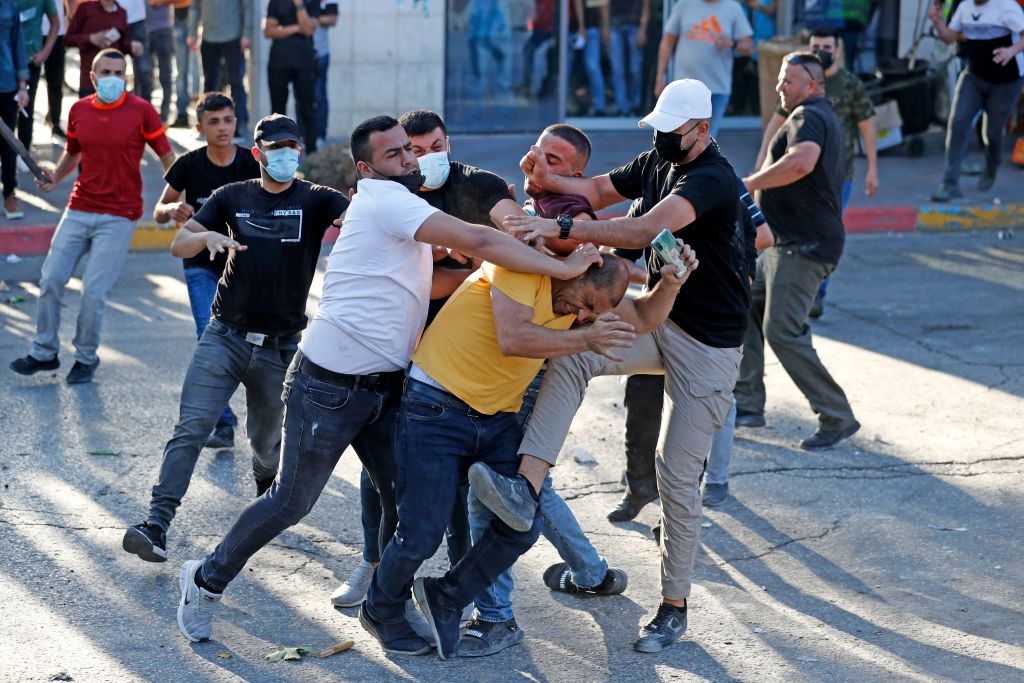
Fatiha Boudjalat, the co-founder of the secularist movement Viv(r)e la République, is a prominent figure of anti-Islamism in France. She is interviewed regularly on television and radio, and her op-eds are regularly published in Le Figaro. Recently, on Facebook, Boudjalat criticized strongly an Islamist government employee, Sonia Nour, for calling the Tunisian Islamist murderer of two women in Marseille, a "martyr". A few weeks after that, Boudjalat's Facebook account was deleted.
She is not alone in having been targeted by Islamists on Facebook. Leila Ourzik, an artist who lives in Grigny, a predominantly Muslim suburb not far from Paris, is a Muslim who eats and drinks openly during Ramadan and resists wearing the Islamic veil. Because of her un-Islamic behavior, she is openly insulted and threatened daily, as well as on social networks. On Facebook, Ourzik became a target. Islamists harassed her with insults and threats, posted her picture on pornography websites, and finally succeeded in obtaining the deletion of her account on Facebook. Suddenly, without warning, her Facebook account was shut. "Not once, many times" she says to Gatestone. Why? "I do not know, they never tell you. But one day, it is over, everything is deleted".
Olivier Aron, a dentist and former politician, was taken off Facebook for weeks. Aron is active in debates about Islam and Islamism. He is also not shy. On Facebook, he contradicts Islamists. Islamists, however, do not seem interested in debating. They seem interested in censoring. According to Aron, many of them complained to Facebook. "I suppose they accused me of being a racist and an Islamophobe" Aron said. "Intimidation is everyplace. A man I do not even know discovered my telephone number and all my contact details and sent them to his friends". Consequences were not long in coming. Aron's assistant at the dental office received a frightening phone call: "Tell doctor Aron that soon 'Kelkal' will hit him". Kelkal, an Algerian Islamist terrorist, was a member of the Armed Islamic Group (GIA) and responsible for the wave of attacks in France during the summer of 1995. Although Kelkal was killed by the police 20 years ago, for many radicalized Muslims, he remains the prototype of "modern" jihadist.
Last spring, Michel Renard, a history teacher in Saint Chamond, was also deleted from Facebook. "Without any warning, without any possibility of talking to someone, suddenly all my writings were gone," he told Gatestone. Renard had posted online extremely detailed analyses of Islamism. "But," he said, "Islamists are extremely active on Facebook. They insult you; they threaten you". Even though Renard refused to be "friended" on Facebook by his pupils, "their parents complained to the director of the school... Intimidation is everywhere, in real life and on the Net".
These Facebook users, like dozens of others, seem to be the victims of Islamist "packs". Once the opinions and analyses of these Facebook users are noticed, they are denounced to Facebook as "racists" or "Islamophobes" and their accounts are deleted.


In France, Facebook deletes thousands of accounts every year. It would be interesting to know how many among them were deleted because their owners questioned Islamism, but no one knows: Facebook never communicates other than by bland boilerplate declarations that clearly seem intended to avoid explaining anything.
What we do know is that "Facebook has 4,500 'content moderators' and that it recently announced plans to hire another 3,000", according to The Guardian. 7,500 moderators for more than two billion Facebook users? That is ridiculous.
The Guardian continues: "There are moderating hubs around the world, but Facebook refuses to disclose their exact number or locations". The question should be, in fact: Does Facebook outsource content moderation to subcontractors, and if so, to which?
In France, three companies appear to be competing as subcontractors for moderating online content: Netino, Concileo and Atchik Services. The "moderating hubs" of these companies are generally located in French-speaking countries with cheap labor, in North Africa and Madagascar. In France, rumors abound that Facebook's moderators are located in French-speaking Muslim countries such as Tunisia, Algeria and Morocco. Facebook never confirms or denies outsourcing its "moderation" work to companies employing cheap Muslim labor in North Africa.
Notably, Muslim hate-speakers continue to proliferate on Facebook, while anti-Islamists face harassment and the loss of their accounts.
It is a symptom of the dominant denial in the French media that it keeps repeating -- despite massive evidence to the contrary -- that "Islamism is not at war with Western culture." As a consequence, freedom of speech in France is now "moderated" by Muslims in Muslim countries.
Ironically, however, if Facebook were instead outsourcing its "moderation" work to companies in France or Belgium, the result would be the same. Extremist Muslims hunt in packs, while anti-extremists are mainly individuals. The French Conseil supérieur de l'audiovisuel, for example, France's regulating agency for radio and television, is overwhelmed by a storm of protests each time the French anti-Islamist journalist, Éric Zemmour, appears on television. Zemmour is sued twice a year for "racism" -- simply because Islamist organizations such as the Collectif contre l'islamophobie en France ("Collective Against Islamophobia in France", CCIF) launch campaignsto urge French Muslims to protest against Zemmour's "Islamophobia". Is the same system used for social networks? Given the total lack of transparency of Facebook's decisions, it is possible.
Unfortunately, counter-attacks against these wolf-pack harassment campaigns are still "under construction."
Not only does Facebook censor content using undisclosed "moderators," but the company has also developed a law-enforcement response team that deals with requests from police and security agencies. In France, such requests from courts and justice departments have increased from 3,208 in 2013 to 8,121 in 2016. According to Le Journal du Net, a news website dedicated to current events and media, in 2015, "following government requests, Facebook deleted 37,990 pages in France, compared to 30,126 for India, 6,574 for Turkey and only 85 pages in Russia" during the same period.
Were only Islamist and jihadi pages deleted? What else? Inconvenient history? For governments in Europe, anti-jihadists are considered an even greater problem than jihadists.
In April 2017, Facebook published a report entitled, "Information Operations and Facebook". On page 9, one can read, "In France, for example, as of April 13, these improvements recently enabled us to take action against over 30,000 fake accounts". The "improvements" Facebook is talking about are related to new analytical techniques permitting Facebook to detect serial "fake news" accounts. These "fake" accounts were, unsurprisingly, especially active during France's presidential campaign in the spring of 2017.
For Facebook and for French officials, the big question does not seem to be: "Is Islamism at war with our freedom?", but only: "Is Vladimir Putin interfering with French politics?" Facebook pays attention to that. Facebook cannot afford to ignore politicians' requests. In every country, the big advertising money for Facebook's platform is dependent on the goodwill of the government.
It is important to remember how, in 2015, at the height of the migration crisis, German chancellor Angela Merkel pressed Facebook's founder, Mark Zuckerberg, to remove the thousands of anti-mass-migration posts on Facebook. "Are you working on this?" Merkel asked in English, to which Zuckerberg replied "in the affirmative".
Two years later, artificial intelligence tools are on their way to bring temporary peace and quiet to governments in exchange for quick profits -- but not peace to the people.
Yves Mamou, author and journalist, based in France, worked for two decades as a journalist for Le Monde.
© 2017 Gatestone Institute. All rights reserved. The articles printed here do not necessarily reflect the views of the Editors or of Gatestone Institute. No part of the Gatestone website or any of its contents may be reproduced, copied or modified, without the prior written consent of Gatestone Institute.

Thursday, July 13, 2017

If Gulf Monarchies Were To Fall, It Would Not Be Good For Israel But Great For Iran

A New “Arab Spring” in the Persian Gulf?

By July 13, 2017


BESA Center Perspectives Paper No. 527, July 13, 2017
EXECUTIVE SUMMARY: The winds of war blowing between Saudi Arabia and Qatar, as well as Iranian subversion, are destabilizing the Persian Gulf principalities. To make matters worse, the economic situation, which has worsened in recent years because of ill-advised decisions, is stoking fears of popular uprisings and widespread disturbances. These internal crises could lead to a new “Arab Spring” in which some of the Gulf monarchies might fall. The main winner would be Tehran, for which the current crisis, along with the boycott imposed on Qatar, has opened a path to a takeover of Bahrain – and Iran has already, in effect, taken over Baghdad, Damascus, Beirut, and Sana’a.   
The Saudi economy has seen an unprecedented deterioration in recent years. The continued decline of oil prices in world markets, the massive assistance to Egypt since the July 2013 takeover by Abdel Fattah Sisi, the cost of funding the coalition fighting the Houthis and their Iranian patrons in Yemen, and of course the considerable aid extended to the Syrian rebels have wreaked havoc on Riyadh’s public treasury and the ruling monarchy’s personal wealth.
As a result, Riyadh has had to slash 900 riyals (about $300) from military and civil servant salaries as part of a major cutback in the public sector, including the abolition of salary increments and bonuses. Recently, the authorities have also had to hike taxes on cigarettes and energy drinks to the tune of 100% of the cost of the product, after having imposed new taxes in June. One sign of the crisis reflecting its severity is a new toll that will go into effect in April 2018 on roads in the Riyadh area and on crossings into neighboring Arab states.
Aside from affecting its own residents, Saudi Arabia’s economic situation also stands to affect other Gulf countries and particularly Bahrain, which is suffering its own deep crisis as Tehran arms and funds Shiite organizations aimed at destabilizing it.
The Iranians have been exploiting Riyadh’s and Bahrain’s difficulties to the hilt. Not long ago, the Saudis thwarted an attack near the holy sites of Mecca. The Iranian subversion could escalate to the point of seeking to destabilize the kingdom (as it is doing in Bahrain) by activating armed militias within its territory.
Shiite Iran is also helping Qatar, which, according to the (Saudi) plan, should by now have been begging for the lifting of the boycott. Tehran is thereby driving a wedge between the Arab Gulf principalities and bolstering its own status as the region’s hegemonic power. It has been sending Qatar tons of food and raw materials daily by sea, and these goods have flooded the emirate’s markets and shopping centers.
There is, however, no free lunch. Tehran is now regarded as having rescued Qatar, and the principality will have to reward it for this. Iranian aid has already weakened the Sunni political-military coalition that was supposed to contend with Tehran’s expansionary ambitions. For example, Qatar has pulled out of the anti-Houthi coalition in Yemen.
The state of affairs in the Persian Gulf is extremely delicate. The fall of one principality would probably lead to the fall of others. The Gulf is undergoing one of the most difficult economic crises in its history, one that could destabilize some of the monarchies. Angry demonstrations and riots against rising prices, new taxes, and mounting unemployment, similar to those that occurred in Tunisia, Egypt, Libya, Yemen, and Syria in 2010 and 2011 – the ultimate nightmare of any Arab leader – are entirely plausible.
Moreover, the Qatar crisis is not over. The principality has strongly rebuffed the twelve Saudi conditions for lifting the blockade and normalizing relations with the foursome (Saudi Arabia, Egypt, the United Arab Emirates, and Bahrain). Those conditions include downgrading Qatar’s diplomatic ties with Tehran; ensuring that forces of the Iranian Revolutionary Guard Corps leave the emirate; shutting Turkish military bases in Qatar; severing Doha’s ties with the Muslim Brotherhood, Hezbollah, al-Qaeda, and ISIS while ceasing to fund them; handing over terrorists residing in Qatar to the foursome; closing the Al Jazeera network; and paying compensation.
The failure of the attempt to isolate Qatar and subjugate it to the foursome’s demands has stirred fears of a Saudi military intervention there. Iran, however, has scored many points with the Arabs thanks to its support for the emirate. This is part of a long-term strategic game in which Iran first seeks to win Arab states’ sympathy and then arms and activates subversive groups in the Gulf.
Tehran is striving to curtail American and Saudi influence in the Gulf, take over the Islamic world in general, and seize the Gulf’s natural resources and holy places via its erstwhile proxies, the Yemeni Houthis positioned along the Saudi border.
If Tehran’s plan succeeds, the Persian Gulf will be effectively divided between it and Russia, a highly undesirable development for Israel. The Gulf crisis is wholly unrelated to Israel, but Jerusalem must closely monitor what is happening there.
The current situation is ostensibly good for the US. Tensions create the perfect setting for exporting weapons and military equipment, as President Trump promised he would do during his Riyadh visit. Yet instead of seeking profits, however substantial, Washington would be better off working to enhance stability in the region, lest it plunge into a new “Arab Spring.”
Dr. Edy Cohen is author of the book The Holocaust in the Eyes of Mahmoud Abbas (Hebrew).

Tuesday, February 21, 2017

Muslims Living Under Sharia, Not What Is Portrayed In The Media

Islamist Watch
http://www.islamist-watch.org on Facebook   http://www.islamist-watch.org on Twitter   RSS Feed

Friday, December 23, 2016

Berlin Truck Murderer Goes To Mosque. Isn't It Time For Muslims To Turn In The Radicals That Are In Their Midst?


Berlin Christmas Market Terrorist Filmed Entering Mosque Hours After Attack


“Morning by morning will I destroy all the wicked of the land; to cut off all the workers of iniquity from the city of Hashem.” Psalms 101:8 (The Israel Bible™)
German Police reported that the suspect in the truck ramming attack at a Christmas market in Berlin on Monday was caught on closed circuit  camera entering a mosque eight hours after the attack .
Anis Amri, a 24 year-old Tunisian,  is suspected of driving a truck through the crowded Breitscheidplatz  market, killing 12 and wounding 48. Amri’s identification papers were found under the driver’s seat of the truck after the attack. The original driver of the truck was found inside the cab, dead of a gunshot wound. It is believed that Amri dropped his ID papers during the struggle with the driver.
Police raided the mosque in southeast Berlin on Thursday night, blowing in the door and using stun grenades. The mosque was also raided in 2015 over suspicion the Imam, Abu Walaa, was recruiting for the Islamic State (ISIS). ISIS has claimed responsibility for the attack in Berlin, claiming Amri as one of their “soldiers”.
Police have launched a massive manhunt for Amri, offering a reward of 100,000 Euros.
Amri left Tunisia about seven years ago, arriving in Italy among a group of Syrian refugees. Security sources in Tunisia believe he was incarcerated in Italy for several years after burning down a school. He applied for asylum in Germany, but  his asylum request was rejected  in June this year. Authorities  were unable to deport him as Amri claimed to have no travel documents.

Read more at https://www.breakingisraelnews.com/80695/berlin-christmas-market-terrorist-filmed-entering-mosque-hours-attack/#vlGKKVds6TtDxMX1.99