Contact Form

Name

Email *

Message *

Showing posts with label Yom Kippur War. Show all posts

Friday, May 26, 2017

Strange Bedfellows Sometimes Are Needed In Bad Situations

Assad’s Survival Is in Israel’s Best Interest
By May 25, 2017


BESA Center Perspectives Paper No. 476, May 25, 2017
EXECUTIVE SUMMARY: Despite the Assad’s regime’s longstanding pretense to raise the banner of all-out war against Israel, since the October 1973 War the Syrian-Israeli border on the Golan Heights has been conspicuously quiet. Today, as Syria no longer capably functions as a sovereign state, a strong Syrian president with firm control over the state is a vital interest for Israel.
Unlike his immediate predecessor, US president Donald Trump did not stand idly by in the wake of a Syrian toxic chemical attack, but launched fifty-nine cruise missiles at the airport from which President Bashar Assad had carried out the strike. After the attack, Trump declared, “Tonight, I ordered a targeted military strike on the airfield in Syria from where the chemical attack was launched. It is in the… security interest of the United States to prevent and deter the spread and use of deadly chemical weapons.… I call on all civilized nations to join us in seeking to end the slaughter and bloodshed in Syria, and also to end terrorism of all kinds and all types.… We ask for God’s wisdom as we face the challenge of our very troubled world.”
At the start of Trump’s term, many believed he would not contend with Assad, and that his agenda did not include removing the Syrian dictator from power as long as the latter fought ISIS. If that was, in fact, Trump’s agenda, he appears to have changed his mind following the chemical attack, and the new calculus has prompted new questions. Who will be the next ruler of Syria? Will a new dictator rise, or will it be a democratically elected president who will find it difficult to function in the stormy Middle East? How will the next ruler relate to Israel? What will be the fate of the Golan Heights?
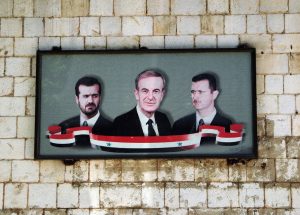
In Syrian and Lebanese circles, an old adage – “A lion [Assad in Arabic] in Lebanon, but a rabbit in the Golan” – has been applied to the Assad dynasty for years. The Assads have carried the banner of all-out war with Israel since the 1970s, but that war has never materialized. Since the Yom Kippur War in 1973, neither Hafez Assad nor his son Bashar initiated a single military activity against Israel from Syrian territory. Instead, they made do with mobilizing other militias from Lebanon against Israel.
Against the backdrop of media reports about bombings in Damascus by the Israeli Air Force and growing tension between Jerusalem and Damascus, one might well ask how the Golan managed to remain quiet for over forty years until the March 2011 violent eruption. The answer is that during that period, the Syrian regime simply had no interest in starting a war with Israel. Not only did it elect not to launch an armed struggle to liberate the land, but it took care to avoid any confrontation on the Golan front, likely fearing another humiliating defeat. The Syrian authorities went so far as to punish any Syrian soldier who provoked Israeli soldiers on the Golan Heights, even as they continued to attack Israel indirectly.
Syria supported the Palestinian Hamas and Islamic Jihad terror groups, for example, and aided Hezbollah in terrorizing IDF soldiers during the IDF’s stay in southern Lebanon. In the mid-1980s, when Hezbollah first emerged, it received, together with the Shiite Amal movement, money and weapons from Tehran via Damascus. Syria was not averse to the principle of attacking Israel, but took care to avoid a direct confrontation with Jerusalem.
Rather than take matters to the battlefield, Syria tried instead to obtain the Golan Heights by diplomatic means. It  took part in the Madrid talks in 1991, and even negotiated directly with Israel (a few months before Hafez Assad’s death in 2000, Ehud Barak met with Syrian foreign minister Farouk Shara in the US), though these talks came to naught.
Apart from diplomacy, the Syrians have voiced demands for the “occupied” Golan Heights, as they describe them, in the press and in demagogic speeches.
As a result of this doctrine of avoiding military confrontation, Israel enjoyed close to four decades of peace and quiet on the Golan, enabling it to develop the area, cultivate the land, and build kibbutzim and tourist sites. The unofficial understandings between Jerusalem and Damascus have dissipated in recent years with the collapse of modern Syria, but they were not the only understandings between the two countries.
In 1976, with the entry of the Syrian army into Lebanon and fear of a confrontation between Syria and Israel, the so-called “red lines” were established. Damascus was forbidden to deploy its soldiers south of the Litani River, to introduce anti-aircraft missiles into Lebanon that would threaten the Israeli Air Force, and to harm the Lebanese Christians who were allied with Israel at the time. The broker of these understandings was US Secretary of State Henry Kissinger.
These “red lines” endured except for two violations: 1) when the Syrians brought Surface-to-Air (SAM) missiles into the Bekaa Valley in 1981 and when the US supported the coalition against Iraq in October 1991; and 2) when the Syrian Air Force stopped the rebellion by Michel Aoun against Syria. (Aoun has since changed sides and is now the pro-Iranian and pro-Syrian president of Lebanon.) The first incident caused a direct confrontation between Syria and Israel in which the Israeli Air Force downed dozens of Syrian planes over Lebanon. This strengthened the Syrians’ perception that a confrontation with Israel was not worthwhile.
In Lebanon, Israel needs a strong president – not someone weak like Amin Gemayel, who buckled under domestic, and external Syrian and Iranian, pressure to cancel a peace agreement with Israel. The agreement, about which most Israelis know little, was concluded 34 years ago. In 1982, following the Lebanon War, the Israeli government negotiated with President Gemayel via US mediation. After a year of intensive negotiations, representatives of the three sides met on May 17, 1983 in a festive atmosphere in southern Lebanon and later in Kiryat Shmona to sign a peace agreement. That agreement was to bring about security and an ostensible normalization of relations between Lebanon and Israel and culminate in Israel’s withdrawal from Lebanon within three months. It was ratified by the Israeli Knesset and the Lebanese Parliament – but President Gemayel bent to pressure and refused to sign. It is clearly not in Israel’s interest to have a president in one of its neighboring countries who cannot rule his own country.
As noted, no mortar shells were fired on the Golan from the 1973 war until recently. The Syrians made sure to maintain quiet in the area, as firing on Israeli villages was always considered by Israel a valid cause to launch a military campaign. This was the case in recent years with the Palestinians in Operation Cast Lead and Operation Protective Edge, and was the case in Lebanon. Indeed, in 1982, the firing from Lebanon on Israeli towns and villages and the infiltration by terrorists into northern Israel led the Israeli government to invade Lebanon, reaching Beirut.
Israel is surrounded by enemies. It needs those enemies to be led by strong, stable rulers who will control their armies and prevent both the firing on, and infiltrations into, Israeli territory. Both the senior and junior Assads succeeded in this and continue to do so to this day, despite the many reports in recent years about Israeli attacks in the heart of Syria.
Syria is now a crumbling country. It is foundering in a mire of extremist militias (ISIS, Jabhat al-Nusra, Jaysh al-Islam, Palestinian organizations like Ahmad Jibril’s Popular Front for the Liberation of Palestine – General Command, Quwat al-Jalil, and the forces of Padi Malih, as well as the moderate rebels). It is divided into several regions, each controlled by a different organization. As Syria collapsed, so too did its understandings with Israel, with mortar shells once again dropping on Israeli territory.
Syria is no longer able to function as a sovereign state, and this is bad for Israel. With all the regret over the loss of and disrespect for human life, and the aversion to the massacre Bashar Assad is carrying out on his people, a strong Syrian president with firm control over the state is a vital interest for Israel. Given the Islamist alternatives to his rule, Syria’s neighbors, including Israel, may well come to miss him as Syria is rapidly Lebanonized. The country will be divided into several entities, each controlled by a separate group/sect. This will hardly be beneficial for Israel or for the Middle East as a whole.
Dr. Edy Cohen is author of the book The Holocaust in the Eyes of Mahmoud Abbas (Hebrew).

Thursday, March 9, 2017

A Mantra For Persons In Leadership And Execution

Trade Insights, Not Barbs


BESA Center Perspectives Paper No. 421, March 8, 2017
EXECUTIVE SUMMARY: The failures found in the wake of Operation Protective Edge in Gaza in 2014 illustrate that in war, nothing is as important as the proper division of roles. The IDF should stay out of politics, and the cabinet should refrain from tactical planning.
State Comptroller Yosef Shapira's report on Operation Protective Edge in the Gaza Strip in 2014, which found fault with the military's conduct as well as in the Diplomatic-Security Cabinet's decision-making process ahead of and during the campaign, stirred controversy for obvious reasons. Those who were criticized want to defend their reputations, while others are eager to use the findings to settle political scores. Israelis are left to wonder how it is that such a grand series of "failures" has resulted in two and a half years of quiet in southern Israel.
I cannot comment on the cabinet's work process, as at the request of Prime Minister Benjamin Netanyahu, I headed a committee that formulated recommendations on how that process could be improved. And while my report is not classified, I think it more prudent to present it to the cabinet before discussing it in public.
Nevertheless, two issues can be illustrated, as they do not stem from the committee's work. The first has to do with cabinet members' level of knowledge, and the second with the cabinet's ability to hold effective discussions.
On the level of knowledge cabinet members have on matters of national security: I have been participating in cabinet meetings since 1992, in my capacity as director of research with Military Intelligence, and I have learned that it is difficult to overcome gaps in the ministers' knowledge. Most of them are preoccupied with the affairs of their offices for many hours of the day, and few have any knowledge or training in national security issues.
I believe it would be best to designate two ministers without portfolio to the cabinet solely for the purpose of being kept apprised of such matters. This would ensure that at any given time, at least two ministers would be prepared for any cabinet meeting. These ministers, who would have to be experienced people, would also serve as a balance against other ministers who are responsible for specific issues, as well as the relevant professional bodies.
The criticism that having two ministers serve in such cabinet roles would "cost money" is dwarfed by the benefit it would entail for the entire forum. As for the cabinet's ability to hold effective discussions, previous prime ministers often put together small fora of individuals with whom they could hold informal consultations.
There was, for example, the eight-minister forum, dubbed "the octet," that served under Netanyahu until the 2013 elections. The secret to this highly effective forum's success was the fact that its discussions were leak-free, as well as minutes-free.
If the Diplomatic-Security Cabinet cannot maintain the absolute discretion required of its sessions, it has no hope of functioning properly. This is not about politics, and it makes no difference who the prime minister is. No prime minister can work with a leaking cabinet.
Everything else aside, we would be wise to focus on implementing the comptroller's findings and conclusions following the Gaza campaign to improve the way future conflicts are managed, instead of bickering and assigning blame.
One of the main issues underscored in Shapira's report was that the military, despite having all the necessary information, failed to outline a proper operational plan to counter the threat posed by Hamas's grid of terror tunnels. This was a fundamental failure, but one for which solutions are already being implemented.
Truth be told, the IDF faced a very similar situation in 1973. The military had information about Syria's arsenal of Sagger anti-tank missiles, including from incidents when IDF tanks had come under Sagger fire in the Golan Heights. In the Yom Kippur War, however, the IDF was taken by surprise and had no solution to the threat. It had failed to develop technological countermeasures, and the results on the battlefield were dire.
At the time, the weighty question arose of why the military had not been prepared to counter a clear and known threat. It appears that this is a known phenomenon -- when facts are known, but conclusions are not drawn or their significance is not fully grasped by the organization.
To overcome this problem, after the Yom Kippur War, the military decided to name an officer, holding the rank of colonel, whose job was to "sound the alarm" whenever it seemed the enemy was developing a new threat. He was the one tasked with ensuring all relevant operational systems were aware of the threat and working on countermeasures.
It became evident after a while that the role was redundant – or so the General Staff believed at the time – and it was annulled. I am not sure creating the role was the best solution for the problem at hand, but it was a valid attempt to deal with it in a practical way. It is again time to look for a solution so that the IDF does not fail in the same way in the future. One must note, however, that no one expected then-Prime Minister Golda Meir to devise a tactical and operational response to the Sagger threat. That responsibility fell to the defense establishment.
The various challenges must be dealt with in a scaled manner for the system to function properly across the board. If the cabinet is busy outlining operational tactics, it will clearly have less time to outline strategy.
Opting for a tactical approach over a strategic one may be useful when dealing with specific incidents, but doing so undermines the greater objective of military campaigns or full-scale wars. Both call for meticulously maintaining the proper division of roles. The military must focus on tactical and operational issues, and the defense minister must provide the IDF with the necessary tools to devise and apply solutions while prioritizing the objectives formulated by the prime minister and approved by the cabinet.
The cabinet's main contribution to the process is on the strategic level. Its members must not be distracted by other things, interesting though they may be. For the same reason, the military should not concern itself with politics, as it has to remain focused on tactical and operational issues. As for the comptroller's report: the blame game must end, as it helps nothing and no one. All this energy should be focused on bolstering the weak points evident in Operation Protective Edge's execution.
This is an edited version of an article that appeared in Israel Hayom on March 3, 2017.
Maj. Gen. (res.) Yaakov Amidror is the Anne and Greg Rosshandler Senior Fellow at the Begin-Sadat Center for Strategic Studies. He is also a distinguished fellow at JINSA’s Gemunder Center for Defense and Strategy.
BESA Center Perspectives Papers are published through the generosity of the Greg Rosshandler Family

Tuesday, September 27, 2016

This Is The Same Rhetoric That Was Spoken Before The Six Day And Yom Kippur Wars. Are We Being Prepared For A Third War?


FORMER IRANIAN MINISTER: IRGC GROUND FORCES 5 TIMES LARGER THAN US ARMY


TEHRAN (FNA)- Mohsen Rafiqdoust, who served as minister of the Islamic Revolutionary Guard Corps throughout the eight years of the Iraqi-imposed war on Iran, said the IRGC Ground Force is five times more than the US army troops, adding that the IRGC can dispatch 6 million troops to any battlefield in a matter of days.
“Today, the number of the IRGC Ground Force is five times more than the US army and it is the Ground Force which ends the wars,” Rafiqdoust said, addressing a gathering in Tehran on Sunday.
“The IRGC Ground Force can send 6 million ready-for-combat troops to the battleground in less than 10 days,” he added.
Noting that the country's warehouses are full of weapons and military equipment, Rafiqdoust said, “Our missiles are ready to be fired at Israel. This has been shown to the Americans and they have been allowed to have videos” (through their broadcast on Iranian TV).
Firing one artillery round against Iran by Israel would mean that “Iran will turn Tel Aviv into dust”, he underlined.
In relevant remarks in 2014, Commander of the IRGC Ground Force Brigadier General Mohammad Pakpour said his troops are among the best in the region.
“Today, the Army and IRGC's Ground Forces are among the best and most powerful ground forces of the region,” Pakpour told reporters on the sidelines of a ceremony to commemorate IRGC Missile Industry martyrs in Tehran.
Also in the same year, General Pakpour underscored the IRGC’s full preparedness to defend the security and territorial integrity of Iran powerfully.
“Thanks God and due to the good management done by Iran, we have no special security problem in the country; generally speaking, the problems are in our neighboring countries and sometimes the terrorist elements are directed towards Iran from outside,” Pakpour said at the time.
“The dedicated forces of the IRGC Ground Force are fully ready to defend and establish security in every part of Iran under any conditions,” he added then.

Monday, July 28, 2014

Tunnels, The Latest Terror Method By Hamas. If They Only Spent As Much On Building Buildings, Their People Would Be So Much Better Off!

Hamas’ Mega-Attack through Gaza Terror Tunnels Exposed

“Hear my cry, O God, listen to my prayer; from the end of the earth I call to you when my heart is faint. Lead me to the rock that is higher than I, for you have been my refuge, a strong tower against the enemy. Let me dwell in your tent forever! Let me take refuge under the shelter of your wings!” (Psalm 61:1-4)
JERUSALEM – Hamas had been preparing a murderous massive assault on Israeli civilian targets during the upcoming Jewish New Year holiday, Rosh Hashanah – this according to anonymous sources in the Israeli security services cited by the Israeli daily Maariv.
Hamas had been planning a surprise attack where 200 fighters would have been dispatched through the dozens of tunnels dug by Hamas under the border from Gaza to Israel. The terror organization aimed to seize kibbutzim and other communities while killing and kidnapping Israeli civilians.
In total, thousands of Hamas terrorists would have been swarming across Israel, wearing IDF uniforms, which would have further complicated an Israeli response. Reports further indicate that Hezbollah may have planned to join the attack as well, opening another front in the north.
The source stressed that the current unplanned war with Hamas inadvertently thwarted a catastrophic event on an apocalyptic magnitude such as the Yom Kippur War, which would have “brought the State of Israel to its knees.” The destruction of these tunnels takes away from Hamas a strategic weapon it has been working on and investing in heavily for years according to the source.
Each tunnel has arteries, veins, offshoots as well as offshoots of offshoots designed in intricate and complex arrangements. As one Israeli spokesman said, “There are two Gazas, one above ground and one below ground: an underground terrorist city.”
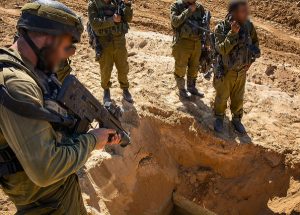
Speaking to the CBC, a senior Israeli defense official said the Israeli military had considerable prior knowledge of Hamas weaponry and tunnels, but was still “surprised” by the extent of both when the current ground operation began. He added that the network had not been detected by aerial surveillance, because Hamas had solved the most obvious problem: how to hide the piles of sand removed from the tunnels. This, he said, was painstakingly taken away, a few bags at a time, and stored out of sight in buildings and underneath greenhouses.
The official said Hamas had diverted huge quantities of cement, imported for civilian construction, into the building of concrete-block walls and roofs for the tunnels. As an example, he cited a 1.7-kilometer tunnel discovered in February 2013 that Israeli engineers estimated would have required 500 tons of concrete - “enough to build a three-story hospital.”
Israel has discovered 31 tunnels so far, and has destroyed several of them by employing bulldozers, explosive and other methods. IDF excavation of the tunnels has resulted in the seizure of tons of Hamas supplies, as well as the discovery of plans for future operations. 
Israeli soldiers have already frustrated several surprise assaults by Hamas through tunnels from Gaza into southern Israel. On July 21, ten Hamas terrorists emerged from a tunnel. They were immediately spotted and eliminated, but the clash cost the lives of two IDF soldiers.
Speaking with Tazpit News Agency, Minister Ya’acov Perry, a member of the Israeli Security Cabinet, commended the IDF for its outstanding achievements. “The IDF is working to uncover a network of underground tunnels that could have created unbearable terrorist attacks,” he said.
He further commended the IDF’s prior intelligence, which enabled these achievements. “I am sure that Israeli technology, which has provided us with the Iron Dome, will provide us with a solution for the terror tunnels as well.” He said various solutions were currently being examined. He further stressed that military capabilities and technological advantages were not enough. A comprehensive reality – changing diplomatic solution must be presented as well.
Writing for Gatestone, Lawrence Franklin says that the construction of network of tunnels used hundreds of tons of concrete that might otherwise have been used by the Palestinians for building homes, shopping malls, parks, schools, hospitals and libraries.

Tuesday, January 7, 2014

Strong Warning To Netanyahu Regarding Giving Away Israeli Land. We Agree!

Share This Post
 9
II Video – The Disengagement from Gush Katif (Israeli developed strip of Gaza) with Ariel Sharon
http://israel-commentary.org/?p=8308
By David Wilder
January 06, 2014
Ariel Sharon is dying. It’s not considered nice to say bad things about dead people, especially immediately after their passing. So I’m writing this while he’s still alive. Barely. When I heard the news I wasn’t sure if I wanted to laugh or cry. Laugh, that finally, he’s leaving us. Or cry, because his ‘this world’ suffering is coming to an end.
That’s how much I like Ariel Sharon. He had many positions, and many titles. I will remember him as a monster. When elected to the office of Prime Minister in March, 2001, the 2nd Intifada, or what we call the Oslo War, was well underway. Terror attacks, shootings, and the like had begun. In Hebron, Arab terrorists had taken positions on the hills surrounding the Jewish neighborhoods and were shooting at us like ducks in a pond. Great for target practice, but not when the targets are men, women and children, in their homes, cars, or just plain walking down the street.
Sharon could have stopped it. He didn’t. It continued for almost a year and a half, here in Hebron. Only after the Passover Massacre in Netanya and the killing of five year old Danielle Shefi at Adura, just outside of Hebron, did he finally put an end to the nightmare. He was Prime Minister when most of the over 1,500 people murdered during that war. He could have stopped it. He didn’t. But that was just the beginning.
The expulsion from Gush Katif (Jewish communities on the coast of Gaza) and the Northern Shomron, abandoning the southern tip of Israel to Hamas, brought over 13,000 rockets into Israel, into Ashkelon, Ashdod and Tel Aviv – to this very day. Actually, it began with Menachem Began. He set the precedent, with Ariel Sharon as his right-hand man, implementing the expulsions from the Sinai, giving it to the Egyptians after the Yom Kippur War in 1973, There Sharon learned that it is possible to forcibly remove Jews from their homes, destroy Jewish communities and abandon land to our enemy (without the Israeli nation executing him as a traitor.)
What then is the punishment of people who remove cities from Israel, abandoning the land, expelling the people, endangering the population? What happened to them, what was their fate: Begin, the hero of Jewish underground, the leader who destroyed the Iraqi nuclear threat, secluded himself for years following his resignation as Prime Minister, unseen until his dying day.
Yitzhak Rabin was assassinated.
Ehud Olmert, one of the primary initiators of the Gush Katif catastrophe, has undergone numerous trials on charges of corruption, facing disgrace.
Katzav, who as President refused to oppose the Gush Katif expulsion, imprisoned following conviction for rape, from the president’s mansion to a jail cell.
Ariel Sharon, suffering the worst kind of hell, neither here nor there, not dead, not alive, for the past eight years. Some 8,600 people were expelled from the Gush, a year for every thousand people. And one can only image what he will face when trying to enter the pearly gates of heaven.
It is written that there is a ‘place’ somewhere between this world and the next, called in Hebrew “Kaf HaKelah.” This is a kind of nether land — not here, not there. It is written that here, such souls who have so sinned in this world, float around, not being in this world, or the next, a kind of horrible limbo. Usually, for such deserving souls, this aspect of punishment happens following a person’s death. In Sharon’s case, it began here in this world.
There is a story, told now for years, about how a famous Rabbi cursed Ariel Sharon, saying he should receive a blow on his head. People approached the Rabbi and expressed their opposition to this curse. So, the Rabbi then blessed Sharon, saying, ‘he should live a long life.’ It seems that both the ‘curse’ and the ‘blessing’ were achieved.
So what (or who) should this come to teach, what is the lesson for the future? This is what I ask the present Prime Minister, Binyamin Netanyahu, as he seems to be negotiating away our land, Eretz Yisrael. Be it Hebron or Shilo, Gitit in the Jordan Valley, or the Arab villages of the ‘Mishulash, on the eastern Sharon plain, bordering Samaria. This is all our land.
It is clear that, at present, there are at least two parallel sets of discussions going on; those led by Justice Minister Tzippy Livni and those being led by Netanyahu himself, seemingly with Abbas, aka Abu Mazen. The US is pushing, but Israel doesn’t necessarily have to budge. That’s up to us; it is up to our Prime Minister, Foreign Minister (who today came out publicly in favor of an agreement), and the Defense Minister. And the others.
What will be in store for them, what will be their fate, should they choose to walk in the footsteps of Ariel Sharon?
It is difficult to fathom their blindness, how and why they reach such depths of absurdity — to even speak of such concessions, of such abandonment, of such expulsions, again.
One thing is very clear: the United States, and in this case, the Secretary of State John Kerry, is pushing very hard, harder than any of his predecessors in recent history. We can only imagine the types of pressure he is applying on Netanyahu. However, it should be known, the word ‘Kerry’ in Hebrew has a distinct meaning: impurity. It is a term utilized to express a tainted uncleanness, almost a defilement, of body and soul. This term quite accurately describes the American SOB. Sometimes, such scum can be contagious. It seems that, in this case, it is starting to rub off on others.
I can only say: Bibi beware. Don’t fall into the potholes left to you by Sharon. And to the others, who can join him, or leave him, can support him or bring him down, your fate is too hanging in the balance. Purify yourselves from the contamination of Kerry. Before Sharon’s miserable fate will almost look good to you.
(David Wilder is a US citizen that emigrated to Israel in 1974. He has been the titular head and spokesperson for the brave Israelis that have chosen to live in Hebron and Kiryat Arba protecting the Cave of Machpelah – the biblical piece of land that Abraham bought from Ephron the Hittite as a burying-place for his wife Sarah at the exorbitant price of four hundred silver shekels. The cave became the family burying-place, Sarah being the first to be buried there; later, Abraham, Isaac, Rebekah, Leah, and Jacob, the Patriarchs of the Jewish people, were placed there (Genesis xxiii).
It is the area that PM Netanyahu, in an apparent moment of insanity gave apx 90% over to the Arabs at the tail end of the Oslo Accord agreement in the vain hope that it would bring peace. Peace has not even come close. It has been nothing but another Arab center for terrorism ever since. Now David Wilder rightfully fears that Netanyahu is on the verge of another such gargantuan error giving Arabs more land in Judea and Samaria and allowing them a so-called Palestinian State for which the Arabs have only one goal — the final destruction of the State of Israel.) jsk
II The Disengagement from Gush Katif (Israeli developed strip of Gaza) with Ariel Sharon
- See more at: http://israel-commentary.org/?p=8308#sthash.aZbsic5q.dpuf