Contact Form

Name

Email *

Message *

Showing posts with label great recession. Show all posts

Friday, January 20, 2017

Obama's Biggest Lies


Washington Post catalogues the biggest lies Obama ever told


Washington Post catalogues the biggest lies Obama ever told
In this photo taken Jan. 18, 2017, President Barack Obama speaks during his final news conference in the briefing room of the White House in Washington. (AP/Pablo Martinez Monsivais)


The Washington Post marked the end of the Obama administration with a list Thursday that likely didn’t please the outgoing president’s supporters.
For the last five years, the Post has made its political Fact Checker a staple of the publication. Ranked by “Pinocchios,” contenders receive one Pinocchio for a little lie and can earn up to four Pinocchios for the most outrageous of fibs.
Though the Post ran its trademark Fact Checker during President Barack Obama’s first campaign, it wasn’t until 2011 that it became a fixture there, so admittedly the publication missed some blatant dishonesty.
But the newspaper has fact-checked more than 250 statements made by the current president. On his last full day in office, the Post published a catalogue of Obama’s 10 biggest lies.
Included on the list, unsurprisingly, was Obama’s statement to the American public while rallying for Congress to pass his signature health-care legislation, Obamacare: “If you like your health care plan, you can keep it.”
“If you like your health-care plan, you can keep it”
This memorable promise by Obama backfired on him in 2013 when the Affordable Care Act went into effect and at least 2 million Americans started receiving cancellation notices. As we explained, part of the reason for so many cancellations is because of an unusually early (March 23, 2010) cutoff date for grandfathering plans — and because of tight regulations written by the administration. So the uproar could be pinned directly on the administration’s own actions.
Another whopper was Obama’s claim that all but 10 percent of the federal deficit was due to former President George W. Bush’s policies. Pushing back against criticisms of running up the deficit at an unparalleled rate with stimulus packages and bailouts, Obama made this claim during his 2012 campaign.
“90 percent of the budget deficit is due to George W. Bush’s policies”
During the 2012 campaign, Obama repeatedly reminded voters that he became president during a grim economic crisis. But he went too far when he claimed that only 10 percent of the federal deficit was due to his own policies. About half of the deficit stemmed from the recession and forecasting errors, but a large chunk (44 percent in 2011) were the result of Obama’s actions. At another point, Obama also falsely suggested that the Bush tax cuts led to the Great Recession.
And throughout Obama’s two terms in office, he has been quick to dismiss clear acts of terrorism — using phrases like “workplace violence” or blaming a YouTube video for an attack on the American consulate in Benghazi, Libya. The Post also included his categorization of the Benghazi attack as “an act of terror” and his reference to ISIS as a “JV team.”
“The day after Benghazi happened, I acknowledged that this was an act of terrorism”
Obama did refer to an “act of terror” in the immediate aftermath of the 2012 Benghazi attacks, but in vague terms, wrapped in a patriotic fervor. He never affirmatively stated that the American ambassador died because of an “act of terror.” Then, over a period of two weeks, given three opportunities in interviews to affirmatively agree that the Benghazi attack was a terrorist attack, the president obfuscated or ducked the question. So this was a case of taking revisionist history too far for political reasons.
“I didn’t call the Islamic State a ‘JV’ team”
In 2014, Obama repeated a claim, crafted by the White House communications team, that he was not “specifically” referring to the Islamic State terror group when he dismissed the militants who had taken over Fallujah as a “JV squad.” But The Fact Checker obtained the previously unreleased transcript of the president’s interview with the New Yorker, and it’s clear that’s who the president was referencing.
But the Post did leave out some key falsehoods recited by Obama over the years. Here are a few:

“Over the past eight years, no foreign terrorist organization has successfully executed an attack on our homeland that was directed from overseas.”

Playing a semantics game, Obama misrepresented the fact that there have been many terrorist attacks carried out on American soil by those with ties to foreign terrorist organizations. In fact, in the case of the 2009 Fort Hood shooting in Killeen, Texas, Major Nidal Hasan murdered 14 people on the military base while shouting “allahu akbar” and was shown to be in direct contact with Al Qaeda terrorist leader Anwar al-Awlaki prior to the attack.
ISIS themselves also claimed responsibility for a 2015 attack in Garland, Texas, when two men were taken down by police officers after they shot up a community center hosting a Muhammad cartoon contest.
Over the last eight years, there were even more terrorist-related attacks in the country, including the San Bernardino attack, Boston Marathon attack, and a 2009 Little Rock, Arkansas, attack when Abdulhakim Mujahid Muhammad shot two soldiers at a military recruiting station. Muhammad also had ties to al-Qaeda.

“Let me say this as plainly as I can: by Aug. 31, 2010, our combat mission in Iraq will end.”

Obama claimed that combat operations would be finished by 2010 and later took credit for ending U.S. combat in Iraq. But his own former Defense Secretary Robert Gates disputed that in 2016, the White House did a “disservice” to troops by engaging in word games.
“I think that it is incredibly unfortunate not to speak openly about what’s going on,” Gates told MSNBC. “American troops are in action, they are being killed, they are in combat. And these semantic backflips to avoid using the term combat is a disservice to those who are out there putting their lives on the line.”

“We have not had a major scandal in my administration.”

Obama sidestepped the comprehensive list of scandals that plagued his tenure as president. These scandals include but are not limited to: the Operation Fast and Furious gun walking scandal, the IRS scandal involving IRS workers intentionally targeting Tea Party organizations, and his own Secretary of State Hillary Clinton using a private email server.

Wednesday, January 4, 2017

Will This Be Trump's Recession?


The false economic recovery narrative will die in 2017


Yes, the narrative of the “new normal” has been around for so long now that many people have simply grown used to it. The assumption is that the fiscal “new normal” has become the fiscal “normal,” and though the fundamentals continue to strain under the weight of poor global demand and historic debt levitated by extraneous fiat stimulus, the masses feel far less fear than is warranted. Hey, why should they? We’ve managed around eight years skating on thin ice, why shouldn’t we expect eight more years of the same?
The banking elites have done the job they set out to do, which was to drive the economy to the very edge of the financial cliff, and then keep it suspended there until the general public became comfortable living next door to the abyss.
Why do this? Well, the greater dynamic at play here is something the average person will not understand or refuses to examine — economics today is about mass psychology. The economy is a tool, or a weapon, by which international financiers can influence the public mind and the emotions of the mob. In order to grasp the mechanics of economics it is not enough to deal in statistics and trade principles; one must also grasp human behavior and how it is manipulated. One must acknowledge that in economics we witness the transmutation of societies by word and by force, by chaos and by order. Economics is alchemy.
The globalists (in their twisted view) seek to change lead into gold, and just as in alchemy, these elements are a metaphor for psychological evolution. For the globalists, social engineering is a form of witchcraft; they see it as creation, or a grand form of architecture.
But it is not creation. The globalists are incapable of such art because true art requires wisdom and empathy. All they know is how to deconstruct existing systems generated by nature and free men and rearrange the left over pieces into something more oppressive and ultimately less interesting than what existed before. Give the internationalists a Mona Lisa and they will shred it, reconstitute it and regurgitate a paint by numbers coloring book.
The globalists only know how to turn gold into lead.
If you do not understand the reality of globalist influence in markets and the nature of economics as a weapon; if you actually believe that the economy operates purely on some kind of free-roaming free market principles, then you will never be able to wrap your head around the otherwise absurd behavior of our financial structure.
The psychology of fiscal “recovery” is a vital tool for change and for developing false dichotomies. For example, I recently came across this article from the pervasive propaganda hub of Bloomberg. In it, Bloomberg outlines a story we are by now very used to hearing from the mainstream — that the presidential era of Barack Obama has left the economy of the U.S. in particular in “far better shape” as he leaves office than when he entered office.
Now, anyone who has been reading my analysis for at least the past six months (if not the past ten years) knows exactly what I think about the current state of the economy and what is likely to happen in the near future. For those new to my position, here is a very quick summary along with linked evidence supporting my claims:
From the 1990’s leading into the year 2007, the Federal Reserve engineered a massive debt and derivatives bubble through the use of artificially low interest rates in the housing market. Alan Greenspan, the presiding Fed chairman at the time, openly admitted in interviews that the central bank knew an irrational bubble had formed, but claims they assumed the negative factors would “wash out.” This is a constant meme set forward by the Fed — that they were essentially too stupid to foresee a collapse of the bubble they knew they had created. They prefer that the public believes that the Fed was “incompetent” rather than deliberately destructive.
The low rates fueled a machine of mortgage backed securities and derivatives based on trillions of dollars in loans to people that had no ability or no intention of ever paying them back. The Fed had aid in this program from the ratings agencies, which labeled obviously toxic debt as AAA for years, and the SEC, which refused to investigate any legitimate claims of asset manipulation and ill intent. This corrupt behavior on the part of the SEC was showcased in the testimony of SEC whistle blower Gary J. Aguirre, who warned of dangerous debt pools and manipulation within the banking industry in 2006 before the derivatives collapse and also warned that the SEC interfered with any investigation attempts into the problem.
This led to the well known “Great Recession” triggered in 2007/2008. The Fed along with numerous other central banks around the world had conjured a crisis and then offered their own solution to that crisis. Namely, the solution of massive fiat stimulus programs purchasing toxic debt, treasury bonds, corporate stocks and anything else that wasn’t nailed down.
The “bailouts” and quantitative easing projects, however, were actually cover for a far larger program of untold trillions in overnight loans to corporations domestic and foreign.  A never-ending river of dollars created out of thin air and pumped into companies for near zero interest. It was these free overnight loans that allowed international conglomerates to purchase their own stocks through stock buybacks, thus reducing the number of existing stocks on the exchanges and artificially boosting the price of the remaining stocks. This caused stock markets to skyrocket from near death to historic highs.
In the meantime, government bureaucracy has worked tirelessly to manipulate statistics to falsely reflect an overall recovery. While some numbers slip through the cracks and issues of true supply and demand continue, the vast majority of the populace has little clue that the collapse of 2008 never actually stopped, it was just shifted into a state of slow motion.
The Fed’s low interest rates, specifically on overnight loans, has allowed the economy to sputter along for eight years, and has greatly enriched the top 1 percent in the process. But now, their strategy is changing.
The problem is that stimulus has a shelf life, and while certain stats can be misrepresented and the stock market can be inflated for a time, eventually, consequences must be accepted for attempting to defy gravity for so long.
The initial collapse was designed to foster an even greater event. Without the derivatives bubble, the central banks never could have convinced the masses to accept the idea of a fiat stimulus bubble which would eventually put the dollar at risk, along with the overall U.S economy. Taking the brunt of the 2008 crash would have been painful, but not insurmountable. But with eight more years and tens of trillions in added debt along with increased geopolitical tensions and an equities bubble for the ages, the scale of the final collapse will be truly unprecedented.
The purpose of this final event will be to generate so much chaos and desperation that the public will be compelled to search for extraordinary solutions. The globalists will be ready with those solutions, including those they have openly outlined decades in advance in publications like The Economist.
The end game? The formation of a single monetary and economic authority under the management of the International Monetary Fund, and the establishment of a single global currency using the IMF’s Special Drawing Rights as a “bridge” for locking national currencies into a harmonized exchange rate until they become pointless, interchangeable and replaceable.
The problem is, the globalists cannot possibly initiate this end game in a vacuum, otherwise, they would take the blame for the inevitable collateral damage to people’s lives as their “great global reset” is undertaken. The globalists need a scapegoat.
Enter Donald Trump, the Brexit Referendum, and the rise of “populist” movements. For the entire first half of 2016, globalists were “warning” non-stop that a rise in populism (conservatives and sovereignty champions) would result in international financial catastrophe. It was as if they knew that the Brexit would succeed and that Donald Trump would win the election…
This has been my position for the past half year — that globalists were planning to allow conservative and sovereignty movements to take the reigns of power, that they would allow the passage of the Brexit and the rise of Trump, just before they pull the plug on the system’s life support. The Federal Reserve in particular has already launched the final phase by beginning a series of rate hikes which will remove the safety net of free overnight loans to companies, thereby sabotaging equities markets. I specifically warned about this over a year ago when most analysts were stating that negative rates and QE4 were “just around the corner.”
And this is where we are today. As noted above, Bloomberg writes an interesting bit of propaganda starting with a bit of truth. Here’s the beginning quote from their article:
“Research suggests factors beyond the control of any U.S. president, not their actual policies, set the course of the economy. Yet with voters, President-Elect Donald Trump will secure much of the praise or blame when it comes to the impact of his agenda over the next four years.”
The recovery narrative from 2008 to today was imperative to the globalist’s greater agenda. For a considerable portion of the public must be made to believe that under a socialist and decidedly globalist president (Barack Obama) the general trend in the economy was positive and that “things were getting better.” This sets the stage for the final collapse and the IMF’s great reset, in which conservatives and sovereignty activists will be blamed, whether there is any evidence of culpability or not, for the crash that the globalists have spent the better part of two decades setting in motion.
After the dust has settled, the argument will be that the world was on course before the Brexit, before Trump and before populism. The argument will be that globalism was working and conservatives screwed it up with their selfish nationalist endeavors. After the final crash and perhaps numerous deaths from poverty and violence, the argument will be that the only conceivable solution must be a return to globalism in an extreme form; or total global centralization, so that such a tragedy will never happen again.
Bloomberg helps to set up the scenario, by claiming that Trump is “inheriting” a stable and improving economy compared to the economy that Barack Obama inherited:
“While today’s economy is a mixed bag by historical standards, one thing is clear: Obama has left Trump a 2016 economy in a better state, by many measures, than when he was first elected president in 2008 in the middle of the worst downturn since the Great Depression.”
Of course, Bloomberg fails to mention that the standards and statistics by which they measure economic “improvement” are entirely fraudulent.
For example, real GDP is at -2 percent, not +2 percent as Bloomberg claims, when one calculates for distortions such as government spending, which is counted towards GDP even though government does not actually produce anything. Government can only steal productivity from citizens and reassign that wealth elsewhere.
Bloomberg also cites a vastly improved unemployment rate. They once again refuse to bring up the fact that over 95 million Americans are no longer counted as unemployed by the Bureau of Labor Statistics because they have been jobless for so long they do not qualify to be included on the rolls. This lie of reduced unemployment has been pervasive through the entirety of the Obama Administration.
Bloomberg then mentions a greatly improved housing market that Trump will enjoy when he takes office. They certainly do not include the fact that pending home sales are now plummeting. And, they do not mention that the majority of the boost in home sales during Obama’s two terms was due to corporations like Blackstone buying up distressed mortgages and turning the homes into rentals. The housing market is not being supported by individuals and families seeking home ownership, but corporations snatching up real estate on the cheap and driving up prices.
And there you have it. The globalist setup continues with mainstream outlets telling Americans that the economy is in ascension as Trump and populists move into positions of power, when in truth the economy is as dire as it ever was if not worse off. The false recovery narrative will indeed die in 2017, and it will be because the globalists want it to die while nationalists are at the helm. This is perhaps the biggest con game in recent history; with conservatives as the fall guy and the rest of the public as the gullible mark. One can only hope that we can educate enough people on this scenario to make a difference before it is too late.
— Brandon Smith

Thursday, December 8, 2016

Obama Recovery Is A Mirage


GALLUP CEO CLAIMS THERE IS NO ECONOMIC RECOVERY


Economy photo
Photo by frankieleon 
The U.S. Council on Competitiveness asked Gallup to conduct, pro bono, a comprehensive study of U.S. growth and productivity for the Council’s 30th anniversary.
Chairman Jim Clifton enthusiastically said yes, and describes his findings…
A Gallup senior economist led the study. Top Gallup experts and esteemed external senior scientists reviewed it to ensure statistical and theoretical accuracy and objectivity.
Conventional wisdom — as reported in many major newspapers and media — tells us the U.S. economy is “recovering.” Well-meaning economists, academics and government officials use the term “recovery” when discussing the economy, implying that growth is getting stronger.
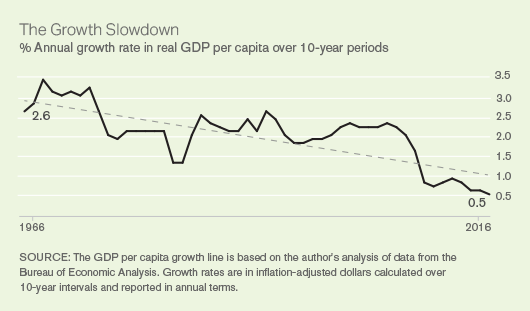
The study, released today, finds there is no recovery. Since 2007, U.S. GDP per capita growth has been 1%.
The Great Recession may be over, but America is dangerously running on empty.
20161202_GrowthSlowdown_chart
Think of our country as a company, America Inc., which has more than 100 million full-time employees, with about $18 trillion in sales and $20 trillion of debt. The most serious problem facing it is no growth. In addition, America Inc. has three soaring expenses threatening to bankrupt the company and its shareholder-citizens: healthcare, housing and education.
As this report notes, in 1980, these three sectors accounted for 25% of total national spending — today, they account for more than 36%. They also account for most of the total measured inflation over the same period. And without inflation in these sectors, real annual productivity — defined as GDP per capita growth — would have been an estimated 3.9% instead of 1.7%.
My own opinion is that America Inc. is too big to “turn around” like one would a company or any other organization. There is no quick fix to something this huge and complex. But there is a long-term fix, which is to get GDP increasing to 3% and higher while slowing the increasing costs of healthcare, housing and education.
When real growth returns, productivity will increase, and America Inc.’s empty tank will refill.
* * *
Full report below (please note that if you are unsatisfied with this study please report Gallup to The Washington Post for being a Russian puppet..)

Friday, June 17, 2016

Is Trump The Solution To The Economy Issues Or Will He Worsen Things? Here's One Man's Opinion

Overthrow the Establishment to Fix the Economy

Image: Overthrow the Establishment to Fix the EconomyDonald Trump (AP file photo)
By Larry KudlowThursday, 16 Jun 2016 09:57 PMMore Posts by Larry Kudlow

Famed investor Wilbur Ross recently told CNBC that “Trump represents a more radical new approach to government that the nation’s economy desperately needs.” He’s right.

Trump seeks an overthrow of the establishment. He’s a disrupter. Just what we need to fix the economy.

The situation is that desperate.

The last 15 years of economic policy, especially the last eight years, represent a relapse that harks back to the 1970s. Now like then, we have a high-tax, high-spend, high-regulation, Fed-pump-priming, standard-less dollar-manipulation policy mix. In general, it’s a government-planning approach in the U.S. and around the world.

We’ve not experienced high inflation in recent years, but that’s not because the Fed hasn’t tried hard enough. Meanwhile, all the QE, bond buying, and interest-rate fixing did not succeed.

It’s been a Keynesian mishmash. Gigantic federal spending and infrastructure building (remember “shovel ready jobs”?). Overtaxed investors, successful earners, and large and small businesses. Overregulated banks, energy, businesses, and health care. None of it worked. Whatever happened to those government-spending multipliers? Never happened.

The economy has barely recovered from the so-called Great Recession, with a 2 percent annual rate of growth since mid-2009. Peak worker wages, business investment, and productivity all occurred around the year 2000. 

The U.S. has the highest corporate tax system in the world, companies and their cash are fleeing overseas, welfare rolls are skyrocketing, employment participation rates are falling, and interest-rate markets have come under the spell of the Fed’s misallocation of credit.

And in response to all that, the general electorate — and the middle class in particular — is angry and suffering high anxiety about the future.

As AEI president Arthur Brooks argues, people who earn their own income are happy campers, while people who live on government assistance are unhappy. So at the margin, if you count more people living off government-welfare assistance, and even those working who are earning less in real inflation-adjusted terms, it’s a very unhappy country.

Putting aside the growing threat from Islamic jihadist terrorism, most of America’s problems are home grown. So when I say overthrow the establishment to fix the economy, and the brilliant businessman Wilbur Ross says we need radical new approaches to government, we’re talking two sides of the same coin.

In the 1980s and 1990s, radical change in economic policies fostered by Ronald Reagan and Margaret Thatcher put the brakes on government planning and ushered in a new free-market supply-side era and a two-decade boom. That model has been abandoned in the new century. This must be reversed.

Who, exactly, do I mean by the establishment that needs overthrowing? Much of the blame must be placed on the high-pedigreed economists in and out of government who advise politicians, policymakers, the Fed, big corporate CEOs, and interest-group trade associations to pursue a cronyist corporate-welfare system that both creates and then relies on a government-driven economy. Not all economists — there still are a few free-marketeers out there.

And while Democratic policy planners are the vanguard of the new Bernie Sanders democratic socialism, with Hillary Clinton right in the pack, many Republican advisors are also to blame.

Now, Donald Trump may be an imperfect candidate in his rookie political season, but he gets the basic economic story right: Lower taxes, especially slashing large- and small-business taxes. Roll back regulations. Unleash all forms of energy. Take a market-oriented and consumer-choice approach to health care and education. A friendly attitude toward entrepreneurs.

If Trump follows through with his free-market-oriented policy direction the American economy will take off like a rocket.

Growth is the key, not inequality. Growth creates new businesses, new jobs, higher wages, and a stronger middle class. Growth eases the burdens of poverty. Growth makes everyone happier.

But today, not surprisingly, the business sector is slipping into recession. Profits, production, investment, core capital goods, and business equipment have gone negative. Since supply creates its own demand, the slump in business could spread to the consumer — unless policies are turned around.

Pre-election, that won’t happen. Post-election, it just might. But that’s at least six months away.

And irony of ironies: A bumbling Fed made the right decision to back off interest-rate hikes. In fact, the real message of rock-bottom rates around the world is stagnation and deflation.

But global central banks, much like their governments, are a long stone’s throw away from sound money and currency stabilization. It’s just like our errant fiscal policies.

To save the economy, things must change.

“You only get to vote for who’s on the ballot paper, and your choices are between Hillary Clinton and Donald Trump, and I find that an easy choice to make,” said Wilbur Ross.

By the way, business titan Wilbur Ross would make a very good Treasury secretary, wouldn’t he?

Larry Kudlow is a senior contributor at CNBC. To read more of his work,CLICK HERE NOW.

To find out more about Larry Kudlow and read features by other Creators Syndicate writers and cartoonists, visit the Creators Syndicate web page at www.creators.com
© Creators Syndicate Inc.


Read more: Larry Kudlow: Overthrow the Establishment to Fix the Economy
Important: Can you afford to Retire? 

Monday, June 16, 2014

Looks Like GDP Will Have A Hard Time Getting Up To Federal Reserve Forecast

Lindsey Group: Economic 'Walls Are Closing In'

Friday, 13 Jun 2014 12:23 PM
By Dan Weil
Share:
  Comment  |
   Contact Us  |
  Print  
|  A   A  
The news for the economy just keeps getting worse, according to a commentary from The Lindsey Group, an economic advisory firm.

On Tuesday, the Bureau of Economic Analysis (BEA) released data suggesting that healthcare services shrank 1.3 percent in the first quarter from the fourth quarter, the report says.

That's significant, because the BEA had assumed Obamacare would spark growth of 2.3 percent, and that's the figure it used for healthcare services in estimating GDP. The BEA's latest estimate was that GDP shrank 1 percent in the first quarter.


"It is reasonable to assume that, given the size of this sector, this will cause the estimate of first quarter growth to be revised down by a further percentage point, making it a minus 2 percent," The Lindsey Group writes.

"Now both BEA and Obamacare look foolish."

The Federal Reserve's March forecast of 2.8 percent to 3 percent GDP growth for 2014 also looks "foolish" now, the commentary says. Growth will more likely total 1.75 percent for the year, it states.

"If one pencils in a -2.0 [percent] for the first quarter, even a string of four percent quarters for the rest of the year only gets 2.5 percent growth, and the more likely result of 3 percent quarters produces 1.75 percent for the year — well below the March projection of 3 percent and the December projection of 3.25 percent," the report notes.

"The walls are closing in, and . . . the news coming out of the FOMC [Federal Open Market Committee] over the next six months will be a painful combination of downgrades to growth and an acceleration of the expected date of policy tightening."

Meanwhile, Johns Hopkins University economist Laurence Ball contends that the Great Recession, which ran from 2007 to 2009 in the United States, is still affecting economies around the world, limiting their growth potential.

"Recent recessions have had dire effects on economies' productive capacity," he writes in a paper published by the National Bureau of Economic Research. "Countries with the deepest recessions have also experienced the greatest long-term damage."

The U.S. loss of potential economic output totals 4.7 percent, Ball calculates.


Related Stories:
© 2014 Moneynews. All rights reserved.