Modernizing America's Nuclear Capabilities Is a Must
In April 2017, the Pentagon launched the U.S. Defense Department's legislatively mandated quadrennial Nuclear Posture Review to determine American policy, strategy and capabilities. The process now underway involves testimony from experts arguing over how the estimated $27 billion spent annually (growing over the next decade by an additional $10 billion a year) on America's nuclear arsenal should be allocated.
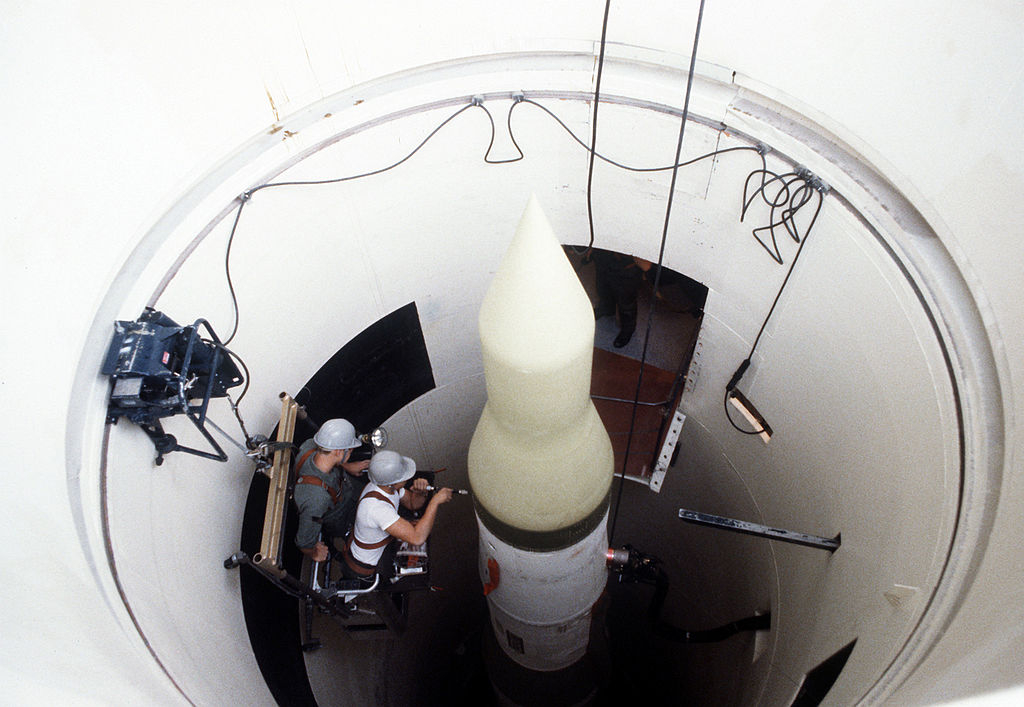
One claim, made by a number of experts, is that investing in the effort to upgrade America's exiting nuclear arsenal -- the land-based intercontinental ballistic missiles (ICBMs) -- would be destabilizing and wasteful. They are, it is claimed, highly vulnerable to enemy attack and therefore do not provide deterrence. Among the 40 House members who suggest killing the land-based missiles is the ranking Democratic member of the House Armed Services Committee. The opposite position was expressed recently by General Robin Rand, the commander of the Air Force Global Strike Command (AFGSC). He persuasively argued that, far from being either destabilizing or unnecessary, "Our bomber and Intercontinental Ballistic Missile (ICBM) forces, and our nuclear command, control, and communications systems defend our national interests, assure our allies and partners, and deter potential adversaries." Addressing the Senate Armed Services Strategic Forces Subcommittee on June 7, Rand said, "ICBMs are the sole weapon system capable of rapid global response and impose a time-proven and unpalatable cost to attack by peer, near-peer and aspiring nuclear nations." The discrepancy in viewpoints stems from the difference in perception about American nuclear power and deterrence. Those who disagree with Rand are stuck in Cold War thinking, which has become largely irrelevant in today's world. To understand this better, a review of the history of the U.S.-Soviet arms race is necessary. In January 1967, U.S. President Lyndon Johnson announced that the USSR had greatly expanded its powerful multiple-warhead land-based missiles, as well as having begun to build an anti-ballistic-missile defense system (ABM) around Moscow -- which would enable it to launch a first strike against the U.S. without fear of an effective retaliation against Soviet leadership bunkers -- and called for strategic arms limitations talks (SALT). Johnson's successor, Richard Nixon, continued with the process, formally launching the negotiations in November 1969 that led to the signing of the SALT I executive agreement in May 1972. When Gerald Ford became president, he agreed with Soviet President Leonid Brezhnev on a general framework for a second agreement -- SALT II -- marginally to limit the deployment capabilities of each side, but still allow major increases in warheads, especially powerful, multi-warhead land-based Soviet missiles. Although SALT II was signed in June 1979 by Ford's successor, President Jimmy Carter, it was never ratified by the Senate, members of which, on both sides of the aisle, argued that it would not "reverse trends in the military balance adverse to the United States." A week after 19 senators expressed this warning in a letter to Carter, the Soviets invaded Afghanistan and Carter withdrew the treaty from further consideration. Carter's successor, Ronald Reagan -- who had been vehemently opposed SALT II before his election -- knew its upward limits would readily accommodate his proposed modernization efforts and thus agreed to abide by it in principle. But here, he switched gears while pursuing a markedly different military and diplomatic avenue, in the form of the Strategic Arms Reduction Treaty (START). Reagan proposed that the U.S. simultaneously modernize while seeking reductions, instead of merely allowing huge increases in warheads under the SALT process. This also challenged the Soviet idea of a nuclear freeze -- especially in that the Soviets were well through their nuclear modernization and the United States had not even begun. Early in the Reagan administration, the U.S. still continued seeking to make its land-based silo missiles better able to withstand a massive Soviet strike. Many plans were examined, but all were expensive and required the use of a great deal of land on which to move the missiles on trains, trucks or mobile launchers. Ultimately, in 1983, Reagan reached a simple, but elegant, solution: a three-step program. First, deep reductions in nuclear weapons; second, putting the new, modern, large 10-warhead Peacekeeper land-based missiles in existing Minuteman silos, and third, simultaneously developing a much smaller mobile missile with only one warhead, to be built later. This was essentially accomplished during the three successive administrations after the end of the Cold War, but with one key change. Given that the number of Russian and American strategic warheads eventually were reduced by more than 90% under the START I, Moscow and New START Treaties, American silo-based missiles -- all with only a single warhead -- became fundamentally survivable, even deployed in silos where they remain today.
The situation is therefore now the opposite of what it was during the 1970s and 1980s. At the height of the Cold War, the U.S. -- with 1,000 American missile silos -- faced more than 13,000 Soviet (subsequently Russian) warheads, or a 13-to-1 ratio. Today, we face roughly 1,750 Russian warheads but have 450 silos, a 4-to-1 ratio. In other words, the strategic environment became more stable, not less, and eliminating the very nuclear triad responsible for this stability makes no sense. Although the nuclear triad was conceptualized and developed during the Cold War, maintaining it is just as imperative today. ICBMs are as highly stabilizing now as they were highly destabilizing prior to the dramatic reduction in the number of warheads from 1981-2017. Why is that? In 1989, America had 1,000 nuclear missile silos, and a small number of additional bomber and submarine bases and submarines at sea, facing 13,500 Soviet warheads. Today, the U.S. has 450 such silos facing 1,750 Russian warheads. That is a switch from a ratio of 13 Russian warheads to every U.S. missile silo, to a ratio of 4 Russian warheads to every U.S. missile silo. Getting rid of Minuteman ICBMs would reverse that progress and make the ratio even worse, with 175 Russian warheads to every U.S. missile silo. How is that an improvement? It is crucial, therefore, to continue to invest in modernizing the ICBMs. As for the suggestion -- among some of the less extreme anti-ICBM analysts -- that the current ICBM force be extended for a few more years and modernization be reassessed later -- is not a viable option, according to General Rand. He says that the U.S. "cannot afford to delay modernization initiatives" while the "American people and our allies are counting on congressional action to fund our nuclear enterprise modernization efforts." Let us hope that those who do not grasp how necessary it is for the United States to go forward with the ground-based strategic deterrent have little influence over the Nuclear Posture Review that is currently underway. America's ability to defend itself is at stake. Dr. Peter Huessy is President of GeoStrategic Analysis, a defense consulting firm he founded in 1981, as well as Director of Strategic Deterrent Studies at the Mitchell Institute for Aerospace Studies. He was also for 20 years, the senior defense consultant at the National Defense University Foundation.
© 2017 Gatestone Institute. All rights reserved. The articles printed here do not necessarily reflect the views of the Editors or of Gatestone Institute. No part of the Gatestone website or any of its contents may be reproduced, copied or modified, without the prior written consent of Gatestone Institute.
|
Showing posts with label nuclear missiles. Show all posts
Showing posts with label nuclear missiles. Show all posts
Thursday, July 27, 2017
A Strong Defense Starts With Overwhelming Offense--We Must Keep Our Offense Strong




Tuesday, February 14, 2017
Iran Deal Gets Worse By The Moment. It Should Be Cancelled
Read More About:
Share This Post
3
www.israel-commentary.org
The Iran Deal Can’t Be Enforced
Read More About: These are weasel words of the highest order coupled with flat-out misrepresentation by Iran and willful blindness by the United States
By JOHN BOLTON
The Wall Street Journal
Feb. 6, 2017
Iran’s continued missile testing on Saturday has given President Trump one more reason to tear up his predecessor’s deal with the regime in Tehran. After Iran’s Jan. 29 ballistic-missile launch, the Trump administration responded with new sanctions and tough talk.
But these alone won’t have a material effect on Tehran or its decades-long effort to acquire deliverable nuclear weapons. The real issue is whether America will abrogate Barack Obama’s deal with Iran, recognizing it as a strategic debacle, a result of the last president’s misguided worldview and diplomatic malpractice.
Terminating the agreement would underline that Iran is already violating it, clearly intends to continue pursuing nuclear arms, works closely with North Korea in seeking deliverable nuclear weapons, and continues to support international terrorism and provocative military actions.
Escaping from the Serbonian Bog that Obama’s negotiations created would restore the resolute leadership and moral clarity the U.S. has lacked for eight years.
But those who supported the Iran deal, along with even many who had opposed it, argue against abrogation. Instead they say that America should “strictly enforce” the deal’s terms and hope that Iran pulls out.
This would be a mistake for two reasons. First, the strategic miscalculations embodied in the deal endanger the U.S. and its allies, not least by lending legitimacy to the ayatollahs, the world’s central bankers for terrorism.
Second, “strictly enforcing” the deal is as likely to succeed as nailing Jell-O to a wall. Not only does the entire agreement reflect appeasement, but President Obama’s diplomacy produced weak, ambiguous and confusing language in many specific provisions.
These drafting failures created huge loopholes, and Iran is now driving its missile and nuclear programs straight through them.
Take Tehran’s recent ballistic-missile tests. The Trump administration sees them as violating the deal. Iran disagrees. Let’s see what “strict enforcement” would really mean, bearing in mind that the misbegotten deal is 104 pages long, consisting of Security Council Resolution 2231 and two attachments: Annex A, the Joint Comprehensive Plan of Action (the main nuclear deal, known by the acronym JCPOA); and Annex B, covering other matters including ballistic missiles.
Annex B isn’t actually an agreement. Iran is not a party to it. Instead it is a statement by the Security Council’s five permanent members and Germany, intended to “improve transparency” and “create an atmosphere conducive” to implementing the deal. The key paragraph of Annex B says: “Iran is called upon not to undertake any activity related to ballistic missiles designed to be capable of delivering nuclear weapons” for eight years.
Note the language: Iran is not forbidden from engaging in all ballistic-missile activity, merely “called upon” to do so. The range of proscribed activity is distinctly limited, applying only to missiles “designed to be capable” of carrying nuclear weapons. Implementation is left to the Security Council.
The loopholes are larger than the activity supposedly barred. Iran simply denies that its missiles are “designed” for nuclear payloads—because, after all, it does not have a nuclear-weapons program. This is a palpable lie, but both the JCPOA and a unanimous Security Council accepted it.
Resolution 2231 includes a paragraph: “Welcoming Iran’s reaffirmation in the JCPOA that it will under no circumstances ever seek, develop or acquire any nuclear weapons.” The ayatollahs have been doing precisely that ever since their 1979 revolution.
Finally, Resolution 2231 itself also merely “calls upon” Iran to comply with Annex B’s ballistic-missile limits, even as the same sentence says that all states “shall comply” with other provisions. When the Security Council wants to “prohibit” or “demand” or even “decide,” it knows how to say so. It did not here.
The upshot is very simple: Iran can’t violate the ballistic-missile language because it has reaffirmed that it doesn’t have a nuclear-weapons program. Really, what could go wrong?
These are weasel words of the highest order, coupled with flat-out misrepresentation by Iran and willful blindness by the United States. The Jell-O will not stick to the wall. The deal cannot be “strictly enforced.” And this is only one example of the slippery language found throughout the deal.
Pentagon sources have said that the missile Iran recently tested failed while re-entering the Earth’s atmosphere. This is telling. If the missile program were, as Iran claims, only for launching weather and communications satellites, there would be no need to test re-entry vehicles. The goal would be to put satellites in orbit and keep them there.
But nuclear warheads obviously have to re-enter the atmosphere to reach their targets. The recent tests provide even more evidence of what Iran’s ballistic-missile program has always been about, namely supplying delivery vehicles for nuclear weapons.
Time always works on the side of nuclear proliferators, and the Iran deal is providing the ayatollahs with protective camouflage. Every day Washington lets pass without ripping the deal up is a day of danger for America and its friends. We proceed slowly at our peril.
Mr. Bolton is a senior fellow at the American Enterprise Institute and author of “Surrender Is Not an Option: Defending America at the United Nations and Abroad” (Simon & Schuster, 2007).
Monday, February 29, 2016
The "Success" Of The North Korea Nuclear Deal. Why Would We Think Iran Will Be Any Different?

North Korea's Nuclear Missile Threat: Very Bad News
The mainstream media and their stable of "experts" consistently underestimate North Korea's missile and nuclear weapon capabilities. The gap between how the media report on the North Korean nuclear missile threat and the reality of the threat has become so wide as to be dangerous.
In the aftermath of North Korea's latest nuclear test on January 6, 2016, for instance, and its launch of a mock satellite on February 7, 2016, the American people were told that North Korea has not miniaturized a nuclear warhead for delivery by missile nor could the missile strike the U.S. with any accuracy. Mirren Gidda, for example, writing in Newsweek, inexplicably claims "International experts doubt that North Korea has manufactured nuclear weapons small enough to fit on a missile." Yet this commonplace assertion that North Korea does not have nuclear-armed missiles is simply untrue. Eight years ago, in 2008, the CIA's top East Asia analyst publicly stated that North Korea had successfully miniaturized nuclear warheads for delivery on its Nodong medium-range missile. This capability indicates that the Nodong is able to strike South Korea and Japan, or, if launched off a freighter, even the United States.[1] In 2009, European intelligence agencies at NATO headquarters also told the media that North Korea's Nodong missiles were armed with nuclear warheads.[2] In 2011, the Director of the Defense Intelligence Agency (DIA), Lt. General Ronald Burgess, testified before the Senate Armed Services Committee that North Korea has weaponized its nuclear devices into warheads for arming ballistic missiles.[3] And as it turned out, North Korea achieved a long-range missile capability to strike the U.S. at least as early as 2012, according to testimony of administration officials before Congress. North Korea's accomplishment occurred a bare two years outside of the fifteen-year "safe" window promised by the CIA in 1995. In February and March of 2015, former senior national security officials of the Reagan and Clinton administrations warned that North Korea and Iran should be regarded as capable of delivering by satellite a small nuclear warhead to make an EMP attack against the United States. In numerous articles that should have made media headlines -- by Dr. William Graham (President Reagan's Science Advisor, Administrator of NASA, and Chairman of the Congressional EMP Commission), Ambassador R. James Woolsey (President Clinton's Director of Central Intelligence), Ambassador Henry Cooper (former Director of the Strategic Defense Initiative), and Fritz Ermarth (former Chairman of the National Intelligence Council) -- have gone largely ignored by much of the media.[4] On April 7, 2015, at a Pentagon press conference, Admiral William Gortney, Commander of North American Aerospace Defense (NORAD), responsible for protecting the U.S. from long-range missiles, warned that the intelligence community assesses North Korea's KN-08 mobile ICBM could strike the U.S. with a nuclear warhead. And on October 8, 2015, Gortney again warned the Atlantic Council: "I agree with the intelligence community that we assess that they [North Koreans] have the ability, they have the weapons, and they have the ability to miniaturize those weapons, and they have the ability to put them on a rocket that can range the [U.S.] homeland."[5] Given this overwhelming evidence of North Korea's ability to strike the U.S., how strange that network and cable television and most major news outlets have never informed the American public that North Korea already has nuclear-armed missiles that can strike the United States. Just weeks prior to North Korea's fourth illegal nuclear test of an alleged hydrogen bomb on January 6, 2016, and prior to North Korea's second successful orbiting of a satellite a month later, the Department of Defense (DoD) finished, in late 2015, a report to Congress. The report, which was not released to the public prior to the recent 2016 North Korean tests, appeared to be low-balling the North Korean nuclear missile threat. The DoD report -- finally released on February 12, 2016 -- acknowledges that North Korea does indeed have a mobile ICBM: the KN-08. It is armed with a nuclear warhead that "likely would be capable" of striking the U.S. mainland, but "current reliability as a weapon system would be low" because the KN-08 has not been flight-tested. Such hedging language about the KN-08 echoes repeated past assurances by the Obama Administration to the American people that North Korea does not yet have a miniaturized nuclear missile warhead, and cannot deliver on its threats to strike the United States. The earlier DoD report from 2015 had also downplayed the North Korean nuclear missile threat by comforting readers that, "The pace of its progress will also depend, in part, on how much aid it can acquire from other countries." Yet the DoD report is replete with evidence that North Korea is in fact receiving copious aid from Russia and China -- including Golf-class ballistic missile submarines and an SS-N-6 submarine-launched ballistic missile from Russia.
The DoD report from 2015 also acknowledges that North Korea is developing another system for a nuclear strike on the U.S., delivered by satellite; but also notes that the system currently lacks "a reentry vehicle." However, a nuclear EMP attack delivered by satellite requires no reentry vehicle. In short, the DoD report was inexplicably silent about North Korea's current nuclear and missile capability, which, if used, could kill millions of Americans in an EMP attack -- as warned by both the 2004 and 2008 Congressional EMP Commission reports. A careful technical reading of the DoD report clearly confirms the very bad news that North Korea can strike the U.S. mainland with nuclear missiles right now. But the casual or non-expert reader can get the false impression from the report, as no doubt was intended, that President Obama was right to assert that there is no nuclear missile threat from North Korea. As one newspaper article on the DoD report declared in its headline, "Pentagon: North Korea Lacks Technology For Anti-U.S. Nuclear Strike." When not downplaying the missile and nuclear developments in North Korea, media reports tended to also discover benign North Korean motives for their missile and nuclear tests or technical arguments designed to lessen their import. One BBC report quoted Andrea Berger, for instance, from the Royal United Services Institute in London, who assured everyone that North Korea "wants a peace treaty with the USA" but "seems to believe that it will not be taken seriously until it can enter talks on this issue with sizeable military strength." The New York Times also echoed other analyses, claiming, "Although North Korea can learn much about the technology to build ballistic missiles from satellite launches, putting a satellite into orbit does not guarantee an ability to deliver a nuclear warhead on an intercontinental ballistic missile." The New York Times then further diminished the North Korean threat by commenting, "North Korea has never tested a ballistic-missile version of its Unha-series rockets. [And] after four nuclear tests by the North, Western analysts were still unsure whether the country had mastered the technology to build a warhead small enough to mount on a long-range missile" or "survive the intense heat while re-entering the atmosphere, as well as a guidance system capable of delivering a warhead close to a target."[6] North Korea's H-BombThe dominant media assessment of North Korea's nuclear test also followed the same "minimalist" pattern as its coverage of North Korea's satellite-launch missile test.The most common assumption by critics downplaying North Korea's test was that the bomb was no more than 10 kilotons in strength and thus not anywhere near as advanced as a hydrogen bomb, as the North Korean's claimed, nor appreciably different from previous North Korean tests. Again, the conventional wisdom missed the real news. Let us explain. Henry Sokolski, of the National Proliferation Education Center (NPEC), and Dr. Peter Vincent Pry, the Executive Director of the Congressional EMP Task Force, a former top staffer on the House Armed Services Committee, a former CIA analyst, and the co-author of this essay, both said "Not so fast." First, U.S. intelligence on North Korea is not perfect. Second, the test could very well have been what is known as a "boosted fission weapon" (which such experts as former Secretary of the Air Force and Reagan's Deputy National Security Adviser Tom Reed believes it was),[7]rather than a primitive fission atomic bomb. Remember, the U.S. and other intelligence services have not detected uranium or plutonium (A-Bomb fuels) in any of the North Korean tests, but they have detected tritium (H-Bomb fuel) in at least one. A boosted weapon could explain this anomaly. One Rand analyst also thinks the test might have been of a boosted fission weapon, and uses a different seismic model that gives a test yield of 50 kilotons (KT) and not the 6-10 KT reported by South Korea and widely used by press reporting on the issue. What Sokolski implies is that North Korea may be getting help from Russia or China, a possibility that changes the framework of how we in the U.S. have traditionally approached and dealt with proliferation of nuclear weapons, particularly the possible sophistication of nuclear threats from aspirant states. If North Korea and Iran are getting help from Russia or China, as retired U.S. Northcom Commander General (Retired) Charles Jacoby agrees they are,[8] and do not have to rely only on their indigenous capabilities, their nuclear and missile programs at any time could be more advanced than is commonly thought. There is also the possibility that such advanced technology could be sold to other rogue regimes or by all of them to each other. North Korea could, in fact, already have the H-Bomb. Everyone assumes that the North Korean test was not an H-Bomb because the seismic signal indicates that the yield was too low for an H-Bomb. But North Korea could very well have conducted a "decoupled" nuclear test. In a decoupled test, the nuclear explosion is in a large cavern filled with shock-absorbing materials to reduce the seismic signal and conceal the true yield of the test. North Korea would not need help from Russia or China to do a decoupled test. It is both easy and well within North Korea's capabilities. A decoupled test could reduce the seismic signal by more than 10-fold. Thus, a test that looks like 10 kiloton yield in the seismic signal could have had a yield of 100 KT. Also, a 50 KT seismic signal could really have been a 500 KT test. Such high yields are in H-Bomb territory. Alternatively, North Korea could be testing only the primary or first stage of a much more powerful two-stage H-Bomb. In the last decades of the Cold War this is what the U.S. did to comply with the Threshold Test Ban Treaty (TTBT). The U.S. rarely tested its H-Bombs to full yield -- both to comply with the TTBT and because if anything went wrong with a warhead, the problem would most likely be in the first stage. After the July 1974 Threshold Test Ban Treaty (TTBT)[9] between the USA and the USSR, the U.S. never tested a nuclear weapon of more than 150 kilotons. Most tests were far below the 150 kiloton level and many were below 10 kilotons. And the U.S. has not tested to any yield in the past twenty years because component testing suffices even for America's most powerful nuclear weapons. Can the U.S. get away with this because its scientific knowledge is so much better than that of other nations? Russia, China, Britain, and France are not testing their H-Bombs either, as such testing is not necessary to be confident the bombs work. Israel developed the H-Bomb without testing it. South Africa was on the way to doing so, without testing, when it dismantled its arsenal under pressure from the Reagan administration. Pakistan and India claim to have tested H-Bombs; many of the "instant experts" dismissing the North Korean threat, however, also insist Pakistan and India are not being truthful because the test yields were like North Korea's recent test, also supposedly "too low." Most "experts" cannot believe that North Korea and Pakistan could duplicate what the superpowers have done and reinvent the H-Bomb. None appears to remember that critical design information for thermonuclear weapons was leaked by a magazine, The Progressive, when it published the article. "The H-bomb Secret."[10] The Carter administration, losing its case in the U.S. Supreme Court, objected to, but failed to stop, its publication. And "The H-Bomb Secret" is but just one example of copious critical design information for nuclear weapons that has been leaked, stolen, or foolishly declassified. The EMP Commission and the authors of this article believe that North Korea tested what the Russians call a Super-EMP weapon. It better explains all the data. Super-EMP Nuclear WarheadThe EMP Commission warned in its 2004 report, that "Certain types of relatively low-yield nuclear weapons can be employed to generate potentially catastrophic EMP effects over wide geographic areas, and designs for variants of such weapons may have been illicitly trafficked for a quarter-century."A Super-EMP weapon is designed to produce gamma rays, not a big explosive yield. So a Super-EMP weapon is consistent with all the North Korean tests, including low yield tests, such as the first 3 KT test, and two other suspected North Korean tests. Those were sub-kiloton yet also showed evidence of traces of tritium. Because a Super-EMP weapon is low-yield, and not designed for blast effects, it can be easily tamped when tested. That possibility could account for America's inability to detect any plutonium or uranium from North Korea's tests. One design of a Super-EMP weapon, of Russian origin, is virtually a pure fusion weapon, so that after an explosive test, there would be little or no plutonium or uranium to detect. As a Super-EMP weapon is, essentially, a very low-yield H-Bomb, it would be consistent with North Korea's claim. North Korea's two successful satellite launches -- of the KSM-3 in 2012 and the KSM-4 in 2016 -- both look like tests of a Fractional Orbital Bombardment System (FOBS). The FOBS, a Soviet-era secret weapon, would, like a satellite, launch a warhead into low-earth orbit. The FOBS could therefore disguise a nuclear EMP attack as a peaceful space launch. It would conceal the intended target because its flight path masked that information. FOBS would also have allowed the Soviets to attack the United States from over the South Pole, the opposite direction from which U.S. early-warning radars and missile-interceptors, under the North American Aerospace Defense Command (NORAD), are oriented, both during the Cold War and today.[11] North Korea's KSM-3 satellite orbits the Earth at precisely at the right trajectory and altitude for making a surprise nuclear EMP attack on the United States -- practicable only if the North Koreans have a warhead small enough for delivery by satellite, as a Super-EMP warhead would be. North Korea has also flown a Nodong medium-range ballistic missile (MRBM) over Japan at an altitude consistent with a potential EMP attack. Russian experts, one Chinese military commentator, and South Korea's military intelligence all claim that North Korea has Super-EMP warheads. If we follow the rules for "all sources analysis," this data should not be ignored. In November 1999, the North Korea Advisory Group of the U.S. Congress reported that they were convinced that North Korea was developing nuclear weapons, despite the 1994 Agreed Framework deal with the United States, under which North Korea promised to not build such weapons. At the time, the Clinton Administration claimed no such work was being done by the North Koreans.[12] Yet we now know the Advisory Group was right, and the Clinton Administration wrong. Implications for the Nuclear Missile Threat from IranThe late Israeli Prime Minister Yitzhak Rabin warned us that it was a terrible mistake to hold talks with North Korea in Beijing in 1994 in an effort to persuade North Korea to stop missile exports to the Middle East.[13]Rabin said that instead of trying to solve the problem, "North Korea tried to fool Israel. North Korea demanded $1 billion to stop the sales." At the same time, according to Rabin, North Korea received hundreds of millions of dollars from Iran to produce missiles with longer ranges, threatening not only America's Middle East allies but allies elsewhere, once the North Koreans received financial help from Iran's mullahs. The bottom line is that North Korea and Iran are strategic partners who cooperate on missile technology and probably nuclear technology. As both receive help from Russia and China, it is time to stop wishful thinking -- that everything is fine, that diplomacy will work -- and to face reality. North Korea has nuclear-armed missiles that threaten the U.S. mainland -- right now. Defending our homeland from that threat is an imperative, including protecting our full electrical grid, other critical infrastructures and of course our cities. And if North Korea has such a capability, how close is Iran to such weaponry? The mainstream media must face these facts and start reporting that North Korea has nuclear-armed missiles that threaten the United States -- right now. Defending the homeland now, including its critical electrical grid, from a nuclear EMP attack is imperative. What should the United States therefore do? First, the President should declare that a nuclear EMP attack on the United States is an existential threat to the American people and would warrant an all-out retaliatory response. The President should prevent North Korea from further developing its long-range nuclear missile capabilities and capabilities to perform EMP attacks. The U.S. could surgically destroy -- on the launchpad -- any North Korean space-launch vehicle (SLV) or long-range missile prior to launch, or shoot down any SLV or long-range missile launch, including North Korea's KSM-3 and KSM-4 satellites. The administration should also provide support to, and work in close consultation with, the newly re-established Congressional EMP Commission. Their primary goal should be to protect DoD assets, military critical infrastructures, and the civilian electric grid that provides 99% of the electric power needed to sustain DoD power-projection capabilities. The Congress also should immediately pass the Critical Infrastructure Protection Act (CIPA), which passed the House unanimously and now awaits action in the Senate. CIPA empowers the Department of Homeland Security to work with the utilities, State governments and emergency planners at all levels of government, to develop plans to protect and recover the national electric grid and other civilian critical infrastructures from an EMP attack. Finally, the next President should revive President Ronald Reagan's vision of the Strategic Defense Initiative (SDI) and develop and deploy space-based missile defenses. Space-based missile defenses will offer a realistic prospect of rendering nuclear missile threats obsolete, thus neutralizing the growing nuclear missile threats to the United States from North Korea, Iran, China, and Russia. Dr. Peter Vincent Pry is Executive Director of the EMP Task Force on National and Homeland Security, a Congressional Advisory Board, and served in the Congressional EMP Commission, the Congressional Strategic Posture Commission, the House Armed Services Committee, and the CIA. Peter Huessy is President of Geostrategic Analysis, Senior Defense Consultant to the Mitchell Institute of the Air Force Association, and teaches nuclear deterrent policy at the US Naval Academy. [1] Interview with CIA East Asia Division Chief Arthur Brown by Ruriko Kubota and Yosuke Inuzke, "DPRK Has Produced Small-Type Nuclear warheads," Sankei Shimbun, Tokyo: October 1, 2008. [2] "Spy Agencies Believe North Korea Has Nuke Warheads," Agence France Presse, March 31, 2009. [3] Lt. General Ronald Burgess, Director, Defense Intelligence Agency, "Worldwide Threat Assessment: Statement before the Committee on Armed Services, U.S. Senate," Washington, D.C.: March 14, 2011 and "North Korea Nukes Might Fit On Missiles, Aircraft," Global Security Newswire: NTI, March 14, 2011. [4] "Experts: Iran Now A Nuclear-Ready State, Missiles Capable Of Hitting US" Newsmax (February 1, 2015); "When Iran Goes Nuclear," Washington Times (March 2, 2015), and Ambassador Henry Cooper and Dr. Peter Vincent Pry, "The Threat To Melt The Electric Grid," Wall Street Journal (April 30, 2015); Ambassador Henry Cooper, "North Korea's H-Bomb--And Iran's?" Family Security Matters (January 12, 2016). [5] Admiral William Gortney, Commander, North American Aerospace Command, "Protecting the Homeland," remarks at the Atlantic Council, October 7, 2015. [6] The New York Times apparently does not understand that an EMP strike delivered with a nuclear warhead does not re-enter the atmosphere nor is accuracy particularly an issue. Detonated thirty to seventy kilometers high roughly over the center of the eastern seaboard of the United States would be sufficient; and "Why Does the New York Times So Hate Missile Defense?", Gatestone Institute, June 11, 2013. [7] Personal Conversation with Secretary Tom Reed by Peter Huessy, February 9, 2016 at the Institute of World Politics. [8] Author's Conversation with General (Retired) Charles Jacoby at Real Clear Defense forum on ballistic missile defense issues, February 9, 2016. [9] Treaty between the United States of America and the Union of Soviet Socialist Republics on the Limitation of Underground Nuclear Weapon Tests (and Protocol Thereto) (TTBT). BUREAU OF ARMS CONTROL, VERIFICATION, AND COMPLIANCE Signed at Moscow July 3, 1974. Entered into force December 11, 1990. [10] United States of America v. Progressive, Inc., Erwin Knoll, Samuel Day, Jr., and Howard Morland, 467 F. Supp. 990 (W.D. Wis. 1979), was a lawsuit brought against The Progressivemagazine by the United States Department of Energy (DOE) in 1979. A temporary injunctionwas granted against The Progressive to prevent the publication of an article by activist Howard Morland that purported to reveal the "secret" of the hydrogen. Though the information had been compiled from publicly available sources, the DOE claimed that it fell under the "born secret" clause of the Atomic Energy Act of 1954. [11] In Air Power Australia, "The Soviet Fractional Orbital Bombardment System Program", Technical Report APA-TR-2010-0101 by Miroslav Gyurosi, January 2010. [12] North Korea Advisory Group, Report to the Speaker, November 1999. [13] The talks between Israel and North Korea were held in June 1993; see NTI-Jerusalem Post 18 Dec 1994, page 2, Rabin: "Earlier Talks with North Korea over missiles were a Major Mistake."
© 2016 Gatestone Institute. All rights reserved. No part of the Gatestone website or any of its contents may be reproduced, copied or modified, without the prior written consent of Gatestone Institute.
|


Friday, January 23, 2015
Iran Might Have A Missile That Could Hit Europe And Beyond? Should Americans Be Concerned?
Satellite Images Confirm Iran in Possession of Missiles that can Reach “Far Beyond Europe”
“A prudent man seeth the evil, and hideth himself; but the thoughtless pass on, and are punished.” (Proverbs 27:12)
image: http://www.breakingisraelnews.com/wp-content/uploads/2015/01/iran-satellite-rocket-missile.jpg

This image, first shown on Channel 2, shows the launching pad of long range missiles in Iran.
Israeli television broadcast what it said were the first satellite images seen in the West of a 27-meter (over 88-foot) missile on a launch pad in Tehran. A missile that large, the report claimed, could reach “far beyond Europe”.
The news report was broadcast by Israel’s Channel 2 Wednesday. According to the report, the missile is capable of launching a spacecraft – or carrying a conventional or non-conventional warhead great distances.
Channel 2 showed satellite images documenting Iran’s “very rapid progress” in the field of long-range missile manufacture. One photograph was of a site near Tehran, which the West has been aware of for two years now, where the Iranians are working on engines for long-range missiles.
The second photo, depicting the missile on its launch pad, was of a secondary site nearby, one the news channel said the West had not seen before.
The photographs were courtesy of the Eros B commercial Earth observation satellite, designed and built by Israel Aircraft Industries, and owned by Israeli firm ImageSat International. The Eros B was launched into orbit in 2006.
Israel has long been warning the West of Iran’s nuclear ambitions. It has publicly condemned any negotiations with Iran which would leave the Islamic Republic with the capability of enriching its own uranium. Iran maintains it wishes to enrich uranium for peaceful purposes, but this has not stopped its various officials from threatening to wipe Israel off the map over the years.
Read more at http://www.breakingisraelnews.com/28154/satellite-images-confirm-iran-in-possession-of-missiles-that-can-reach-far-beyond-europe-middle-east/#lKwcLPzAVFQGW5qk.99
Subscribe to:
Posts (Atom)