Our goal is to have intelligent discussion of the topics of the day. We realize everyone has their opinion and they should be allowed to express it in a discussion forum without calling each other names. We learn from discussion and not from name calling or argument.We use cookies to personalise content and ads, to provide social media features and to analyse our traffic. We also share information about your use of our site with our social media, advertising and analytics partners. See details
It has been nearly three months since Hurricane Maria devastated Puerto Rico, and the island’s recovery has been slow. The U.S. territory is struggling with shortages of food and medical supplies, and a full 45% of residents still don’t have power.
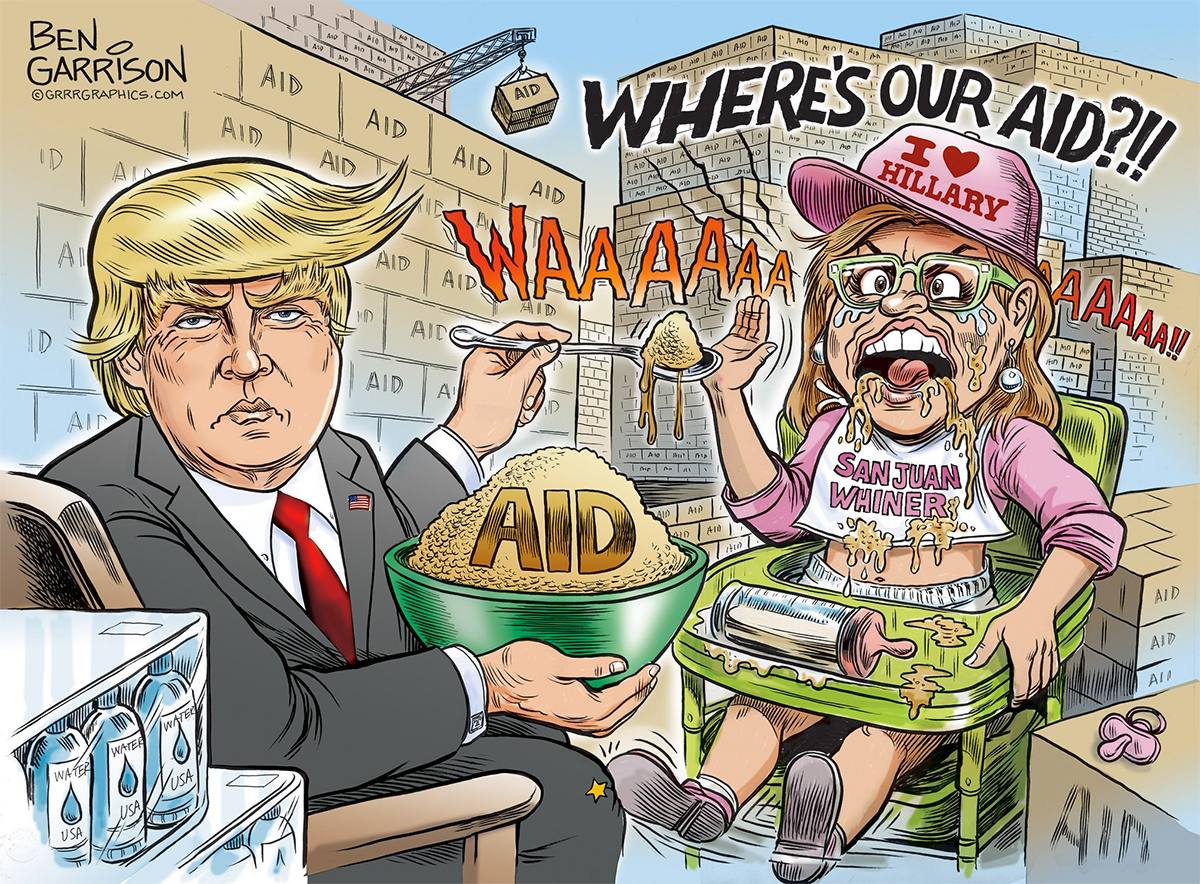
San Juan Mayor Carmen Yulín Cruz blames Washington for failing to devote adequate resources to Puerto Rico’s recovery: She recently dubbed President Trump the “disaster-in-chief”. But a journalist for El Nuevo Día, the newspaper with the largest circulation in Puerto Rico, has found a different culprit: “the Jew.”
Columnist Wilda Rodríguez wrote a piece Monday, titled “What Does ‘The Jew’ Want From The Colony?” According to Rodríguez, it is “Wall Street types,” not politicians, that dictate U.S. policy. And, who are the power brokers on Wall Street?
“In the end, Congress will do what ‘the Jew’ wants, as the vulgar prototype of true power is called,” she wrote.
Rodríguez added a disclaimer: “No offense to people of that religion.” She even argued that the term is a source of pride for Israeli Jews.
“More than 20 years ago, the Israeli paper Ma’ariv had an article in Hebrew that explained how the Jews control Washington,” she wrote. “For Israelis, recognizing Jewish power over Washington is not an offensive statement. It is the victory of the Diaspora.”
What does “the Jew” want? Rodriguez believes that Wall Street is punishing Puerto Ricans because of the island’s $70 billion debt. “That we could get away without paying would be fatal to Wall Street morale,” she wrote. “The punishment needs to make it clear to the debtor world that Wall Street cannot be manipulated.”
El Nuevo Día has since added an editorial note to the top of the article that apologizes to the island’s Jewish community, adding, “we do not promote content that can be interpreted as anti-Semitic.”
Jeffrey Boxer is the Forward’s deputy digital director.
In a landslide vote Sunday, Puerto Rican voters approved a referendum that stated the Caribbean territory ought to request statehood.
The Wall Street Journal reported that 97 percent of voters who went to the polls said the island should become the nation’s 51st state. However, there was historically-low turnout for the vote; only 23 percent of registered voters cast a ballot amid a boycott from two out of three of Puerto Rico’s major political parties, which could hinder efforts for Washington to recognize Puerto Rico as a state.
“An overwhelming majority voted for statehood. Today we are sending a strong and clear message for equal rights as American citizens,” Puerto Rico Gov. Ricardo Rosselló said, according to NBC News. “This was a democratic process and statehood got a historic 97 percent of the vote.”
However, Héctor Ferrer of the Popular Democratic Party — which supported the boycott — said that “statehood-ers shot themselves in the foot.”
“Eight out of 10 voters went to the beach, went to the river, went to go eat, went to go hang out, went to church, but they sure didn’t go out to vote,” Ferrer said at a press conference in San Juan. “Gov. Rosselló is now going to go to Washington and say this (statehood) is what people wanted. But we’re going too to say no, that’s not true and the numbers speak for themselves.”
The next step would be for the governor to put into what’s known as the “Tennessee Plan,” which is one method by which territories can lobby to become states. The governor will select two senators and five congressmen to travel to Washington to persuade the government to recognize it as the 51st state.
According to Newsweek, six other states aside from Tennessee have used this method to attain statehood — Michigan, Iowa, California, Oregon, Kansas and Alaska. New Mexico failed in its attempt to exercise the Tennessee Plan in 1850, although it would later be granted statehood in 1912.
According to The Hill, President Donald Trump expressed a willingness to consider Puerto Rican statehood on the campaign trail. However, while the Republican Party has traditionally supported Puerto Rican statehood, conservatives may now be concerned that doing so would add two senators and seven electoral votes from a state that’s voted overwhelmingly liberal in recent years.
However, this doesn’t necessarily mean that Puerto Rico will stay that way. In a great irony, Alaska’s statehood back in 1959 was directly tied to Hawaii’s, since lawmakers believed Alaska would vote Democrat and Hawaii would be reliably Republican. That state of affairs hasn’t taken long to reverse itself.
A bigger problem might be the low voter turnout. Newsweek noted the official plank of the Democrats is that they would only recognize statehood if it were decided through “fair, open and democratic elections.” The low turnout for the referendum — particularly given previous plebiscites in 1993 and 2012 had far higher turnout — means the actual will of the people is somewhat unclear.
However, what happened Sunday could be the first step toward the first new star on the flag in over a half a century — and a major shakeup in the American political landscape.
Please like and share on Facebook and Twitter with your thoughts on Puerto Rican statehood
Puerto Ricans Face ‘Sacrifice Everywhere’ on an Insolvent Island
Photo
Workers at the Río Piedras terminal in San Juan, Puerto Rico, face waning business. Transportation businesses have been hurt by the economic crisis as drivers have to wait hours to fill a trip for their routes.CreditErika P. Rodriguez for The New York Times
SAN JUAN, Puerto Rico — Angel González, a retired schoolteacher facing a 10 percent cut to his pension, is beginning to wonder whether his three-person household will have to cut back to one cellphone and take turns using it.
Santiago Domenech, a general contractor with $2 million of his savings tied up in bonds Puerto Rico just defaulted on, once had 450 employees. Now he has eight. His father-in-law, Alfredo Torres, owns Puerto Rico’s oldest bookstore, but it has been going downhill for two years.
“The government is bankrupt,” said Bernardo Rivera, 75, a private bus driver who sometimes earns only $40 all day. “Everyone is bankrupt. There is nothing left. People who do not have jobs do not take the bus to work.”
These are some of the voices of Puerto Rico’s business owners, retirees and public servants who are caught in the middle — they would say the bottom — of the largest local government insolvency in United States history. Faced with a $123 billion debt it cannot pay, Puerto Rico filed for a kind of bankruptcy protection on Wednesday, a move that sent shivers down the spines of everyone from bond holders fearful of staggering losses to street sweepers and public employees whose already meager paychecks are likely to dwindle.
Photo
Only eight passengers were recorded in one day on a board at the terminal.CreditErika P. Rodriguez for The New York Times
Just days after a May Day strike sent tens of thousands of people to the streets in a protest that turned violent, people gathered at work, in parks and their homes in never-ending debates over the uncertainties. At the Río Piedras terminal where Mr. Rivera works, the drivers and cleaning crews huddled to gripe about waning business and pensions, as well as ever-rising fees and water and electricity bills.
Although the move on Wednesday was hardly a surprise, it left a sense of gloom and anxiety here, as civil servants question whether their pensions will ever be paid and private companies suffer the consequences of the brutal domino effect that results when taxes rise, salaries drop and the middle class takes off on a mass exodus for Florida.
“I’m going to stay here, even if I make only $1,” Mr. Rivera said.
The government plans sweeping austerity measures in the coming months that will hit teachers especially hard. On Friday, Puerto Rico’s education secretary announced a proposal to close 184 schools. Teachers may see their hours trimmed by two days a month.
So while the government seeks protection from lawsuits from the hedge funds and other financial firms that invested in Puerto Rico’s risky debt, residents of this United States territory are taking the squeeze. Fines for parking and other traffic violations have doubled. Dozens of government agencies are on the chopping block, while perks like the annual Christmas bonus and pay for unused sick time make for wistful memories.
On an island where household electric bills often reach hundreds of dollars, residents are worried that their future has been placed in the hands of strangers — an oversight board and a federal judge — who may or may not feel much empathy for American citizens whose per capita income is about $15,000 but who pay $6.25 for a gallon of milk and have an 11.5 percent sales tax.
“At some point I will have to decide whether I live in a house, or with medical insurance,” said Mr. González, 55, a retired electronics teacher. “And the food?” he said, letting the thought trail off.
His pension is about $1,900 a month, of which $556 goes to pay his family’s medical plan.
Photo
The Dr. Martin G. Brumbaugh elementary school in Puerta de Tierra, San Juan, will be one of many schools closed as part of austerity measures.CreditErika P. Rodriguez for The New York Times
Gov. Ricardo A. Rosselló, who took office in January, acknowledged that low-income people without access to health care and parents with children in public schools would be the most vulnerable in the months ahead.
“There has to be sacrifice everywhere,” he said in an interview. “We have been very clear about what that sacrifice is.”
His measures were deliberately spread out, so they do not hit any one group unfairly hard, he said. Although most residents believe Mr. Rosselló had no choice but to seek some sort of protection from the flurry of lawsuits that had already begun, others have criticized him for breaking a campaign promise. He is in the awkward position of being the son of one of the long line of former governors who brought Puerto Rico to its fiscal knees by borrowing and borrowing to balance budgets and to finance a bloated bureaucracy ripe with political patronage.
The last two administrations cut tens of thousands of positions from public payrolls, and now Mr. Rosselló has vowed to make “strategic cuts” that do not cause layoffs but put the government in a position to better negotiate with its creditors. Among the ideas is to cut government pensions by 10 percent, which will hurt retired police officers and teachers most, because they do not receive Social Security benefits.
Creditors were unimpressed, Mr. Rosselló said.
“They don’t think that fiscal plan is appropriate; they think they should get more money and that the people of Puerto Rico should get less,” he said. “Of course, my position is I am completely against that, and I will protect the people of Puerto Rico over anything.”
California Today
The news and stories that matter to Californians (and anyone else interested in the state), delivered weekday mornings.
When he took office, Mr. Rosselló said his first task was to determine “how deep the rabbit hole went.” He expected a $3 billion deficit, and instead found a deficit of $7.5 billion.
“What was happening in Puerto Rico is the definition of a Ponzi scheme,” he said.
Roberto Pagán, vice president of the Puerto Rico chapter of the Service Employees International Union, said he expected that up to 400,000 people would lose health plans because they will not be able to afford it. Public services like filing a child abuse complaint will probably go unattended.
“In this fiscal plan, we see proposals that are very optimistic and hardly realistic,” Mr. Pagán said.
Photo
A closed furniture store in Río Piedras, San Juan.CreditErika P. Rodriguez for The New York Times
Mr. Domenech, 50, the general contractor, who lives in Aguadilla in western Puerto Rico, said he had no idea where people like him stood in the new Puerto Rican reality. With the government owing huge sums to credit unions and companies like Microsoft, hedge funds and gasoline suppliers, where do his unpaid bills fit in?
Not only are his savings tied up in Puerto Rico’s bonds, but his contracting business also went under, he said, largely because the government did not pay the invoices on an airport renovation project that dragged on and went over budget.
“They left me with no money,” Mr. Domenech said. “I feel frustrated and helpless.”
He has thought about moving to Canada.
His father-in-law, Mr. Torres, 63, owns Librería La Tertulia, the island’s oldest book store, which depends on the disposable income of students and professors at the University of Puerto Rico’s campus in Río Piedras. But students protesting severe budget cuts have been on strike for over a month, and the store’s profits dipped up to 70 percent this semester, Mr. Torres said.
“It’s not just me,” he said. “It’s the pharmacy, it’s the grocery store.”
He said that it would be easy for him to blame the slow foot traffic on the student strike but that he looks at the deteriorating urban core around him and blames decades of neglect that pushed more people to suburban shopping malls and still others off the island altogether. The boarded storefronts at Paseo de Diego, a nearby pedestrian mall, underscore his point.
“A lot of this is perception, but it’s real,” he said. “Go walk around the plaza.”
Data from the Bureau of Labor Statistics shows that Puerto Rico’s work force dropped by about 300,000 in the past decade, said Carlos J. Saavedra-Gutiérrez, the labor secretary here.
“This is a new chapter,” he said, as he rattled off labor changes he hopes will stimulate the economy and create “a stopgap to the exodus.”
Many of those left behind do not have the money to leave. Jesús González, 53, has spent 30 years sweeping the streets of San Juan, but with the cuts coming to pensions, he estimates that he will have to stay on the job until he is at least 70.
Photo
Michael Portes and Agustin Portes worked on rebuilding the wall of a monument in front of the Capitol building in San Juan on Saturday. Puerto Rico’s work force has dropped by about 300,000 in the past decade.CreditErika P. Rodriguez for The New York Times
“The fiscal board making all the decisions is going to take it all from us,” he said. “They have to.”
Both of Iris D. Matos’s grown children moved to the mainland in search of work. She and her husband, both retired electric company employees, are bracing for a $500 monthly cut in their pensions, even as their grandchildren depend on them for basic necessities.
“There isn’t a single sector that hasn’t been hit: The older people are worried about their retirements, the parents have had their hours cut, and the young people are on strike at the university, and the kids are about to see their schools closed,” Ms. Matos, 64, said. “They are spreading the pain, but to only one class of people: us.”
The campaign to buy Hillary Clinton the White House cost the Democrat Party $1.2 billion. That does not include the media collusion, left-wing hate group assaults on innocent Americans and active interference by such worthies as former Attorney General Loretta Lynch. Granted, 1.2 big ones ain’t what it used to be — that’s only a couple of Solyndras, or 1/100th what former President Barack Obama funneled to his pals in Iran — but it’s still a hell of a lot of scratch to blow on a loser. Moreover, it was a completely unnecessary waste of time, effort, money and violence.
If the deal reached Sunday night under cover of darkness is anything to go by — and it very much is — the Dems needn’t have raised a dime, faked a news story, thrown a Molotov cocktail or met with Bill Clinton on a single airport tarmac. In fact, the new Omnibus spending bill, concocted to avoid a Democrat-engineered government shutdown, offers over 1 trillion reasons why they probably should have left the old girl’s bloated political carcass to rot in the sun. What the Republican-controlled Congress came up with looks remarkably similar to the budget the Democrats would have excreted, had Hillary managed to stumble across the finish line first. In return for a chance to keep milking the federal cow, Republicans handed the Democrats the whole bloody farm.
Illegal aliens needn’t fret; Trump’s border wall didn’t make the cut. In fact, the bill’s language even includes a provision prohibiting funds from being redirected to any future wall-building projects. There isn’t a nickel in the whole thing for his proposed “deportation force.” And Trump’s request for a $3 billion increase in general border security funding was slashed to 1/3 of what he hoped. Fortunately, federal funding for so-called “sanctuary cities” remains untouched; so we get to stay on the hook for every Tomas, Ricardo and Javier with a face full of tattoos and a dream of slinging rock and/or lead in Baltimore.
Planned Parenthood can continue their pursuit of “crunchy” baby parts and Lamborghinis. Their federal tax subsidies, the deletion of which has been a central part of every major Republican talking point since Cecile Richards was just another ghoul in a Prada pantsuit, avoided deletion. That’s right, kiddies; the Republican-controlled Congress managed to save your right to pay for dead babies, lobbying campaigns and — well — not much else.
Joining the dead baby marketeers in continuing to fart through taxpayer-funded silk are the EPA, Obamacare subsidies and even Puerto Rico, which the Democrats will now face no repercussions for turning into America’s very own slice of the third world.
Best of all, the monstrosity of a spending bill passed with the assent of 131 Republicans and 178 Democrats, up-armoring it with a veto-proof majority. Following President Donald Trump’s world-shattering victory last fall, the Republicans effectively took control of the entire D.C. circus; the House, the Senate and the big boy chair in the big house on Pennsylvania Avenue. And they’ve been doing their level best to give it away ever since.
[Editor's Note: The following post is by TDV Editor-in-Chief, Jeff Berwick]
You know what's easier than making millions upon millions of dollars? Losing it...
This is the story of one sports great who thought he was investing conservatively. The problem? He was not investing conservatively at all. In fact he was investing in one of the riskiest assets available today - government bonds. His financial advisor did not advise him of that.
Before we get to his story, let's paint a picture of his home country, Puerto Rico. To put it bluntly, it is mired in debt. Lots and lots of debt. Sound familiar?
According to Puerto Rico's representative in Congress, Puerto Rico's debt crisis is the result of the island's status as a United States territory.
For 115 years Puerto Rico has been an US territory, and its people US citizens since 1917.
For nearly a decade the Puerto Rican economy has been contracting. It has had to borrow to pay bills. The island's $70 billion in debt has been downgraded to junk by credit rating agencies in recent weeks. It's solution? To beg for more subsidy from the US government.
What used to be a tax haven is no more when it comes to Puerto Rico. In fact, even Time Magazine has suggested that thousands of US-based mom and pop investors stand to lose their island shirts in "the next financial catastrophe", Puerto Rico. That is just what happens when an island of 4 million accumulates $70 billion in debt. 51% of the island's population is on welfare.
The island's debt crisis has not persuaded well-to-do people away from purchasing Puerto Rican government bonds. In so doing, many have nearly lost it all. Take Puerto Rican boxing legend Felix "Tito" Trinidad Jr., for example.
After winning belts in three different weight classes, earning $90 million throughout his career, Trinidad will be inducted into the International Boxing Hall of Fame in June, alongside Oscar De La Hoya. There's just one thing...He's basically broke...Despite his success, Trinidad has but $9 million in assets and a whopping $27 million in debt.
Where was his error? That is simple...He spent $63 million in Puerto Rican government bonds! The global economic crisis has not been kind to these bonds, making them practically worthless.
So, what is the moral of the story? Felix Trinidad lost everything, for all intents and purposes, because he invested in government bonds. This might seem like far-removed story for Americans, but the truth is this will happen to many Americans who are told that government and corporate bonds are safe assets, just as Trinidad thought.
While Trinidad was able to strike a debt deal because of his notoriety, let's face it - you probably wouldn't get the same treatment. He is a national hero.
PUERTO RICO AS AN ESCAPE PLAN?
Americans have moved to or put money in Puerto Rico for its tax benefits, but they will be dissapointed to learn that Puerto Rico is a nanny-state (in the most intimate way possible) of the US and the government there will likely be taken over by the US government if not the International Monetary Fund and forced to restructure the economy. As you can see, the nation is already suffering from a failing economy and too much debt.
It is not likely that any Puerto Rican tax benefits will last long. When considering the bigger picture, there are many places more desirable to live than Puerto Rico, which will continue going downhill economically due to its dependence upon the US. It will probably help the US in its own decline as well. The truth of the matter is this: Puerto Rico is too interconnected with the US to experience any meaningful growth.
A much better gateway to freedom is to procure a second passport in a low or no tax jurisdiction and then move outside of the West completely to a freer country than both the US and Puerto Rico and live as a Permanent Traveler globetrotting this beautiful little ball floating in space.
Puerto Rico basically has no hope of getting out of this mess if it continues on the path it has been on of slashing spending and raising taxes. This is not a blueprint for growth. To be fair, things have grown so dire in Puerto Rico, the country is thinking about legalizing marijuana and prostitution - a much better path than taxes.
The TDV Wealth Management Crisis Conference is designed for people with the assets and abilities to move considerable funds offshore from the US. The major problem many of these folks face is sorting through the details of what makes most sense for them now. That is where The Dollar Vigilante comes in. Our team of international financial experts can do this with you and for you. There is no better time than now..Don't get stuck in-between like Trinidad did. Know the risks and make the right decisions for you and your family.