Contact Form

Name

Email *

Message *

Showing posts with label qaddafi. Show all posts

Wednesday, August 23, 2017

China Expanding Its International Influence

China in the Red Sea: The Djibouti Naval Base and the Return of Admiral Zheng He

By August 23, 2017


BESA Center Perspectives Paper No. 567, August 23, 2017
EXECUTIVE SUMMARY: Last month, the Chinese established their first-ever military-naval base outside the Asia-Pacific region, in Djibouti. The establishment of the base is an expression of the “Maritime Silk Road” policy intended to exert Chinese presence in the Indian Ocean and into the Mediterranean. The establishment of the Djibouti base also reflects Beijing’s recent celebration of Zheng He, the 15th century admiral, whose voyages in the South China Sea and Indian Ocean have come to symbolize Chinese power and a Chinese-led global order. 
On July 11, ships carrying military personnel set sail from the Chinese naval base in Zhanjiang for the Horn of Africa. Their destination was Djibouti, where China has opened its first overseas naval base. According to the Chinese Xinhua news agency, the base is intended to “ensure China’s performance of missions, such as escorting, peace-keeping and humanitarian aid in Africa and west Asia. The base will also be conducive to overseas tasks including military cooperation, joint exercises, evacuating and protecting overseas Chinese and emergency rescue, as well as jointly maintaining security of international strategic seaways.” According to the agreement between Beijing and Djibouti, which is valid at least until 2026, the base may contain as many as 10,000 troops.
The establishment of the Djibouti base is an important steppingstone in China’s departure from its traditional focus on the East Asian-Pacific region and an expression of its expanding interests in Africa and the Middle East. It may also be seen as a culmination of Premier Xi Jinping’s “One Road-One Belt” strategy, which seeks to establish land and sea routes across Asia and the Indian Ocean. More specifically, it corresponds with China’s initiative to construct a “Maritime Silk Road” built around “a string of pearls”: a series of Chinese footholds around the Indian Ocean and into the Persian Gulf and Red Sea.
While the “One Road-One Belt” initiative is usually understood to be primarily economic in nature, the Djibouti base is clearly an act of Chinese power projection. The military nature of the base has been emphasized by the Global Times, a Chinese state-run newspaper. A recent editorial stressed the fact that the base “is not a commercial resupply point” but rather a military installation containing Chinese troops.
At the same time, the Chinese media have been careful to note that the establishment of the base does not imply a drive towards world hegemony, laying their emphasis instead on its potential role in protecting Chinese peacekeeping missions. News of the Djibouti base has nevertheless been the cause of some alarm in Washington as the base is located only a few miles from Camp Lemonnier, the largest American base in the region and the only permanent American base in Africa.
The establishment of the base follows several years of increasing Chinese involvement in Africa and the Middle East. Clearly, it is crucial for Beijing to protect its flow of resources. Half the oil imported by China goes through the Mandeb Strait, and most Chinese exports to Europe are transported through the Gulf of Aden and Suez Canal. Chinese funding is being used across the region to build infrastructure, such as a modern rail link between Nairobi and Mombasa.
In addition to Beijing’s economic aid and commercial involvement in Africa, the region is also home to thousands of Chinese workers. In 2013, China sent a warship and military transport aircraft to evacuate some 35,000 Chinese citizens from Libya following the overthrow of Muammar Qaddafi.  According to Taiwanese political analyst Lai Yueqian, the Libyan crisis was a major element leading to the decision to establish the Djibouti base.
The relatively swift overthrow of Qaddafi by the western powers (against China’s will) meant that Beijing was faced with the urgent task of evacuating its citizens as well as the loss of over $1 billion of investment. As a result, China began to increase its presence in the region. In 2015, the Chinese navy conducted exercises with its Russian counterpart in the Mediterranean. This year, while en route to another joint Russian-Chinese exercise in the Baltic, Beijing conducted a live fire drill in the Mediterranean.
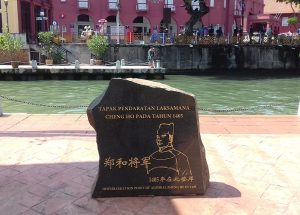
The Chinese vision of a new maritime Silk Road is closely related to the official celebration of Zheng He, the early 15th century admiral who brought China fame and power through his voyages in Southeast Asia and across the Indian Ocean to Africa. According to Christina Lin, the building of land and sea bridges across Eurasia and Africa contains a deeply symbolic element, referred to by Lin as the “Zheng He narrative.” Zheng He’s voyages are frequently noted as a symbol of a world order based on trade rather than violence and controlled by the benevolent hegemony of the Chinese Imperial court.
In Chinese publications of recent years, Zheng He’s fleets are glorified as a tool of regional economic growth, scientific research, peaceful cultural exchange, and universal friendship. It is worth noting that while Zheng He’s voyages collected treasures (such as the famous giraffe brought back for the Imperial Court from Africa), its main objective was to display Ming power and dominance  and to collect tribute from local rulers. Indeed, a number of rulers who refused to recognize the hegemony of the Chinese Emperor were punished and taken back to China as prisoners.
Zheng is particularly poignant as he is often perceived as both a testament to Chinese greatness and a symbol of China’s missed opportunities. The dismantling of his ships and shipyards by the Ming emperors is widely perceived as one of the causes of the gradual decline of Chinese power and the eventual rise of the West. The reference to Zheng He and the Silk Routes can therefore be seen as an implication that the mistake made 500 years ago is now being corrected, as the Middle Kingdom returns to its former centrality.
Thus, it would seem to be more than a coincidence that the recent embarkation of ships to Djibouti occurred on the same date that Admiral Zheng He first set sail on his famous voyages over 600 years ago. While the supremacy of Zheng He’s fleet may still be far off, the new base on the coast of Africa seems to mark a declaration of larger intentions.
Dr. Gideon Elazar is a lecturer at Bar-Ilan University and a postdoctoral fellow at Ben-Gurion University specializing in Asian Studies.

Wednesday, May 18, 2016

ISIS Terror Moves To Libya. Aren't We Proud Of Deposing Gadaffi?


Report details "scenes of horror" in ISIS-held Libya


ISIS militants stand behind what are said to be Ethiopian Christians along a beach in Wilayat Barqa, Libya, in this still image from an undated video made available on a social media website on April 19, 2015.
 REUTERS
CAIRO -- A leading international rights group on Wednesday released a report documenting atrocities by Libya's Islamic State of Iraq and Syria (ISIS) affiliate - including instances of "crucifixions" and shooting a man to death for "cursing God" - in the coastal city of Sirte, a stronghold of the militants.
Human Rights Watch recounts "scenes of horror" that followed the city's seizure by ISIS militants in February 2015, with beheadings of dozens of residents accused of being spies or sorcerers.
Men were flogged for acts such as smoking or listening to music, and fathers were ordered to "marry off their daughters" to the group's fighters as ISIS spread a wave of terror among the townspeople.
The 41-page HRW report entitled "'We Feel We Are Cursed': Life under ISIS in Sirte, Libya," is based on interviews with 45 Sirte residents conducted by the New York-based group in March. The residents were among the two thirds of the city's 80,000-strong population that fled after ISIS overran Sirte.
The militant branch, more known for its spread in Iraq and Syria, gained a foothold in Libya amid the chaos that engulfed the country since the ouster andkilling of the longtime autocratic leader Muammar Qaddafi in 2011.
ISIS managed to exploit the turmoil as political rivalries left Libya torn between rival governments, parliaments, and myriad of militias backing either side. Its spread triggered fears in Europe at the prospects of the continent being separated from a permanent ISIS base in Libya only by a relatively small stretch of the Mediterranean Sea.
"While the world's attention is focused on atrocities in Syria and Iraq, ISIS is also getting away with murder in Libya," said Letta Tayler, a senior terrorism and counterterrorism researcher at HRW, using an alternative acronym for the Islamic State group.
U.S. military experts estimated in April that ISIS has up to 6,000 fighters in Libya. However, Libyan military intelligence officials have told HRW that the affiliate's numbers are up to 1,800 - 70 percent of whom are foreigners. Estimates by other Libyan security analysts put the number of ISIS fighters in the country at 3,000. Some fighters were originally migrants who came to Libya's coastal cities in hopes of crossing into Europe by sea - risky journeys that have claimed thousands of lives in the past years - but then became stuck in Libya and joined the militants.
In running Sirte, HRW said ISIS gave homes and all the goods seized from residents who fled to its fighters.
Sirte, the birthplace of Qaddafi, was among cities worst hit by a wave of retaliatory attacks, lootings, and killings that followed the dictator's ouster. This also helped ISIS find a haven among those disillusioned by Libya's post-Gadhafi governments.
Along with witness accounts, the HRW report also offered a glimpse into what life under ISIS has been like in Sirte.
After taking the city, ISIS handed out a 13-point charter or rulebook and seized public funds. In return for personal safety, residents had to comply with its rulings, based on the group's harsh interpretation of Islamic law, or Sharia.
Sirte's central Martyrs' Square was transformed into a stage for public extrajudicial killings - including beheadings by a sword - for a wide variety of offenses.
If the group killed someone accused of "cursing God," that person's family would not even be allowed to bury his body because he was denounced by ISIS as an "infidel." Also, ISIS reportedly had a hit list of 130 names, mostly of government officials, police, and other loyalists.
Women were forced to cover up and wear the conservative black head-to-toe cloak known as abbaya from the age of 10, and were not allowed to leave home without a male guardian. ISIS established a religious police that fined offenders up to $116 and flogged male relatives for not acting as proper guardians to their women. Many mothers covered up their daughters younger than 10 years, as a precaution and for fear of the militants.
ISIS also imposed the "zakat" or religious tax, something enforced in other ISIS-controlled territories and even by its rival al Qaeda group. Farmers were forced to hand over to ISIS one out of every 10 sheep and one out of every five camels.
The HRW report comes just days after the United States and other Western countries threw their support behind Libya's newly formed and U.N.-brokered government, saying they would supply the government with weapons to counter ISIS.
The move is also seeking to end the power struggle that started in 2014 between a Tripoli-based parliament and the country's internationally-recognized assembly, seated in eastern Libya.
But while the step could boost the U.N.-brokered government's efforts to consolidate power and regain control over Libyan state institutions like the central bank and national oil company, it also comes with risks - not least of which is that the arms could end up in hands of ISIS or militias in a country already awash with weapons.

Tuesday, April 19, 2016

For Once Obama Tells The Truth. Is He Sick?

Obama Admits His Biggest Mistake – It’s Surprisingly Honest

Screen Shot 2016-01-13 at 5.01.16 PMBarack Obama told Chris Wallace from Fox News what was the biggest mistake of his entire presidency. When asked this same question in the past, Barack Obama has often given silly answers. He would divert the question and basically infer that he should have explained Obamacare better or something, because his policies are so awesome. But this time he actually gave an honest answer.
Asked by host Chris Wallace about the “worst mistake” of his soon-to-end White House years, Obama listed the aftermath of the ouster and death of Moammar Qaddafi, even as he defended the intervention.
“Probably failing to plan for the day after,” Obama said in the session, which was taped at the University of Chicago on April 7. He added that intervening in Libya “was the right thing to do.”
The Libya operation and its chaotic aftermath has been resurrected in the 2016 presidential campaign. That’s in part because of the increasing presence of the Islamic State there, and U.S. airstrikes to disrupt its operation.
Democratic contender Hillary Clinton, as Obama’s secretary of state, strongly supported the intervention. In a 2011 interview with CBS News when still secretary, Clinton said of Qaddafi, “We came. We saw. He died.”
It’s not often that Barack Obama takes responsibility for a mistake and failing to plan for the day after the death of Qaddafi was a huge mistake. Hillary Clinton was instrumental in initiating the attack on Qaddafi according to Robert Gates.
Former Defense Secretary Robert Gates told Yahoo News in January that he thought Clinton’s “influence was pivotal in persuading the president to broaden the goal in Libya beyond just saving the people in Benghazi” from Qaddafi’s forces and “essentially focusing more on regime change. The president told me that it was one of the closest decisions he’d ever made, sort of 51-49, and I’m not sure that he would’ve made that decision if Secretary Clinton hadn’t supported it.”
Rand Paul and other members of the tea party movement have been scrutinizing the regime change decision and criticizing the absence of a plan to deal with the aftermath. For once, Barack Obama actually admitted that they screwed up in Libya.
Will Hillary Clinton call Libya the biggest mistake of her career? Don’t hold your breath.

Sunday, April 12, 2015

Obama Is Violently Anti-American And His Positions Are Now Crystal Clear!

Decoding the Obama Doctrine

James Jeffrey, Barack Obama’s former ambassador extraordinary and plenipotentiary to Iraq, has this to say about the administration’s current record in the Middle East: “We’re in a goddamn free fall.”
Count the mistakes: Helping overthrow Muammar Qaddafi in Libya, leading to anarchy and civil war. Pressuring Husni Mubarak of Egypt to resign, then backing the Muslim Brotherhood, leading now-president Sisi to turn toward Moscow. Alienating Washington’s most stalwart ally in the region, the Government of Israel. Dismissing ISIS as “junior varsity” just before it seized major cities. Hailing Yemen as a counterterrorism success just before its government was overthrown. Alarming the Saudi authorities to the point that they put together a military alliance against Iran. Coddling Recep Tayyip ErdoÄŸan of Turkey, encouraging his dictatorial tendencies. Leaving Iraq and Afghanistan prematurely, dooming the vast American investment in those two countries.
And, most of all: Making deeply flawed deals with the nuclear-ambitious mullahs of Iran.
Is this a random series of errors by an incompetent leadership or does some grand, if misconceived, idea stand behind the pattern? To an extent, it’s ineptitude, as when Mr. Obama bowed to the Saudi king, threatened Syria’s government over chemical weapons before changing his mind, and now sends the U.S. military to aid Tehran in Iraq and fight it in Yemen.
But there also is a grand idea and it calls for explanation. As a man of the left, Mr. Obama sees the United States historically having exerted a malign influence on the outside world. Greedy corporations, an overly-powerful military-industrial complex, a yahoo nationalism, engrained racism, and cultural imperialism combined to render America, on balance, a force for evil.
Being a student of community organizer Saul Alinsky, Mr. Obama did not overtly proclaim this view but passed himself off as a patriot, though he (and his charming wife) did offer occasional hints of their radical views about “fundamentally transforming the United States.” On ascending to the presidency, Mr. Obama moved slowly, uneager to spread alarm and wanting to be reelected. By now, however, after six full years and only his legacy to worry about, the full-blown Obama is emerging.
The Obama Doctrine is simple and universal: Warm relations with adversaries and cool them with friends.
Several assumptions underlie this approach: The U.S. government morally must compensate for its prior errors. Smiling at hostile states will inspire them to reciprocate. Using force creates more problems than it solves. Historic U.S. allies, partners, and helpers are morally inferior accessories. In the Middle East, this means reaching out to revisionists (ErdoÄŸan, the Muslim Brotherhood, the Islamic Republic of Iran) and pushing away cooperative governments (EgyptIsrael, Saudi Arabia).
Of these actors, two stand out: Iran and Israel. Establishing good relations with Tehran appears to be Obama’s great preoccupation. As Michael Doran of the Hudson Institute has shown, Mr. Obama during his entire presidency has worked toward rendering Iran what he calls “a very successful regional power … abiding by international norms and international rules.” Contrarily, his pre-presidential friendships with truculent anti-Zionists such as Ali Abunimah, Rashid Khalidi, and Edward Said point to the depth of his hostility toward the Jewish state.
The Obama Doctrine demystifies what is otherwise inscrutable. For example, it explains why the White House blithely ignored the Iranian supreme leader’s outrageous “Death to America” yelp in March, dismissing it as mere domestic pandering, even as Mr. Obama glommed onto the Israeli prime minister’s near simultaneous electoral campaign comment rejecting a two-state solution with the Palestinians during his term of office (“we take him at his word”).
The doctrine also offers guidelines to predict possible developments during Mr. Obama’s remaining tenure, such as: Wretched P5+1 deals with Iran compelling Israel’s government to attack Iranian nuclear facilities. Gentle policies toward Damascus clearing the way for the Assad regime to re-extend its power. Ankara choosing to provoke a crisis in the eastern Mediterranean over Cypriot gas and oil reserves.
The great question ahead is how, in their wisdom, the American people will judge the Obama Doctrine when they next vote for president in 19 months. Will they repudiate his policy of shuffling and contrition, as they comparably did in 1980 when they elected Ronald Reagan over Jimmy Carter? Or will they choose four more years of it, thereby turning the Obama Doctrine into the new norm and Americans into European-style remorseful masochists?
Their verdict in 2016 has potentially world-historical implications.
Reprinted with author’s permission from The Washington Times

Read more at http://www.breakingisraelnews.com/35614/decoding-the-obama-doctrine-opinion/#4lZotHLxqJIkmBCT.99

Wednesday, December 31, 2014

Are The People Of Libya Better Off After We Helped Topple Qaddafi?

Author(s):  Bel Trew
Source:  foreignpolicy.com.     Article date: December 29th, 2014


0
(Abdullah Doma/AFP/Getty Images)
RIPOLI, Libya — Zeina, 27, was hanging out her washing when the first Grad rocket smashed into a neighbor’s house at the end of her dusty street. The deafening boom was followed by the telltale buzz of more incoming rockets. Libya’s civil war had landed on her doorstep.
“It started as a normal day — then we heard the sound of shelling and rockets,” said the young mother. “Without warning, they hit our houses. We fled with just the clothes we were wearing.”
Zeina is now crammed together with seven other people in a cinderblock outhouse that is part of Tripoli’s zoo. They are just a handful of the more than 400,000 people who are currently displaced inside Libya, which is witnessing its worst crisis since the 2011 NATO-backed revolt that toppled dictator Muammar Qaddafi.
For three years, Libya has been without a functioning government, police force, or army. The country has been ripped apart by warring fiefdoms of ex-rebels who helped oust Qaddafi but have since directed politics with AK-47s and anti-aircraft guns. This summer, as the battle lines began to harden, two rival factions emerged to vie for control of Libya: On one side is the newly elected parliament that has been banished to the eastern city of Tobruk — supported by the fractured remains of Qaddafi soldiers who defected during the uprising, as well as regional powers like Egypt, Saudi Arabia, and the United Arab Emirates. On the other side is Libya Dawn, a self-described revolutionary coalition of militiamen and Islamist-leaning politicians that originated in the western city of Misrata, allegedly backed by Turkey and Qatar.
Zeina’s hometown of Kikla, which lies less than 100 miles southwest of Tripoli, is on the front line between the two factions, which are battling for control of the capital. With two governments and two parliaments, both of which have a tenuous grip on power and access to funds, there is no one in authority to ask for help.
“It’s winter now, and we’re in a desperate situation,” Zeina said. “We heard our houses have been flattened and burned. What do we do?”
* * *
Hundreds of miles to the east, smartly dressed lawmakers, Salafi militants, fighter jet pilots, and tribal leaders sat in a glittering hotel lobby. The building was under strict military lockdown — its long driveway studded with concrete roadblocks and checkpoints. But inside the hushed halls, uniformed waiters moved between the groups serving cappuccinos and croissants. Lavish three-course meals were served in the dining and conference rooms. Outside, the legislators’ children — forced into exile with their parents — played soccer on the abandoned tennis courts that overlook the Mediterranean.
This is the exiled parliament’s stronghold in Tobruk, over 900 miles to the east of Tripoli. When Libya Dawn staged an armed takeover of the capital this summer, it forced the House of Representatives, which had been elected in June, to flee here. Now, loyalists are plotting their return to Tripoli.
Money and war are the main topics of conversation. The country’s oil authorities and ministries now lie in the hands of Libya Dawn, which claims to be the legitimate government. The Islamist coalition’s case was bolstered after a November Supreme Court decision, which it said nullified the House of Representatives and a constitutional amendment on which the June elections were based.
The Libyan Central Bank, fighting to maintain its neutrality, has refused to channel the country’s lucrative oil revenues to either administration since the court decision. It is only paying “expenses” for both administrations, and basic salaries, which ironically includes those of the militias, who were absorbed into the interior and defense ministries by the former parliament in 2012.
The decision has rendered the Tobruk parliament’s plans and newly drafted $42 billion budget for the next financial year nothing more than pieces of paper.
For the politicians and military leaders in Tobruk, that means war.
“The easiest solution is a military takeover [of Tripoli]; it’s the only way to move forward from this ridiculous stalemate,” said one senior lawmaker, dressed in a crisp suit. “We are trying to build a new central bank and premises for different ministries, but this is temporary until we take back Tripoli.”
The United Nations was supposed to have chaired a fresh round of peace talks between the warring factions this month. But so far they have been unable to set a date, let alone an agenda to resolve the crisis.
Tobruk’s military forces, meanwhile, don’t seem to be in the mood for talking. Gen. Khalifa Haftar, a formerly rogue military leader who embarked on a self-styled “War on Terror” against Islamists earlier this year, is at the helm of the recently rebranded “Libyan National Army” — the remnants of the Qaddafi-era armed forces that defected during the revolution. And he seems to believe the wind is at his back.
“A ground invasion of the capital is imminent,” Haftar told me from his sprawling military base in the countryside outside Merj, a town that lies roughly an hour-long helicopter ride west of Tobruk.
Haftar, 71, has seen his fortunes improve dramatically in recent months. He was declared an outlaw by the authorities after unsuccessfully attempting to overthrow the previous Islamist-dominated parliament in February, and was only recently reinstated by the House of Representatives, which lacked a military force of its own to wrest control back from the militias. Haftar quickly changed that: He absorbed pro-government western militias into his army, and is currently encircling the capital and fighting Libya Dawn militiamen in Kikla.
Haftar’s first major offensive was in the eastern city of Benghazi, where his troops have gained serious ground after six months of battling Libya Dawn-allied eastern militias and jihadis — including the U.N.-designated terror group Ansar al-Sharia. Haftar claims his forces have “secured” around 95 percent of the city.
Seeking to build on his momentum, Haftar then turned west. In November, he sent his battered MiG fighter jets to Tripoli to bomb Libya Dawn positions and weapons depots. This month, the general pushed further west, striking targets on the border with Tunisia, which briefly closed the largest border crossing, Ras Jedir. On Dec. 28, his forces hit Misrata, the hometown of most of the Libya Dawn leadership.
“We cannot continue with two governments, two parliaments, so Libya Dawn should end or we are going to arrest them all,” he said, promising further airstrikes in Misrata.
Haftar’s men told me that a large multimillion-dollar arms deal with an Eastern European country, which would see the acquisition of updated fighter jets, helicopters, and heavy weaponry, will be the nail in the coffin of their enemies. The Tobruk authorities are footing the bill, and are just waiting for delivery.
Tobruk Prime Minister Abdullah al-Thinni, a former military man himself, echoed Haftar’s hawkishness.
“We are supporting the front line with more jet fighters to break the deadlock,” he told me from his temporary offices in Labraq, a city just west of Tobruk, consisting of stark, Soviet-style concrete buildings. “Citizens of Tripoli are getting ready now and are waiting for the moment when the army enters the city.”
But there is lingering bad blood between Thinni and his military commander, which could presage a future conflict. In June, Thinni, who had been serving as prime minister then too, had been among those in the previous parliament who blacklisted Haftar. That same month, Haftar said that he wanted most of Thinni’s cabinet jailed. The distrust between the two men is still palpable, as both claim ownership of the war in the west.
Thinni said he would only come to the negotiating table if Libya Dawn accepted the legitimacy of his parliament, dropped its alliance with terror groups like Ansar al-Sharia, and gave up Tripoli — an impossible set of preconditions sure to scupper any U.N.-backed mediation initiative. “Libya Dawn members who committed crimes should be tried,” he added.
Establishing his government’s authority over the whole country is going to take a massive influx of money — and Thinni knows it. The prime minister admitted it was near impossible to run a country without access to the country’s government buildings and funds. As an interim solution, he appointed his own heads of the National Oil Corporation, the body solely response for the sale and purchase of oil and gas, and the Libyan Central Bank, which controls the country’s purse strings. He wants to move their offices east, to Benghazi and Ras Lanuf, redirecting oil funds and effectively carving Libya in two.
“It’s about who is controlling the money. We can change the direction of flow of oil income into the banks we choose,” he said. “So Libya Dawn can just sit in Tripoli and invent their own authorities, but in fact they control nothing.”
* * *
In Tripoli, Libya Dawn’s ascendance is visible by simply walking down the street. The Che Guevara-looking Zintan fighters, who backed the Tobruk government, were chased out of town, and have been replaced by Misrati militiamen, who cruise the neighborhoods in pickup trucks mounted with anti-aircraft guns. Their trucks — scrawled with text reading “Correcting the direction of the February 17 revolution” — guard the main ministries and parliament buildings. Graffiti praising Misrata, where Libya Dawn originates, has been scrawled on Qaddafi-era brigade bases they have commandeered.
The charred apartment blocks near the bombed-out airport are a stark reminder of the summer’s fierce fighting. Tripoli residents now tentatively go about their daily business, but activists in the city — who have been outspoken against the militias for years — say there has been a spike in kidnappings against their community since the summer, driving many into hiding or out of the country.
Prime Minister Omar al-Hassi, a 55-year-old former academic from Benghazi who was appointed by Libya Dawn, has the same idea as his rivals. He has moved quickly to seize control of the country’s sole remaining institutions: He headquartered his administration at the National Oil Corporation, taken over government buildings and websites, and appointed his own oil minister.
His forces are also on the offensive against oil sites held by Libya Dawn’s rivals. A few months ago, Libya Dawn militiamen seized control of the lucrative oil fields in the south — including El Sharara, Libya’s largest — bringing production to a grinding halt. In early December, they moved on the eastern oil ports and oil fields currently controlled by forces loyal to the Tobruk authorities, prompting new clashes with Haftar’s men. In the last week, five oil tanks that stored almost a million barrels of oil were set ablaze.
Hassi also sounded just as uncompromising about his enemies in Tobruk as they did about him. He described Thinni and Haftar as criminals for ignoring the court verdict invalidating the House of Representatives, and called on the international community to boycott the exiled parliament.
“Their crimes are huge and they are exacting a collective punishment on us all,” he said. “Whoever doesn’t listen to the court becomes an outlaw and should be stopped.”
Hassi called for fresh parliamentary elections “once the war stops.” Until that day, he argues that his “salvation government” should rule and preside over any peace talks. He defended his administration’s alliance with Ansar al-Sharia — saying the jihadi group had been misunderstood and actually represented a “simple, beautiful, friendly idea.”
Hassi promised his government “was all about dialogue,” but his militiamen, embittered by Haftar’s airstrikes in Tripoli and Benghazi, appear more determined than ever to fight to the death.
“They will keep going until the last man is gunned down — you can forget about peace deals or negotiations,” said the head of one of the largest Islamist militias operating in Benghazi. “We are losing between 20 and 25 men a day; there is no way after such huge losses the men will give up.”
While hatred for Haftar unites all the militias under Libya Dawn’s banner, wildly differing views of the country’s future could drive them apart in the future. The coalition includes both liberals and radical Islamists — and already there are signs of discontent simmering beneath the surface among some on the extremes.
Speaking on the phone from the front line in Benghazi, one Ansar al-Sharia fighter said they were not happy with Libya Dawn’s insistence on pursuing the trappings of a democratic state. “We’ll be happy if sharia law is properly implemented — but we won’t settle for less,” he said tersely.
* * *
Back in the cramped cinderblock outhouse that Zeina calls home, the young mother and her friends are stockpiling blankets in preparation for winter. They count themselves lucky, because they have access to running water. Next door, a family hastily constructs their own makeshift concrete block home in the dusty street. Others have been forced to make do living in parks and schools.
But there are many others who have fared far worse. Libya Body Count, a local independent monitoring organization, reports that over 2,700 people have been killed this year alone. As battles across the country intensify, that number goes up every day. Hundreds of thousands of civilians who have fled the war are now struggling to stay alive as the temperatures drop, and aid workers are unable to provide urgently needed medical care, food, and shelter. Meanwhile the economy is in tatters — Libya relies on oil revenues, and the fighting at the oil ports has seen production plummet by 60 percent in recent days.
The poorest and most vulnerable, like Zeina, have been hit hardest by the crisis. And with nobody truly in charge of the country, they have been left to fend for themselves.
“We just want to go home and for this war to stop,” Zeina said. “We were promised everything. It’s been three years now, and what good have we seen?”
Bel Trew is broadcast and print journalist based in Cairo.