Contact Form

Name

Email *

Message *

Showing posts with label CFPB. Show all posts

Wednesday, November 29, 2017

Violate The Constitution--Pelosi's Mantra


FAKE NEWS: Pelosi Unleashes Bizarre Tweet Defending 'The Rightful Acting Director of CFPB'


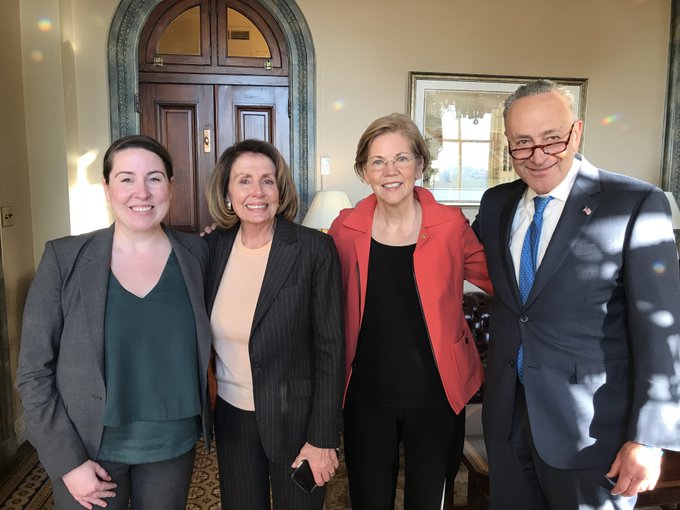
On Tuesday evening, House Minority Leader Nancy Pelosi (D-CA) unleashed one of the more bizarre tweets in Congressional history: a picture of herself standing alongside former Consumer Financial Protection Bureau deputy director Leanne English, Senator Elizabeth Warren (D-MA) and Senate Minority Leader Chuck Schumer (D-NY) with the royalist caption, “Incredibly thankful for the determination of Leandra English, the rightful Acting Director of @CFPB#DefendCFPB.”
The tweet smacks of Game of Thrones or the restoration of Charles II to the British throne. Nancy Pelosi would throw out the Usurper Mulvaney and make way for the rightful heir, Leanne English, First of Her Name, Queen of the Andals and the First Bureaucrats.

Unfortunately for Pelosi, English isn’t the rightful acting director of the agency, as a federal court found last night. She was installed inappropriately by the outgoing partisan hack director, Richard Cordray, and replaced by Office of Management and Budget Director Mick Mulvaney, at the legal behest of the President of the United States.
But Democrats don’t think the Constitution applies to Democrats. So long as they can maintain power through whatever means necessary, they’re happy to do so. Fortunately, the revolution is over, and the English lost.

Tuesday, November 28, 2017

Another Win For The Trumpster

Trump pick is winner, for now, in fight over consumer agency

By JESSICA GRESKO and KEN SWEET The Associated Press
WASHINGTON (AP) — President Donald Trump scored a victory Tuesday when a federal judge refused to block the president's choice to temporarily run the nation's top consumer financial watchdog and, for the moment, ended a two-way battle for leadership of the agency.
Judge Timothy Kelly declined to stop the president from putting Mick Mulvaney in place as the acting director of the CFPB. In doing so, Kelly ruled against Leandra English, the CFPB's deputy director, who had requested an emergency restraining order to stop Mulvaney from becoming the acting director.
Both Mulvaney and English claimed to be the rightful acting director, with each citing different federal laws. The leadership crisis developed over the weekend after the CFPB's permanent director, Richard Cordray, resigned and appointed English as his successor. Shortly afterward, the White House announced that Mulvaney, currently budget director, would take over the CFPB on an interim basis.
The judge's ruling Tuesday is not the final decision in the case. But in making his decision, the judge said that English had not shown a substantial likelihood that she eventually would succeed on the merits of her case. The judge's decision is not immediately appealable.
Kelly was nominated by President Trump and was confirmed by the Senate in September.
The CFPB was established after the financial crisis to make sure customers are not being exploited and that banks are complying with the consumer protection laws on the books. Cordray, appointed by President Barack Obama, was criticized by congressional Republicans as being overzealous, but lauded by consumer advocates for aggressively going after banks for wrongdoing. On Monday, Mulvaney said the CFPB under a Trump administration would act differently than the agency under the Obama administration.
Lawyers for English will have to make a choice about how to proceed. After the hearing, a lawyer for English, Deepak Gupta, said he hopes to be able to move the case along quickly.
"I'm going to have to explore the options with my client, so I don't know what the next step is and I'm not going to say that right now," he said, adding options include asking the judge for a final decision on the merits of the case.
Gupta said it is not in his client's interest or the government's interest to have a "cloud of impropriety and uncertainty hanging over the bureau for any longer than is necessary."
The White House said it "applauds the court's decision," saying it provides "further support for the president's rightful authority to designate Director Mulvaney as acting director of the CFPB."
Trump's authority to install Mulvaney was backed up by Mary McLeod, the CFPB's general counsel, who wrote a memo over the weekend agreeing with the White House that Mulvaney should be recognized as acting director. The Office of Legal Counsel, which acts as a legal adviser to the president, also argued that Mulvaney, not English, was the legitimate acting director of the agency.

Monday, April 10, 2017

Think The CFBP Is A Good Agency. There Is Another View

Every agency in government is overseen by Congress, right? Wrong!  Every agency must go to Congress for funding, right? Wrong!  Banks are expanding exponentially, right? Wrong.  Check out this following video to get the real story.

Conservative Tom

Here is the link:
https://www.prageru.com/courses/economics/how-government-agency-hurts-us-all

Friday, March 21, 2014

CFPB--Just Another Out Of Control Government Agency Spending Citizen Money With Reckless Abandon!

CFPB Hit With FOIA Lawsuit After Refusing To Disclose Cost Of Luxe Building Makeover

March 20, 2014 by  
 15 7
 
 0 42

After eight months of trying to get an affirmative response from the Consumer Financial Protection Bureau (CFPB) after filing a Freedom of Information Act (FOIA) request, theWashington Examiner has filed a lawsuit against the agency for refusing to release financial records relating to the lavish remodel of its Washington, D.C. offices.
The Examiner filed the lawsuit in the U.S. District Court for the District of Columbia Wednesday with help from nonprofit government watchdog Judicial Watch. According toExaminer Executive Editor Mark Tapscott, the paper filed the suit because withholding information about how the public’s money is being spent is “exactly the kind of information the FOIA is meant to make available to taxpayers.”
Documents to explain why a government bureau is spending so lavishly on renovations to its headquarters are exactly the kind of information the FOIA is meant to make available to taxpayers.
…We shouldn’t have to go to court to get them, but it’s important to make the point that the American people have just as much of a right to know what CFPB is doing with their tax dollars as they do their local dogcatchers.
The renovation project at CFPB headquarters has more than doubled since it was first announced, ballooning from an estimate of $55 million to $139 million. The Examiner had filed a FOIA last July to request not only financial information relating to the project, but also design documents created by star project architectural firm Skidmore, Owings & Merill, in hopes of reconciling the scope of the renovation with its escalating cost.
Formed in 2011, the CFPB was created out of the Dodd-Frank Wall Street Reform and Consumer Protection Act, but the agency has been the target of conservative criticism almost from the beginning for its wide-ranging powers and aloofness from the citizens it was tasked with protecting.
“[F]rom its inception, the CFPB has been placed dangerously out of reach of the American people,” said Judicial Watch President Tom Fitton Wednesday. “And it has acted with arrogant indifference to attempts to pierce its veil of obdurate secrecy. This lawsuit could help shed some much-needed light on what is otherwise an essentially covert operation with oppressive control over consumer finances.”

Monday, January 13, 2014

Obama's Going Around The Senate, When It Was In Session, Should Be Overturned. It Will Rest On Roberts, The Most UnDependable Justice.


Court weighs president's recess appointments power


Associated Press

 In this Dec. 19, 2013 file photo, a view of the Supreme Court can be seen from the view from near the top of the Capitol Dome on Capitol Hill in Washington. The Supreme Court hears arguments Monday in a clash between President Obama and Senate Republicans over the power granted the president in the Constitution to make temporary appointments to fill high-level positions. (AP Photo/Susan Walsh)
.
View gallery

In this Dec. 19, 2013 file photo, a view of the Supreme Court can be seen from the view from near the top of the Capitol Dome on Capitol Hill in Washington. The Supreme Court hears arguments Monday in a clash between President Obama and Senate Republicans over the power granted the president in the Constitution to make temporary appointments to fill high-level positions. (AP Photo/Susan Walsh)
WASHINGTON (AP) — The Supreme Court is refereeing a politically charged dispute between President Barack Obama and Senate Republicans over the president's power to temporarily fill high-level positions.
The case being argued at the high court Monday is the first in the nation's history to consider the meaning of the provision of the Constitution that allows the president to make temporary appointments to positions that otherwise require Senate confirmation, but only when the Senate is in recess.
The court battle is an outgrowth of increasing partisanship and the political stalemate that's been a hallmark of Washington for years, and especially since Obama took office in 2009.
Senate Republicans' refusal to allow votes for nominees to the National Labor Relations Board and the new Consumer Financial Protection Bureau led Obama to make the temporary, or recess, appointments in January 2012.
Three federal appeals courts have said Obama overstepped his authority because the Senate was not in recess when he acted.
The Supreme Court case involves a dispute between a Washington state bottling company and a local Teamsters union in which the NLRB sided with the union. The U.S. Court of Appeals for the District of Columbia Circuit overturned the board's ruling. Hundreds more NLRB rulings could be voided if the Supreme Court upholds the appeals court decision.
More broadly, if the justices ratify the lower court ruling, it would make it nearly impossible for a president to use the recess power. Under such a ruling, presidential nominees could be blocked indefinitely when the president's party does not control the Senate.
Three federal appeals courts have upheld recess appointments in previous administrations.
Senate Republicans also are taking part in the case, in support of the company, Noel Canning.
The impasse over confirming nominees to the NLRB and the CFPB was resolved last summer, and majority Democrats have since changed Senate rules to limit the ability of the minority party to block most presidential nominees.
A few hours after the court hears the case Monday, the Senate is scheduled to vote on the nomination of Robert Wilkins, currently a federal trial judge, to serve on the federal appeals court in the District of Columbia.
Senate Democrats changed the rules over fierce Republican opposition after the GOP had blocked the nomination of Wilkins and two others to the appeals court.
While situations like the one that led to the current court case are unlikely to arise in the short term, a Republican takeover of the Senate after the November elections could prompt a new round of stalled nominations, said John Elwood, a Washington lawyer who served in the Justice Department during the Bush administration and has written extensively about recess appointments. "We may be back where we were before," Elwood said.
The justices will be considering two broad questions and a narrower one as well.
The big issues are whether recess appointments can be made only during the once-a-year break between sessions of Congress and whether the vacancy must occur while the Senate is away in order to be filled during the same break.
Solicitor General Donald Verrilli Jr. told the court that 14 presidents have temporarily installed 600 civilians and thousands of military officers in positions that were vacant when the Senate went into recess at any point, a practice that has been well understood by both presidents and lawmakers. A high court ruling that a recess only happens once a year would "dramatically upset that long-settled equilibrium," Verrilli said.
The narrower issue is whether brief, pro forma sessions of the Senate, held every few days to break up a longer Senate hiatus, can prevent the president from making recess appointments. That's what the Senate did, at Republicans' insistence, during the time when Obama acted.
Senate Republicans say the answer is easy.
"Who determines — the Senate, or the president — whether the Senate is in session? The Constitution's text and structure point to only one answer: the Senate," the Republicans said in court papers.
But Verrilli said the Senate made clear in voting for the pro forma sessions that no business would be conducted and that, in essence, the Senate would be in recess. "The president took the Senate at its word. And rightly so," he said.
The parties' roles were reversed when a Republican president, George W. Bush, was in the White House and Democrats controlled the Senate in the final two years of his presidency. Then, Senate Majority Leader Harry Reid, D-Nev., employed the same tactic of convening the Senate every few days to keep Bush from filling vacancies through recess appointments. Unlike Obama, Bush did not press the issue.