Contact Form

Name

Email *

Message *

Showing posts with label Shia. Show all posts

Sunday, June 4, 2017

US Must Support el-Sisi

  • When it comes to regional interests in the Middle East, the priority is the most dominant and violent force.
  • Egypt stands out as a primary target, given the cocktail of challenges that position it as a center of radical Islam. Egypt faces political, violent, and theological militancy within its borders.
  • For a nation to do what it must to survive, it needs the steadfast support of world powers. Step one is annihilating all sources of violent Islam.
For a Western audience, Egyptian President Abdel Fattah al-Sisi is a complex figure, who was shunned by the Obama administration. There appear truly pressing, immediate priorities in Egypt, such as developing the economy and combating the avalanche of extremist attempts to overthrow him. Among Middle East and North African territories, Egypt stands out as a primary target, given the cocktail of challenges that position it as a center of radical Islam.
President Sisi faces violent extremist hotbeds in the Sinai Peninsula, and the still-destabilizing influence of the Muslim Brotherhood (a political arm of violent radicals). Most notably, Sisi brought a reality check to the Arab Spring when he led the military overthrow of the Muslim Brotherhood government in 2013, ushering a spiritual and cultural Islamic reformation with widespread popular support from Egyptians on a grass-roots level.
Sisi faces more than just militant and political extremists within Egypt's borders; he is also walking a theological tightrope. Egypt is home to the regressive theocratic influence of the most revered Islamic institution in the Sunni world, Cairo's Al-Azhar University, which openly views freedom as a "ticking time-bomb."
Being held hostage intellectually by the grip of Al-Azhar University ensures that there is a constant supply when it comes to producing the next generation of militant and political Islamists.
Egypt also faces extremist infiltration from neighboring Libya, a nation caught in a power vacuum after the murder of its leader, Col. Muammar Gaddafi. This vacuum has been readily filled by Islamic militants, including ISIS.
Upon returning home in April from his first visit to the U.S. since 2013, Sisi faced a series of domestic terror attacks that once again put Egypt in a global spotlight. On Palm Sunday, in April, two suicide bombings in Coptic Christian churches killed more than 45 people and injured another 120. For Egypt, one of the last regional strongholds that still has a vibrant non-Muslim minority population, violent eruptions on major Christian holidays have become routine.
In England, just days after the May 22 Manchester suicide bombing, attention was once again on Egypt where 29 Coptic Christians were gunned down on a bus traveling to a monastery near the city of Minya. The attack was launched by masked terrorists who arrived in three pick-up trucks and opened fire on the passengers, many of whom were children. Egyptian intelligence believes the Minya attack was led by ISIS jihadists based in Libya. In February, the aspiring terrorist caliphate also launched a campaign against Egypt's Christian population. The Egyptian military responded swiftly with air strikes against terrorist camps, along with a televised warning against sponsored terrorism.
President Sisi's response to the brutal slaughter of peaceful Christian worshippers is being called rare but should not be surprising, considering the aggressive measures that need to be taken to hold extremism at bay, and to eradicate the threat that local groups pose to the Egyptian people. Coming out of the Riyadh Summit, where President Trump and a host of Muslim nations, including Egypt, agreed to drive out extremism, Sisi's reaction was necessary.
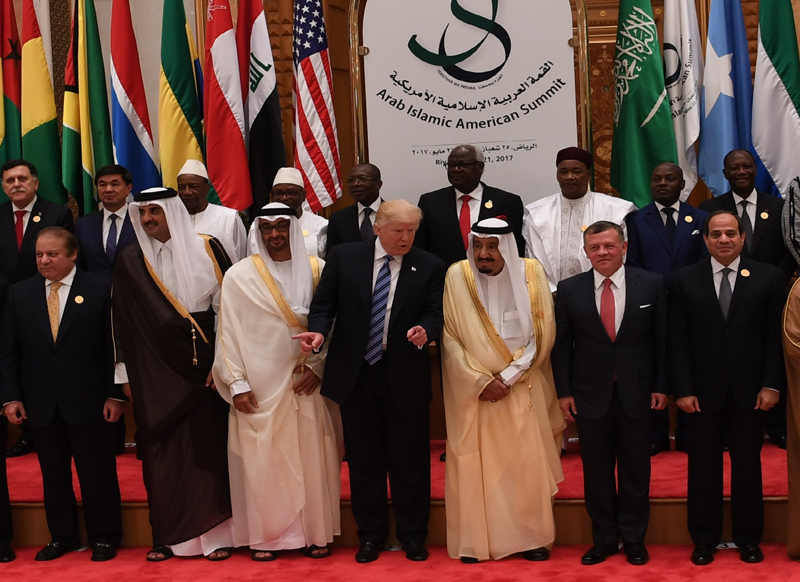
Egyptian President Abdel Fattah al-Sisi (front row, far-right) attended the May 21 Arab Islamic American Summit in Riyadh, Saudi Arabia, along with U.S. President Donald Trump (front-center). The problems of Islamic extremism and terrorism were much-discussed at the summit. (Photo by Thaer Ghanaim/PPO via Getty Images)

In a war that is equally ideological and kinetic, Muslim nations and others trying to survive the plague of Islamic terrorism will need to be as ruthless as their extremist counterparts. That is something that the warring political factions in the U.S. quickly need to understand. When it comes to regional interests in the Middle East, the priority is combating the most dominant and violent force. If that force wins, human rights are completely off the table. Beyond Egypt, President Trump has received considerable backlash in the U.S. for siding with what are seen as repressive regimes, whether it was hosting Turkey's President Recep Tayyip Erdoğan in the White House or engaging with dictators and monarchs during the Riyadh Summit.
In order to bring security to the region, alliances need to look at the real instigators and agents of chaos. There is a metastasizing threat that requires a new coalition of the willing. For a nation to do what it must to survive, it needs the steadfast support of world powers. Step one is annihilating all sources of violent Islam.
Shireen Qudosi is the Director of Muslim Matters, with America Matters.
© 2017 Gatestone Institute. All rights reserved. The articles printed here do not necessarily reflect the views of the Editors or of Gatestone Institute. No part of the Gatestone website or any of its contents may be reproduced, copied or modified, without the prior written consent of Gatestone Institute.Supp

Monday, May 8, 2017

Turkey Will Never Be The Friend We Thought It Would Be

Turkey: Directionless and Friendless

By May 7, 2017


BESA Center Perspectives Paper No. 460, May 7, 2017
EXECUTIVE SUMMARY: Optimists thought Turkish President Recep Tayyip Erdoğan’s inflammatory, anti-Western pre-referendum rhetoric was just election talk that would disappear after the ballots were counted, but that was a vain hope. The sweeping new powers granted to Erdoğan by the constitutional amendments, and the average Turk’s persistent desire for more confrontation with Turkey’s “enemies”, will force Erdoğan to keep up the fiery language, especially ahead of crucial presidential elections in 2019.
Populist rhetoric might gain millions of votes and keep a nation proud, but when applied to foreign policy, it can spell trouble. In the wake of the April 16 referendum that granted President Recep Tayyip Erdoğan sweeping new powers, Turkey’s confrontational foreign policy, which is based on the neo-Ottoman ideal of fighting infidel lands, shows no sign of retreating into any sense of realism.
Until the birth of Erdoğan’s Justice and Development Party (AKP), the Turkish foreign minister was a total stranger to the ordinary Turk, whose average schooling is a mere six years. By the mid-2000s, however, Turkish coffeehouse talk encompassed not only party politics, unemployment, inflation, and football, but also the Arab-Israeli dispute, new alliances with the Muslim world, NATO, the EU, China, Russia, and Cyprus. A decade later, “direct democracy” in foreign policy has strengthened Erdoğan’s popularity but is also bringing Turkish diplomacy to the brink of collapse.
In 2009, Erdoğan’s pick for foreign minister was Prof. Ahmet Davutoğlu. A few years later, Davutoğlu’s “zero problems with neighbors” policy had left Turkey with almost no friendly neighbors and a thousand problems. That was mainly due to Davutoğlu’s unrealistic romanticism and political ambitions about reviving the Ottoman Empire to “make Turkey great again.” In his wording, Turkey in the twenty-first century would “correct the wrong flow of history in the past century.” Former Ottoman lands would cheer the Turks as their leaders and territory resumed their place at the center of world politics, with the Muslim ummah coming once more under Turkish leadership. All would be fine, everyone would be happy, and peace would reign.
Turkey the new superpower? Easy, thought Davutoğlu. Was he being a little self-aggrandizing? Absolutely not. His Islamist romanticism fell to pieces, however, after it crashed into a wall of Middle East realism. During his term as prime minister, a seat he later took up, Turkey was probably the only country in the world to have no full diplomatic relations with Israel, Syria, Egypt, Cyprus, and Armenia all at the same time, in addition to very tense relations with Russia, Iraq, Iran, the EU, and, occasionally, the US.
But the confrontational rhetoric kept bringing in votes for Erdoğan, Davutoğlu, and the AKP. In August 2014, Erdoğan won 51.5% of the nationwide vote to become Turkey’s first directly elected president. In November 2015, Davutoğlu’s AKP won 49.4% of the vote in parliamentary elections [although he was dismissed by Erdoğan as party chairman and prime minister in May 2016].
Rallying for a Yes vote before the April 16 referendum on the controversial constitutional amendments, Erdoğan appealed to the same nationalist sentiment as he fanned fears of, and enmity towards, real enemies (terrorist organizations) and imaginary ones (the “superior mind” that always conspires against Turkey’s rise). His conservative/nationalist fans willingly embraced this message, with feel-good psychology dominating election rallies. Fans waved both Turkish and Ottoman flags, reflecting their support for neo-Ottoman illusions of grandeur. Turkey was no longer the isolated, powerless, poor, semi-closed country it once was, the punching bag of major western powers. The Turkish awakening was unstoppable.
In his election campaign, Erdoğan often resorted to an “us: good Muslims; them: bad Crusaders” formulation. Commenting on the serious allegation of election fraud after the referendum, he said: “The Crusader mentality in the West and its servants at home have attacked us.” He did not explain how a country of nearly 80 million would contain almost 40 million “servants of the Crusader mentality”, as the referendum results gave him a razor-thin victory – 48.6% of Turks voted No to his executive presidential system.
In the same election campaign, Erdoğan promised tens of thousands of Turks who “want the death penalty back” that he would reinstate capital punishment, although such a move would kill Turkey’s 54-year-long (theoretical) march towards EU membership. In his typically populist “You want it, you got it” style, Erdoğan once again pleased the average Turk who wants to see Turkey’s enemies hanged.
A few days after the referendum, the Parliamentary Assembly of the Council of Europe, Europe’s top human rights body, voted in favor of reopening monitoring procedures in Turkey, reflecting “strong concern over the functioning of democratic institutions.” Turkey had been off the embarrassing watch list since 2004 – ironically, during Erdoğan’s first term as prime minister. Instead of admitting fault for gradually easing Turkey into authoritarian, one-man Islamist rule, Erdoğan and his men accused Europe of “Islamophobia, racism and anti-Turkish sentiments.”
Optimists thought Erdoğan’s inflammatory pre-election rhetoric would dissipate after the referendum and reason would be restored. That optimism might be well-founded, but only to a limited extent. It is true that throughout his political career, Erdogan has boldly zigzagged between his Islamist and pragmatic selves. But he has now been enslaved by a nation that is pressing him for more confrontation with Turkey’s enemies. They include basically the entire non-Muslim world, plus Iran, Iraq, Syria, Egypt, Muslim Kurds, and all the Shia in the Middle East.
Most recently, Erdoğan pledged to take Turkey’s EU accession bid to a referendum, hinting that he would campaign for a Trexit. It is somewhat bizarre that a country would leave the EU without ever having become a member. But this, too, appeals to the angry Turk who queues in front of EU consular offices to get a travel visa despite the humiliation, who wants to send his children to the West for a better education, but who loves to challenge the “Crusaders”. Prime Minister Binali Yildirim, a staunch Erdoğan confidant who campaigned to dissolve his own office [the constitutional changes abolish the office of prime minister], had to admit that “Turkey’s relations with the EU have reached their lowest point in recent times.”
Meanwhile, Turkey has carried out a series of air strikes against Washington’s Kurdish allies fighting ISIS in Syria and Iraq, angering the US, Russia, Iran, Iraq, and Syria all at the same time. “The collision course is coming. It’s already come in some respects and it’s a question of how badly this deteriorates,” Michael Hanna, a senior fellow at the New York-based Century Foundation, told TIME. “There are US personnel on the ground. In the worst-case scenario … Turkey, a NATO ally, a close traditional partner of the United States, could kill American personnel on the ground.”
The military campaign in particular showed how baseless western fears of an emerging Turco-Russian alliance could be. In theory, Turkey seeks to pivot from its conventional western alignment; it appears headed not only towards a break with the EU but also towards a solid pact with Russia. This theory sounds credible at first glance, especially as Erdoğan has fed Turks a steady stream of hatred towards the West. However, challenging the West will not automatically guarantee a genuine alliance with Russia.
The issue is not only Turkey’s historic rivalry with Russia and the countless wars the two have fought since Ottoman times. It is not only Turkey’s NATO membership; nor is it solely memories of the Cold War. It is not just the unpleasant episode of November 2015, which made Turkey the first NATO member state to shoot down a Soviet or Russian warplane since World War II. Never mind that Erdoğan’s countless appeals to Russian President Vladimir Putin for Turkish membership in the Shanghai Cooperation Organization have gone unanswered, to put it mildly. Forget the unmistakable divergence of Turkish and Russian interests in the Syrian war theater. There is deep and mutual mistrust on the Ankara-Moscow axis, and it will remain there at least for the next few years.
Erdoğan clearly wants to build leverage to force concessions from the US and from what he views as a collapsing and fearful Europe. He wants to fully utilize Turkey’s “nuisance value” – the blackmail dimension in Turkey’s relations with the EU, as clearly seen in the shaky migrant deal of 2016. He also wants to keep appealing to the average Turk. After all, in two years he will be rushing once again from one rally to another in a campaign to win another presidential term.
Burak Bekdil is an Ankara-based columnist. He regularly writes for the Gatestone Institute and Defense News and is a fellow at the Middle East Forum.

Thursday, March 17, 2016

Finally US Goes After Iran Which Thumbs Its Nose!


US GOVERNMENT BLAMES 9/11 ON IRAN, FINES IRAN $10.5 BILLION; IRAN REFUSES TO PAY


 |  | 


61
 
15
 
0
Reddit


84
 
1
Iran
by Eric Zuesse
On March 14th, Iran announced that it will never pay the $10.5B that a U.S. court demanded it pay for the 9/11 attacks.
The same Bill-Clinton-appointed judge who had ruled, on 29 September 2015, that Saudi Arabia has sovereign immunity for 9/11 and so can’t be sued for it, ruled recently, on March 9th that Iran doesn’t have sovereign immunity and fined Iran $10.5 billion to be paid to 9/11 victims and insurers; but, on March 14, Iran’s Foreign Ministry said Iran won’t pay, because, as the Ministry’s spokesman Hossein Jaberi Ansari put it, “The ruling is ludicrous and absurd to the point that it makes a mockery of the principle of justice while [it] further tarnishes the US judiciary’s reputation.”
The United States is allied with Iran’s enemy Saudi Arabia, the largest purchaser of U.S.-made weapons, and also the top influence in the Gulf Cooperation Council of Arabic oil royal families regarding where they buy their weapons. Those purchases, which are crucial to the stockholders in Lockheed Martin and other U.S. weapons-makers, are determined basically by the Saud family, the owners of Saudi Arabia.
The Sauds, as the owners of the leading fundamentalist-Sunni country, including sole ownership of the world’s largest oil company Aramco, also own Islam’s two holiest sites, Mecca and Medina, and are therefore the leaders of Islam worldwide, because all Muslims (not only fundamentalist Sunnis) are required to bow down in prayer five times every day facing Mecca — facing the Saud family and the clergy that authorize continued ownership of Saudi Arabia by the Saud family: the Wahhabist clergy. Back in 1744, the founder of Wahhabism, Muhammad Ibn Wahhab, and the founder of Saudi Arabia, Muhammad Ibn Saud, jointly swore an eternal oath that Saud’s descendants would own the country, and that Wahhab’s clergymen would grant them God’s approval of their ownership and of their right to conquer other lands to expand the faith. (Religions throughout history have mainly been spread by conquest.)
Part of that oath was also that the Sauds would exterminate Shia Muslims, so as to unify Islam worldwide as fundamentalist Sunnis, in order to enable a unified (100% Sunni) faith to take over the entire world. Iran is the center of Shia Islam, and so is especially the target of the Sauds to conquer and ‘convert’ the world to Wahhabism — which is called “Salafism” outside Saudi Arabia, and which is known outside Islam as simply fundamentalist Sunni Islam. Al Qaeda, ISIS, and other global-jihadist groups, all are Salafists; they’re all Sunni fundamentalists. Shia Islam has no real equivalent to this “global Caliphate” idea, the goal of conquering the world to ‘convert’ all lands someday to Islam. Jihadism, in that sense, doesn’t exist, except in the Sunni variant of Islam. Perhaps this is what Mr. Ansari meant by calling that judge’s verdict “ludicrous and absurd.” (However, Shia Islam tends to be more anti-Israeli  than does Sunni Islam; but, again, that’s no sort of global  aspiration; it’s strictly  Middle-Eastern.) (And, of course, historians, and the U.S. government, know these things, even if the U.S. public don’t — especially because it would be inconvenient for the U.S. government if the U.S. public knew what’s actually driving this nation’s foreign policies.)
According to the evidence (or alleged evidence) that the judge in this case, George B. Daniels, cited in his “Findings of Fact and Conclusions of Law”  — in this case called “Fiona Havlish v. Usama Bin Laden”:
Iran has been waging virtually an undeclared war against both the United States and Israel for thirty years.
…
Iran wages this undeclared war through asymetrical, or unconventional strategies and terrorism, often through proxies such as Hizballah, Hamas [which is actually “a Palestinian Sunni-Islamic fundamentalist organization” and as such is devoted to the destruction of Shiite Iran as well as Jewish Israel], Al Qaeda [which is likewise Salafist], and others  [all of which are Salafist].
…
For more than two decades, the IRGC [Islamic Republican Guard Corps, run by Iran’s Supreme Leader Ali Khameni] has provided funding and/or training for terrorism operations targeting American citizens, including Hizballah and Al Qaeda. [Hizballah has targeted American citizens who are serving in the U.S. military in Lebanon, because Hizballah is anti-Israeli, not because they are anti-American; and the U.S. military protect Israel. However, Al Qaeda targets non-Sunnis everywhere, and this also means that Al Qaeda is anti-Shia and aims to conquer Iran too: Al Qaeda is Salafist, dedicated to the conquest of all non-Sunni nations. Iran doesn’t fund or train its own enemies, such as Al Qaeda and ISIS.] … The factual reality — as found by the 9/11 Report — is that ’the relationship between Al Qaeda and Iran demonstrated that Sunni-Shia divisions did not necessarily pose an insurmountable barrier to cooperation between terrorist organizations.’
…
While Osama bin Laden and Al Qaeda were headquartered in Sudan in the early 1990s, Hassan al-Turabi fostered the creation of a foundation and alliance for combined Sunni and Shi’a opposition to the United States and the West, an effort that was agreed to and joined by Osama bin Laden and Ayman al-Zawahiri, leaders of Al Qaeda, and by the leadership of Iran. … Thereafter, senior Al Qaeda operatives and trainers traveled to Iran to receive training in explosives. … In 1993, in a meeting in Khartoum, Sudan, arranged by Ali Mohamed, a confessed Al Qaeda terrorist and trainer now in a U.S. prison, … Osama bin Laden and Ayman al-Zawahiri met directly with Iran’s master terrorist Imad Mughniyah and Iranian officials. [Wikipedia’s article on that witness, Ali Mohamed, says: “Ali Abdul Saoud Mohamed, is a double agent who worked for both the CIA and Egyptian Islamic Jihad simultaneously, reporting on the workings of each for the benefit of the other.” He would tell U.S. interrogators whatever they wanted to hear — such as that Iran was significantly involved in the 9/11 plot.]
Iran’s news-report on March 14th summarizes that U.S. court decision by saying:
The court ruling is based on the 9/11 Commission Report which stated that some attackers moved through Iran and did not have their passports stamped.
The verdict comes as none of the 19 hijackers on September 11 were Iranian citizens. Fifteen were from Saudi Arabia, while two from the United Arab Emirates [another Salafist-run country] and one each from Egypt and Lebanon [Salafists from each].
That alleged permission for “some attackers” to move freely through Iran instead of requiring them to use other countries to transit, is the basis of the court’s blaming Iran for 9/11, even though nothing is alleged in the court’s findings, that Iran participated in the 9/11 attacks, and also despite the following being noted even in the judge’s findings:
“Although Al Qaeda operatives Khalid Sheikh Mohammed and Ramzi Binalshibh (now Guantanamo detainees) denied any reason, other than Iran’s refraining from stamping passports, for the hijackers to have traveled through Iran or any relationship between the hijackers and Hizballah, … their denials are not credible. … The actions of Iranian border authorities in refraining from stamping the passports of the Saudi hijackers vastly increased the likelihood of the operational success of the 9/11 plot.”
Therefore, the U.S. government blames 9/11 on Iran, and only  on Iran (not at all on the Sauds and their Salafist friends).
However, according to the bookkeeper and bagman for Al Qaeda — the man who travelled to collect in cash each one of the multi-million-dollar donations to Al Qaeda, with which donations the organization paid, as he said, the “salaries” of all of the fighters, including all of the 9/11 hijackers — almost all of the donors were members of the Saudi royal family, and a few of their friends.
Among the named multimillion-dollar donors were: Prince Bandar bin Sultan al-Saud, Prince Waleed bin Tallal al-Saud, Prince Turki al-Faisal al-Saud, and Prince Mohammed al-Faisal al-Saud. Furthermore, he delivered sealed letters back-and-forth between bin Laden and Turki as well as “Abdullah, Fahd, okay, Salman [the present King], Waleed bin Talal, Bandar, Turki of course, and … Shaykh Bin Baz, Shaykh Uthaimeen, Shaykh Shehri, and Shaykh Hammoud al-Uqlaa.”
Bin Laden was advising them on whom the next Saudi King should be. He also advised, on that, “Halad or Shaykh Abu Hasan, Shayk Mujahideen, Shaykh Aman, and Shaykh Abul Sef … they want to know who they should support.” However, ultimately, the deciders on whom the next King should be were “Ulema [the Wahhabist clergy], essentially they are the king maker, … the people who … certify the Islamic legality of the jihad of Osama bin Laden.”
He explained that the royals donated to bin Laden because he was spreading the faith and was therefore important to the Ulema — the clergy. That’s why they funded Al Qaeda — to spread the faith. For example, “Prince Nawaf” (bin Sultan bin Abdulaziz al-Saud), even though he, like “all the Prince(s), they were giving money” to Al Qaeda, was rejected  by the Ulema, “because Nawaf was known as a(n) extremely anti-Islamic person, okay, Sul — Sultan was being seen as a sodomite.” So, the ultimate people behind 9/11 were not only the Saud Princes but the Ulema — the kingmakers (who, however, are required to select the King only from among the Saud Princes).
But, like the Sauds, and their lesser royals (all of them likewise Salafist) who rule the other Arabic oil-kingdoms, the U.S. government wants to conquer (yet again, after the first  time, the 1953 coup) Iran; so, the U.S. court-system, in this decision, is declaring the Iranian government to be not just a cause, but — in effect — the sole cause, of 9/11. It’s a way to squeeze Iran, to keep it down until another ‘revolution’ there (hoped to be by the CIA, like the first one was).
And, as far as the 9/11-victim families are concerned: the U.S. government, obviously, has higher priorities than to be concerned about any sort of real “justice” for them. Punishing Iran (until it breaks, ‘America’s’ way) is far more important, to the powers-that-be in America. The victim-families can find their ‘justice’ only in heaven – if ever. (And, of course, the Salafists – including the 9/11 perpetrators – would have a different opinion regarding which individuals go to heaven, and which to hell.)
Related Reads
Even George W. Bush’s Former Chief Economist Says 9/11 Was an Inside Job
Too Soon? New Tom Petty Parody “Free Fallin’” Starring Building 7 by Architects & Engineers for 9/11 Truth
Blacksmith Takes on 9/11 Truthers: “For the undying 9/11 MORONIC JET FUEL ARGUMENT”
Delivered by The Daily Sheeple
We encourage you to share and republish our reports, analyses, breaking news and videos (Click for details).

Contributed by Zero Hedge of www.zerohedge.com.