Contact Form

Name

Email *

Message *

Showing posts with label sunnis. Show all posts

Thursday, January 4, 2018

The State Of Affairs In The Middle East Shows Iranian Gains

How Iran Became the Dominant Power in the Middle East
By January 4, 2018


BESA Center Perspectives Paper No. 706, January 4, 2018
EXECUTIVE SUMMARY: Iran has emerged as the big winner of the so-called “Arab Spring.” Russia also benefited greatly – it achieved its aims in Syria by helping to preserve the Assad regime, and in the process, became the key broker of the postwar settlement – but Tehran made major gains not only in Syria but in Iraq, Yemen, and Lebanon as well.
Iran has emerged as the winner of the so-called “Arab Spring,” a state of affairs some lay at the feet of the Obama administration. When the US administration (together with five other powers) signed a nuclear accord with Tehran to curb its nuclear program, it did not insist on a halt to Iran’s assorted aggressions in the Middle East.
But Obama is not entirely to blame for Iran’s success. In each of the four Arab countries in which Tehran has made incursions, its rivals inadvertently played a key role in strengthening the Iranian position through the trans-border Shiite connection.
In other words, interventions by other foreign powers unintentionally strengthened the pro-Iranian Shiite group in each of the countries in question. In some cases (though not all), the outcome was influenced by nationalist opposition to foreign interference. In all four cases, however, the interventions reinforced a regional transnational sectarian connection that is enabling the fulfillment of Iranian aspirations to become the dominant force in the Middle East.
How have the other intervening powers helped Iran win the Middle East game (at least for now)?
Iraq
In the case of Iraq, another enemy of the Islamic Republic accidentally brought about Iranian dominance in a country that used to be a major rival. In this instance it was the US that played the key role. Following their 2003 occupation of Iraq, the Americans tried to democratize the country. But elections in an ethnically and religiously fragmented state like Iraq mean that the largest ethnic or sectarian group is going to win.
The Shiites are the majority group in a polarized Iraq, and some of their leaders are allies of the Iranian Shiite regime. This trans-border connection has guaranteed significant Iranian influence in Iraq. Thus, the US invasion and democratization project in Iraq brought to power forces allied with its main enemy in the region – even if the alliance with Tehran is not welcomed by all Iraqis, including some Shiites.
Syria
The third case of an external intervention that resulted in growing Iranian influence is the Russian involvement in Syria. In this instance, the intervening power is not an enemy of Iran’s – at the moment. It was one for a very long time, however, and the future of the alliance is uncertain.
At any rate, the Russian bombing in 2015 was the decisive factor that ultimately brought about the victory of the Assad regime in the Syrian civil war. This is the case even though Tehran, Hezbollah, and other Iranian-led Shiite militias had been fighting alongside the regime since well before the Russian bombing started.
As in the other cases, the support of Iran and its Shiite allies for the Alawite regime in Damascus is based at least partly on a common sectarian affiliation, as the Alawites are considered an offshoot of Shiite Islam. The Assad regime’s dependence on the Iranian/Shiite militias’ support seems to guarantee that Tehran will remain a major influence in Syria.
While the Russian bombing provided the coup de grĂ¢ce, the Iranians and their allies continue to provide the ground forces necessary to preserve the regime. Israel is worried that the regime’s debt to Iran will translate into a continuous Iranian/Hezbollah military presence in Syria near the border with the Israeli-controlled Golan Heights. Recent Russian statements seem to indicate Moscow’s acceptance of such a military presence. This forward military deployment of Iran and its allies creates the potential for escalation, whether intended or inadvertent.
Yemen
Finally, there is the case of the war in Yemen, which grinds on at great cost to the civilian population. We can’t be sure about the outcome as the war is still ongoing, but at least one thing is clear: The persistent bombing by the Saudi-led Sunni coalition has failed to remove from power the Shiite-affiliated Houthis, who still control a considerable part of the country. Moreover, the Sunni military campaign against them has reinforced the Houthis’ alliance with Tehran and probably alienated a large proportion of the Yemeni population from the Saudis and their Sunni allies, creating another bastion of Iranian influence in the Arab world.
In this case the stronghold is adjacent to Iran’s number one opponent in the Arab world: Saudi Arabia. Here, too, the situation contains the potential for an escalation in which the Iranian-Saudi cold war turns hot.
Conclusion
The instability and polarization that characterize the Middle East raise doubts about the future of the Iranian rise. Still, developments over the past few decades, culminating in the American intervention in Iraq and the “Arab Spring,” have resulted in major Iranian achievements irrespective of the nuclear issue. The causes of these gains in the four countries discussed here are 1) the sectarian divisions in the region, particularly the trans-border Shiite connection; and 2) the effects of external intervention.
In most cases, those effects – which were based on nationalist/sectarian resentment of the external intervening force – were unintended. In the Syrian instance, however, the outcome reflects the military victory of the intervening force.  In all four cases, Iran is the regional power that has gained the most.
This poses a major challenge to Riyadh and its Sunni allies, as well as to Israel. It largely explains the recent Saudi-Israeli rapprochement, manifested in the recent, unprecedented interview of Israeli Chief of Staff Lt. General Gadi Eisenkot by a Saudi news outlet. In the interview, Eisenkot highlighted the perception of the Iranian threat shared by the two parties and declared Israel’s willingness to share intelligence with Riyadh. Such developments could augur a major realignment in the Middle East with far-reaching implications for both war and peace.
For war, the key implication is the rising likelihood of a confrontation between Israel and Iranian allies in Syria and Lebanon, notably Hezbollah, although mutual deterrence is likely to reduce the probability of actual fighting.
For peace, the emerging Israeli-Saudi/Sunni alliance, based on the “enemy of my enemy is my friend” principle, creates the potential for progress in the Israeli-Palestinian peace process. But in that context, there is a crucial role for the Trump administration, which maintains good relations with both Israel and the Saudis.
This will be a key challenge for the US administration, which thus far has essentially maintained US disengagement from the Middle East. That disengagement is likely to accelerate with the destruction of ISIS in Syria and Iraq. The new developments in Israeli-Sunni relations create a great opportunity for the administration. It might be tempted to take advantage of it to rack up some accomplishments in foreign policy, which have been sparse so far.
Prof. Benjamin Miller is a professor of International Relations at the School of Political Sciences, the University of Haifa.

Sunday, June 4, 2017

US Must Support el-Sisi

  • When it comes to regional interests in the Middle East, the priority is the most dominant and violent force.
  • Egypt stands out as a primary target, given the cocktail of challenges that position it as a center of radical Islam. Egypt faces political, violent, and theological militancy within its borders.
  • For a nation to do what it must to survive, it needs the steadfast support of world powers. Step one is annihilating all sources of violent Islam.
For a Western audience, Egyptian President Abdel Fattah al-Sisi is a complex figure, who was shunned by the Obama administration. There appear truly pressing, immediate priorities in Egypt, such as developing the economy and combating the avalanche of extremist attempts to overthrow him. Among Middle East and North African territories, Egypt stands out as a primary target, given the cocktail of challenges that position it as a center of radical Islam.
President Sisi faces violent extremist hotbeds in the Sinai Peninsula, and the still-destabilizing influence of the Muslim Brotherhood (a political arm of violent radicals). Most notably, Sisi brought a reality check to the Arab Spring when he led the military overthrow of the Muslim Brotherhood government in 2013, ushering a spiritual and cultural Islamic reformation with widespread popular support from Egyptians on a grass-roots level.
Sisi faces more than just militant and political extremists within Egypt's borders; he is also walking a theological tightrope. Egypt is home to the regressive theocratic influence of the most revered Islamic institution in the Sunni world, Cairo's Al-Azhar University, which openly views freedom as a "ticking time-bomb."
Being held hostage intellectually by the grip of Al-Azhar University ensures that there is a constant supply when it comes to producing the next generation of militant and political Islamists.
Egypt also faces extremist infiltration from neighboring Libya, a nation caught in a power vacuum after the murder of its leader, Col. Muammar Gaddafi. This vacuum has been readily filled by Islamic militants, including ISIS.
Upon returning home in April from his first visit to the U.S. since 2013, Sisi faced a series of domestic terror attacks that once again put Egypt in a global spotlight. On Palm Sunday, in April, two suicide bombings in Coptic Christian churches killed more than 45 people and injured another 120. For Egypt, one of the last regional strongholds that still has a vibrant non-Muslim minority population, violent eruptions on major Christian holidays have become routine.
In England, just days after the May 22 Manchester suicide bombing, attention was once again on Egypt where 29 Coptic Christians were gunned down on a bus traveling to a monastery near the city of Minya. The attack was launched by masked terrorists who arrived in three pick-up trucks and opened fire on the passengers, many of whom were children. Egyptian intelligence believes the Minya attack was led by ISIS jihadists based in Libya. In February, the aspiring terrorist caliphate also launched a campaign against Egypt's Christian population. The Egyptian military responded swiftly with air strikes against terrorist camps, along with a televised warning against sponsored terrorism.
President Sisi's response to the brutal slaughter of peaceful Christian worshippers is being called rare but should not be surprising, considering the aggressive measures that need to be taken to hold extremism at bay, and to eradicate the threat that local groups pose to the Egyptian people. Coming out of the Riyadh Summit, where President Trump and a host of Muslim nations, including Egypt, agreed to drive out extremism, Sisi's reaction was necessary.

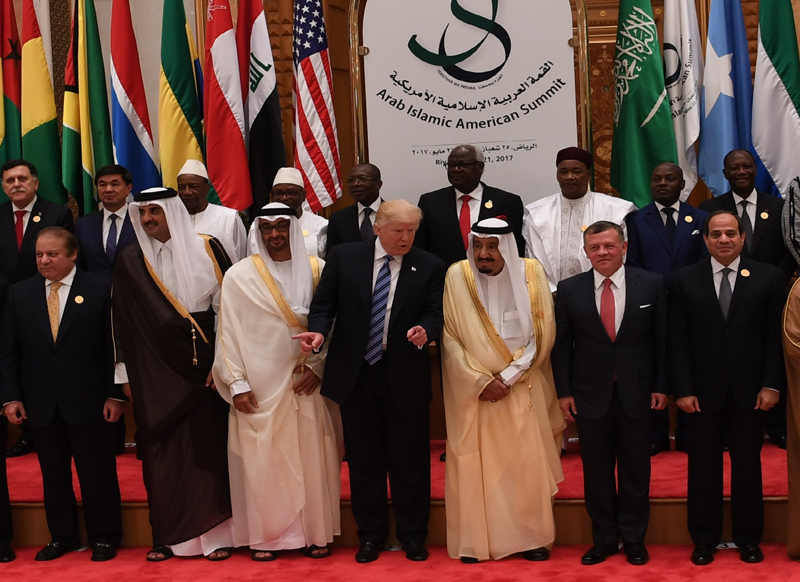
Egyptian President Abdel Fattah al-Sisi (front row, far-right) attended the May 21 Arab Islamic American Summit in Riyadh, Saudi Arabia, along with U.S. President Donald Trump (front-center). The problems of Islamic extremism and terrorism were much-discussed at the summit. (Photo by Thaer Ghanaim/PPO via Getty Images)

In a war that is equally ideological and kinetic, Muslim nations and others trying to survive the plague of Islamic terrorism will need to be as ruthless as their extremist counterparts. That is something that the warring political factions in the U.S. quickly need to understand. When it comes to regional interests in the Middle East, the priority is combating the most dominant and violent force. If that force wins, human rights are completely off the table. Beyond Egypt, President Trump has received considerable backlash in the U.S. for siding with what are seen as repressive regimes, whether it was hosting Turkey's President Recep Tayyip ErdoÄŸan in the White House or engaging with dictators and monarchs during the Riyadh Summit.
In order to bring security to the region, alliances need to look at the real instigators and agents of chaos. There is a metastasizing threat that requires a new coalition of the willing. For a nation to do what it must to survive, it needs the steadfast support of world powers. Step one is annihilating all sources of violent Islam.
Shireen Qudosi is the Director of Muslim Matters, with America Matters.
© 2017 Gatestone Institute. All rights reserved. The articles printed here do not necessarily reflect the views of the Editors or of Gatestone Institute. No part of the Gatestone website or any of its contents may be reproduced, copied or modified, without the prior written consent of Gatestone Institute.Supp

Saturday, April 15, 2017

Trump A Hero Of Arabs?


  • Arabs and Muslims have long lost faith in their leaders' ability to deal with the crises plaguing Arab and Islamic countries. The civil war in Syria, which has been raging for more than five years and which has claimed the lives of more than half a million people, is seen as a shining best example of Arab and Muslim leaders' incompetence and apathy.
  • Others are calling Trump "Lion of the Sunnis", "Caliph of the Muslims" and "Defender of the Islamic Holy Sites." Some wrote: "Blessed be the hands of Abu Ivanka al-Amiriki (Trump)," and expressed hope that he would do more to rid the Syrian people of their dictator. "We love you Trump" and "Trump is our hope" are two of many hashtags that have become extremely popular on social media, especially Twitter. Many of the writers are Syrians, Egyptians and Gulf citizens.
  • Many Arabs and Muslims perceive themselves to have been betrayed by the Obama administration. They felt, rightly, that the Obama administration turned its back on Washington's friends and allies in the Arab world in favor of Iran and the Muslim Brotherhood.
A new hero has been born in the Arab world and his name is Donald Trump. And this is not a joke.
Arabs and Muslims love leaders who talk tough and do not hesitate to use force. In the Arab world, compromise is a sign of weakness.
Until recently, Trump was anathema to many Arabs and Muslims. So what happened? U.S. President Donald Trump did something Arab leaders have failed to do: he helped the Syrian civilians who were being gassed by their ruler.
Arabs and Muslims have long lost faith in their leaders' ability to deal with the crises plaguing Arab and Islamic countries. The civil war in Syria, which has been raging for more than five years and which has claimed the lives of more than half a million people, is seen as a shining best example of Arab and Muslim leaders' incompetence and apathy.
The most recent Arab League summit in Jordan, which brought together many Arab heads of state and monarchs, will be best remembered for the photos of leaders falling asleep during the discussions. These pictures, which have been circulating widely in the Arab media, feel like salt in the festering wound of Arab leaders' indifference to their peoples' plights.
The summit, which utterly failed to find a solution to the ongoing killings in Syria, Yemen, Iraq and other Arab countries, is now being sarcastically referred to by many Arabs as the "Sleep Summit."


The recent Arab League summit in Jordan, which brought together many Arab heads of state and monarchs, will be best remembered for the photos of leaders falling asleep during the discussions. Pictured above: Palestinian Authority President Mahmoud Abba (left) and the Emir of Kuwait, Sabah Ahmad Al-Jaber Al-Sabah (right) snooze during the summit proceedings.

Few Arabs, of course, were expecting their leaders to step up. As far as many Arabs are concerned, their leaders are "traitors" and "puppets" in the hands of the U.S. (and sometimes Israel), and interested only in preserving their seats and enriching themselves and their families on the backs of their constituents.
Even gassing civilians in Syria did not surprise the Arab people. Scenes of children and other civilians suffocating from poisonous gas are not new to the Arab world. Similar atrocities have already taken place in Iraq and other Arab countries in the past few decades.
Desperate for a leader who is willing to send a strong message to the Syrian dictator Bashar Assad, many Arabs and Muslims are now looking at Trump as their "savior." His recent action in Syria stands in sharp and positive relief to the treacherous inactivity of the corrupt Arab heads of state who have turned their backs on their own people.
The missile strike that Trump ordered in retaliation for the use of chemical weapons in Syria has earned him unprecedented appreciation and respect throughout Arab and Islamic countries. The last time a U.S. president won such praise was when George W. Bush liberated Kuwait from Saddam Hussein's army.
Now, Arab leaders can only sit on the side and watch with envy as their constituents heap praise on Trump for ordering the military strike against Assad's forces. Thousands of Arabs have taken to social media to express their admiration and gratitude for Trump after the U.S. missile strike. Many are affectionately referring to Trump as "Abu Ivanka al-Amriki."
Others are calling Trump "Lion of the Sunnis", "Caliph of the Muslims" and "Defender of the Islamic Holy Sites." Some wrote: "Blessed be the hands of Abu Ivanka al-Amiriki (Trump)," and expressed hope that he would do more to rid the Syrian people of their dictator. "We love you Trump" and "Trump is our hope" are two of many hashtags that have become extremely popular on social media, especially Twitter. Many of the writers are Syrians, Egyptians and Gulf citizens.
Arabs are replacing their profile photos on Facebook and Twitter with an image of Trump. "Trump did in a few months what Obama was unable to do in eight years," many of them commented. "For the first time in six years, the Assad regime is being held accountable for its atrocities."
Lebanese journalist Maria Maaloof wrote: "Thank you Mr. President for not ignoring the cries of the (Syrian) children."
By striking Syria, Trump seems to have made America great again, at least in the eyes of many Arabs and Muslims.
Many Arabs and Muslims perceive themselves to have been betrayed by the Obama administration. They felt, rightly, that the Obama administration turned its back on Washington's friends and allies in the Arab world in favor of Iran and the Muslim Brotherhood. It is no surprise, therefore, that Saudi Arabia and other Gulf countries were among the first to voice support for the U.S. strike against Syria.
For now, Trump's military strike in Syria has partially restored U.S. credibility among Arabs and Muslims. Moreover, it has broadcast that the days of the Obama administration's appeasement and inaction are over. Arabs love world leaders who stand up to oppression and injustice; his swift and strong response accounts for the about-face on Trump in the Arab world. The U.S. strike is a first step towards restoring the U.S. role as a true leader. It remains to be seen whether Trump will demonstrate the same determination in dealing with the duplicity and malevolence of other Arabs and Muslims.
Bassam Tawil is a scholar based in the Middle East.

© 2017 Gatestone Institute. All rights reserved. The articles printed here do not necessarily reflect the views of the Editors or of Gatestone Institute. No part of the Gatestone website or any of its contents may be reproduced, copied or modified, without the prior written consent of Gatestone Institute.

Saturday, February 25, 2017

Another Great Emigre To Canada

Man wanted for Terrorism in Pakistan finds refuge in Canada

A Pakistani-Canadian man wanted for leading a mob attack on a Mosque in Pakistan has found refuge in Canada.
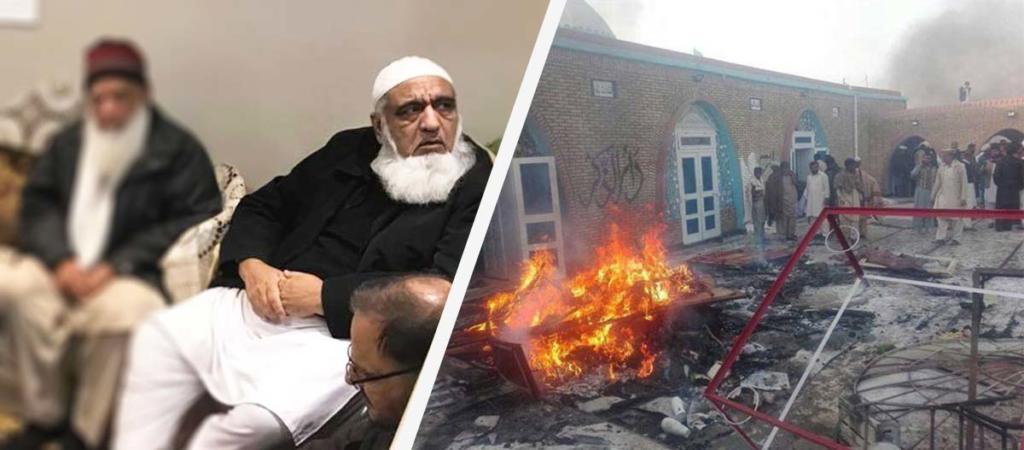
In December 2016, Rasheed Ahmed, a dual citizen of Pakistan and Canada led a 3000-strong mob which attacked a historic Mosque in the town of Dulmial, northern Pakistan. The Mosque which dates back to 1860 has been at the center of a property dispute between Ahmadis and Sunnis. In 1996 the local Sunnis claimed ownership of the Mosque, a claim which was subsequently dismissed by the court.
Rasheed who is in his early 80’s and has lived in Canada for over 40 years traveled to Pakistan from his home in Missausaga and revived the decade-old campaign to grab hold of the Mosque property. Rasheed along with local clerics also filed an application with the Police requesting assistance in the “take over” of the Mosque.
An application filed with the local Police department by Rasheed and dozen other clerics stated:
“The Qadianis (Ahmadis) are using the Mosque as their worship place which is illegal under the law, We request that you free the Mosque from the Infidels and save Muslim interests by saving the Mosque from these Infidels, If these steps are not taken we will be forced to take extreme measures in order to liberate this Mosque”
The Ahmadis are followers of the Ahmadiyya sect of Islam which is considered heretic by mainstream Muslims. In 1974 Pakistan amended the constitution to declare the Ahmadis “non-Muslims”.
On December 12, 2016, a mob of roughly 3000 armed with automatic weapons and led by Rasheed attacked the Mosque leaving two dead and a half-dozen injured. During the attack which lasted several hours, the Police stood by as the mob ransacked the Mosque and set fire to property. The violent episode came to an end after the Army was called in and imposed a curfew in the town.
Days after the attack, Pakistani authorities named Rasheed Ahmed as the main suspect in the Mosque attack. On December 17th, five days after the attack, the Provincial Government requested the Federal Government that Rasheed should be barred from leaving the country for his role in the attack.
On January 15th, Dawn News reported that Rasheed had managed to flee the country before his name could be added to the Exit Control List (ECL).
While talking to Stewart Bell of National Post, Rasheed acknowledged that he was wanted for “terrorism” in Pakistan and said that in addition to terrorism charges police had also charged him with 10 to 12 more crimes.
Describing the events of December attack, Rasheed said, Fearing arrest, he phoned the Canadian high commission for help but it was closed. He went on to say:
Luckily I escaped, Thank God. It’s all work of God, I believe, because had I been caught it would have been not good for my health at all.
Rasheed said upon his return to Canada, he was questioned by Canadian authorities but “they were satisfied and said that I can go.” He claimed the Canadian Intelligence also cleared him of any wrongdoing:
“CSIS (the Canadian Security Intelligence Service) came and asked me questions and they said, ‘Okay, no problem.’”
Since the attack, Pakistan has arrested up to 80 people involved in the attack and more are being looked for, But Rasheed has managed to escape prosecution as there is no extradition treaty between Canada and Pakistan.

Sunday, December 27, 2015

ISIS Gets Worse. Now Organ Harvesting Is OK.

ISIS Sanctioned Organ Harvesting in Document Taken in U.S. Raid

Image: ISIS Sanctioned Organ Harvesting in Document Taken in U.S. Raid
Friday, 25 Dec 2015 05:33 PM

 Islamic State has sanctioned the harvesting of human organs in a previously undisclosed ruling by the group's Islamic scholars, raising concerns that the violent extremist group may be trafficking in body parts.
The ruling, contained in a January 31, 2015 document reviewed by Reuters, says taking organs from a living captive to save a Muslim's life, even if it is fatal for the captive, is permissible.
Reuters couldn't independently confirm the authenticity of the document. U.S. officials say it was among a trove of data and other information obtained by U.S. special forces in a raid in eastern Syria in May.
"The apostate's life and organs don't have to be respected and may be taken with impunity," says the document, which is in the form of a fatwa, or religious ruling, from the Islamic State's Research and Fatwa Committee.
"Organs that end the captive's life if removed: The removal of that type is also not prohibited," Fatwa Number 68 says, according to a U.S. government translation.
The document does not offer any proof that Islamic State actually engages in organ harvesting or organ trafficking. But it does provide religious sanction for doing so under the group's harsh interpretation of Islam - which is rejected by most Muslims. Previously, Iraq has accused Islamic State of harvesting human organs and trafficking them for profit.
The document does not define "apostate," though the Islamic State has killed or imprisoned non-Muslims, such as Christians, and Shiite Muslims, as well as Sunni Muslims who don't follow its extremist views.

U.S. officials say the records that were seized have given the U.S. government a deep look into how Islamic State organizes, raises funds and codifies laws for its followers.
Iraq's ambassador to the United Nations, Mohamed Ali Alhakim, told Reuters the documents should be examined by the U.N. Security Council as evidence that Islamic State could be trafficking in organs to raise cash.
The May raid in Syria, which resulted in the death of Islamic State top financial official Abu Sayyaf and the capture of his wife, netted seven terabytes of data in the form of computer hard drives, thumb drives, CDs, DVDs and papers, said Brett McGurk, U.S. President Barack Obama's Special Presidential Envoy for the Global Coalition to Counter ISIL, in an interview. Abu Sayyaf was a Tunisian militant whose real name was Fathi ben Awn ben Jildi Murad al-Tunisi.
Latest News Update

U.S. officials have previously described the Abu Sayyaf raid and some of the documentation seized. But until now, none of the actual documents have been released - aside from materials illustrating Islamic State's trafficking in antiquities, made public at an event at New York's Metropolitan Museum of Art in September.
The U.S. government has shared some of the documents from the Abu Sayyaf raid with allied governments in an effort to increase their understanding of Islamic State in recent weeks as Washington works to shore up support for countering the group.
The group of documents reviewed by Reuters - entitled "Lessons Learned From the Abu Sayyaf Raid" - show how the Islamic State has provided a legal justification to its followers for a range of practices.
For instance, "Fatwa Number 64" dated January 29, 2015, provides detailed rules for rape, prescribing when Islamic State men can and cannot have sexual intercourse with female slaves.
The fatwa sanctioning organ harvesting justifies the practice in part by drawing an analogy to cannibalism in extreme circumstances, a practice it says earlier Islamic scholars had allowed. "A group of Islamic scholars have permitted, if necessary, one to kill the apostate in order to eat his flesh, which is part of benefiting from his body," it says.
McGurk said Islamic State's Research and Fatwa Committee reports directly to the group's leader, Abu Bakr al-Baghdadi.
The ruling on organ harvesting cites Islamic texts, principles and laws that it says support what it calls "the notion that transplanting healthy organs into a Muslim person's body in order to save the latter's life or replace a damaged organ with it is permissible."
Senior U.S. officials, including McGurk, said they have not been able to ascertain whether the Islamic State had followed through on the fatwa on organ harvesting.
The document provides "a religious justification for harnessing the organs of what they call infidels," he said.
William McCants, a Brookings Institution scholar who is author of the book "The ISIS Apocalypse," said the group's ruling on slavery and human organs don't represent modern Islamic interpretations.
In February, Alhakim, had urged the U.N. Security Council to investigate the deaths of 12 doctors in the Islamic State-held city of Mosul. Alhakim said the doctors were killed after refusing to remove organs.
The U.N. special envoy for Iraq, Nickolay Mladenov, said at the time that he could not confirm the claim, but it would be investigated. The U.N. has not provided an update on that investigation, which Alhakim said he would ask the Security Council to revisit.
© 2015 Thomson/Reuters. All rights reserved.