Contact Form

Name

Email *

Message *

Showing posts with label al-Sisi. Show all posts

Sunday, June 4, 2017

US Must Support el-Sisi

  • When it comes to regional interests in the Middle East, the priority is the most dominant and violent force.
  • Egypt stands out as a primary target, given the cocktail of challenges that position it as a center of radical Islam. Egypt faces political, violent, and theological militancy within its borders.
  • For a nation to do what it must to survive, it needs the steadfast support of world powers. Step one is annihilating all sources of violent Islam.
For a Western audience, Egyptian President Abdel Fattah al-Sisi is a complex figure, who was shunned by the Obama administration. There appear truly pressing, immediate priorities in Egypt, such as developing the economy and combating the avalanche of extremist attempts to overthrow him. Among Middle East and North African territories, Egypt stands out as a primary target, given the cocktail of challenges that position it as a center of radical Islam.
President Sisi faces violent extremist hotbeds in the Sinai Peninsula, and the still-destabilizing influence of the Muslim Brotherhood (a political arm of violent radicals). Most notably, Sisi brought a reality check to the Arab Spring when he led the military overthrow of the Muslim Brotherhood government in 2013, ushering a spiritual and cultural Islamic reformation with widespread popular support from Egyptians on a grass-roots level.
Sisi faces more than just militant and political extremists within Egypt's borders; he is also walking a theological tightrope. Egypt is home to the regressive theocratic influence of the most revered Islamic institution in the Sunni world, Cairo's Al-Azhar University, which openly views freedom as a "ticking time-bomb."
Being held hostage intellectually by the grip of Al-Azhar University ensures that there is a constant supply when it comes to producing the next generation of militant and political Islamists.
Egypt also faces extremist infiltration from neighboring Libya, a nation caught in a power vacuum after the murder of its leader, Col. Muammar Gaddafi. This vacuum has been readily filled by Islamic militants, including ISIS.
Upon returning home in April from his first visit to the U.S. since 2013, Sisi faced a series of domestic terror attacks that once again put Egypt in a global spotlight. On Palm Sunday, in April, two suicide bombings in Coptic Christian churches killed more than 45 people and injured another 120. For Egypt, one of the last regional strongholds that still has a vibrant non-Muslim minority population, violent eruptions on major Christian holidays have become routine.
In England, just days after the May 22 Manchester suicide bombing, attention was once again on Egypt where 29 Coptic Christians were gunned down on a bus traveling to a monastery near the city of Minya. The attack was launched by masked terrorists who arrived in three pick-up trucks and opened fire on the passengers, many of whom were children. Egyptian intelligence believes the Minya attack was led by ISIS jihadists based in Libya. In February, the aspiring terrorist caliphate also launched a campaign against Egypt's Christian population. The Egyptian military responded swiftly with air strikes against terrorist camps, along with a televised warning against sponsored terrorism.
President Sisi's response to the brutal slaughter of peaceful Christian worshippers is being called rare but should not be surprising, considering the aggressive measures that need to be taken to hold extremism at bay, and to eradicate the threat that local groups pose to the Egyptian people. Coming out of the Riyadh Summit, where President Trump and a host of Muslim nations, including Egypt, agreed to drive out extremism, Sisi's reaction was necessary.
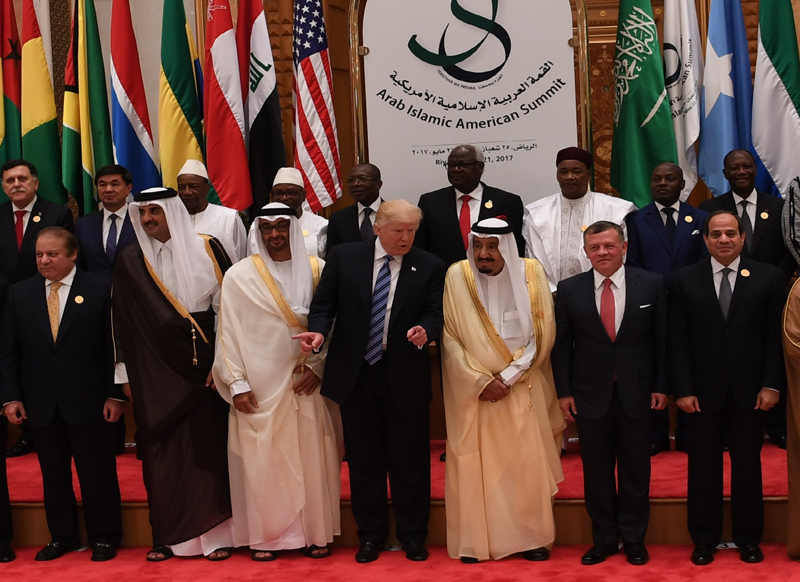
Egyptian President Abdel Fattah al-Sisi (front row, far-right) attended the May 21 Arab Islamic American Summit in Riyadh, Saudi Arabia, along with U.S. President Donald Trump (front-center). The problems of Islamic extremism and terrorism were much-discussed at the summit. (Photo by Thaer Ghanaim/PPO via Getty Images)

In a war that is equally ideological and kinetic, Muslim nations and others trying to survive the plague of Islamic terrorism will need to be as ruthless as their extremist counterparts. That is something that the warring political factions in the U.S. quickly need to understand. When it comes to regional interests in the Middle East, the priority is combating the most dominant and violent force. If that force wins, human rights are completely off the table. Beyond Egypt, President Trump has received considerable backlash in the U.S. for siding with what are seen as repressive regimes, whether it was hosting Turkey's President Recep Tayyip Erdoğan in the White House or engaging with dictators and monarchs during the Riyadh Summit.
In order to bring security to the region, alliances need to look at the real instigators and agents of chaos. There is a metastasizing threat that requires a new coalition of the willing. For a nation to do what it must to survive, it needs the steadfast support of world powers. Step one is annihilating all sources of violent Islam.
Shireen Qudosi is the Director of Muslim Matters, with America Matters.
© 2017 Gatestone Institute. All rights reserved. The articles printed here do not necessarily reflect the views of the Editors or of Gatestone Institute. No part of the Gatestone website or any of its contents may be reproduced, copied or modified, without the prior written consent of Gatestone Institute.Supp

Friday, April 21, 2017

Another Trump Success

Trump Succeeds In Freeing American Charity Worker From Egyptian Prison. Obama Had Failed.

Photo by Olivier Douliery-Pool/Getty Images
50590443115307
An Egyptian-American charity worker has been released from prison in Cairo
 after three years behind bars. The American citizen returned home to the 
United States late Thursday.
“President Trump and his aides worked for several weeks with Egyptian
 President Abdel Fatah al-Sissi to secure the freedom of Aya Hijazi, 30, a 
U.S. citizen, as well as her husband, Mohamed Hassanein, who is Egyptian, 
and four other humanitarian workers,” reports The Washington Post. “Trump 
dispatched a U.S. government aircraft to Cairo to bring Hijazi and her family 
to Washington.”
Trump apparently succeeded where former president Obama failed. The 
Post continues:
The Obama administration unsuccessfully pressed Sissi’s government for their release. It was not until Trump moved to reset U.S. relations with Egypt by embracing Sissi at the White House on April 3 — he publicly hailed the autocrat’s leadership as “fantastic” and offered the U.S. government’s “strong backing” — that Egypt’s posture changed. Last Sunday, a court in Cairo dropped all charges against Hijazi and the others.


According to White House officials, this wasn’t your classic Obama-era quid
 pro quo transaction or controversial prisoner exchange. Unlike Obama,
oversaw Hijazi’s release and received assurances from Cairo that the prisoner
 release was a gesture of good faith.
We received “assurance from the highest levels [of Sissi’s government] 
that whatever the verdict was, Egypt would use presidential authority to 
send her home,” an unidentified senior administration told the Post.
Trump reportedly sent his military aide, Air Force Maj. Wes Spurlock, “to 
escort Hijazi and her family on the plane home to Washington,” according to 
the Post.
A Virginia native, Hijazi served as an aid worker for the Belady Foundation in
 Cairo. She and her husband set up a rehabilitation center for abandoned
 and impoverished children in the city.
But Hijazi’s work caught the attention of Egyptian authorities in 2014 when 
she was detained alongside her husband and fellow aid workers on May 1 
of that year on trumped-up charges of child abuse and human trafficking. 
Stripped of due process and basic rights, Hijazi was sent to prison without 
a shred of evidence to justify her detainment. It’s unclear why the Sissi regime
 threw these aid workers in prison, but it is possible  that their work, shining 
a bright light on the plight of Egypt’s forgotten street children, made Cairo
 look bad and attracted unwanted attention to the government. In prison,
 Hijazi and her colleagues were allegedly abused at the hands of prison guards.
Hijazi’s release comes as Secretary of Defense James Mattis tours the Middle
 East and reasserts America's alliance with Sunni partners that have felt 
abandoned and neglected by the Obama administration’s diplomatic pivot 
toward Shiite Iran. 

Wednesday, September 21, 2016

Egyptian Times Take On Al-Sisi Meetings With Trump And Clinton


Does Al-Sisi click more with Trump or Clinton?

Several US academics and activists called on Trump and Clinton not to meet Al-Sisi, but the meetings were held anyway

President Abdel Fattah Al-Sisi met with Presidential Republican party candidate Donald Trump and Presidential Democratic party candidate Hillary Clinton on the sidelines of the annual United Nations (UN) general assembly, currently held in New York.
The meetings with the Egyptian president came as part of Trump and Clinton’s meetings with world leaders before the US presidential elections that will be held in November. Both candidates tackled different issues with Al-Sisi during the meetings.

Al-Sisi’s meeting with Trump
It has become known that Al-Sisi is the Republican candidate’s favourite leader in the Middle East. They both share the same policy and prioritise combating terrorism over any other issue. In 2015, Republican politician Ted Cruz said that Al-Sisi is a “terror-fighting commander who should be befriended and emulated”. During Al-Sisi’s meeting with Trump, the main focus was on how to combat terrorism. Trump praised Al-Sisi’s efforts in combating terrorism and what Egypt has done over the past few years for the “betterment of the world”.
In a press statement released by Trump’s campaign, Trump said in the meeting that if he were fortunate to win the elections in November, he would work together with Egypt in combating terrorism. Additionally, the US will be an important ally to Egypt that the latter can depend on for days and years ahead.
Trump’s supporters have deemed his meetings with Al-Sisi and other leaders as a victory. The bilateral meeting was considered to be between two leaders who share the same vision and want to fight radical Islamists.
During the meeting, Trump backtracked from his campaign to create policy that would ban foreign Muslims from entering the US, showing more tolerance towards their presence. He said he had high regards for “peace-loving Muslims”.
The meeting didn’t touch upon any issues other than how the US will be Egypt’s loyal friend under Trump’s administration for they share a common enemy. Trump praised Al-Sisi’s close ties with Israel on countering terrorism as well.

Al-Sisi’s meeting with Clinton

Unlike Al-Sisi’s meeting with Trump, Clinton highlighted the deterioration of the human rights situation in Egypt. She called on Al-Sisi to release US citizen Aya Hegazy, who has been detained in Egypt for over two years on charges of inciting protests through a foundation that supports street children. Clinton also shed light on Egypt’s policy that harasses activists and human rights organisations. Besides also discussing the importance of enhancing bilateral ties with Egypt, Clinton said that it’s rather important for Egypt to cooperate with Israel in combating terrorism.
Clinton further added that the rule of law and respect for human rights is important for Egypt’s “future progress”. In December 2015, when Clinton was debating with former presidential candidate Bernie Sanders, she called the Egyptian government “basically an army dictatorship”.
Unlike the Republican party, the Democratic party has shown a rather negative attitude towards the ouster of former president Mohamed Morsi, describing the 30 June uprising as a military coup.

Both candidates referred to Israel as an important party that Egypt should collaborate with in its counter-terrorism measures.

Several academics and scholars released a joint letter on Friday that criticised both Trump and Clinton for meeting Al-Sisi. They highlighted his intolerance to dissent and the severe deterioration of the human rights situation in Egypt, but Al-Sisi met Trump and Clinton separately on Monday anyway.

Thursday, June 23, 2016

Moderate Muslims Need NOT Apply To US Administration. The Sign Outside The White House Says "Only Radical Muslims Welcome."

JPOST.COM, CAROLINE B. GLICK


COLUMN ONE: OBAMA AND THE MODERATE MUSLIMS


In the 15 years since September 11, first under Bush, and to a more extreme degree under Obama, the US has refused to name the enemy that fights America with the expressed aim of destroying it.

US Presidnet Barack Obama in the Oval Office at the White House [File]. (photo credit: Reuters)
As far as the White House is concerned, Jeffrey Goldberg, The Atlantic’s top reporter, is President Barack Obama’s unofficial mouthpiece.
This was one of the many things we learned from The New York Times in David Samuels’s profile of Deputy National Security Adviser Ben Rhodes.
In the course of explaining how Rhodes was able to sell Obama’s nuclear deal with Iran, despite the fact that it cleared Iran’s path to a nuclear arsenal while giving the world’s leading state sponsor of terrorism more than a hundred billion dollars, Samuels reported that “handpicked Beltway insiders like Jeffrey Goldberg of The Atlantic… helped retail the administration’s narrative.”
Given his White House-assigned role, Goldberg’s explanation of Obama’s refusal to discuss radical Islam is worthwhile reading. It reflects what Obama wants the public to believe about his position.
On Wednesday Goldberg wrote that in Obama’s view, discussing radical Islam is counterproductive because it harms the moderates who need to stand up to the radicals.
“Obama,” he wrote, “believes that [a] clash is taking place [not between Western and Muslim civilization but] within a single civilization, and that Americans are sometimes collateral damage in this fight between Muslim modernizers and Muslim fundamentalists.”
Pointing out that there are Muslim fundamentalists, Obama has argued to Goldberg, will only strengthen them against the modernizers.
Over the past week, prominent conservative commentators have agreed with Obama’s position.
Eli Lake from Bloomberg and Prof. John Yoo writing in National Review, among others, criticized presumptive Republican presidential nominee Donald Trump for speaking openly radical Islam. Like Goldberg, they argued that Trump’s outspokenness alienates moderate Muslims.
But what moderate Muslims is Obama trying to help? Consider his treatment of Egyptian President Abdel Fattah al-Sisi.
Sisi is without a doubt, the most outspoken and powerful advocate of a moderate reformation of Islam, and of Islamic rejection of jihad, alive today.
Sisi has staked his power and his life on his war to defeat the Muslim Brotherhood, Islamic State and jihadist Islam in general.
Sisi speaks openly about the danger of jihadist Islam. In his historic speech before the leading Sunni clerics at Cairo’s Al-Azhar University on January 1, 2015, Sisi challenged the clerics to reform Islam.
Among other things he said, “I address the religious clerics. We have to think hard about what we are facing…. It is inconceivable that the thinking that we hold most sacred should cause the entire Islamic nation to be a source of anxiety, danger, killing and destruction for the rest of the world.
Impossible! “That thinking – I am not saying ‘religion,’ but ‘thinking’ – that corpus of texts and ideas that we have held sacred over the years, to the point that departing from them has become almost impossible, is antagonizing the entire world!…
“Is it possible that 1.6 billion people [Muslims] should want to kill the rest of the world’s inhabitants – that is 7 billion – so that they themselves may live? Impossible! “I say and repeat again that we are in need of a religious revolution. You imams are responsible before Allah. The entire world, I say it again, the entire world is waiting for your next move…because this Islamic nation is being torn, it is being destroyed, it is being lost – and it is being lost by our own hands.”
Certainly since September 11, 2001, no Muslim leader has issues a clearer call for moderation in Islam than Sisi did in that speech. And he has continued to speak in the manner ever since.
No other Muslim leader of note has put everything on the line as Sisi has to defeat the forces of jihad both on the field and in the mosques.
Moreover, Sisi has put his anti-jihadist belief into action by expanding security cooperation between Egypt and Israel and by bringing the Gulf states into his undeclared alliance with the Jewish state.
He has also acted to end the demonization of Israel in the Egyptian media.
Obviously, supporting Sisi is a no-brainer for a leader who insists that his goal is to empower moderate Muslims. And yet, far from being Sisi’s greatest supporter, Obama opposes him.
Since Sisi led the Egyptian military in overthrowing the Obama-backed Muslim Brotherhood regime as it was poised to transform Egypt into a jihadist terrorist state, Obama has worked to undermine him.
Obama has denied Sisi weapons critical to his fight with ISIS in Sinai. He has repeatedly and consistently chastised Sisi for human rights abuses against radical Islamists who, if permitted to return to power, would trounce the very notion of human rights while endangering the US’s key interests in Middle East.
Then there is Iran.
If Obama fears radical Islam, as Goldberg insists that he does, why did he turn his back on the Green Revolution in 2009? Why did he betray the millions of Iranians who rose up against their Islamist leaders in the hopes of installing a democratic order in Iran where women’s rights, and minority rights are respected? Why did he instead side with the radical, jihadist, terrorism-supporting, nuclear weapons-developing and -proliferating ayatollahs? And why has Obama striven to reach an accommodation with the Iranian regime despite its continued dedication to the destruction of the US? Goldberg’s claim that Obama is interested in empowering Muslim moderates in their fight against radicals doesn’t pass the laugh test.
Obama’s actual schemes for relating to – as opposed to acknowledging, fighting or defeating – the forces of jihad involve empowering those forces at the expense of the moderates who oppose them.
Yes, there are exceptions to this rule – like Obama’s belated assistance to the Kurds in Syria and Iraq. But that doesn’t mean that empowering Islamic jihadists at the expense of moderate Muslims is not Obama’s overarching strategy.
In the case of the Kurds, Obama only agreed to help them after spending years training Syrian opposition forces aligned with the Muslim Brotherhood. It was only after nearly all of those forces cut contact with their American trainers and popped up in al-Qaida-aligned militias that Obama began actively supporting the Kurds.
Then there is his behavior toward American jihadists.
Almost every major jihadist attack on US soil since Obama took office has been carried out by US citizens. But Obama has not countered the threat they pose by embracing American Muslims who reject jihad.
To the contrary, Obama has spent the past seven- and-a-half years empowering radical Muslims and Islamic groups like the pro-Hamas terrorism apologists from the Council on American-Islamic Relations (CAIR) and the Muslim Public Affairs Council (MPAC).
This week The Daily Caller reported that MPAC President Salam al-Marayati, is serving as an adviser to the US Department of Homeland Security.
Marayati accused Israel of responsibility for the September 11 attacks on the US, and has called on Muslims not to cooperate with federal counter-terrorism probes. According to the report, Marayati has visited the White House 11 times since 2009.
The Daily Caller also reported that a Syrian immigrant to the US was hired to serve as a member of Obama’s task for on “violent extremism” last year.
Laila Alawa, who joined the task force the day she received US citizenship, referred to the September 11 attacks as an event that “changed the world for good.”
According to the Daily Caller, her task force called for the administration to avoid using the terms “jihad” and “Shari’a” in discussing terrorism – as if Obama needed the tip.
So far from helping Muslim moderates, Obama’s actual policy is to help radical Muslims. In stark opposition to his talking points to Goldberg, since he entered office, Obama has worked to empower radical Muslims in the US and throughout the Middle East at the expense of moderates. Indeed, it is hard to think of an anti-jihad Muslim leader in the US or in the Middle East whom Obama has supported.
The victims in Orlando, San Bernadino, Garland, Amarillo, Boston and beyond are proof that Obama’s actual policies are not making America safer. The rise of ISIS and Iran makes clear that his actual policies are making the world more dangerous.
Maybe if his actual policies were what he claims they are, things might be different today. Maybe White House support for anti-jihadist Muslims combined with a purge of all mention of jihad and related terms from the federal lexicon would be the winning policy. But on its face, it is hard to see how forbidding federal employees from discussing jihadists in relevant terms makes sense.
How can enforcing ignorance of a problem help you to solve it? How does refusing to call out the Islamic extremists that Islamic moderates like the Green revolutionaries and Sisi risk their lives to fight weaken them? How does empowering jihad apologists from CAIR and MPAC help moderate, anti-jihad American Muslims who currently have no voice in Obama’s White House? Eli Lake argued that it was by keeping mum on jihad that then-president George W. Bush and Gen. David Petraeus convinced Sunni tribal leaders in Iraq to join the US in fighting al-Qaida during the surge campaign in 2007-2008.
The same leaders now support ISIS.
A counter-argument to Lake’s is that Bush’s policy of playing down the jihadist doctrine of the likes of al-Qaida had nothing to do with the Sunni chieftains’ decision to side with the US forces.
Rather, they worked with the Americans first because the Americans paid them a lot of money to do so. And second, because they believed the Americans when they said that they would stay the course in Iraq.
They now side with ISIS because they don’t trust America, and would rather live under ISIS rule than under Iranian rule.
In other words, for them, the question wasn’t one of political niceties, but of financial gain and power assessments. And that remains the question that determines their actions today.
In the 15 years since September 11, first under Bush, and since 2009, to a more extreme degree under Obama, the US has refused to name the enemy that fights America with the expressed aim of destroying it.
Maybe, just maybe, this is one of the reasons that the Americans have also failed to truly help anti-jihadist – or moderate – Muslims. Maybe you can’t help one without calling out the other.

Monday, January 5, 2015

Egypt's Leader Is Speaking The Truth. Islam Must Go Through Its "Reformation" Before It Can Be A World Wide Religion.


Egypt’s al-Sisi Makes Extraordinary Speech on Islam

January 3rd, 2015 - 10:20 pm
Egypt’s President Abdel Fattah al-Sisi made an extraordinary speech on New Year’s Day to Cairo’s Al-Azhar and the Awqaf Ministry calling for a long overdue virtual ecclesiastical revolution in Islam.  This is 

something no Western leader has the had the courage to do, certainly not Barack Obama, despite his Muslim education.

Accusing the umma (world Islamic population) of encouraging the hostility of the entire world, al-Sisi’s speech is so dramatic and essentially revolutionary it brings to mind Khrushchev’s famous speech exposing Stalin. Many have called for a reformation of Islam, but for the leader of the largest Arab nation to do so has world-changing implications.
Here are the key parts as translated on Raymond Ibrahim’s blog:
I am referring here to the religious clerics.   We have to think hard about what we are facing—and I have, in fact, addressed this topic a couple of times before.  It’s inconceivable that the thinking that we hold most sacred should cause the entire umma [Islamic world] to be a source of anxiety, danger, killing and destruction for the rest of the world. Impossible!
That thinking—I am not saying “religion” but “thinking”—that corpus of texts and ideas that we have sacralized over the years, to the point that departing from them has become almost impossible, is antagonizing the entire world.  It’s antagonizing the entire world!
Is it possible that 1.6 billion people [Muslims] should want to kill the rest of the world’s inhabitants—that is 7 billion—so that they themselves may live? Impossible!
I am saying these words here at Al Azhar, before this assembly of scholars and ulema—Allah Almighty be witness to your truth on Judgment Day concerning that which I’m talking about now.
All this that I am telling you, you cannot feel it if you remain trapped within this mindset. You need to step outside of yourselves to be able to observe it and reflect on it from a more enlightened perspective.
I say and repeat again that we are in need of a religious revolution. You, imams, are responsible before Allah. The entire world, I say it again, the entire world is waiting for your next move… because this umma is being torn, it is being destroyed, it is being lost—and it is being lost by our own hands. [bolds mine]
Al-Sisi is certainly correct.  The whole world has been waiting for a long time for the next move of these imams or for somebody, anybody that will modernize Islam as other religions have done..  Whether that will happen, of course, is another question, but what al-Sisi is saying here is in many ways more revolutionary than the “Arab Spring.”  People ask, where are the “moderate Muslims”?  Well, one of them may be the president of Egypt. The boys from Hamas, Hezbollah, ISIS, Boko Haram, al Qaeda, etc., etc., are probably not too happy about what al-Sisi said.  Let’s hope he doesn’t suffer the fate of Anwar Sadat for his courage.

Wednesday, September 10, 2014

Creative Idea On Gaza Proposed by al-Sisi

US Secretary of State Kerry with Egyptian President al-Sisi.


Egypt’s President General Abdel Fattah al-Sisi has come up with a new and surprising solution to resolving the Israeli-Palestinian conflict: Establish a Palestinian state in the Sinai.
Egyptian President Gen. Abdel Fattah al-Sisi has reportedly proposed to Palestinian Authority (PA) head Mahmoud Abbas to extend the Gaza Strip into the Sinai area and establish a Palestinian state there.
According to the plan, Egypt would provide a 1,600-square-kilometer area in the Sinai Peninsula near the Gaza Strip, making the Strip five times its size, where a Palestinian state would be established under full control of the PA. The Palestinian refugees would go to that state, which would be demilitarized.
In addition to the new state south of Gaza there would be full Palestinian autonomy in PA-administered cities Judea and Samaria. In return, Abbas would relinquish the Palestinian demand for a return to the ’67 borders.
Palestinian Authority Head Mahmoud Abbas at a conference in June
Palestinian Authority head Mahmoud Abbas at a conference in June. (Photo: Flash90)
According to IDF Radio, al-Sisi told Abbas that if he does not take this offer, those who succeed him will take it, but Abbas was not convinced and rejected the proposal. IDF Radio further reports that the Americans are also in the picture and have given a green light to the plan.
Prime Minister Benjamin Netanyahu was reportedly advised of the program, but according to a preliminary investigtion by the radio station, he has not updated his staff on the proposed solution.
The radio journalist pointed out that a similar program had been suggested by Israeli academics in the past as well as by former National Security Council head Giora Eiland. Eiland claimed at the time that the area of Gaza is too small to support more than a million residents and therefore must be increased at the expense of the Sinai. However, when this idea was presented a few years ago, Egypt rejected it outright.

Serious Responses to the Egyptian Proposal

Responding to the offer on IDF Radio, Member of Knesset Yaakov Perry said that al-Sisi’s generosity was surprising but that there were many issues outstanding. “Questions must be asked, and we do not yet have enough details, regarding the status of Judea and Samaria and Jerusalem. We should address the offer seriously, even if Abu Mazen (Abbas) has turned it down,” Perry, who is a former head of the Shabak (Israel’s Security Agency), said.
Minister of Transportation Yisrael Katz welcomed al-Sisi’s proposal, which he praised as “the Egyption President’s amazing offer.”
“This is the End of Days. The Americans are in support [of the proposal]. All that is left is to convince Abu Mazen, who is in pursuit of the Palestinian right of return to Israel, and the Israeli Left, who are eager to relinquish land.”

Egypt and the PA Deny the Report

Egypt’s Foreign Ministry denies that al-Sisi ever made such an offer to the Palestinian Authority, i24 News reports.
Abbas’ office likewise denies the report. PA Secretary-General Al-Tayyib Abd Al-Rahim told the Palestinian Ma’an news agency that the report was “fabricated.” He added that Abbas would not accept any alternative to a Palestinian state on the 1949 Armistice lines with eastern Jerusalem as its capital. Abbas’s representative further claimed that Egypt shares the PA’s position on this issue.
Author: Aryeh Savir
Staff Writer, United with Israel