Europe: Burkini War Continues
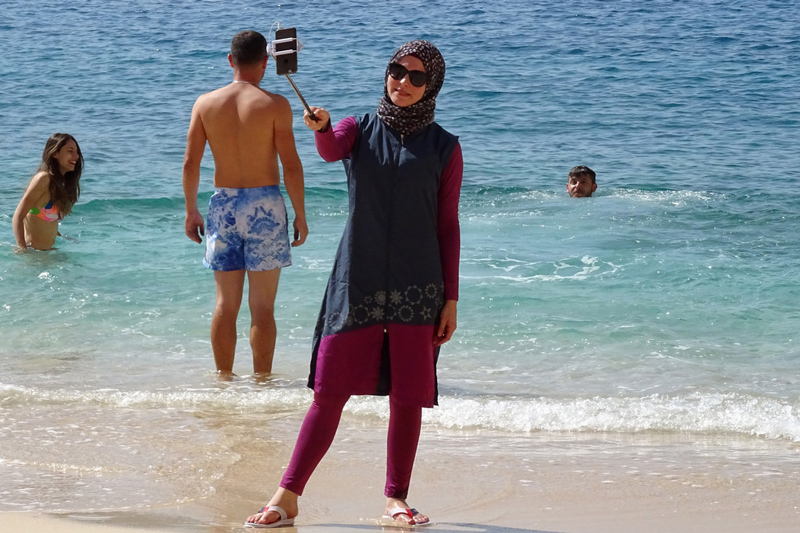
A woman who wore a burkini to swim in a pool in southern France has been charged €490 ($580) to pay for cleaning costs at the facility. The incident, which sparked accusations of Islamophobia, is the latest salvo in an ongoing debate over Islamic dress codes in France and other secular European states.
Those in favor of the burkini argue that women should be allowed to wear whatever they choose. Critics of the garment say it is a religious and political symbol which impedes integration and is incompatible with the liberal principles of secularism and gender equality. In recent months, the debate has added another dimension: public health and hygiene. The woman was vacationing with her family at a bed and breakfast near Marseille when the owner spotted her in the swimming pool wearing a full-body swimsuit, according to the Collective Against Islamophobia in France (CCIF). He subsequently had the pool emptied and cleaned and charged the family for the costs and compensation for the days the pool was out of service. When they refused to pay, the owner allegedly charged them anyway. The woman reported the incident to the CCIF, which said the burkini could not have caused a hygiene issue as the swimsuits are specifically adapted for swimming. "I was disappointed, shocked, wounded by the fact that someone could be so hypocritical and wicked because of a burkini," the woman said. Elsewhere in France, the mayor of Lorette, Gerard Tardy, banned burkinis and other Muslim clothing at a new outdoor swim park, also for reasons of public health: "Monokinis, burkinis, partial veils or veils which totally conceal the face, or a combination thereof, are prohibited on the beach. Any breach of this provision will lead to the immediate expulsion (which may cover the entire swimming season) of the offenders by security or, if necessary, by the police."Aldo Oumouden, spokesman of a mosque in Saint Étienne, responded: "France is multicultural and banning the veil at this facility is an attack on the individual freedom of Muslims and does not even distinguish between burkini and headscarf. How is it that the veil is aggressive or dangerous for the population? It does not represent any health problem, and there is no interference with the freedom of others. Does Mayor Tardy not realize that this decision will further stigmatize Muslims? It is not only unnecessary but also devastating for community harmony."In July, an appeals court in Marseille validated the ban on burkinis in Sisco, a town in Corsica, in the interests of maintaining public order. Mayor Ange-Pierre Vivoni argued the ban was necessary to avoid a repeat of fighting between local youths and Muslims in August 2016, when five people were hurt. Muslims went on a rampage after a tourist took a photograph of several burkini-clad women swimming in a creek. More than 400 people eventually joined the brawl, in which local Corsicans clashed with migrants from North Africa. The following day, more than 500 Corsicans marched through the town shouting "To arms! This is our home!" In May, a dozen Muslim women were arrested for holding a pro-burkini protest during the Cannes International Film Festival in Cannes. The women were wearing red, white and blue burkinis along the town's famous promenade. Police said the women did not have a permit to protest. In March, the frontrunners in the French presidential election clashed over the burkini in a television debate. Marine Le Pen accused Emmanuel Macron of "defending the burkini." Macron accused Le Pen of "dividing society." According to Le Pen, the burkini is a "fundamentalist uniform." This year's controversies harken back to the summer of 2016, when more than 30 cities and towns on the French Riviera banned burkinis from local beaches. In August 2016, the Council of State, France's highest administrative court, ruled that the bans — which were issued after the July 2016 jihadist attack in Nice — were a "serious and manifestly illegal attack on fundamental freedoms, including the freedom of movement and the freedom of conscience." The judges ruled that local authorities could only restrict individual liberties if there was a "demonstrated risk" to public order. There was, they said, no evidence of such a risk. Patrice Spinosi, a lawyer for the Human Rights League (LDH), said that in the absence of a demonstrated threat to public order, the high court "has ruled and has shown that mayors do not have the right to set limits on wearing religious signs in public spaces. It is contrary to the freedom of religion, which is a fundamental freedom." Writing for Le Figaro, French commentator Yves Thréard argued that burkinis are political, not religious, garments: "Secularism and religion are irrelevant here. The burkini is not a Koranic prescription, but another manifestation of political Islam, militant, destructive, seeking to question our way of life, our culture, our civilization. Veils in schools, street prayers, halal school menus, sexual apartheid in swimming pools, hospitals, driving schools, niqab, burqa... for thirty years this infiltration has been undermining our society, seeking to destabilize. It's time to slam the door in its face."
Opinion polls show broad public support for bans on burkinis. According to an Ifop poll publishedby Le Figaro in August 2016, 64% of people in France are opposed to the burkini on beaches; only 6% support it. Ifop director Jérôme Fourquet said: "The results are similar to those we measured in April about the veil and headscarf on public streets (63% opposed). Beaches are equated with streets, where the wearing of ostentatious religious symbols are also rejected by two-thirds of the French."The debate over burkinis is not limited to France. In Portugal, two British tourists said they were "humiliated" after being told to leave a communal swimming pool in Albufeira, a popular holiday destination, because they were wearing burkinis. A member of the hotel staff reportedly told the women to abide by Portuguese norms or leave. In Italy, a Moroccan family caused a stir at a public swimming pool in Montegrotto. Not only were the women wearing burkinis, but the men jumped into the pool wearing street clothes. Photos of the incident went viral after being posted on social media. At a public pool in Pontedera, a Muslim woman was observed swimming, not in a burkini but in a burka. The pool mangers said: "All people of every religion, culture and school of thought are welcome in this facility provided that they observe hygienic and sanitary norms." Elsewhere, a Muslim woman caused a polemic by wearing a burkini at a municipal pool in Ferrara. In Austria, the Neuwaldegger Bad, a private outdoor swimming pool in Vienna, announced a burkini ban: "Only swimwear which is customary for us, bathing suits and bikinis, are permitted." The burkini has also been banned at the Wachaubad in Melk, Lower Austria. A water park in rural Kirchberg requires patrons to wear "local bathing clothing." Mayor Anton Gonaus said this rule has been in place for 25 years and that there have been no problems because up to now there have been no burkini wearers. "This puts Muslim women in a corner and tells them that they do not belong," complained Carla Amina Baghajati, the women's commissioner of the Islamic Community in Austria (IGGiÖ). In July, a Muslim journalist named Menerva Hammad went to a public swimming pool in Vienna in a burkini to gauge reactions. She was confronted by an Austrian woman who said: "This is unhygienic. This is not Turkey." The pool manager sided with Hammad and asked the Austrian woman to leave the premises. Hammad says she has received hate mail from across Austria by people accusing her of setting off a burkini trend at pools across the country. Europe's burkini debate has now spread to the Middle East. In Algeria, thousands of women have joined a "bikini revolt" to reclaim the public space from Islamists who oppose the bikini as a symbol of Western values. In Morocco, where burkinis are banned at many tourism hotspots, the government in January outlawed the sale and production of burkas, evidently in a bid to crack down on Islamic extremism. In Lebanon, a woman wearing a burkini was escorted off the beach at a luxury resort in Tripoli; the action was apparently taken to discourage the trend from spreading and harming tourism. In Egypt, the Ministry of Tourism issued an order requiring hotels and resorts to welcome women wearing the burkini. The government backtracked after hoteliers complained about the potential impact on tourism; hotels and resorts may now decide for themselves whether or not to allow women to wear burkinis. In Saudi Arabia, Crown Prince Mohammed bin Salman has announced plans for a Red Sea beach resort where the law will be changed to allow women to wear bikinis. The project is part of a plan to transform part of the Saudi coastline into a beach resort for the international market. Some observers say the plan is unlikely to succeed. Soeren Kern is a Senior Fellow at the New York-based Gatestone Institute.
© 2017 Gatestone Institute. All rights reserved. The articles printed here do not necessarily reflect the views of the Editors or of Gatestone Institute. No part of the Gatestone website or any of its contents may be reproduced, copied or modified, without the prior written consent of Gatestone Institute.
|
Our goal is to have intelligent discussion of the topics of the day. We realize everyone has their opinion and they should be allowed to express it in a discussion forum without calling each other names. We learn from discussion and not from name calling or argument.We use cookies to personalise content and ads, to provide social media features and to analyse our traffic. We also share information about your use of our site with our social media, advertising and analytics partners. See details
Contact Form
Showing posts with label portugal. Show all posts
Monday, August 14, 2017
Even In Some Middle East Burkini Is Outlawed But It Spreads Through Europe
Saturday, August 27, 2016
Europe Quietly Committing Suicide
Europe: The Substitution of a Population
Deaths that exceed births might sound like science fiction, but they are now Europe's reality. It just happened. During 2015, 5.1 million babies were born in the EU, while 5.2 million persons died, meaning that the EU for the first time in modern history recorded a negative natural change in its population. The numbers come from Eurostat (the statistical office of the European Union), which since 1961 has been counting Europe's population. It is official.
There is, however, another surprising number: the European population increased overall from 508.3 million to 510.1 million. Have you guessed why? The immigrant population increased, by about two million in one year, while the native European population was shrinking. It is the substitution of a population. Europe has lost the will to maintain or grow its population. The situation is as demographically as seismic as during the Great Plague of the 14th Century. This shift is what the British demographer David Coleman described in his study, "Immigration and Ethnic Change in Low-Fertility Countries: A Third Demographic Transition." Europe's suicidal birth rate, coupled with migrants who multiply faster, will transform European culture. The declining fertility rate of native Europeans coincides, in fact, with the institutionalization of Islam in Europe and the "re-Islamization" of its Muslims. In 2015, Portugal recorded the second-lowest birth rate in the European Union (8.3 per 1,000 inhabitants) and negative natural growth of -2.2 per 1,000 inhabitants. Which EU country had the lowest birth rate? Italy. Since the "baby boom" of the 1960s, in the country famous for its large families, the birth rate has more halved. In 2015, the number of births fell to 485,000, fewer than in any other year since the modern Italy was formed in 1861. Eastern Europe now has "the largest population loss in modern history", while Germanyovertook Japan by having the world's lowest birth rate, when averaged over past five years. In Germany and Italy, the decreases were particularly dramatic, down -2.3% and -2.7% respectively.
Some businesses are no longer even interested in European markets. Kimberly-Clark, which makes Huggies diapers, has pulled out of most of Europe. The market is simply not cost-effective. Meanwhile, Procter & Gamble, which produces Pampers diapers, has been investing in the business of the future: diapers for old people. Europe is becoming gray; you can feel all the sadness of a world that has consumed itself. In 2008, the countries of the European Union saw the birth of 5,469,000 children. Five years later, there were nearly half a million fewer, 5,075,000 -- a decrease of 7%. Fertility rates have not only fallen in countries with aching economies, such as Greece, but also in countries such as Norway, which sailed through the financial crisis. As Lord Sacks recently said, "falling birth rates could spell the end of the West". Europe, as it is aging, no longer renews its generations, and instead welcomes massive numbers of migrants from the Middle East, Africa and Asia, who are going to replace the native Europeans, and who are bringing cultures with radically different values about sex, science, political power, culture, economy and the relation between God and man. Liberals and secularists tend to dismiss the importance of demographic and cultural issues. That is why the most important warnings come from some Christian leaders. The first to denounce this dramatic trend was a great Italian missionary, Father Piero Gheddo, who explained that, due to falling birth rates and religious apathy, "Islam would sooner rather than later conquer the majority in Europe". He was followed by others, such as Lebanese Cardinal Bechara Rai, who leads the Eastern Catholics aligned with the Vatican. Rai warned that "Islam will conquer Europe by faith and birth rate". A similar warning just came from yet another cardinal, Raymond Leo Burke. In one generation from now, Europe will be unrecognizable. People in Europe now largely seem to feel that the identity of their civilization is threatened primarily by a frivolous libertarianism, an ideology under the guise of freedom, that wants to deconstruct all the ties that bind man to his family, his parentage, his work, his history, his religion, his language, his nation, his freedom. It seems to come from an inertia that does not care if Europe succeeds or succumbs, if our civilization disappears, drowned by ethnic chaos, or is overrun by a new religion from the desert. As a paper in the Washington Quarterly explains, the fatal meeting between Europe's falling birth rates and rise of Islam has already had significant consequences: Europe has turned into an incubator of terrorism; formed a new poisonous anti-Semitism; seen a political shift to the far right; undergone the biggest crisis in European authoritarian unity and witnessed a refocusing of foreign policy since Europe's withdrawal from the Middle East. Demographic suicide is not only experienced; it appears to be wanted. The xenophile European bourgeoisie, which today controls politics and the media, seem imbued with a snobbish and masochistic racism. They have turned against the values of their own Judeo-Christian culture and combined it with a hallucinatory, romanticized view of the values of other cultures. The sad paradox is that Europeans are now importing young people in large numbers from the Middle East to compensate for their lifestyle choices. An agnostic and sterile continent -- deprived of its gods and children because it banished them -- will have no strength to fight or to assimilate a civilization of the zealous ad the young. The failure to counter the coming transformation seems to come down on the side of Islam. Is what we are seeing the last days of summer? Giulio Meotti, Cultural Editor for Il Foglio, is an Italian journalist and author. |
Sunday, September 14, 2014
Europe's Jihadists Have One Thing In Common, They Are All Children Of Immigrants!
Portugal's Jihadists
by Soeren Kern
September 14, 2014 at 5:00 am
Comment
|
Portugal, like Spain, also figures prominently in a map produced by the jihadist group Islamic State [IS] that outlines a five-year plan for expanding its Islamic Caliphate into Europe.At least a dozen Portuguese nationals have joined jihadist groups fighting in Iraq and Syria, according to newestimates by Portuguese counter-terrorism officials.
"Holy War is the only solution for humanity." — Abdu, Portuguese jihadist.
"Every time these jihadists groups mention the recovery of al-Andalus, they are also referring to Portugal. Jihadists do not believe in national divisions, but in the existence of a single Muslim community that embraces the entire Iberian Peninsula." — Miguel Torres Soriano, Spanish terrorism expert.
All of the Portuguese jihadists (ten men and two women) are under the age of 30 and most of them are children of immigrants, but so far none of the individuals is known to have returned to live in Portugal.
Portuguese authorities are—for now—downplaying the threat these individuals may pose to Portugal upon their return home from the battlefields.
Security analysts from Spain, however, are warning the Portuguese government against complacency. They argue that although the number of Portuguese jihadists may be small compared to other European countries, radical Muslims are becoming increasingly strident in their vows to reconquer Al-Andalus—of which Portugal is a key component—for Islam.
Al-Andalus is the Arabic name given to those parts of Spain, Portugal and France occupied by Muslim conquerors (also known as the Moors) from 711 to 1492, when both the Moors and the Jews were expelled by King Ferdinand and Queen Isabella.
Most of the territory of modern-day Portugal was occupied by the Moors for more than 500 years, from 711 until 1249. During that time, the territory was known by its Arabic name, Gharb Al-Andalus (The West of Al-Andalus) or Al-Gharb (The West).
Jihadists believe that all of the territories Muslims lost during the Christian Reconquista of the Iberian Peninsula still belong to the realm of Islam. They claim that Islamic law gives them the right to return there and re-establish Muslim rule. This belief is based on a verse in the Koran that reads: "And kill them wherever you find them and expel them from wherever they have expelled you..." (Koran 2:191)
A jihadist group called Sharia4Spain—which says it wants to replace the democratic order in Spain with Islamic Sharia law—has called for the "destruction of the constitutional systems of Spain and Portugal and the reestablishment of Sharia law and the system of the Caliphate in all of the Iberian Peninsula."
Portugal, like Spain, also figures prominently in a map produced by the jihadist group Islamic State [IS] that outlines a five-year plan for expanding its Islamic Caliphate into Europe.
In late March 2014, a masked jihadist, using the nom de guerre Abu Isa al-Andalus, appeared in an IS propagandavideo calling on others to join the fighting in Syria. A post accompanying the video stated that the individual was originally from Portugal: "He grew up with [the Portuguese footballer Cristiano] Ronaldo, played for Arsenal, and [then] left football, money and the European way of life for the sake of Allah."
The British security service MI5 eventually identified the jihadist as 29-year-old Celso Rodrigues da Costa, a Portuguese citizen.
Celso Rodrigues da Costa, the Portuguese jihadist known as Abu Isa al-Andalus, appears in an Islamic State recruitment video. (Image source: MEMRI)
|
The Portuguese newspaper Correio da Manhã reported that Costa, a son of immigrants from Guinea-Bissau, a former Portuguese colony in West Africa, was born in the Portuguese capital of Lisbon and was raised in the nearby town of Sintra. At age 20, Costa moved to England to study. "It was there that he joined the Islamic cause," the paper stated.
In the eight minute recruitment video, Costa brandishes an AK-47 rifle and speaks in English with a heavy Portuguese accent. After boasting that IS has "conquered many cities" and is now "implementing the Sharia," he expresses his contempt for Western society:
"If you have families in kafir [infidel] countries, what will happen most probably is you do not have control of your children. In some countries you must put your children in kafir schools and who is going to teach your children? It is going to be maybe a gay, maybe a drug dealer, maybe a paedophile. It is very important for you to protect your children from these animals, these dirty people. Allah says they are the worst of creatures. So you prefer to live among the worst of creatures rather than among the Mujahideen?"British authorities suspect that Costa was recruited in Leyton, East London, where at least a dozen other Portuguese nationals are believed to be recruiting Portuguese Muslims for jihad.
In August, another Portuguese jihadist, a 19-year-old woman identified only as Umm [Arabic for mother] travelled to Syria to become the wife of an IS jihadist named "Abdu," whom she had met on Facebook but never in person. Both are converts to Islam.
An article entitled, "A Portuguese Bride of Jihad," published on September 3 by the Lisbon-based weekly newspaper Expresso, describes how the couple "shared radicalism and life ambitions" through social media: "Both are converted Muslims, extremists, supporters of the Islamic caliphate, and opponents of the West and the countries of 'infidels.' And both are Portuguese." The paper adds: "She fled on August 9, she married on August 10."
Umm's father, who lives in Alentejo, a wine-producing region in south-central Portugal, identified his daughter via her Facebook profile. "Yes, yes, those are her eyes," he said. "It is her, beyond any doubt." The father was viewing photos posted on Facebook in which his eldest daughter, "Umm," who was born into a Roman Catholic family, is wearing a niqab, a black veil covering her entire face, exposing only her eyes. Her marital status on Facebook reads "Married".
The father, who asked not to be identified, told Expresso that his daughter's behavior is "unbelievable, unreal." After her parents separated, the daughter and her mother moved to the Netherlands, where Umm converted to Islam. "She became a radical Muslim about a year ago, it was all very quick. Which is why I was surprised, I cannot understand."
After arriving in Syria, Umm posted: "I have arrived safely in Sham [Greater Syria]. Sisters, do not hesitate. I feel so good, as if I had always lived here. I feel at home. Insha'Allah [Allah willing]. Allah will soon unite us all." Umm continues:
"Before I used to define happiness as being temporary moments. But now that I have moved to an Islamic state, I finally understand that all the ingredients of happiness are right here. I am truly in paradise."Umm also says that life on the battlefield is not as bad as it is being depicted by Western media, but she does admit that bombings are a regular feature of life in Syria. "Should a bomb have my name on it, I will be a martyr," she explains.
Umm's husband, identified only as "Abdu," also has a Facebook page on which he promotes holy war. According toExpresso, Abdu—who was born and raised in the suburbs of Lisbon, and converted to Islam after he moved to London—appears smiling, with various weapons and the black and white flag of jihad. "Holy War is the only solution for humanity," he writes.
In July, Portuguese police arrested a jihadist at Lisbon Portela Airport as he was trying illegally to board an Angola-bound jetliner via its landing gear. The newspaper Diário de Notícias reported that the man, who was born in Angola but held a Dutch passport, had received training in a jihadist camp in Syria.
In May, IS reported that a Portuguese-born French jihadist named Abu Osama Al-Faransi carried out a suicide car-bomb attack against a group of Iraqi army personnel in the Al-Mashahada district of Baghdad.
In January, a jihadist posted metro maps for several cities in Portugal, Spain and Germany, under the headline, "Terrorizing the Disbelievers."
For the time being, the Portuguese government maintains that the terrorism threat level in the country is "moderate," even though authorities in neighboring Spain on September 10 raised the threat level to "high." The move means that Spain's security agencies are stepping up their monitoring efforts at the country's airports, train stations, hospitals, government buildings and other key sites in response to the heightened risk of jihadist attacks.
Portuguese authorities say that the threat of attacks in Portugal is lower than in other parts of Europe because most of the jihadists who hold Portuguese passports actually reside in other European countries, primarily in Britain, France and the Netherlands.
Most of these individuals seem to be second- and third-generation descendants of families who emigrated from Portugal to find work in other European countries. Others seem to be the descendants of immigrants from former Portuguese colonies, including Angola, Guinea-Bissau and Mozambique.
Portuguese officials contend that the Portuguese jihadists who have been identified so far have little-to-no interaction with Portugal's Muslim community, which, at 55,000 members is one of the smaller such communities in Europe.
Spanish terrorism analysts are nevertheless warning the Portuguese against complacency. In a recent interviewwith Expresso, Spanish terrorism expert Fernando Reinares advised: "Portugal should be very alert to the movements of jihadists on its territory and to the radicalization of Portuguese citizens within and outside of its borders."
Another Spanish analyst, Óscar Pérez Ventura, warned: "These Iberian jihadists should be considered very dangerous."
Miguel Torres Soriano, author of the book "Al Andalus 2.0," summed it up this way:
"Take heed. Every time these jihadists groups mention the recovery of al-Andalus, they are also referring to Portugal. Jihadists do not believe in national divisions, but in the existence of a single Muslim community that embraces the entire Iberian Peninsula."Soeren Kern is a Senior Fellow at the New York-based Gatestone Institute. He is also Senior Fellow for European Politics at the Madrid-based Grupo de Estudios Estratégicos / Strategic Studies Group.
Sunday, August 17, 2014
Spain Another Target For ISIS
Islamic State: "We Will Take Spain Back"
by Soeren Kern
August 17, 2014 at 5:00 am
Comment
|
Calls to reconquer al-Andalus are becoming more frequent and more strident.Radical Muslims in Spain have launched a social media campaign aimed at generating support for the jihadist group Islamic State [IS].
"Clearly Spain forms part of the strategic objectives of global jihad. We are not the only ones but we are in their sights." — Spanish Interior Minister Jorge Fernández Díaz.
The campaign involves posters that include images of famous Spanish landmarks and monuments emblazoned with Arabic slogans such as, "We are all the Islamic State" and "Long Live the Islamic State."
One poster includes an image of the medieval Islamic Aljafería Palace in the Spanish city of Zaragoza and the black flag associated with the IS. Another uses an image of the famous La Concha beach in the Basque city of San Sebastián. Yet another includes an image of the statue of Jesus Christ on Monte Urgull in San Sebastián, with the Arabic words "Al-Andalus Country" instead of "Basque Country."
A tweeted photo of an Islamic State supporter holding the IS black flag of jihad in front of Aljafería Palace in Zaragoza.
|
Al-Andalus is the Arabic name given to those parts of Spain, Portugal and France that were occupied by Muslim conquerors (also known as the Moors) from 711 to 1492. As the Basque Country is surrounded by mountains, however, the Moors never succeeded in occupying it.
The poster campaign comes after IS jihadists produced a video in which they vow to liberate al-Andalus from non-Muslims and make it part of their new Islamic Caliphate.
The video shows a jihadist speaking in Spanish with a heavy North African accent. He says:
"I say to the entire world as a warning: We are living under the Islamic flag, the Islamic caliphate. We will die for it until we liberate those occupied lands, from Jakarta to Andalusia. And I declare: Spain is the land of our forefathers and we are going to take it back with the power of Allah."Radical Muslims (and many moderate Muslims) believe that all territories Muslims lost during the Christian Reconquista of Spain still belong to the realm of Islam. They claim that Islamic law gives them the right to return there and re-establish Muslim rule.
In recent years, the return of "occupied" Al-Andalus to the fold of Islam has become an obsession for Muslims of all stripes, and calls to reconquer al-Andalus have become more frequent and more strident.
Commenting on the latest video, Spain's Secretary of State for Security, Francisco Martínez, said Spanish police were remaining "vigilant" in the face of a "grave" jihadist threat.
Meanwhile, Moroccan authorities have warned Spanish police that some of the more than 3,000 Moroccan jihadists fighting in Syria and Iraq are beginning to return home, and that many of them are likely to attempt to infiltrate the Spanish mainland via the North African Spanish exclaves of Ceuta and Melilla.
The Moroccan Interior Minister, Mohamed Hassad, recently identified 1,221 Moroccan citizens who have joined jihadists groups in Syria and Iraq, as well as another 2,000 ethnic Moroccans who are citizens of other countries, including Spain.
Spanish and Moroccan counter-terrorism forces have stepped-up efforts to break up jihadist cells that have been proliferating in both countries.
On August 14, nine members of a recruitment cell for the IS were arrested in northern Morocco, not far from the North African Spanish exclave of Ceuta.
The arrests were made in the Moroccan cities of Fez, Tétouan and Fnideq, in what the Spanish Interior Ministry said was a joint intelligence operation between Moroccan and Spanish counter-terrorism police.
All the detainees are Moroccan citizens, several of whom made repeated trips to Ceuta to recruit jihadists and raise financial support for the IS.
"The jihadists recruited by the cell received instruction in weapons handling, assembly and placement of explosive devices and car theft, in order to participate in suicide terrorist attacks or to fight in conflict zones," a statement by the Spanish Interior Ministry reported.
Some of those recruited by the cell are believed to have participated in beheadings in Syria and Iraq. Police say they are also examining computers and data storage devices to determine if there were plans to carry out a terror attack on Moroccan soil.
On August 4, a 19-year-old Spanish woman and a 14-year-old Spanish girl were arrested in Melilla just days before they were due to join the jihad in Syria. They are first Spanish females to be prevented from becoming jihadists.
"Both were trying to cross the border to Morocco with the aim of contacting the network that would move them immediately to a conflict zone between Syria and Iraq," the Spanish Interior Ministry said in a statement.
The 19-year-old was released after surrendering her passport. The 14-year-old—who police say appeared "completely convinced" that she was doing the right thing by becoming a jihadist—is currently being held in a juvenile detention center where she has no access to the Internet. The girl's parents said she had recently become radicalized after spending time perusing jihadist websites.
In June, Spanish police in Madrid arrested ten individuals (eight Moroccans, one Argentine and one Bulgarian) on allegations that they were members of an international network that recruited jihadists for the IS.
The ringleader was a 47-year-old Moroccan national named Lahcen Ikassrien, who was arrested in Afghanistan in 2001, and released after three-and-a-half years in Guantánamo. In July 2005, the U.S. government handed him over to Spain, where he faced charges of cooperating with al-Qaeda. In October 2006, the Spanish High Court acquitted him on the grounds that no firm evidence existed of his ties to the terrorist group.
Ikassrien, who lives in Madrid, was part of a cell led by Abu Dahdah, a Syrian-born Spaniard sentenced to a 27-year prison term in Spain for his part in the September 11, 2001 attacks, and for being one of the founders of al-Qaeda in Spain. In February 2006, the Spanish Supreme Court reduced the Abu Dahdah's penalty to 12 years because it said that his participation in the 9/11 conspiracy was not proven. He was released in May 2013.
In May, Spanish police broke up a cell in Melilla that allegedly recruited 26 jihadists (24 Moroccans and 2 Spaniards) for al-Qaeda groups fighting in Libya and Mali. All six members of the cell are Spanish citizens. One of them, Benaissa Laghmouchi Baghdadi, is the first Spanish jihadist known to have returned from the fighting in Mali. Police say the cell used social media platforms such as "Sharia4Spain" to recruit jihadists.
In March, police in Spain and Morocco arrested seven suspected jihadists who belonged to cell operating in the southern Spanish city of Málaga. Four of the suspects were arrested in Spain and the other three in Morocco. Spanish officials said the cell was one of the largest of its kind in Europe and responsible for recruiting more jihadists than any other network discovered in Spain so far.
The suspected ringleader of the cell is a wheelchair-bound Spanish convert to Islam named Mustafa Maya Amaya. Maya, 51, was born in Brussels after his Spanish parents moved to Belgium in the 1960s to look for work there. After converting to Islam, he changed his given name from Rafael to Mustafa.
Police say Maya—who maintained close ties to jihadist cells in Belgium, France, Indonesia, Libya, Mali, Morocco, Tunisia, Turkey and Syria—is suspected of recruiting dozens of volunteer jihadists on the Internet and, after a careful selection process, sending them to join terrorist organizations in the Middle East and North Africa.
The sting operation was conducted on March 14, just three days after Spain marked the 10th anniversary of the 2004 Madrid train bombings, which killed 191 people and wounded nearly 2,000. Since then, more than 470 suspected Islamic extremists have been arrested in Spain, according to Spanish Interior Minister Jorge Fernández Díaz.
"Clearly Spain forms part of the strategic objectives of global jihad," Fernández Díaz said on the eve of the anniversary. "We are not the only ones but we are in their sights."
Soeren Kern is a Senior Fellow at the New York-based Gatestone Institute. He is also Senior Fellow for European Politics at the Madrid-based Grupo de Estudios Estratégicos / Strategic Studies Group.
Friday, December 9, 2011
Will European Pact Survive?
The pact fashioned by Merkel and Sarkozy to solve the European debt crisis, is doomed to fail according to Brett Arends who writes today on Market Watch. His main point is, will an independent nation allow other nations to dictate what benefits the government will provide its citizens or what taxes its people will pay. In other words the debtor nation would be conquered, not by military action, but by a financial takeover.
In the case of Europe, Hitler must be kicking himself. This is the easiest blitzkrieg ever! Greece and Portugal would be dictated the terms of their financial takeover by Germany and France and not a shot was fired! Can Italy and Spain be next on the menu?
Will these countries or their citizens, agree to this? Will this be the way the world works in the future? If so, the United States better get its act together very soon or we will be next.
China and Japan must be watching Europe very intently for if it works there, the US will be one of the next takeovers. It only makes sense. We are indebted up to our eyeballs, unemployment has steadily been around 9%, our government cannot get out of its own way to make a plan, and nothing will happen for the next 11 months unless there is an emergency.
In this way, China and Japan would guarantee that the money they invested in Treasuries will be paid back. They would control how much money was spent on defense, foreign aid, domestic spending, infrastructure spending and social benefits (social security, medicare, medicaid, welfare etal).
This is so out-of-the-box scary thinking that I am sure many will disagree with assumptions. However, if it works in Europe and if we don't get our act together to cut spending and yes, maybe increase taxes, we will be the next victim.
My hope is that it will fail in Europe and that the whole experiment can be abandoned and those naysayers can say "Tom, you were wrong again!"
What are your comments?
Conservative Tom
Why Merkel-Sarkozy pact is doomed to fail
BOSTON (MarketWatch) — If you want to understand the latest Franco-German proposal to “save” the euro, imagine this.
Imagine the governments of China and Japan demanding they be given the legal right to override the U.S. budget’s legislative process if needed, and to impose tax hikes and spending cuts on the American people as needed.
After all, China and Japan are our biggest creditors. The U.S. government owes them trillions. We’re not quite as deeply in debt as a share of our economic output, as Europe’s naughtiest Nellies. But we’re not far behind either.
Markets rallied this week on hopes that the leaders of the European Union will at long last solve the region’s budget crisis. Center stage is the new proposal from Angela Merkel and Nicolas Sarkozy. They want to turn Europe into, effectively, a federal government, with the power to impose budget discipline on wayward members.
Their proposal is preposterous. Anything can happen in this life, but it would be remarkable indeed if this idea got off the ground. Anyone pinning their hopes that this will solve the crisis needs to think it through.
Why would the Portuguese accept the right of Germany to impose budget cuts on their country? Why would the Greeks?
Would we accept that role for the Chinese and the Japanese, the biggest holders of Treasury debt? How would you feel if you opened the paper to be told that the new Sino-Japanese “Fiscal Stability Commission” in Washington had just slashed your grandma’s Social Security checks by one-third, scaled back federal highway repairs, and that it would impose a 10% national sales tax?
That is, after all, effectively what is being offered to the people of Greece, Italy, Spain, Portugal and Ireland.
It’s absurd. There is no reason why these countries should have to surrender sovereignty. They can simply, where necessary, default. A default by, say, Louisiana would not destroy the dollar. Neither did the bankruptcy of Enron or Lehman.
The British look smarter and smarter for staying out of the euro area in the first place. Prime Minister John Major, and then, later, Chancellor of the Exchequer Gordon Brown, each took the decision to keep the British pound free. At the time fashionable opinion predicted disaster for the Brits. So much for that.
(Predictably, fashionable opinion now says the Brits look “isolated” for staying out. Really, you couldn’t make it up).
It has long been clear the Franco-German duo wanted to use their shared currency to bludgeon the continent into something closer to a federal system.
Any investor pinning their hopes on this bird flying needs to be aware it looks a lot more like a turkey than an eagle.
This week’s meeting of European leaders already marks the fifth “summit” to solve the region’s debt crisis since early 2009.
My favorite comment this time: “After a series of ‘final’ summits, it would be nice this time to have a real ‘final’ summit.” That was from Standard & Poor’s chief European economist, appropriately-enough named Jean-Michel Six. What’s the betting Mr. Six will be attending Summit No. Six in the new year?
Brett Arends is a senior columnist for MarketWatch and a personal-finance columnist for the Wall Street Journal.
Subscribe to:
Posts (Atom)