Contact Form

Name

Email *

Message *

Showing posts with label Pawlenty. Show all posts

Wednesday, August 15, 2018

The Red Wave Is Beginning To Roll


Trump critic derailed in Minnesota GOP primaries

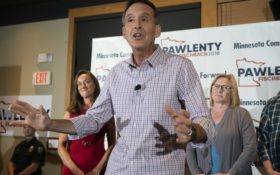
Former Minnesota Gov. Tim Pawlenty, who once called President Donald Trump “unhinged and unfit for the presidency,” lost to a lesser-known county official in the Republican primary, prematurely ending the “Never Trump” Republican’s bid to win back his old job.
Hennepin County Commissioner Jeff Johnson, who won his party’s endorsement but still was considered an underdog, won by nearly 10 points over the former two-term governor and presidential candidate.
“I think it is just further indication that the rules have changed, not just in Minnesota, not just in our party,” Johnson said. “People are expecting something different from candidates.”

Johnson now faces Democratic Rep. Tim Walz, who one a three-way race on the Democratic side to replace outgoing Gov. Mark Dayton.
Republicans need only the governorship to take full control of state government in Minnesota, a traditionally left-leaning state that had become a lone outpost of divided government in the conservative Upper Midwest. Big donors saw Pawlenty as the man to do it.
Johnson had been viewed as a longshot given Pawlenty’s unparalleled name recognition and the money that quickly flowed to his campaign when he announced his campaign in early April. Pawlenty was the last Republican to win statewide in Minnesota with his 2006 victory for a second term.
But conservatives were unwilling to coronate Pawlenty, who didn’t bother challenging Johnson at the state party convention. His loss effectively ends a political career that peaked with two terms as governor and a short-lived 2012 presidential bid.

“Obviously not the result we hoped for and worked for,” Pawlenty said Tuesday night before congratulating Johnson on doing “a great job.”
Pawlenty struggled to live down his October 2016 critique of then-candidate Trump, though he later assured Republican voters that he still voted for the president and supported the bulk of his policies.
His post-political career as a lobbyist for the nation’s largest banks came with the aura of establishment politician trying to force his way back into Minnesota.
Several voters said they liked Pawlenty but believed he’d already had his time. For 21-year-old Republican voter Emma Glynn, Pawlenty’s two prior terms were a knock against him.

Glynn said she’s concerned about the influx of refugees resettling in Minnesota — which is home to the largest population of Somalis outside of east Africa. While both GOP candidates have made a crackdown on illegal immigration cornerstones of their campaign, Glynn said she felt Johnson was better suited to put an end to refugee resettlement.
“And if he’s not, at least he’s someone who’s new,” said Glynn, who works as a server in a restaurant and in a psychiatric group home.
Democrats had expected Pawlenty to win, spending months preparing to face him in the fall. Pawlenty served as a foil in Democratic candidates’ advertising, with Walz saying “I won’t let Tim Pawlenty take us back” in one TV spot. A heavily liberal outside political group spent millions bashing Pawlenty in the lead-up to the primary, with millions more in advertisements reserved for the fall.
Even for some Republicans, the reminders of Pawlenty’s tenure were enough to make them reconsider.
The Associated Press contributed to this article.

Monday, November 28, 2011

Morris' View of the Republican Race


In yesterday's posting, Dick Morris sums up how he feels the race is currently. The only person that he completely leaves out of the race is Ron Paul (unless I missed his mention). We do not know if this is an oversight or his opinion, especially since Paul has out distanced several on his listing.  However, he does categorize Republican voters very interestingly.   Other than the oversight, it is interesting reading.

THE SHAPE OF THE PRES RACE
By DICK MORRIS
Published on DickMorris.com on November 27, 2011

Printer-Friendly Version
To understand the Republican Presidential race, grasp first that the party is one of ideas.  One is born into the Democratic Party.  If you are black or Latino or poor or gay or become a single mother, your partisan identity is often spoken for.  But you become a member of the Republican Party by agreeing with certain ideas.  So there are several distinct groupings within the Republican Party merged together by shared ideals but with sharply different priorities and perspectives.  Imagine that each sector of the party is like a division in the NFL or in Major League Baseball, with its own separate playoffs or pennant race and its own separate champion.  Then, the winners of the divisions meet in the primaries.  We are still in the pre-runoff phase.

Start with the Economic Conservative Division.  These folks are deeply committed to free market economics.  Often from big companies and corporations, they tend to be well off and to believe in capitalism and oppose redistribution of wealth.  In their division, the candidates were Mitt Romney, Donald Trump, Tim Pawlenty, Chris Christie, and Mitch Daniels.  Mitt is the only one left.  He is the champ of that division which guarantees him a berth in the runoffs.

Closely allied to them is the Establishment Republican Division.  This was the group that rallied to Bush-43 and impelled him to the nomination.  They have to choose between Romney, Perry, and Gingrich.  They can't back Cain or Bachmann because both are too much outsiders.  Perry has disappointed them so they are going largely for Mitt.  But some will probably end up for Newt.

Then go to the Evangelical Division. They are motivated by religious and social issues like abortion, gay marriage and such.  The candidates were Mike Huckabee, Herman Cain, Michele Bachmann, Rick Santorum, and Rick Perry.  Huck didn't run.  First Bachmann surged, then Perry and then Cain.  But Cain fell back because of the sex harassment charges.  This block can't support Romney (although they will if he is nominated) because he is Mormon and flip flopped on abortion.  They are reluctant to back Gingrich because of his personal issues.  So they must choose among Perry, Cain, Bachmann, and Santorum.  They haven't chosen yet.  But they will.  One of these candidates has to be in the runoffs because this group has to have a candidate.

Then we go to the national security people.  They are focused on defense, support the war in Afghanistan and back tough protections against terrorism.  Their possible candidates are Gingrich, Bachmann, Perry, Romney, or Santorum.  They won't back Cain because of his inexperience and they disagree with Paul and Huntsman.  Gingrich's strong debate performance turned them on, but Romney is making a strong play for their votes.  Santorum could gain traction, but likely not.  Perry wants their votes, but he hurt himself by his lack of familiarity with the issues. They will probably split between Newt and Mitt.  Between their votes and those of the party establishment Newt can pick up, it virtually assures Gingrich of a runoff birth.

Then there are the Tea Party folks.  They focus on the federal deficit, the national debt, reining in spending, holding down taxes, opposing Obamacare, and reducing government regulation.  They had, initially, to choose among Daniels, Christie, Gingrich, Santorum, Perry, Cain, and Bachmann.  They won't support Romney because of Romneycare in Massachusetts (although they would if he is the nominee).  With Christie and Daniels out, they first went Bachmann because of her battle in Congress to cut spending.  Then they were seduced by Perry but his immigration position turned them off so they went for Cain.  Now they are worried about Cain and are looking at Gingrich or Bachmann or maybe still Cain.

So that's the state of play.  Romney has an assured runoff berth but nobody else does.  If Newt doesn't stumble over his consulting practice or personal issues, he will likely make the runoff as the National Security candidate with good support from the Party Establishment and Tea Party Divisions.

But that would still leave the Evangelicals out there.  They can't back Romney due to his religion or Newt because of his personal issues.  So they will back someone else - Cain, Perry, Bachmann, or Santorum.  And a lot of Tea Party people - who overlap with the Evangelicals - will also be looking at these candidates.  One of these four is going to be in the final mix.

Then it will likely be a three way fight: Romney, Gingrich, and an Evangelical/Tea Party candidate to be named later.

This is the context of the Iowa caucuses.  It is first and foremost a way to sort out the Evangelical/Tea Party conundrum and come up with their candidate.  That's what January 3rd will be all about.

Tuesday, June 28, 2011

Our Latest Poll on Presidential Candidates

In our latest poll, we asked who our readers would like to see as a Presidential Candidate for the 2012 election.  It turned up surprising results.  Current leaders in other polls (Mitt Romney and Sarah Palin) barely scraped up 5% each along with Rick Perry and the formidable "unnamed candidate" while Ron Paul was an out of the box winner at more than 35%. Second place was Herman Cain with 17%. Tied for third were Michelle Bachman and Chris Christy at 11%.  The real losers were Gingrich, Santorum and Pawlenty who did not garner a single vote.

While this poll is far from scientific so to take anything to the bank, would be foolhardy.  However, we have seen other polls where Ron Paul has scored well so he might be stronger than we would have expected.  I am glad to see that Herman Cain scored so well as it proves what I have always thought, conservatives vote for the man and his ideas rather than other "cosmetic" issues.

In the future as the field starts to thin out, we will again run this poll.
Thanks to all who voted.
Tom

Saturday, June 11, 2011

Is Boeing Issue An Indicator of the Future

Government always knows best or they would like us to think so.  They know what is the best health care; they know the best car safety; they know the best drugs and they know what is best for labor unions. None are correct except the last.  Labor unions are best friends with big government. You see both of them believe that others know better than you.
 
In the latest merger of ideas between government and labor unions, we find the desire for a business (Boeing) which wants to create a second manufacturing plant in another state (South Carolina) which just happens to be a right to work state in order to lower its cost of manufacturing for its new 787 Dreamliner plane.
 
 Seems to me a good idea for several reasons.  Not only are the plants not in the same geographic area so natural disasters would not effect both plants.  Additionally, employees could be drawn from different pools of workers some of which might never move to Washington. However, the last positive is the lower cost of labor in South Carolina which has brought a charge by the National Labor Relations Council (NLRB) .
 
The charge is that Boeing is retaliating against their Washington State workers by opening this plant in South Carolina.  Since the new plant will be non union, the unions are up in arms. Maybe if the union had worked with the company on other issues in the Washington plant, this would not have happened.  Regardless, the Republican candidates, notably Pawlenty and Romney, have seized on this as an issue and I say rightly so.
 
Once we start protecting unions against the best interests of the country, we are in trouble.  Now let me make one thing perfectly clear.  Unions have their place and they came into being at a time where there were major concerns for the workers of the United States. I get that and agree wholeheartedly. However, over the past 90 years more or less, the pendulum has changed and the unions are now stronger than the companies and it is time for a move back to the center.
 
A company must have the ability to handle its business so as to make a profit and to do what is in its best interests.  Once the government gets involved to protect the union, it completely changes the dynamics.
 
This move by the NLRB is wrong and should be resisted.  Boeing should be able to make the decision to open a new plant and pay the wages commensurate with the skills of the people employed.  If the pay is too low, people will not work there or they will join a union to increase the wages. Seems simple to me. What about you?
 
We are listening and want to hear from you.
 
 
Here is an article from TheHill's  Blog Briefing Room that gives more information on the issue.


Pawlenty: NLRB’s suit against Boeing evokes 'Soviet Union circa 1970s'

By Ben Geman - 06/11/11 10:55 AM ET

GOP White House contender Tim Pawlenty is ramping up his attacks on the National Labor Relations Board for its complaint against Boeing over the company’s decision to open a non-union airline production plant in South Carolina, allegedly retaliating against unionized workers in Washington state.
“The NLRB decision and what they are saying to an American economy as to where and how they can do business is outrageous. This is not the Soviet Union circa 1970s or 1960s or ‘50s,” Pawlenty, the former Minnesota governor, said on Fox News Friday.
“The idea that we have a federal agency telling an American business in a supposedly free market that it can’t grow a business or start a business in another state is one of the most outrageous things I have seen,” Pawlenty said.
Boeing opened a 787 Dreamliner assembly plant Friday in South Carolina.

The NLRB alleges Boeing decided to place the plant outside its longstanding Washington production hub “in retaliation for past strike activity and to chill future strike activity by its union employees.” The complaint seeks to require Boeing to maintain the second production line in Washington state.
The NLRB complaint has become fodder for GOP candidates seeking to show their pro-business bona fides.
Pawlenty has attacked it repeatedly, and it has also come under fire from former Massachusetts Gov. Mitt Romney and former House Speaker Newt Gingrich.
Democrats and liberal groups are fighting back against criticism of the National Labor Relations Board as they grow worried that the attacks could diminish the labor board’s authority.
A hearing in the case before an administrative law judge is set for June 14 in Seattle.