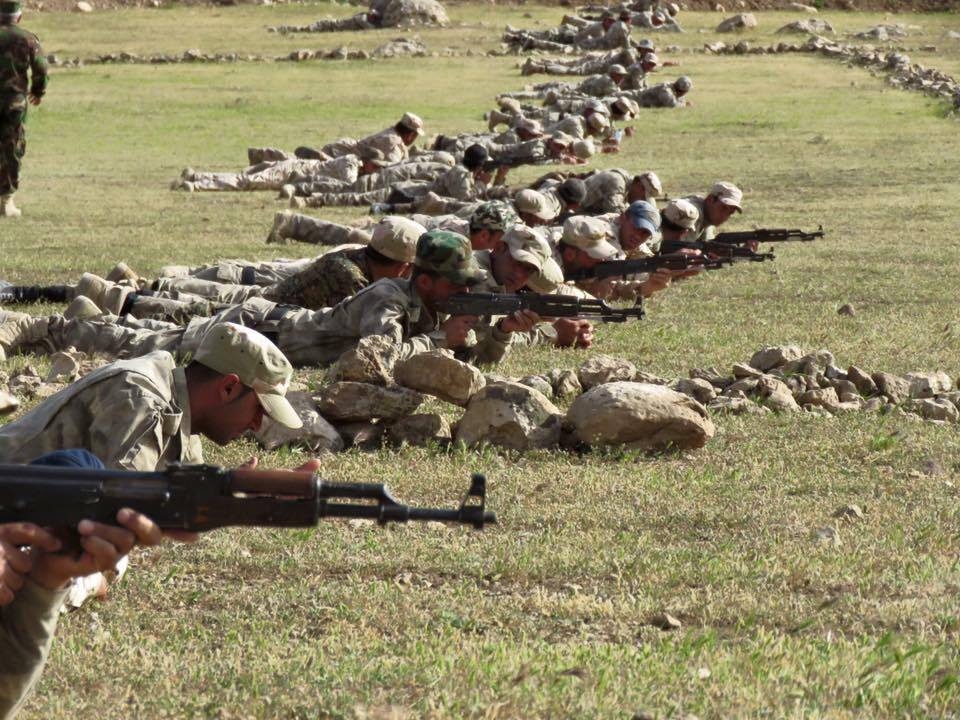
Why Christians Need Self Rule in Iraq
On March 8, three members of an Assyrian Christian family -- Dr. Hisham Maskoni, his wife, Dr. Shadha Malik Dano, and her elderly mother -- were stabbed to death in their home in Baghdad. The two doctors, who had left Iraq, the country of their birth, in 2003, returned five years ago to work at St. Raphael Hospital in the capital.
The victims, who lived in a neighborhood controlled by a Shiite militia, had been tortured, according to Ashur Sargon Eskrya, president of the Assyrian Aid Society-Iraq, in an interview with Gatestone. Eskrya also said that the motive behind the killings -- as in the case of an innocent Christian killed in Baghdad in February -- had not been established, and that so far, no suspects have been arrested. "These murders," he added, "are giving us yet another signal that there is no place for Assyrian Christians in Iraq." An indigenous people of the Middle East, Assyrians have been targeted and murdered over the centuries for their religion and ethnicity. Yet they were once the rulers of the ancient Assyrian Empire. The traditional Assyrian homeland contains parts of Turkey, Iran, Syria and Iraq. The Assyrian legacy to civilization is significant. Ancient Assyrians were pioneers in science, mathematics, astronomy, medicine, literature, art and technology. They were also exceptional builders, as shown by archaeological sites, including those at Ashur, Nimrud and Nineveh in Iraq. With the rise of Islam and the Arabian conquests of the 7th century, however, Assyrians and other eastern Christian peoples fell to a subordinate status -- "dhimmitude" -- which forced them to pay a tax, the jizya, in exchange for "protection." Since then, they have been persecuted repeatedly. According to the Assyrian International News Agency, every fifty years, an Assyrian massacre took place, but the 1914-1923 Christian genocide in Ottoman Turkey dwarfed previous massacres and resulted in the systematic exterminationof around 750,000 Assyrians – nearly three-quarters of their prewar population. After the end of World War I and with the dissolution of the Ottoman Empire, Assyrians were excluded from the new forging of nation-states in the region. In spite of their having been severely persecuted and displaced by Muslims, Assyrians were not granted independence or autonomy in their ancient lands. Instead, they were left to the "tender mercies" of Turkey, Syria, Iraq, Iran and the Kurds. Devoid of a government or security force, Assyrians in Turkey, Iran and Syria have been largely erased from their indigenous homeland. In Iraq's Nineveh Plain, however, Assyrians still form the majority and wish to establish a sustainable and democratic form of self-governance. Assyrians currently have a security force in the region: The Nineveh Plain Protection Units (NPU).
In an interview with Gatestone, Athra Kado, the head of the Assyrian Democratic Movement in the town of Alqosh in Iraq and Director of the NPU media center, said: "Our nation has suffered for centuries. The latest genocide by ISIS, as well as recent murders, such as those in Baghdad, are deeply affecting our people physically and psychologically. The only way for us to have a bright future is to establish a local administration in the Nineveh Plain lands, which will be a safe haven for all persecuted communities, including Yazidis. "The new administration that needs to be established in the Nineveh plain should be protected internationally. This would also include forming a no-fly zone, and having the province monitored by international powers for a temporary period until we strengthen our military force and reconstruct our areas. In order to make this a reality, our Nineveh Plain Protection Units should be supported in both military and logistical terms."Eskrya concurred, recounting for Gatestone: "Throughout the bloody history of the region -- including the 1914-1923 Christian genocide, the 1933 massacre in Simele, the 1963 Iraqi-Kurdish War, the dictatorial regime of Saddam Hussein and the 2014 ISIS genocide -- Assyrians have lost their trust in governments that rule them, and they have even lost their trust in their own neighbors who engaged in kidnapping or even killing Assyrian Christians and raping women.Juliana Taimoorazy, founding president of the Iraqi Christian Relief Council and a senior fellow at the Philos Project, has been advocating serious security measures, economic development and the rebuilding of homes for Assyrians. In an interview with Gatestone, she said: "We fear crimes such as the murder of the Assyrian family in Baghdad will chip away at the hope that has returned to the hearts and minds of those who have decided to return to their towns in the Nineveh plain. However, our resolve is steadfast, and we will not be shaken. I liken our Assyrian nation to a tree that is standing tall amidst terrible winds. Although our branches may break, our roots will always remain solid in the earth of Nineveh."Uzay Bulut is a Turkish journalist born and raised in Turkey. She is presently based in Washington D.C.
© 2018 Gatestone Institute. All rights reserved. The articles printed here do not necessarily reflect the views of the Editors or of Gatestone Institute. No part of the Gatestone website or any of its contents may be reproduced, copied or modified, without the prior written consent of Gatestone Institute.
|
Our goal is to have intelligent discussion of the topics of the day. We realize everyone has their opinion and they should be allowed to express it in a discussion forum without calling each other names. We learn from discussion and not from name calling or argument.We use cookies to personalise content and ads, to provide social media features and to analyse our traffic. We also share information about your use of our site with our social media, advertising and analytics partners. See details
Contact Form
Showing posts with label Assyrian Christians. Show all posts
Friday, March 30, 2018
Christians Need Autonomy
Friday, March 20, 2015
Christian Holocaust Has Begun!
Has a Christian Holocaust begun? When will West wake up to ISIS threat
The recently displaced archbishop of Mosul, Iraq was speaking with particular candor when I met him last fall in the Middle East.
He said, “People in the West say ‘they don’t know.’ How can you not know? You either support ISIS or you must have turned off all the satellites. I am sorry to say this, but my pain is big.”
Like so many Christians in Iraq and Syria who watched ISIS kidnap their leaders, burn their churches, sell their children, and threaten all others with conversion or beheading; the archbishop wonders how it is that these maniacs so easily took his home city this summer?
The people whose lives have been threatened or destroyed by ISIS just don’t understand how this pre-modern evil could run unchecked.
It is a good question.
Mosul is Iraq’s second largest city and was once the home of Iraq’s most vulnerable and persistent Christian community, tracing their lineage nearly to the time of Christ.
Now there are no Christians left.
All of this happened under the watchful eye of West, and while you’d hope that the humanitarian threat alone would have motivated the West to act, you would be certain that Mosul’s strategic importance would do so.
Neither proved true.
Mosul was easily taken by ISIS troops, riding in on their decrepit pick up trucks with guns bolted to them. Her ancient streets have since been turned red with innocent blood, and the city has become a base for a jihad that rages wildly throughout the entire region and boils underground in scores of countries throughout the world.
The archbishop’s perspective represented the sentiment of nearly everyone I have met or have communicated with in the region. The people whose lives have been threatened or destroyed by ISIS just don’t understand how this pre-modern evil could run unchecked.
They wonder how it could be that it took the most powerful nations in the world, using airstrikes, over four months with the help of Kurdish forces to defeat a few hundred jihadists waging war in the town of Kobani, and how it is that ISIS has been able to openly run its “state” from a self-determined capital city called “Raqqa” without the daily threat of hundreds of unrelenting airstrikes. They also wonder how it is that Turkey’s border remains so porous allowing jihadist after jihadist to readily join ISIS.
The examples of Western inaction are unending.
At present, as many as 300 Assyrian Christians remain in captivity having been kidnapped two weeks ago as ISIS assaulted ten Assyrian, Christian villages along the Khabour River in Syria. That assault was conducted by a group of ISIS fighters travelling in a convoy of more than 40 clearly marked ISIS vehicles directly toward these vulnerable, Christian villages.
How is it possible that Western satellites didn’t spot a forty-car ISIS convoy in route to unarmed Christian villages in Syria, and if it was spotted how is that it wasn’t destroyed?
Over and over again, our coalition leaders have demonstrated that they aren’t as serious as they need to be about this threat and it’s time that we put increasing pressure on governments to do more. Now.
The prevailing argument against Western engagement, or Western support of regional engagement, remains a sense that this is “their” fight and not ours. Critics say, “it’s high time the Middle East takes care of their own issues.”
As I chronicle in my book "Defying ISIS" we have witnessed the threat of ISIS spilling over our own borders again and again.
In the last few months we have watched in horror as ISIS sympathizers have attacked innocent people, businesses and governments in at least the United States, Canada, France, Australia, the United Kingdom, and Belgium. Even as we’ve watched wanna-be jihadists travel to and from America and Europe on western passports to fight in the ISIS jihad themselves.
Their propaganda machine is causing mega-corporations like Google and Twitter to struggle to keep up with the amount of jihadist propaganda showing up online every single day, and, shockingly, one study recently noted that one-in-five Arabic language tweets in the United States and the United Kingdom referencing ISIS were in “support” of the organization.
The fact is, we will deal with this crisis there or we will deal with it here.
Not dealing with it seriously is simply not an option.
We expected Syria would fix itself as well.
And what did it get us?
ISIS.
Johnnie Moore is a humanitarian and author who has been called “one of the world’s leading spokespersons for Christians in the Middle East.” His new book,Defying ISIS: Preserving Christianity in the Place of Its Birth and in Your Own Backyard, was released as an eBook on March 13. Keep up with him on Twitter (@JohnnieM) or at Facebook.com/JohnnieOnline.
Friday, February 27, 2015
If Baghdadi Is Dead, It Could Not Happen To A More Deserving Guy! Or Is This More Garbage News?

It was not yet confirmed whether ISIS leader Al-Baghdadi (pictured) was killed. (Photo: Dabiq)
ISIS Leadership Suffers Severe Blow in Iraq
The Islamic State (ISIS or ISIL) suffered a major blow overnight due to US-led coalition airstrikes. Dozens of ISIS operatives are reportedly dead, including much of the top leadership, from an attack on the Iraqi town of al-Qaim along the Syrian border. The airstrikes, which were conducted by French pilots, also caused extensive damage to ISIS’s infrastructure.
According to a report by al-Arabiya, the airstrikes focused on five strategic targets in al-Qaim, including a location where ISIS leadership was scheduled to meet. It is not clear whether ISIS head Abu Bakr al-Baghdadi is among the dead, but he is believed to have been on his way to the meeting at the time of the attack. Many ISIS institutions were also destroyed.
ISIS commanded civilians to stay in their homes in the aftermath. They are currently being joined by reinforcements to help clear the casualties and fight the coalition. US envoy Gen. John Allen told the Senate Foreign Relations Committee on Wednesday that the coalition has thus far eliminated half of ISIS’s leadership and severely hampered its ability to organize logistics.
“Any aura of the invincibility of ISIL has been shattered,” he said.
The Syrian Observatory for Human Rights reported on Monday that 1,465 ISIS members have been eliminated in airstrikes since September 23, 2014. More than 1,000 civilians were also killed.
Nonetheless, ISIS still presents a major threat to the region. The Islamic terror group recently concluded a three-day operation in which at least 220 Assyrian Christians were abducted from 10 villages in northeast Syria. ISIS has killed members of religious minorities, including 21 Coptic Christians in Libya whose beheading was recorded on video last week.
By: World Israel News Staff
Tuesday, February 24, 2015
More Christians In ISIS Hands. Will More Heads Topple? Assuredly.
ISIS Militants Kidnap More Than 70 Christians in Syria
Tuesday, 24 Feb 2015 06:30 AM
Islamic State militants have abducted at least 70 Assyrian Christians, including women and children, after overrunning a string of villages in northeastern Syria, two activist groups said Tuesday.
The extremist fighters swept through the villages nestled along the banks of Khabur River near the town of Tal Tamr in Hassakeh province around dawn on Monday. The area is predominantly inhabited by Assyrians, an indigenous Christian people who trace their roots back to the ancient Mesopotamians.
In the assault, the militants took between 70 and 100 Assyrians captive, said Nuri Kino, the head of the activist group A Demand For Action, which focuses on religious minorities in the Middle East. He said some 3,000 people managed to flee the onslaught and have sought refuge in the cities of Hassakeh and Qamishli.
Kino said his organization based its information on conversations with villagers who fled the onslaught and their relatives.
The Britain-based Syrian Observatory for Human Rights also reported the abductions, but put the number of Assyrians held by the Islamic State group at 90. The Observatory relies on a network of activists inside Syria.
Both activist groups said that most of the captives come from the village of Tal Shamiram, located some 85 kilometers (50 miles) southwest of the provincial capital of Qamishli.
An Assyrian woman from Tal Shamiram who now lives in Beirut said she has been scrambling to find out what has become of her parents as well as her brother and his wife and kids.
"Land lines have been cut, their mobiles are closed," she told The Associated Press. "Have they been slaughtered? Are they still alive? We're searching for any news."
She spoke on condition of anonymity for fear of endangering relatives believed to be held by the militants.
"My family visited me last month and returned to Syria. There were clashes but it was normal, nothing exceptional. I feel so helpless, I cannot do anything for them but pray," she said by telephone, her voice breaking.
The Islamic State group's online radio station, al-Bayan, said in a report Tuesday that IS fighters had detained "tens of crusaders" and seized 10 villages around Tal Tamr after clashes with Kurdish militiamen. IS frequently refers to Christians as "crusaders."
It was not immediately clear what the Islamic State group planned to do with the Assyrians.
The militants have a long history of killing captives, including foreign journalists, Syrian soldiers and Kurdish militiamen. Most recently, militants in Libya affiliated with the Islamic State group released a video showing the beheading of 21 Egyptian Christians.
But the Islamic State group also could use its Assyrian captives to try to arrange a prisoner swap with the Kurdish and Christian militias it is battling in northeastern Syria. There is a precedent: the extremists have released Kurdish school children as well as Turkish truck drivers and diplomats after holding them for months.
© Copyright 2015 The Associated Press. All rights reserved. This material may not be published, broadcast, rewritten or redistributed.The extremist fighters swept through the villages nestled along the banks of Khabur River near the town of Tal Tamr in Hassakeh province around dawn on Monday. The area is predominantly inhabited by Assyrians, an indigenous Christian people who trace their roots back to the ancient Mesopotamians.
Kino said his organization based its information on conversations with villagers who fled the onslaught and their relatives.
The Britain-based Syrian Observatory for Human Rights also reported the abductions, but put the number of Assyrians held by the Islamic State group at 90. The Observatory relies on a network of activists inside Syria.
Both activist groups said that most of the captives come from the village of Tal Shamiram, located some 85 kilometers (50 miles) southwest of the provincial capital of Qamishli.
An Assyrian woman from Tal Shamiram who now lives in Beirut said she has been scrambling to find out what has become of her parents as well as her brother and his wife and kids.
She spoke on condition of anonymity for fear of endangering relatives believed to be held by the militants.
"My family visited me last month and returned to Syria. There were clashes but it was normal, nothing exceptional. I feel so helpless, I cannot do anything for them but pray," she said by telephone, her voice breaking.
The Islamic State group's online radio station, al-Bayan, said in a report Tuesday that IS fighters had detained "tens of crusaders" and seized 10 villages around Tal Tamr after clashes with Kurdish militiamen. IS frequently refers to Christians as "crusaders."
It was not immediately clear what the Islamic State group planned to do with the Assyrians.
The militants have a long history of killing captives, including foreign journalists, Syrian soldiers and Kurdish militiamen. Most recently, militants in Libya affiliated with the Islamic State group released a video showing the beheading of 21 Egyptian Christians.
Subscribe to:
Posts (Atom)