Contact Form

Name

Email *

Message *

Showing posts with label Houthi Rebels. Show all posts

Wednesday, January 25, 2017

Al-Qaeda Should Fear Trump


Reports: First Drone Strikes Under Trump Kill Al-Qaeda Commander in Yemen

SIGN UP FOR OUR NEWSLETTER

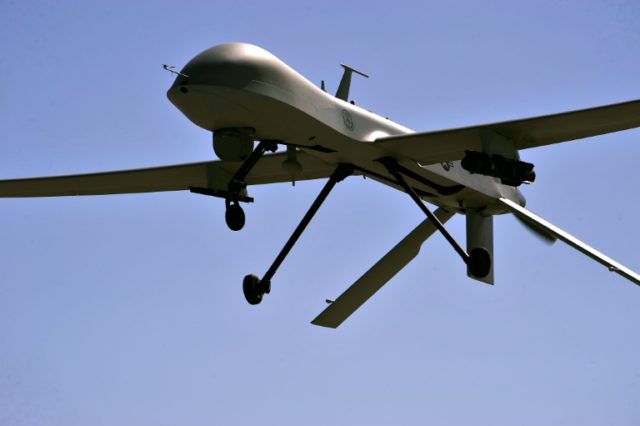
The first reported U.S. drone strikes under President Donald Trump have allegedly killed 10 jihadists from the thriving al-Qaeda branch in Yemen, including one of the terrorist groups’ field commanders.

According to The New York Times (NYT), “The United States did not take responsibility for the strikes, as is its standard policy. No other forces are known to be conducting drone strikes in the area.”
VIDEOAP Top Stories Jan. 14 P

Citing Yemeni security and tribal officials who spoke on condition of anonymity, the Associated Press (APreveals that two U.S. drone strikes on Saturday took out al-Qaeda Yemen field commander Abu Anis al-Abi and two others.
Reporting from the Yemeni capital Sanaa, which has fallen under the control of Iran-allied Shiite Houthi rebels, NYT explains that the two airstrikes targeted the south-central Yemeni province of Bayda, killing “10 militants with Al Qaeda, three of them hit while riding on a motorcycle and the other seven killed in a vehicle in a separate drone attack in the same area.”
Overall, renewed fighting in Yemen reportedly killed an estimated 75 people on Saturday and Sunday, including the 10 jihadists killed in the suspected U.S. drone strikes.

The Times notes:
The greatest loss of life in Yemen over the weekend was from an offensive begun two weeks ago on the Red Sea coast by the Saudi-led coalition fighting on behalf of the [internationally recognized] government of President Abdu Rabbu Mansour Hadi… Airstrikes by the Saudi-led coalition killed at least 52 Houthi fighters in [the Red Sea port city of] Mokha on Saturday and Sunday, according to Yemeni news reports, while the Houthis killed 14 of the Hadi government attackers.”
NYT acknowledges that casualty reports by both sides — the Saudi-led coalition and the Iran-allied Shiite Houthis — vary widely, adding that “the true number of victims was impossible to verify, but it was clear that large numbers had been killed on both sides in the current offensive.”

 Yemeni government forces seize Red Sea port of Mokha: AFP

The Saudi-led coalition in collaboration with forces loyal to the Yemeni president have reportedly seized back the port city Mokha, which the Times notes had been used to smuggle Iranian weapons destined for the Houthi rebels.
The Yemen-based al-Qaeda in the Arabian Peninsula (AQAP), considered one of the most dangerous branches of the terrorist group, has largely benefited from the security and political chaos in Yemen, seizing large swathes of territory and growing stronger than ever, as Shiite Houthis and armed groups loyal to the country’s former President Ali Abdullah Saleh, fight against the U.S.-backed Saudi-led coalition and Hadi forces.
The al-Qaeda branch has tightened its grip on the southern and southeastern parts of the Arab country.
AQAP capitalized on the Saudi-led coalition’s primary focus on the Iran-allied Houthis. Meanwhile, al-Qaeda’s rival the Islamic State (ISIS/ISIL) has also established a presence in Yemen.
In March 2015, deteriorating security conditions forced the U.S. to withdraw its military personnel out of Yemen as the Houthis, which controlled at least nine of the country’s 21 provinces at the time, stepped up their offensive.
The U.S. insisted that it had retained its capabilities to conduct counterterrorism operations in Yemen even after evacuating its troops out of the country and closing its embassy there in March 2015.
It was not until May 2016 that a small contingent of U.S. forces returned to Yemen and began targeting the resurgent al-Qaeda jihadists once again.
The use of drone strikes in Yemen, the world’s poorest country, dramatically increased under President Barack Obama’s watch, particularly in 2012 and 2016, according to data from the Britain-based Bureau of Investigative Journalism, which notes that “there were ten times more air strikes in the covert war on terror during President Barack Obama’s presidency than under his predecessor, George W. Bush.”
“A total of 563 strikes, largely by drones, targeted Pakistan, Somalia and Yemen during Obama’s two terms, compared to 57 strikes under Bush. Between 384 and 807 civilians were killed in those countries,” notes the bureau.
In its second public assessment issued in response to mounting pressure for more transparency about lethal U.S. operations overseas, Obama intelligence officials provided a much lower casualty count on Thursday, saying as many as 117 civilians had been killed in drone and other counter-terror attacks in Pakistan, Yemen, and elsewhere under the former president.
President Trump has vowed to toughen American efforts against terrorist groups.

Tuesday, January 3, 2017

Obama's Motto: Speak Mildly And Wave An Olive Branch. Quite A Difference Between That And What Teddy R Said


Obama Leaves U.S. Navy Without Carrier at Sea for 1st Time Since WWII


 Print

For the first time since World War II, there is no U.S. aircraft carrier at sea to respond to threats, according to Fox News.
In a nearly unprecedented move, there will likely be a nearly one-month gap between the docking of the USS Dwight D. Eisenhower, which docked last Friday, and the deployment of the USS George H.W. Bush, the ship meant to replace it. According to Defense News, the Bush is not scheduled to leave the port of Norfolk until at least the Jan. 20 inauguration of Donald Trump, and it could possibly leave later.
The Bush, Fox News reported, has been delayed in the shipyards for over six months. A carrier at port could be “surged” in order to meet any threat that emerges, the Navy said. However, at a time of geopolitical instability, it is notable that our president has taken arguably taken our most important tool of military prestige and removed it from the waters of the world.

The Navy, meanwhile, refrained from comment on the matter.
“We are not going to discuss the timing of operational movements of carrier strike groups into and out of the U.S. Central Command area of responsibility,” U.S. Naval Forces Central Command spokesman Capt. Terry Shannon told Fox News.
The Eisenhower’s return to port was preceded by a seven-month tour in the Middle East, where the carrier launched hundreds of attacks against Islamic State group targets in Iraq and Syria, both from the Persian Gulf and the Mediterranean Sea.

Meanwhile, off the shores of Yemen, two American destroyers were recently attacked by Houthi rebels, a group sponsored by Iran. There are also, as you may have heard, significant geopolitical difficulties involving both Russia and China.
President Obama has overseen one of the largest downgrades in military prestige that we’ve seen from the executive branch. However, not having a carrier at sea — much less in the Middle East — for the first time since World War II is one of its most disgraceful moves yet. To make things worse, it comes at a perilous time.
While there are other ways that the United States can strike back in case of an attack, the aircraft carrier is the safest, surest projection of strength we have. The fact that Obama has chosen this time, close to a transfer of power in the United States of America, is telling.
We need a president whose leadership can keep America safe. This certainly isn’t how its done. We can only hope Donald Trump does better.

Please like and share on Facebook and Twitter if you agree that what Obama did is an outrage.
What are your thoughts on Obama's move?

Friday, March 11, 2016

Iranian Guns Destined For Houthi Rebels In Yemen


Weapons seized by Australia may have come from Iran, intended for Houthis


Story highlights
  • More than 2,000 weapons were found on a ship off the coast of Oman
  • They may have been sent by Iran and headed for Houthi rebels in Yemen, U.S. Navy says
  • They were discovered by an Australian vessel that's part of a multinational naval partnership
  • The U.N. has arms embargoes imposed on Somalia and rebels in Yemen
(CNN) An Australian naval ship has seized a large arms cache that may have come from Iran and headed to Yemen by way of Somalia.
The Australian Navy said that one of its ships patrolling the region, the HMAS Darwin, intercepted a small, stateless fishing vessel about 170 nautical miles off the coast of Oman when it made the discovery.
On board they found more than 2,000 pieces of weaponry — including 1,989 AK-47 assault rifles and 100 rocket-propelled grenades.
According to a U.S. assessment, the weapons were believed to be initially sent from Iran and were likely intended for Houthi rebels in Yemen, Lt. Ian McConnaughey with the U.S. Navy told CNN.
U.S. Central Command is still gathering more information to determine the arms' final destination, McConnaughey said.
An Australian Defense Ministry spokesman told CNN there were 18 people of various nationalities on board the ship, but officials could not initially confirm that their identification documents were valid.
Authorities believe the weapons were headed for Somalia based on interviews with crew members, but that information is preliminary and may change as the investigation continues, the spokesman said.
The crew was allowed to depart after the weapons were seized, in accordance with international maritime law.
Combined Maritime Forces
Australia is part of a multinational naval partnership, the Combined Maritime Forces, that helps police more than three million square miles of international waters.
CMF routinely conducts boardings to determine the origin of unmarked vessels (so-called “flag verification boardings”) on a “regular basis,” according to McConaughey. A similar number of weapons was seized in September by coalition forces.
The Darwin was on its first patrol in the region when it conducted this seizure, Vice Admiral David Johnston of the Australian Navy said.
“Darwin's successful boarding and subsequent seizure of the weapons concealed under fishing nets highlights the need to remain vigilant in the region,” he said.
Previous accusations
Iran has been accused before of attempting to arm the Shiite Houthis in a civil war that's largely a proxy fight between those two parties and Yemeni President Abdu Rabu Mansour Hadi, who is backed by Saudi Arabia and other Sunni gulf states.
For years, the Houthis have held sway in northern Yemen but lacked influence in the country's Sunni-led government.
The Houthi rebels seized the presidential palace in January last year, temporarily forcing Hadi from Sanaa, the capital city.
Just south of Yemen across the Gulf of Aden, Somalia has been mired in similar violence since civil war broke out there in the early 1990s, following the collapse of the Siad Barre regime. Its relatively ineffective institutions — Somalia has consistently been ranked as one of the world's most fragile or failed states by international observers — largely failed to stymie the rise of piracy and Islamic extremism.
The United Nations has placed arms embargoes on Somalia and rebels in Yemen.

Wednesday, April 1, 2015

Hezbollah Chief Is Realizing That If Arabs Can Go After Yemen's Rebels, Can They Be Far Behind. We Believe He Is Scared!

Hezbollah's Nasrallah: Arabs Should Unite Against Israel, Not Yemini Rebels

“And the LORD said: ‘Behold, they are one people, and they have all one language; and this is what they begin to do?!…” (Genesis 11:6)
Hezbollah leader Hassan Nasrallah sharply criticized the Saudi-led coalition fighting Houthi rebels in Yemen on Friday, saying Arabs should instead be uniting against Israel, their common enemy.
Rebel militias have overtaken the Yemeni capital of Sanaa, along with much of the rest of the country, in recent months, and Saudi Arabia views them as a threat.
Nasrallah called Operation Decisive Storm, “surprising and painful”.
Both the Shiite Hezbollah and the Houthi rebels enjoy Iranian support, putting them at odds with Saudi Arabia. While Iran has openly armed the Lebanon-based Hezbollah, the Islamic Republic denies doing the same for the Houthis, a claim which the Yemeni rebels second.
Nasrallah bemoaned the fact that “for decades there has been no ‘Decisive Storm,’ not even a slight gust of resolve to fight Israel,” claiming Hezbollah would gladly have “partnered” with Arab states on such a campaign.
“You say the new situation in Yemen threatens your national security,” he noted. “Do you not feel the threat posed by Israel, which has one of the strongest armies in the world?”
He continued: “This means that in the eyes of [the Saudis], Israel is not an enemy or a threat that requires such a ‘storm.’”
Nasrallah went on to accuse Saudi Arabia of abandoning the Palestinians to Israel “to murder and expel, and to the US to search for an illusionary diplomatic solution.
“You have money, so why do the Palestinian people live in poverty? This people has called on Iran to aid it, and Iran, despite the economic siege placed upon it thanks to you, has given everything it can to the Palestinian people, both by way of its diplomatic positions and through funding and weapons.”
He charged Saudi Arabia of initiating the campaign because “Saudi Arabia lost its control and dominance in Yemen, and the aim of war is to restore control and hegemony over Yemen. Period.”
He warned the Saudis against continuing their efforts in Yemen. “Throughout history, invaders were defeated and the invaders were humiliated,” Nasrallah said. “The rulers in Saudi Arabia still have an opportunity” to resolve the conflict through negotiations “in order not to face a humiliating defeat.”
Explaining why Iran had succeeded in expanding its influence in the region at Saudi Arabia’s expense, he told its leaders, “you are lazy, losers, and you don’t take responsibility.”

Read more at http://www.breakingisraelnews.com/34795/hezbollah-leader-urges-arabs-to-unite-against-israel-instead-of-yemeni-rebels-middle-east/#hSX3L8pQIWVYrfzi.99