Contact Form

Name

Email *

Message *

Showing posts with label Ludwig von Mises Institute. Show all posts

Tuesday, April 15, 2014

A Brief History Of The West And Federal Governance.

Ranchers And Empire In The American West

April 15, 2014 by  
 79 7
 
 2 258

This column by Ryan W. McMaken originally appeared on the Ludwig von Mises Institute website on April 14, 2014.
The militarized siege of a cattle ranch near Bunkerville, Nev., drew national attention as dozens of federal agents, armed with machine guns, sniper rifles, helicopters and more descended on the ranch to seize cattle and people and generally to show everyone who’s boss.
The conservative press has framed the story in a variety of ways, casting the story both as matter of outright federal seizure of private land and as an absurd environmental crusade to save a tortoise from extinction.
The reality looks to be a little murkier, however, as is often the case when dealing with land ownership in the American West. Back in September, the Las Vegas Sun reported on the Bundy family and noted that troubles began 20 years ago when the family’s patriarch unilaterally determined that he would no longer pay the Bureau of Land Management use fees that have long been required to graze on federal lands. The exact legal and historical details of the Bundy family’s case will emerge slowly over time, but even if the family is completely in the wrong legally (which it probably is), it’s safe to say that taxpayer dollars might be better spent on things other than a shock and awe campaign waged against a tiny ranch in the middle of a Nevada desert. Nonetheless, this is just the latest dispute in a long history of ranchers jockeying with the Federal government over land use permits and land use regulations.
While those who are unfamiliar with land use in the West may see this as some sort of new dastardly deed on the part of the federal government, it is in fact the case that leasing federal land for grazing (among many other things) has been the status quo in the West for more than a century, and the federal government has owned at least 40 percent or more of the land in many Western states ever since it was annexed to the United States in the 19th century. In fact, the nation’s 13 Western states are home to 93 percent of federal land, with two-thirds of all land in Utah and 81 percent of all land in Nevada owned by the feds.
The image of the American West as a place of private property and blissful independence from government control has long been a myth, and the fact is that life in the West has involved the federal government much more so than life in the East much of the time. This is because the land and other natural resources in the West are controlled by a vast socialist bureaucracy governing water, land and minerals going back to the late 19th century. Certainly, within the larger framework of federal control, heavily asserted by a central government bloated by the Civil War, there were many communities that did live extremely independently and in ways that might be considered anarchistic. However, since the 1890s, the overall economy of the American West is best viewed as one that has been dominated by federal land ownership, regulation, subsidies and bureaucracy.

The Rise Of The Federal Bureaucracy In The West

In his history of the American West, Richard White writes:
Beginning in the 1890s, the central government ceased to be a nursemaid to the future states and a prodigal distributor of resources to the country’s citizens and corporations. Washington instead became a manager of Western land, resources, and, inevitably, people.
Behind this was the philosophy that the central government could best ensure that the resources of the Western U.S. were distributed and managed “efficiently.” This belief was the natural outcome of the stilted and error-laden classical economics of the time whose models depended on assumptions about idealized markets and competition that did not exist in the unindustrialized West. In other words, in the minds of 19th-century intellectuals, government intervention would be necessary to create the conditions necessary for the existence of efficient capitalism. As it had done with the railroads, the federal government would step in to ensure competition and efficiency in the new marketplaces of the frontier.
By 1903, Theodore Roosevelt’s Public Land Commission solidified the concept of public ownership throughout the West, thus ending the idea that all lands in the West should be distributed via the homestead acts, which were themselves artifacts of federal government programs.
The rise of the Bureau of Reclamation (which managed water) and the Bureau of Land Management ensured that both water and land would be controlled either directly or indirectly by federal government agencies indefinitely. Whatever the philosophical origins, the situation quickly degenerated into the all-too-familiar situation seen anywhere that the state dominates and controls the distribution of resources. Federal agencies became the target of lobbying efforts by interest groups large and small, with regulatory capture resulting. Leases for land for oil drilling, mining and grazing quickly became important for doing business in the region; and, naturally, maintaining influence within federal agencies under such conditions was a key to success.
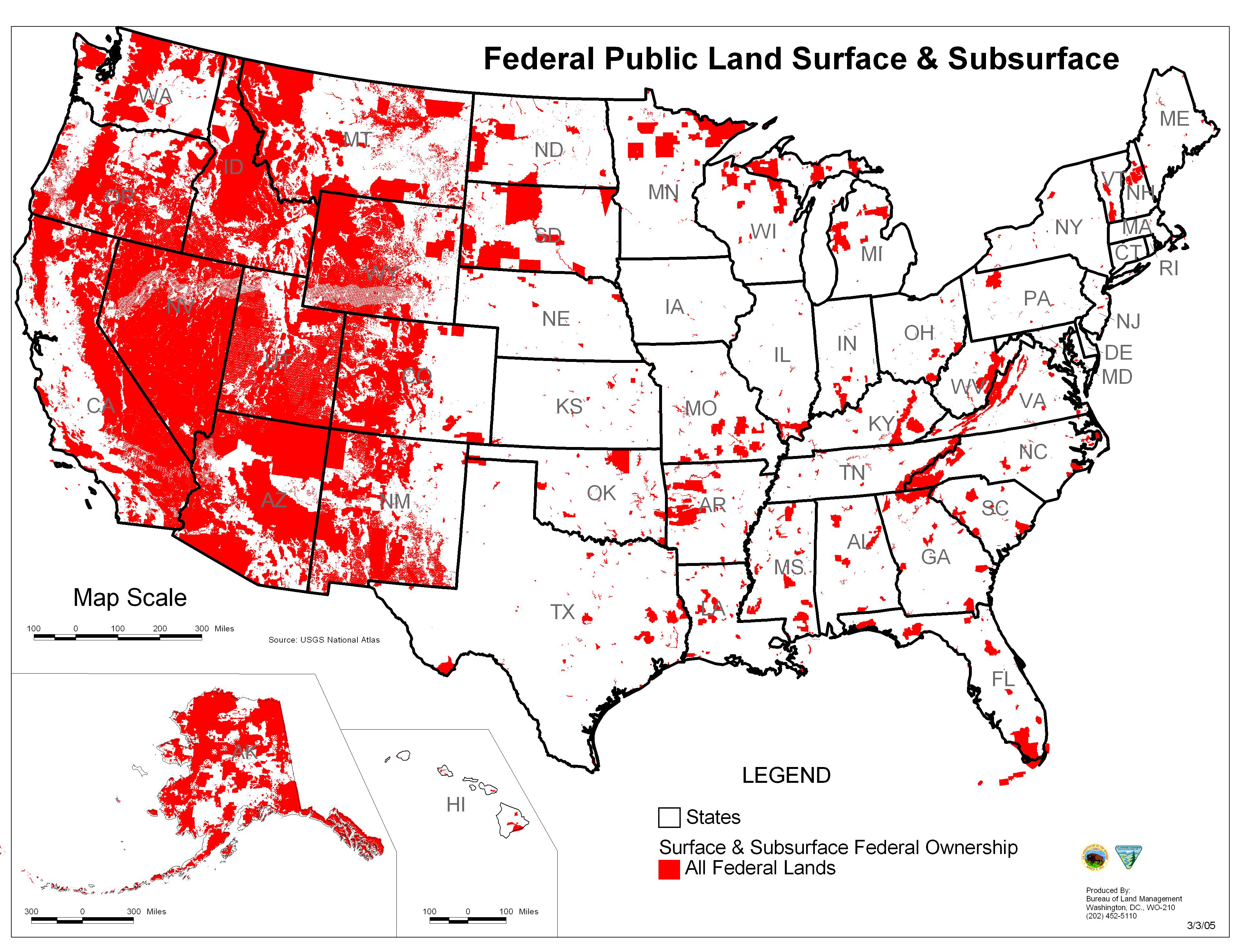
us_public
Support for federal control in the region remained widespread among Westerners themselves. As a region that was poorer and less able to attract capital than the East, many Westerners quickly made peace with this system of federal ownership — not least of all because the Federal government, through subsidies, public works programs and military spending, had become an economic driver in the West.
But competition for control of federal lands among various segments of the population continued all the same. Writes White:
Corporations tended to be more fickle allies of the federal bureaucracies, but on the whole, they, too, proved sympathetic to federal management; certainly they were more sympathetic than small businessmen. Large and small resource users in the West, all pursuing their own calculus of self-interest, split over particular proposals. … Small stock grazers and small lumbermen tended to oppose the new federal presence which tended to thwart their ambition for expansion. Larger stock raisers and big timber companies, however, realized that federal supervision could serve their interests by helping restrain the overproduction that plagued their industries, by restricting the expansion of potential competitors, and by allowing them to turn their greater financial resources into privileged access to the federal domain.
In other words, private firms that dominated the Western economies liked the federal bureaucracy because it helped powerful firms keep prices high and bar entry for competitors.
In later decades, the federal agencies would also be influenced by new environmental and conservationist groups, but for all the talk of preserving the desert tortoise in the Bundy ranch case, it should not surprise anyone if we find later that major oil and gas firms are actually behind the drive to finally end desert access for small ranchers.

The Legacy Of Empire In The West

When we see federal agents harassing ranchers, we should be reminded that the conquest of the American West was really an early exercise in empire that would set the stage for the enormous government that Americans now face today. While we now view the West as just another part of the United States today, it was once a colonial empire seized militarily from Indians and Mexicans, and then — through federal programs such as the homestead acts, land grants and major infrastructure projects like railroads — turned into an enormous source of subsidies for American settlers and corporations. Those who inhabited the lands prior to annexation, such as the Indian tribes and the Hispanos of old New Spain, were rounded up and put in reservations or forced to abandon old economic and social systems.
Like most jurisdictions within colonial empires, the American West was administered not locally, but directly from the capital of the conquering state. It was in D.C. where the borders of new states where drawn, where officials were appointed and where orders were given to federal troops who policed the region. Even after statehood was granted (by the central government, of course), the region remained dominated by the federal government. The overseas empire that began with the Spanish-American War was simply the natural outgrowth of the conquests in western North America during the nineteenth century. It was in the West that the United States government learned how to be an empire, to directly control enormous swaths of land, and to dominate and control local economies.
This legacy continues today. As we viewed the standoff in Nevada, we saw the echoes of a previous conquest of those same lands decades earlier. Many in the West today now find themselves victims of the same federal government that their ancestors once cheered as it drove out the original inhabitants, laid down roads and built dams. The federal government is a fickle master, however; and the fact that it never relinquished control of so many lands that it had seized makes it an undeniable force for all who wish to do business here.
Note: The views expressed in Daily Articles on Mises.org are not necessarily those of the Mises Institute.

Wednesday, March 12, 2014

Railroads Not Example Of Entrepreneurship. Government Waste Exemplified!

Crony Capitalism And The Transcontinental Railroads

March 12, 2014 by  
 4 1
 
 1 21

This article, written by Mises Daily editor Ryan W. McMaken, was originally published by Mises on March 10.
When Barack Obama used the transcontinental railroads as an example of the wonderful things that can be accomplished with grandiose government programs, he was attacked for mistakenly referring to the railroads as “inter continental.” Notably, he was attacked by approximately no one for talking up a government program that in reality should be best remembered as a pioneering feat in government corruption, corporate welfare, and immense waste.
Although not related in quite the heroic terms it once was, the trans­continental railroads retain their place as one of the great alleged suc­cess stories of nineteenth-century America. According to the popular myths, the same myths now exploited by the president, and challenged by no one, the railroads, these supposedly great monuments to the ingenuity of American industrialists, united East and West by bringing together the economies of the West coast and the East coast. This government program then set the stage for the massive economic growth and national greatness that would occur in the United States during the early twentieth century.
And yet, few claims about the necessity or success of the transcontinental railroads are true. While none would argue that transcontinentals would not become economically feasible in the private market at some point, during the 1860s, as the first transcontinentals took shape, there was no economic justification. This is why the first transcontinentals were all creatures, not of capitalism or the private markets, but of government. There simply were not enough people, capital, manufactured goods, or crops between Missouri and the West coast to support a private-sector railroad.
As creatures of government and of taxpayer-funded schemes to subsidize the railroads and their wealthy owners through cheap loans and outright subsidies, the railroads quickly became scandal-ridden, wasteful, and contemptuous of the public they were supposed to serve.
This tale is told in grim detail in historian Richard White’s 2011 tome on the transcontinental railroads, Railroaded: The Transcontinentals and the Making of Modern America, which exposes the near-utter disconnect between the railroads and the true geography of the markets in the mid-nineteenth century.
While it has been long-assumed that the West coast benefited immensely from the transcontinentals that connected the West coast to eastern markets, in fact the overland railroads made little difference. The West coast already had its own economy founded on exports to Europe and Asia, and Californians and Oregonians obtained all the goods they needed by sea. Indeed, for years after their completion, the railroads of the West coast were unable to effectively compete with the steamship operators (many of them also subsidized by Congress) that provided cheaper transportation of goods. Naturally then, this situation degenerated into a political competition between railroads and steamship companies seeking more favorable treatment from the federal government.
In general, however, the economy of the West coast turned to the more efficient and more competitive sea carriers. By the 1860s, the sea carriers were already taking advantage of well-developed trade with the Panama Railroad across Central America, completed in 1855, that was providing true transcontinental shipping at a much lower price over a much shorter overland route.
In spite of massive subsidies and free lands equal in size to New England, the lack of overland trade made it difficult for the railroads to turn a profit, and after a series of bankruptcies, bailouts, and other schemes, railroad owners like Leland Stanford, Thomas Durant, and Jay Gould managed to make a lot of money manipulating federal largesse, but many others, including families and ranchers who followed the flood of money and capital west during the boom, but who found themselves as paupers on the western plains after the bust, were ruined by the railroad’s bubble economy.
With the signing of the first bill to create the transcontinentals in 1862, it was already known that there was no economic justification for the railroads, which is why they were, according to White, “justified on the grounds of military necessity.” Lacking any privately funded-entrepreneurs willing to build a road through more than a thousand miles of territory uninhabited by whites, the 1862 Railroad Act created the Union Pacific, making it the first federally-created corporation since the Bank of the United States. Legal and economic shenanigans ensued, and it would not be until the 1890s that anyone built a privately-funded railroad, the Great Northern Railway.
Indeed, by the 1890s, global progress in technology and technique had greatly reduced the cost of constructing railroads. The benefits of waiting for the private sector to construct railroads when costs and consumer demand made them feasible could have been enormous. The costs of not waiting were indeed huge. The transcontinentals set the stage for the corruption and corporate capitalism that now defines the Gilded Age in the minds of many. While much of the American economy of that era was characterized by very free markets, the railroad markets west of Missouri were anything but. In the end, the railroads constituted a huge transfer of wealth from taxpayers, Indians, Mexicans, and more efficient enterprises who found themselves competing with these subsidized behemoths.
It was the same old story of using the state to socialize costs while privatizing profits. As one opposition Congressman declared in response to the Railroad Bill, the enterprise was “substantially a proposition to build this road … on Government credit without making [the railroads] the property of the Government when built. If there be profit, the corporations may take it; if there be loss, the Government must bear it.”
Even if presented with this information today, many Americans, both left and right, are likely to just shrug and make the consequentialist argument that the railroads were “worth it” because without them, “America” (whatever that means to the one making the argument) wouldn’t be as “great” (another perfectly malleable term) without the transcontinentals being built by the U.S. government. This enormously presumptuous statement, however, completely ignores the opportunity cost of constructing and financing the railroads in that fashion. What else could have been funded with the resources that went to the railroads during the decades following the American Civil War? We’ll never know.
Yet even during the 1870s and 80s, when it became apparent to many that the railroads were a gargantuan waste of money, and most of the railroad companies were in bankruptcy, the railroad’s supporters claimed that it had all been a great idea because, although the railroads were bankrupt, the railroads themselves were still there, and were now presumed to be an immutable part of the landscape forever available for future Americans. Even that argument held no water, of course, because it turns out that railroads require an enormous amount of upkeep and maintenance. This was especially true of the first transcontinentals which were poorly and cheaply constructed, and which required rebuilding in many places. The railroads were in fact huge white elephants that in many cases could only be maintained with cheap government financing and other forms of corporate welfare.
Interestingly, White, in his conclusions in Railroaded, appears somewhat dismayed at the chaos that reigned among the railroad companies and within the so-called markets that connected the railroads to the farmers, ranchers, and miners who used the railroads for shipping. Lacking the insights of the Austrian School, White fails to see the booms, busts, and waste of the transcontinentals as the natural outcome of a government-dominated market divorced from a functioning consumer market or price system. White’s understanding of economics remains mired in neo-classical assumptions using buzzwords like “competition” and “efficiency” as the most important aspects of markets. In this, White is very much like his nineteenth-century subjects who, we learn from White, were themselves stuck in non-Austrian economic thinking that so often concludes that when markets appear to be broken, they can be fixed by government-mandated competition and government-determined prices that are said to be more “efficient.” The central role of the consumer, so well understood by Austrians, was often ignored by even the most consistent free-marketeer of that time and place.
I’m forced to forgive White for his ignorance of economics, however, for he has done a great service in providing us with such detailed and unvarnished documentation of the crony capitalist world of the transcontinental railroads. Although he’s likely a complete stranger to the works of Bastiat, White concludes that the unseen cost of the transcontinentals is one of the great ignored realities of the railroads. Those who dogmatically defend the government’s transcontinentals, White asserts, need to “escape” thinking that assumes the “inevitability of the present.” Yes, it’s a fact that the government-financed railroads were built, and yes, it’s a fact that American standards of living increased greatly in the decades that followed. The assumed connection between those two events, however, is on far shakier ground, and the assumption that it was right to tax and defraud millions of American taxpayers to make the enormous boondoggle a reality, is on the shakiest ground of all.

Wednesday, November 27, 2013

GE's Inside Dealings With Government--It's Enough To Make You Sick!

General Electric’s Crony Capitalism

November 27, 2013 by  
 6 4
 
 0 127
General Electric’s Crony Capitalism
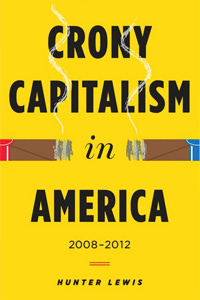
This is an adaptation of chapter 10 from Hunter Lewis’s book Crony Capitalism in America: 2008-2012available in the Mises Store.
During the presidential campaign of 2012, an online commentator observed that President Obama had not met with his Jobs Council for six months. How could this be, the commentator asked, when jobs were foremost on the president’s agenda? The answer was not hard to discover.
The Council was headed by General Electric CEO Jeffrey Immelt, a noted Obama political backer. Other members included Penny Pritzker, an heiress who served as Obama’s finance chairwoman in 2008, and Richard Trumpka, president of the AFL-CIO, one of the largest Obama campaign contributors. The group was established after the 2010 mid-term election losses as a device to emphasize the administration’s focus on jobs but, more importantly, to recognize political allies and campaign donors and prepare for the 2012 presidential election. This was more or less acknowledged when, after the president’s re-election, it was disbanded, despite the persistence of high unemployment.
Why had the president chosen General Electric’s Immelt in particular as the head of this campaign arm? For one reason, Immelt was sympathetic to the president’s brand of state-led capitalism. He had gone so far as to say of China in a television interview: “The one thing that actually works, state run communism, may not be your cup of tea, but their government works.”[1]
In addition, employees of General Electric as a group had been Obama’s ninth largest campaign contributor in 2008, donating $529,855. These donations in part reflected the company’s close and indeed symbiotic relationship with government in finance, defense, green energy, television, technology, and export, and its status as a primary beneficiary of the administration’s stimulus bill. It was impossible to say where the government stopped and General Electric began and vice versa.
Even more importantly, the government rescued the company from what seemed likely to be bankruptcy in 2008-2009. It also let the company off with an exceptionally mild slap-on-the-wrist fine of $50 million for cooking its books in the late 1990s and 2000s, when there might instead have been a large fine and criminal fraud charges.[2] As a further indication of its exceptionally close ties, the Obama administration inserted language into the late 2012 fiscal cliff bill that enabled the company to avoid paying much federal income taxes.[3]
How had General Electric come to be in need of a government rescue during the Crash of 2008? For most of its history, the company was considered the bluest of blue chip firms, the last company that anybody would have expected to be in need of a rescue. Prior to the Crash of 2008, it enjoyed the highest possible score from the financial rating agencies. There was a problem, however: the rating was undeserved, perhaps the result of rating agency myopia, perhaps some behind-closed-door deal.
GE Capital, the company’s finance arm, was the fastest growing part of the company. By 2007, it contributed almost 40 percent of revenues and almost half of the profits. It generated these revenues and profits by using the company’s triple A financial rating to borrow money at rates even lower than paid by banks for short periods of time and then relending for longer periods to consumers, including sub-prime borrowers. This was a classic house of cards. It should have resulted in the company’s bankruptcy. But when, in September 2008, GE ran out of credit, and the survival of the company suddenly became doubtful, Immelt knew what to do.
David Stockman, budget director under President Reagan and professional investor, described what happened:
The nation’s number one crony capitalist — Jeff Immelt of GE — jumped on the phone to [Treasury] Secretary Paulson and yelled “fire!” Soon the Fed and FDIC stopped the commercial-paper [short-term corporate debt] unwind dead in its track by essentially nationalizing the entire market. Even a cursory look at the data, however, shows that Immelt’s SOS call was a self-serving crock.
So in the fall of 2008, the US supposedly stood on the edge of an abyss, with a likely shutdown of the entire financial system, and a Depression from which we might never emerge. But this was actually just hyperbole, a way to scare President George W. Bush and members of Congress. No wonder the former said that “I’ve abandoned free market principles to save the free market system.” To say something so foolish in public in a television interview, he must have actually believed it.
Secretary Paulson is also alleged to have said, after receiving Immelt’s desperate call in September 2008, that he realized the crisis had now spread from Wall Street to Main Street. But he must have known that GE was, by that time, the very embodiment of Wall Street, despite being headquartered nearby in Connecticut. No doubt “helping Main Street” provided good cover for, among other things, saving Paulson’s Goldman Sachs.
By the time the Obama administration arrived, GE spent more money on lobbying than any other company. Immelt was asked first to join the President’s Economic Recovery Advisory Board and then, as we have noted, to chair the Council on Jobs and Competitiveness. When the administration’s Environmental Protection Agency (EPA) began enforcing new rules to reduce greenhouse gas emissions, the very first exemption was granted to a GE-powered facility, the Avenal Power Center in California.[4] Meanwhile, GE built a part for General Motors’ electric car, the Chevy Volt, a favorite project of the administration that had been given hidden subsidies of as much as $250,000 per vehicle along with buyer tax credits.[5] When that proved insufficient to get the car sold, the government bought thousands of Volts for its own fleet.
It was potentially embarrassing to the administration that GE outsourced so many jobs overseas. For example, when Congress outlawed old-fashioned incandescent light bulbs, partly at GE’s urging, manufacture of the new fluorescent bulbs was moved from GE’s light bulb plants in Ohio and Kentucky to China. Also potentially embarrassing, but little known, was that the fluorescents contained mercury, an environmental hazard, and that some of the Chinese workers had reportedly been poisoned by exposure to it.[6] None of this, however, kept GE from benefiting, directly or indirectly, from what may have been billions in Stimulus Act grants.
–Hunter Lewis
Note: The views expressed in Daily Articles on Mises.org are not necessarily those of the Mises Institute.

Hunter Lewis is cofounder of Against Crony Capitalism. He is the former CEO of Cambridge Associates and the author of eight books, including two new books, Free Prices Now! andCrony Capitalism in America: 2008-2012. He has served on boards and committees of 15 not-for-profit organizations, including environmental, teaching, research, and cultural organizations, as well as the World Bank. See Hunter Lewis’s article archives.
You can subscribe to future articles by Hunter Lewis via this RSS feed.
Notes

[1] Charlie Rose CBS interview, http://www.freebeacon (December 10, 2012).
[2] Grant’s Interest Rate Observer (October 5, 2012): 1.
[3] Carney, http://www.washingtonexaminer.com (January 2, 2013).
[4] http://www.washingtonexaminer.com (February 2, 2011).
[6] Times of London: also http://www.washingtonexaminer.com (May 17, 2011).
You can receive the Mises Dailies in your inbox. Subscribe or unsubscribe.
Creative Commons License
This work is licensed under a Creative Commons Attribution 3.0 Unported License.