Our goal is to have intelligent discussion of the topics of the day. We realize everyone has their opinion and they should be allowed to express it in a discussion forum without calling each other names. We learn from discussion and not from name calling or argument.We use cookies to personalise content and ads, to provide social media features and to analyse our traffic. We also share information about your use of our site with our social media, advertising and analytics partners. See details
Brussels saw a big win four days ago when the key suspect behind the 2015 Paris terror attacks, Salah Abdeslam, was caught after a four-month-long manhunt. But that victory has been eclipsed by the devastating explosions that hit the city’s airport and metro transit Tuesday. The Islamic State has claimed credit for these fresh attacks, which have killed at least 32 people and injured around 200.
Here’s Rita Katz, of the terrorist monitoring agency SITE Intelligence Group:
Brussels was by no means a surprising target, as my colleague Feargus O’Sullivan explains; and it’s also not the only one. Sites in Syria and Iraq, where ISIS is active, experience routineviolence. But apart from these places, there are eight other cities that have been touched by terrorism in the past month.
Here is a Google map of those locations, followed by a timeline of the attacks:
March 21: Bamako, Mali
Unidentified gunmen opened fire at a hotel here, where a European Union mission of almost 600 peoplewas headquartered, Reuters reports. The mission’s purpose was to train Malian forces to combat Islamist militant groups active in the region.
One attacker was killed and two others arrested, and E.U. officials came out of the incident unharmed:
It’s not immediately clear which terrorist group the gunmen were affiliated with, although it’s likely linked to the Al Qaeda affiliate in North Africa—the same group that took responsibility for a previous attack on a Bamako hotelback in November. Around 170 people were taken hostage in that attack, and 27 were killed, according to the BBC.
Turkey’s interior minister later linked the attack to the Islamic State; via Al Jazeera:
"We have determined that Mehmet Ozturk, born in 1992 in Gaziantep, has carried out the heinous attack on Saturday in Istanbul," Ala said in a news conference broadcast live on television.
"It has been established that he is a member of Daesh [the Arabic acronym for ISIL]," he added.
I often think of Istiklal as a body part: it is a heart, a backbone, a nerve. On Saturday Istilkal was an artery. Isis wanted it cut.
I read about the bombing and became sick. I texted my friends to see if they were safe, and reflected on how frequent this ritual of checking in after a bombing has become.
March 16: Maiduguri, Nigeria
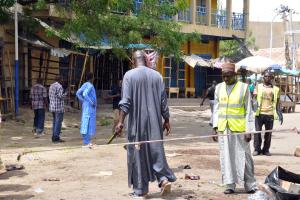
Two female suicide bombers blew themselves up at a mosque in the outskirts of Maiduguri, a city in the Northeastern region of Nigeria, during morning prayers. The blasts killed 24 worshippers, according to The New York Times.
Boko Haram, an Islamist extremist group based in that region has often deployed female suicide bombers to target civilians in Maiduguri, and is likely behind this attack as well. Here’s a bit more context about the city, via The Guardian:
Maiduguri has a population of about a million, and currently hosts almost as many displaced people. About 2.5 million people have been forced to flee their homes during Boko Haram’s six-year uprising. About 20,000 people have been killed in Nigeria and hundreds more elsewhere as the insurgents have carried out attacks in Cameroon, Niger and Chad.
March 16: Peshawar, Pakistan
A blast killed at least 15 and injured around 30 people traveling by bus in Peshawar, a northwestern city of Pakistan that’s routinely targeted by Taliban militants, the BBC reports.
According to Reuters, Lashkar-e-Islam, an ally of the Pakistani Taliban, planted an improvised explosive device under the bus, which was transporting around 50 government officials to their offices in the city.
March 13: Ankara, Turkey
Militants from an insurgent group, Kurdistan Freedom Hawks, set off a car bomb in Kizilay Square at the heart of Turkey’s capital, killing at least 37. The attack was retribution for the government’s military operations in the southeastern region, the BBC reports; and tensions between the Kurdish militants and the Turkish government forces have only escalated since it occurred.
March 13: Grand-Bassam, Ivory Coast
At a resort outside the Ivory Coast city of Abidjan, gunmen belonging to the North African affiliate of Al Qaeda opened fire at people enjoying a leisurely day at the beach, the New York Times reports:
The attack, on the first sunny Sunday in weeks, took place in Grand-Bassam, a popular palm tree-lined getaway for Ivorians and foreigners. Fourteen civilians and two members of the country’s special forces were killed, as well as six gunmen, according to a spokeswoman for the president.
The aftermath of the Ivory Coast beach hotel attacks:
Ivorians have taken to social media to dispel fear and express support for the families affected by the attack. But worries about the lasting damage the attack will inflict on the country’s key tourism industry remain.
March 7: Shabqadar, Pakistan
Around 10 people were killed and 30 injured by a suicide bomb in the small town of Shabqadar, in a northwestern province where the ethnic Pashtun community resides. Via Dawn:
According to police, a policeman tried to stop and search the suicide bomber but he forced his way through the main entrance of the sub-district courts and detonated his vest when another constable pounced on him before he could proceed towards the more crowded family court.
The attack, carried out by the Taliban's Jamaat-ur-Ahrar bloc, was revenge for the execution of the man convicted of killing a liberal governor of Punjab in 2011 who had wanted to change the country’s blasphemy laws.
In the wake of the attacks in Brussels, people have been recalling many of the above attacks on Twitter to highlight that terrorism is not just a Western issue, but a global one:
Maiduguri (Nigeria) (AFP) - Dozens of Nigerian women who were forced to marry Boko Haram fighters were reportedly slaughtered by their "husbands" before a battle with troops in the northeast town of Bama, multiple witnesses said Thursday.
Five witnesses who recounted the massacres to AFP said the Islamist militants feared they would be killed by advancing soldiers or separated from their wives when they fled the town.
They killed the women to prevent them from subsequently marrying soldiers or other so-called non-believers, they added.
"The terrorists said they will not allow their wives to be married to infidels," said Sharifatu Bakura, 39, a mother of three.
Nigeria's military along with forces from neighbouring Cameroon, Chad and Niger have claimed huge victories over the insurgents in recent weeks but defenceless civilians still face serious threats.
- 'Dozens' of corpses -
According to Bakura's account, which was supported by others, Boko Haram fighters received word of a military assault on Bama, formerly an Islamist stronghold in Borno state.
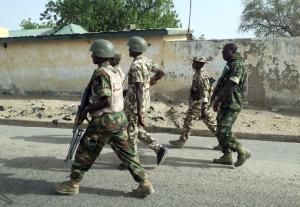
A photo released by the Nigerian Army shows soldiers in Goniri on March 16, 2015 (AFP Photo/)
The insurgents had decided to flee to the nearby town of Gwoza before the troops' arrival but first decided "to kill their wives so that nobody will remarry them", she said.
Bukara's husband was killed by the insurgents four months ago but she was spared from a forced marriage because she was visibly pregnant.
Boko Haram forcibly married scores of women in Bama after seizing it in September. Nigeria's military announced the recapture of the town on Monday.
Witnesses who were taken under military protection this week to Borno's capital Maiduguri, 73 kilometres (45 miles) away, said the killing of women began 10 days before Bama was liberated.
The Islamists said "if they kill their wives, they would remain pious until both of them meet again in heaven, where they would re-unite", said Salma Mahmud, another witness.
A vigilante who fought alongside the military in the battle to retake Bama, Abba Kassim, said he saw "dozens of women corpses" in the town.
Security operatives search on March 7, 2015 for information at the main gate to the Monday Market wh …
- Commander's instructions -
While other witnesses reportedly a similarly high casualty figure the numbers were impossible to verify.
Fanna Aisami, 52, also in Maiduguri after escaping Bama this week, said the executions followed a warning from Boko Haram's top commander in the town.
"He informed them of the situation and the consequence of the takeover of the town by the advancing troops.
"He warned them that when soldiers killed them they would take their wives back to the society where they would be forced to marry and live with infidels," the mother of seven said, speaking by phone to AFP in Kano.
The commander "said it would be better for them to kill their wives and send them to heaven," Aisami added.
A number of women were shot dead in front of the commander's house, she further said.
Yagana Mairambe, 58, reported similar details but told AFP that "some Boko Haram men refused" and fled with their wives towards neighbouring Yobe state.
Nigeria's national security spokesman Mike Omeri told AFP he would try to verify the reports while the military could not immediately be reached for comment.
With Boko Haram gunmen facing heavy military pressure across northeast Nigeria, attacks, including suicide bombings, have persisted, even as the government in Abuja tries to assure voters that March 28 elections will be secure.
The Islamist uprising has claimed more than 13,000 lives since 2009 and President Goodluck Jonathan has faced fierce criticism over failure to contain the violence.
The latest reported atrocities in Bama recall similar massacres at high schools and colleges across northeast Nigeria, where Boko Haram has executed scores of students learning a so-called infidel curriculum.