Contact Form

Name

Email *

Message *

Showing posts with label National Counterterrorism Center. Show all posts

Thursday, November 19, 2015

The Screening Of Syrian Refugees--More Than Eyewash? No Mention Of Illegal Immigrants,

How Syrian refugees get to the United States
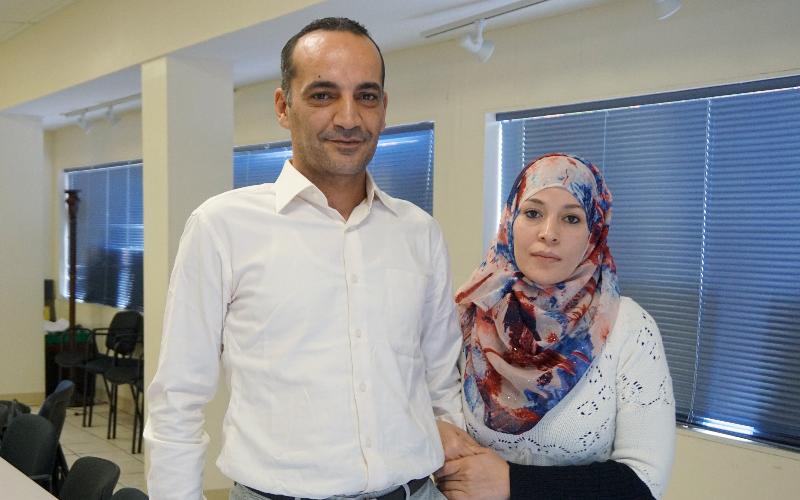
TNS/This couple came to the U.S. 10 months ago after their infant son was killed in an airstrike in Damascus, Syria.
WASHINGTON (TNS) — A growing chorus of lawmakers, including Speaker Paul Ryan, has said the United States Syrian refugee program should be paused while Congress evaluates the process for safety concerns following the Paris attacks.
A CQ Roll Call analysis shows that the 1,869 Syrian refugees who have crossed U.S. borders since October 2014 were likely screened by the FBI, passed an in-person Department of Homeland Security interview and underwent other security and background checks.
The Obama administration said it would take in 10,000 additional Syrian refugees in fiscal 2016. The fiscal 2015 total was 1,682.

The resettlement application process

The United Nations High Commissioner for Refugees
The majority of potential refugee referrals for the United States are delivered by the U.N. High Commissioner for Refugees, serving as an intermediary between the refugee and the United States.
Those attempting to come into the country can also apply on their own, though only about 25 percent do so, a State Department official said during a background briefing for reporters in September. The rest go through this U.N. agency, which also screens refugees before they even come across the radar of a U.S. official.
Department of Homeland Security
Refugees coming from Syria immediately trigger an additional layer of security, known as the “Syria Enhanced Review.”
A U.S. Citizenship and Immigration Services (USCIS) official reviews each refugee’s case before scheduling an interview. If certain criteria are found during the review, the agency escalates the case to its Fraud Detection and National Security Division, according to FDNS acting Associate Director Matthew Emrich testimony at an October Senate hearing.
In-person screening
Once a Syrian refugee’s case is reviewed, a field team conducts an interview to determine whether he or she should legally be considered a refugee, the State Department official said in September.
At that time, USCIS takes fingerprints and a photo of the person applying to come to the U.S.; this data passes through an FBI database. DHS also screens the person against a terrorist and criminal watchlist, as well as a database of previous run-ins with immigration officials.
Security checks
A slew of federal agencies get involved with vetting Syrian refugees, including the Department of Defense.
Most of the security details are classified, though Emrich’s testimony said further checks involve the State Department’s Consular Lookout and Support System, the FBI’s Terrorist Screening Center and interagency checks from the National Counterterrorism Center.
Health screening
While the security checks take place, the refugees undergo health assessments for diseases that could prevent them from entering the United States.
Tuberculosis is the most common disease of concern the U.S. officials find, according to the State Department official on background. Additional screenings include syphilis, gonorrhea and leprosy.
Testing positive for one of these diseases doesn’t automatically disqualify refugees from coming to the United States, but it does delay the process while they undergo treatment.
Arrival
On arriving in the United States, refugees can run into additional questioning from Customs and Border Patrol and the Transportation Security Administration.
Most refugees go through a three-day class giving them basic information about life in the country. Refugees are provided between one and three months’ assistance with housing, food and clothing, according to the State Department.
Refugees lose their refugee status after one year, at which point they must apply for permanent alien status. After five years, refugees are eligible to apply for U.S. citizenship.
–Sean McMinn
CQ-Roll Call

Thursday, February 19, 2015

How Many Terrorists Are Among Those Syrian Refugees Obama Is Bringing Here? 10, 20, 100, 1000? Who Knows, Even The Government Doesn't Know!

image: http://www.wnd.com/files/2015/02/tsarnaev.jpg
tsarnaev
Dzhokhar and Tamerlan Tsarnaev were caught on camera before the Boston Marathon Bombing in April 2013
Amid concerns potential terrorists can take advantage of the U.S. refugee quota for Syrians, it may be instructive to recall the family of Dzhokhar and Tamerlan Tsarnaev, the brothers who carried out the Boston Marathon bombing, were granted political asylum in the U.S. under a similar program.
WND reported last week a senior FBI official has admitted the U.S. is finding it virtually impossible to screen out terrorists that could be hiding among the tens of thousands of Syrian “refugees” heading soon to American cities through the State Department’s refugee-resettlement program.
Dzhokhar Tsarnaev and his parents came in April 2002 to the U.S. on a 90-day tourist visa and applied for political asylum, citing fears of persecution due to the father’s ties to Chechnya.
Tamerlan arrived in the U.S. about two years later. The brothers’ parents received asylum and then filed petitions for their four children, who each received “derivative asylum status.” The brothers are charged with exploding two pressure cooker bombs during the Boston Marathon April, 15, 2013, killing three people and injuring an estimated 264 others.
Further, with the help of President Jimmy Carter’s national security adviser, Zbigniew Brzezinski, a high-ranking Chechen separatist leader accused of terrorism by Russia was granted political asylum in the U.S. and lived for a period of time in Boston.
The Chechen leader, Ilyas Akhmadov, who also served as Chechnya’s foreign minister, insists he was falsely accused by the Kremlin.
Akhmadov was once the deputy to the radical Chechen Islamist leader Shamil Basayev, who was killed in 2006 before being described by ABC News as “one of the most-wanted terrorists in the world.”
Tamerlan Tsarnaev traveled to Russia in January 2012 and visited the North Caucasus, including Chechnya, where Basayev’s predecessors continue to operate.
Shamil Basayev’s picture was reportedly found in the deleted Instagram account of Dzhokhar Tsarnaev.
Chechen rebel and asylum program
Akhmadov has been on Russia’s most-wanted list, charged with organizing terrorist training camps and armed insurgent actions. Despite Russian objections, Akhmadov now lives in Washington, D.C., after the U.S. said it could find no links to terror.
The story surrounding Akhmadov is complicated by accusations and counter-accusations, as well as by the support his asylum application received from prominent political figures, including Brzezinski; Sen. John McCain, R-Ariz.; former Secretaries of State Madeleine Albright and Alexander Haig; and former defense secretary Frank Carlucci.
Akhmadov received asylum from an immigration judge in Boston. The ruling became effective in August 2004 after the Department of Homeland Security’s abrupt withdrawal of its notice of appeal to the judge’s decision.
He also received a grant from the National Endowment for Democracy.
“I’m not exaggerating when I say that one of the happiest days of my life was when I called Ilyas to tell him that he would be able to stay in America,” said Brzezinski in an interview with his nephew, Matthew Brzezinski, who wrote an extensive August 2004 profile of Akhmadov for the Washington Post.
Zbigniew Brzezinski also wrote the forward for Akhmadov’s 2010 book, “The Chechen Struggle: Independence Won and Lost.”
Russia: ‘He’s a terrorist’
Russia strongly opposed the asylum.
“He’s a terrorist, there is no doubt about it,” Aleksander Lukashevich, a senior political counselor at the Russian Embassy in Washington, told the Washington Post in 2005. “We have proof. … Our foreign minister has made Russia’s position on extradition quite clear.”
“How would Americans feel if Russia offered sanctuary to Osama bin Laden?” asked the Russian online newspaper Pravda.
Russian President Vladimir Putin accused the U.S. of hypocrisy for granting Akhmadov asylum.
“We cannot have double standards while fighting terrorism, and it cannot be used as a geopolitical game,” Putin said.
Akhmadov was charged with organizing terrorist training camps and leading 2,000 armed insurgents in a deadly 1999 Dagestani incursion.
Akhmadov was also once an aide to Shamil Basayev, leader of Chechnya’s violent jihadist movement.
Basayev led the most famous Chechnya rebel attack, dubbed the Budyonnovsk hospital hostage in 1995.
In the attack, more than 1,000 hostages were held for a week, and 100 of them were killed when Russian forces stormed the hospital. Russia says the hostages were mainly executed by Basayev’s men, while the rebels claimed Russian forces killed the hostages in the firefight.
Akhmadov told Matthew Brzezinski in 2004 that he distanced himself from Basayev after the war leader became an Islamic fundamentalist. Akhmadov went to work at the Chechen foreign ministry.
“I found him someone whose life was dedicated to peace, not terrorism,” Albright assured then-Attorney General John Ashcroft in a 2003 letter endorsing Akhmadov’s request for political asylum.
“I have met with Mr. Akhmadov on three occasions,” McCain wrote to DHS. “I have found him to be a proponent of peace and human rights in Chechnya.”
Washington Post editorial supporting Akhmadov’s asylum described him as opposing the use of suicide bombings and for working for a “negotiated peace” in his country.
Syrian refugees
The news media have reported concerns over a program to bring to the U.S. Syrians caught up in the ongoing insurgency targeting the regime of Syrian President Bashar al-Assad.
Nicholas Rasmussen, director of the National Counterterrorism Center, told the House Homeland Security Committee on Wednesday, “It’s clearly a population of concern.”
Numerous GOP lawmakers expressed fears Syrian jihadists could take advantage of the refugee program.
Committee Chairman Mike McCaul, R-Texas, asserted it would be a “huge mistake” to bring Syriam refugees from the conflict to the U.S.
Larry Bartlett, the State Department’s director of refugee admission for the Bureau of Population, Refugees and Migration, told ABC News that each refugee is vetted through an “intensive” system run by numerous U.S. intelligence agencies, including the Pentagon.
However, some counter-terror analysis and lawmakers have raised questions about the U.S. government’s ability to screen for potential jihadists from amongst the refugees.
A letter to National Security Adviser Susan Rice signed by McCaul and other leading Republicans warned, “The continued civil war and destabilization in Syria undeniably make it more difficult to acquire the information needed to conduct reliable threat assessments on specific refugees.”
The U.S. government “cannot allow the refugee process to become a backdoor for jihadists,” they wrote.
WND reported a senior FBI official expressed further concern about the ability to screen out terrorists that could be hiding among the thousands of Syrian “refugees” heading soon to American cities.
Michael Steinbach, deputy assistant director of the FBI’s counter terrorism unit, was questioned by McCaul at Wednesday’s House Homeland Security Committee.
“Would bringing in Syrian refugees pose a greater risk to Americans?” asked McCaul.
“Yes, I’m concerned,” said Steinbach. “We’ll have to go take a look at those lists and go through all of those intelligence holdings and be very careful to try and identify connections to foreign terrorist groups.”
In Iraq, where the U.S. maintained a large occupation force, the U.S. government’s vetting process missed “dozens” of Iraqi jihadists who slipped into the country posing as refugees and took up residence in Kentucky, according to a November 2013 ABC News report.
With additional research by Joshua Klein.

Read more at http://www.wnd.com/2015/02/terrorists-already-hit-u-s-via-refugee-program/#rF5lB0QfjiwQvx0C.99