Palestinian Leaders Punish Gaza, Blame Israel
Until a few days ago, the Palestinian Authority (PA) and its leaders were strongly denouncing Hamas for its brutal crackdown on Palestinians protesting economic hardship in the Gaza Strip. Now, the PA is condemning Israel for launching military strikes on Hamas targets in the Gaza Strip. The Israeli strikes, however, were provoked; they came hours after a long-range rocket fired from the Hamas-ruled Gaza Strip hit a house in the Kfar Saba region of Israel, and injured seven people. The PA and its leaders, including Mahmoud Abbas, have yet to condemn the launching of rockets at Israel. Instead of condemning those responsible for firing the first rocket, which miraculously did not result in any deaths when it hit a home in the early hours of the morning, the PA leaders are lashing out at Israel for launching a "new aggression" against the Gaza Strip. According to the logic of the PA, the conflict started when Israel fired back. The leaders of the PA seem especially careful not to blame Hamas or any other Palestinian group for the latest tensions in the Gaza Strip. In a series of statements in the past few days, PA officials sought, as usual, to put all the blame on Israel. These are the same officials who, until a few days ago, were attacking Hamas for breaking the bones of Palestinian protesters who took to the streets of the Gaza Strip to demand improved living conditions and a solution to the soaring unemployment there. Abbas and his officials have apparently not heard of the arson kites and booby-trapped balloons that have been launched from the Gaza Strip towards Israeli towns on nearly a daily basis over the past few months. They also apparently have not heard of the rockets and mortars that are fired from the Gaza Strip at Israel almost every day. The PA further appears unaware that Hamas has been sending thousands of Palestinians, including women and children, to demonstrate near the border with Israel and attack Israeli soldiers with explosive devices, firebombs and rocks. These demonstrations, which began exactly a year ago under the banner of the "March of Return," have resulted in the deaths and injury of thousands of Palestinians. Rather than demanding that Hamas cease and desist from endangering the lives of Palestinians by sending them to clash with Israeli soldiers and breach the Gaza-Israel border, the PA and its leaders are condemning Israel for perpetrating "crimes" against Palestinians. The PA envoy to the United Nations, Riad Mansour, said this week that the current tensions in the Gaza Strip were the result of the "silence of the international community towards Israeli crimes." Another reason for the escalation, he claimed, was the "blockade" -- which Israel established at its border of the Gaza Strip to prevent weapons being brought in -- and the use of force against Palestinian demonstrators. Mansour was echoing the official PA position of holding Israel -- and Israel alone -- responsible for the violence and suffering of the Palestinians in the Gaza Strip. This is the same PA that has been imposing severe economic and financial sanctions on the Gaza Strip since 2017. Those sanctions include, among other things, cutting salaries and welfare payments to thousands of Palestinian employees and families in the Gaza Strip. The PA is even considering additional sanctions against the Gaza Strip as part of its effort to undermine the Hamas regime. On the one hand, the PA is accusing Israel of imposing restrictions on the Palestinians in the Gaza Strip. On the other hand, it is the PA itself that is punishing the people there by cutting their salaries and firing thousands of civil servants. When Palestinians in the West Bank took to the streets to protest the PA sanctions against the Gaza Strip, the PA sent its security forces to break up the protests and arrest many of the demonstrators. This is the same PA that is now accusing Israel of using force to disperse Palestinian protesters at the Gaza-Israel border. Until a few days ago, the PA was accusing Hamas of committing crimes against unarmed Palestinians protesting the high cost of living and increased taxation by Hamas. Now, the PA is denouncing Israel for targeting Hamas after Hamas fired rockets into Israeli towns. One PLO official, Tayseer Khaled, went as far as likening Hamas's repressive measures to those of Nazi Germany's secret police, the Gestapo. Another Palestinian official, Jamal Muheissen, said that Hamas was like a terrorist group that has hijacked an airplane. Last week, Abbas himself denounced Hamas as "dogs" and said that it will end up in the dustbin of history. "They [Hamas] can go to hell; those dogs," Abbas saidwhile he was visiting in hospital a senior Fatah official who was reportedly badly beaten by Hamas members in the Gaza Strip. The official, Atef Abu Seif, was transferred from the Gaza Strip to a hospital in Ramallah. Abbas and the PA are furious because Hamas militiamen and security officers have been breaking the arms and legs of protesters in the Gaza Strip. They do not seem overly concerned, however, when Hamas or other groups in the Gaza Strip indiscriminately fire rockets and booby-trapped balloons at Israeli civilians. Abbas says he would like to see Hamas "go to hell" and "end up in the dustbin of history," but when Israel responds to Hamas's rocket attacks, he and his officials rush to condemn Israel. Clearly, the PA leaders are afraid to condemn the rocket attacks on Israel. They evidently do not want to be accused by their people of betraying the Palestinian "resistance" against Israel. The PA's anti-Israel incitement makes it impossible for Abbas and his PA officials to speak out against terror attacks on Israel. Without a doubt, Abbas despises Hamas and would indeed see it buried and gone. Deep down, he and his officials also likely hope that Israel will one day do that job for them. The PA leaders, however, do not hate Hamas because it launches rockets at Israel. They hate Hamas because the Islamist movement humiliated them and expelled them from the Gaza Strip in 2007. They hate Hamas because since then, Hamas has been arresting, beating and torturing Abbas loyalists in the Gaza Strip. Abbas and the PA are simply doing the one thing they are good at: trying to frame Israel for Palestinian crimes against their own people. Only when Hamas beats the brains out of PA supporters do Abbas and his associates respond. As far as they are concerned, rockets and mortars can explode to their hearts' content -- as long as they land on Israeli homes. Thanks to this double game, which the PA has been playing for a long time, Abbas and his senior officials appear increasingly to be losing credibility among their people. Khaled Abu Toameh, an award-winning journalist based in Jerusalem, is a Shillman Journalism Fellow at Gatestone Institute.
© 2019 Gatestone Institute. All rights reserved. The articles printed here do not necessarily reflect the views of the Editors or of Gatestone Institute. No part of the Gatestone website or any of its contents may be reproduced, copied or modified, without the prior written consent of Gatestone Institute.
|
Our goal is to have intelligent discussion of the topics of the day. We realize everyone has their opinion and they should be allowed to express it in a discussion forum without calling each other names. We learn from discussion and not from name calling or argument.We use cookies to personalise content and ads, to provide social media features and to analyse our traffic. We also share information about your use of our site with our social media, advertising and analytics partners. See details
Contact Form
Showing posts with label Palestinian Authority. Show all posts
Thursday, March 28, 2019
And Some Want Israel To Negotiate With This?
Thursday, May 31, 2018
A Plot Of Land With International Implications
EU and Palestinian Illegal "Facts on the Ground"
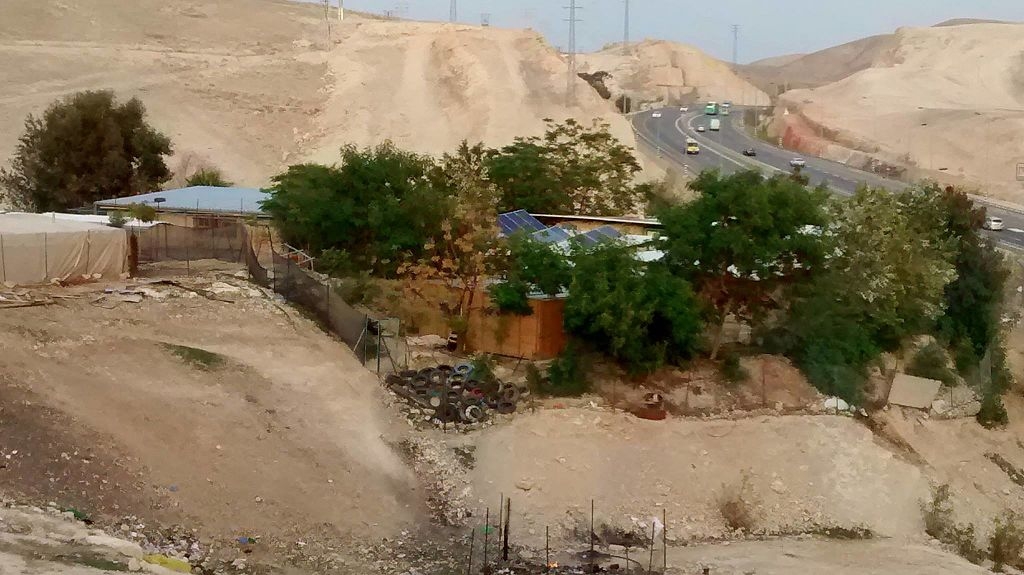
What the Palestinian Authority, the European Union, Israel's High Court of Justice, three Israeli towns, and the Jahalin tribe have in common is the Bedouin settlement of Khan al-Akhmar.
The battle for this Arab settlement has been waged in the international media and the Israeli Supreme Court for more than a decade, and its story is a microcosm of the Arab-Israel conflict, complete with alternative narratives, shifting alliances, unclear lines of responsibility and murky vested interests. The first problem is that Khan al Akhmar is located in an area, unpoetically named Area C, where, according to the United Nations, "Israel retains near exclusive control, including over law enforcement, planning and construction." This small cluster of Bedouin homes is actually sitting on land in an Israeli township, Kfar Adumim, at a strategic crossroads between Jerusalem, the Dead Sea, and the outlying Arab neighborhoods of Jerusalem, making it crucial both to the Israelis and the Palestinians. Until fairly recently, the residents of the Arab settlement -- a branch of the Jahalin tribe of Bedouin -- had lived in southern Israel. At some point in the 1970s, a feud broke out between different branches of the tribe, and the Jahalin fled northward, and arrived in the Maaleh Adumim region in the late 1970s, where they have remained ever since. Like almost all other Bedouin in the Middle East, they began to abandon their nomadic lifestyle in favor of more permanent settlements and livelihoods not dependent on shepherding. Unfortunately, this branch of the tribe set up camp in a strategically critical area near a major highway, and began tapping into municipal water and electricity lines for subsistence. Here is the other problem: since the 1980s, when their squatter's camp began to take shape, it has always been illegal as well as impractical. Its proximity to the highway has been posing a safety hazard for the Bedouin children who play alongside it, as well as for the motorists who must avoid being hit by the rocks thrown at their vehicles. Out of literally dozens of these incidents reported in the press, here are a few examples: From the day the Jahalin set up camp on this spot, they knew that they were squatting inside an Israeli municipality, and that it was not a long-term solution for their housing needs. What they did not know was that the Palestinian Authority had designs on the same piece of land, but for different reasons, and that international forces would soon begin to use them as chess pieces in a high-stakes game against Israel.
On August 23, 2009, Salim Fayyad, then Prime Minister of the Palestinian Authority (PA), published his master plan for the creation of a Palestinian State. The basis of "The Fayyad Plan" (officially titled "Palestine: Ending the Occupation, Establishing the State") was -- and remains -- the creation of a de facto state without the need for negotiation with Israel, through facts on the ground in areas under full Israeli administrative and security administration. One of the key areas in the "facts on the ground" vision of Palestinian statehood, as opposed to the mutually agreed-upon negotiations of the Oslo Accords, is precisely the region near the highway. The Jahalin Bedouin squatters presented a perfect means of establishing an extra-judicial foothold there. For the Palestinian Authority, the best interests of the Jahalin Bedouin were beside the point. The real story was the land. Building on it was key to taking possession of an otherwise unattainable piece of territory, and then making this possession appear irreversible. So while the PA and the European Union continue to pay lip service to their commitment to a negotiated settlement, their behavior indicates that this is not their intention: The Palestinians have no interest in a negotiated settlement, and the EU's continued bankrolling of illegal construction in Area C actually encourages the Palestinians not to sit down and to talk to the Israelis. Why should they negotiate, if they can get everything they want by simply replicating the story of Khan al Akhmar in strategic points throughout Area C? Like it or not, the Oslo Accords -- which the Palestinian Authority signed and the European Union witnessed -- clearly state that Israel has sole responsibility for issuing building permits, zoning and planning. Even without the Oslo Accords, the Hague Conventions -- the accepted basis for international law -- place sole responsibility for issuing building and zoning permits on the State of Israel. Back to the Bedouin: some of them Bedouin in neighboring clusters signed relocation agreements; others simply pulled up stakes and moved elsewhere to avoid the construction and traffic around the highway; all of them understood that they could not remain where they were. Then, the Palestinian Authority and the European Union jumped in, giving this cluster of tents and shacks a name, pumping money into "Khan al Akhmar," and kicking up a vast media storm about destitute Arabs being dispossessed from their "historic" community. An Italian NGO, Vento de Terra, built a school on the site to serve Bedouin children from across the region. They bombarded the media with images of barefoot Bedouin children living under the threat of dispossession and ethnic cleansing by Israel, and pressured the Jahalin to cooperate (as reported in the High Court decisions on the case). The Bedouin buckled under the pressure and allowed their new "representatives" to take charge: The residents of Khan al Akhmar remained where the PA wanted them. The Jahalin Bedouin were "represented" by the PA and the EU in four separate lawsuits, stalling the relocation of the squatters for more than a decade. In each case, Israel's Supreme Court confirmed that the Bedouin encampment at Khan al Akhmar was illegal and needed to be evacuated to a State-sponsored alternative location. For ten years, the Israeli government suspended the demolition and evacuation orders, considered any and all alternatives, and eventually created a new, legal option to relocate the Bedouin on State-owned land only five miles away near Abu Dis, an Arab neighborhood on the outskirts of Jerusalem. The new neighborhood, "Jahalin West," offers a package worth more than half a million shekels (nearly $140,000) for each wife in each of the many-wived Jahalin households. Each wife would receive, free of charge, a large plot of land, completely developed and zoned for residential construction, with water and electricity. Jahalin West would offer services that these Bedouin have never had -- services the PA has never offered them: running water, electricity, permanent homes they themselves are free to design, health clinics, public transportation, schools, access to employment, and more. Jahalin West is ready and waiting; it has been lying dormant for years. The "representatives" of the Jahalin have repeatedly rejected the State's relocation package and refused to allow the Jahalin to rebuild their lives in a new neighborhood if it means losing their grip on the land they are presently occupying. After allowing the Jahalin's lawyers one last chance to come up with a feasible alternative to Jahalin West, which they were unable to do, the Supreme Court closed the book on Khan al Akhmar. The High Court's recent decision rejected two petitions that had been filed on behalf of the Bedouin. "There are no legal grounds to justify intervention in the Minister of Defense's decision to enforce the demolition orders that were issued against the illegal structures in Khan al Akhmar," wrote Justices Sohlberg, Willner and Baron. "This decision does not make light of the complex human aspects that are unavoidable in a large-scale evacuation of illegal construction, despite its illegality. Law enforcement is important, as is the attempt to reach a resolution through dialogue and peaceful means.The judges criticized the plaintiffs' conduct, noting that they had repeatedly taken advantage of the State's willingness to reach an agreed-upon solution by presenting futile, unfeasible suggestions. "The impression is that the aim of these alternative suggestion was to 'buy time.' ... Raising unrealistic suggestions at this point, after years in which the State postponed enforcement of demolition orders in order to consider alternatives, is unacceptable."The decision denied the plaintiffs' request that the Court intervene in the State's decision to enforce the law, and expressed the hope that the matter could be resolved peacefully and in an atmosphere of cooperation. The Palestinian Authority has already announced its intention to resist the relocation of the Jahalin to their new, legal neighborhood near Abu Dis "by all available means," and the international uproar has begun. Israel is being condemned for "cruel and inhumane" treatment of the Jahalin, and for its attempts to commit supposed "ethnic cleansing" and "forced population transfer." The French government (which has a rather poor record of summarily deporting nomadic groups en masse) has declared Israel's High Court decision a violation of international law, while at the same time explaining that Khan al Akhmar is of "critical strategic importance to the contiguity of the future Palestinian State." The coming weeks will be a test of Israel's sovereignty and resolve. At the same time, the weeks ahead will also expose the real intentions of the PA and the European NGOs and governments who continue to bankroll illegal construction and land seizure in areas recognized by international law to be under Israeli jurisdiction. Bassam Tawil is a Muslim Arab based in the Middle East.
© 2018 Gatestone Institute. All rights reserved. The articles printed here do not necessarily reflect the views of the Editors or of Gatestone Institute. No part of the Gatestone website or any of its contents may be reproduced, copied or modified, without the prior written consent of Gatestone Institute.
|
Subscribe to:
Comments (Atom)