Trump, One Year After the Election: Achievements and Failures
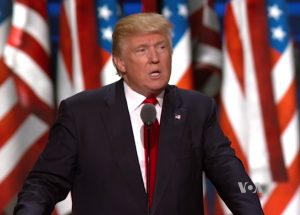
Donald Trump accepts nomination, photo via Voice of America - Wikimedia CC
BESA Center Perspectives Paper No. 647, November 20, 2017
EXECUTIVE SUMMARY: No president, particularly one lacking experience in politics, can achieve his goals without the cooperation of government authorities, the media, and the public. Thus far, Trump has not demonstrated the ability to learn lessons that will bring him to this place, and his public approval ratings have accordingly plummeted. Should he sustain his erratic conduct, Republicans may well distance themselves from his policies in next year’s midterm congressional elections. This will make it even harder for him to pass laws, budgets, and programs.
Donald Trump’s victory in the presidential elections held a year ago surprised veteran politicians, renowned election experts, prominent journalists, seasoned commentators, and senior academicians. Few believed that a real estate tycoon lacking political or public experience and exhibiting an unruly and excitable style could be elected to one of the world’s most important positions. Experts failed to grasp the degree of alienation and revulsion felt by voters in the face of the failing conduct of Washington politicians.
After Trump entered the White House, many believed or at least hoped that the sheer weight of the position and the responsibility would render his conduct more presidential, but this did not happen. Personality changes are not easily made, especially at an advanced age.
Trump is one of the strangest presidents in American history. He is blunt and sometimes rude; he likes to confront and humiliate both individuals and whole sectors; he is temperamental, at times to an extreme; and he takes almost everything personally. Many share the sense that he sees himself and his job as nothing more than as host of a reality show – a sequel of sorts to “The Apprentice,” a program he hosted successfully in the past.
At times, it seems Trump is driven solely by the desire to systematically undo the legacy of his predecessor, Barack Obama – its good parts as well as its bad. Whether or not that was his original intent, he frequently changes his mind and sometimes contradicts himself.
Trump was unable to create a functioning system in the White House, and broke records in terms of bizarre appointments and quick layoffs. For almost the entire first year of his term, complete chaos ruled in the White House. Within a few months, he had fired or forced the resignation of senior officials and confidants. They included his political adviser, widely considered the architect of his victory, Steve Bannon; White House Press Secretary Sean Spicer; his replacement, Anthony Scaramucci; White House Chief of Staff Reince Priebus; and National Security Adviser Michael Flynn.
Trump broke many conventions. He was the Republican Party’s nominee, but some of its leaders viewed him as a foreign element, criticized his style, and objected to his positions on important domestic and foreign issues. Those within the party who have been opposed to Trump included John McCain (the Republican presidential candidate against Obama in the 2008 elections), Senators Marco Rubio and Lindsey Graham, House Speaker Paul Ryan, and former President George W. Bush.
Senator Bob Corker, chairman of the Senate Foreign Relations Committee, who was Trump’s confidant and candidate for secretary of state, described the president as unstable. He said Trump has turned the White House into “an adult day care center,” and suggests that he is a dangerous man on the path to bringing about World War III.
From the onset of his term, Trump has struggled with the authorities and the media. He condemned judges who canceled his immigration restrictions, dismissed FBI Director James Comey on the grounds that he had been negligent in the Hillary Clinton e-mail investigation, and nearly fired Attorney General Jeff Sessions for not rising enough to his defense on the “Russiagate” investigation. He also confronted Congress for rejecting his efforts to cancel Obamacare and to pass laws he advocated.
Trump also conducted an unprecedented campaign against the media, both print and electronic, which he accused of disseminating “fake news” about his conduct and policies. Indeed, the media, especially east coast liberal outlets such as The New York Times, The Washington Post, MSNBC, and CNN did attack him with a fair amount of bias, but his retorts went far beyond focused, substantive responses. He used his Twitter account to lash out against his rivals both domestically and abroad. Never has there been an American president who acted in such a way, with all attempts to reduce or moderate his tweets coming to nothing.
In one area – a very important area to him and to the public – he has succeeded greatly. The US economy is flourishing, showing mostly positive data: growth reached 2.4%, and industrial productivity went up about 3%. Wall Street investments are up almost a third. At the same time, unemployment fell to 4.3% and inflation to 1.6%. Trump also blocked the transfer of whole factories from the US to Mexico. These results were not, of course, achieved in a week or a month, and some are the product of Obama’s economic policies. Still, it seems that the aura of Trump as a successful businessman has contributed to the flourishing of the economy.
Trump has also sought to rehabilitate America’s standing and credibility in the world, which was greatly undermined during Obama’s term. He seems to be taking practical steps here and there to achieve this goal. In contrast to Obama, Trump responded to Bashar Assad’s use of chemical weapons against his own people by firing cruise missiles at the base from which the Syrian planes took off to drop the chemical bombs. He also dropped the largest conventional bomb available to the US military on al-Qaeda strongholds in Afghanistan. Yet these were isolated actions that did not stem from a new comprehensive strategy.
Trump planned to improve the strained relations between the US and Russia, to press China to change its terms of trade with the US and to moderate its expansionist ambitions in the South China Sea, to induce European NATO members to increase their allocations to the alliance, to change trade relations with neighbors Canada and Mexico, to erect a wall to stop illegal immigration from Mexico, to cancel the nuclear deal with Iran, which he termed “one of the worst…transactions the United States has ever entered into,” to defeat ISIS, to end the war in Syria, to promote a “peace deal” between Israel and the Palestinians, and to restore US relations with its allies in the Middle East, including Israel, Egypt, and Saudi Arabia.
Of this list he achieved very little in his first year. There has been no improvement in relations with Moscow, mainly due to the cloud hanging over the inquiry about its involvement in the presidential election. North Korea accelerated its testing of nuclear bombs and ballistic missiles, creating a serious crisis. Trump demanded that Kim Jong-un stop the tests and threatened that if he did not do so, the US would use force against him. Kim responded with threats of his own. Trump was forced to change his approach to Beijing due to his need for it to pressure Pyongyang as only it can. This is a dangerous crisis that could lead to regional or wider-spread war.
The North Korean crisis has direct ramifications for Iran’s nuclear and missile program, and Tehran and Pyongyang are cooperating and improving weapons and technologies. Failure to stop Kim will almost certainly fail to stop the bomb. Trump did not cancel the agreement with Iran, but neither did he certify that Iran is complying with its terms, passing the issue to Congress for decision.
In the election campaign, Trump condemned Obama’s negative approach towards Israel, promising to revert it, to move the US embassy to Jerusalem, and to achieve a “peace deal” between Israel and the Palestinians. While he has improved the atmosphere in US-Israel relations, he has yet to move the embassy, and has pressed Netanyahu to moderate building in West Bank neighborhoods. He set his son-in-law, Jared Kushner, and his close associate, Jason Greenblatt, to the task of renewing negotiations between Israel and the Palestinians, but a breakthrough has yet to be achieved despite several attempts. Following the victory over ISIS, Trump abandoned Syria and lost his ability to influence any political arrangement made there. Thus, the victorious alliance of Iran, Russia, and Hezbollah has intensified, threatening Israel’s security.
Trump won the election mainly by waging a tough, anti-establishment campaign against Washington. But he seems to have taken the mandate he received a few steps too far, and failed to move from the stage of a presidential candidate to that of president. Trump’s public approval ratings at the end of his first year in office were the lowest ever recorded. Various polls rate him at 36-38%, indicating “insufficient.” An erosion in his popularity has also been noted among his “base” supporters, who are generally white and often non-college-educated. Among those voters, support fell from 60% or higher to 50% or less. These rates indicate distrust in Trump’s personality or ability to function.
No president, particularly one lacking experience in politics, can achieve his goals the without cooperation of government authorities, the media, and the public. Hitherto, Trump has not demonstrated the ability to learn lessons that will bring him to this place. Moreover, in exactly one year, midterm elections will be held for the Senate and the House of Representatives. If the Republicans, who now control both houses, fear losing their majority, they will distance themselves from Trump and thus make it even harder for him to pass laws, budgets, and programs. If he has any capacity to change, this may come as a result of electoral pressure.
Prof. Eytan Gilboa is director of the Center for International Communication and a senior research associate at the Begin-Sadat Center for Strategic Studies.
BESA Center Perspectives Papers are published through the generosity of the Greg Rosshandler Family


