France in Free Fall
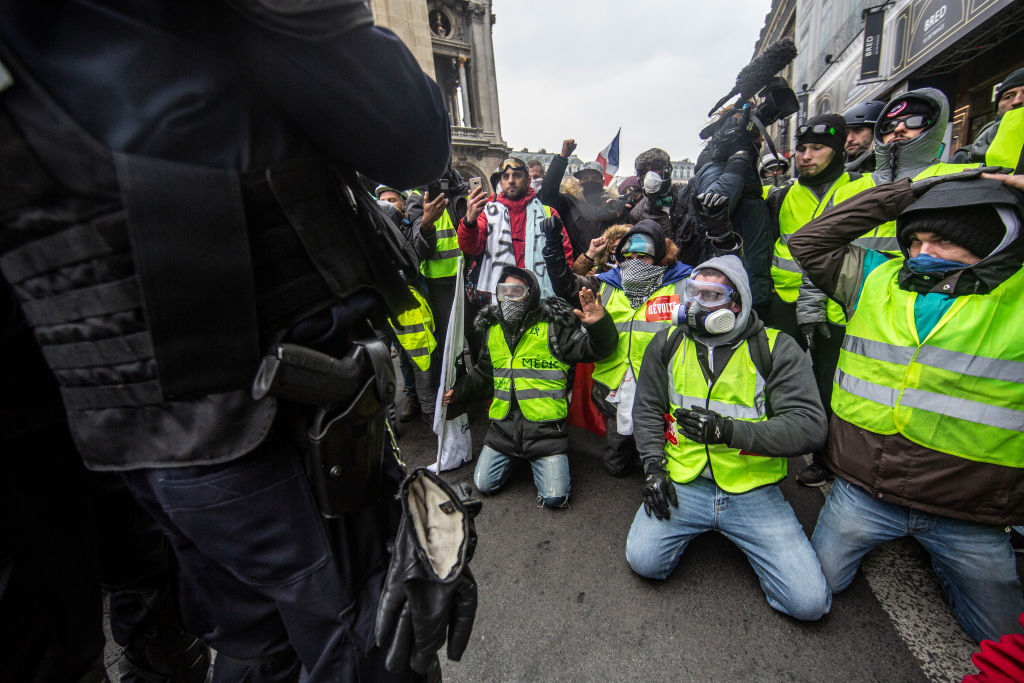
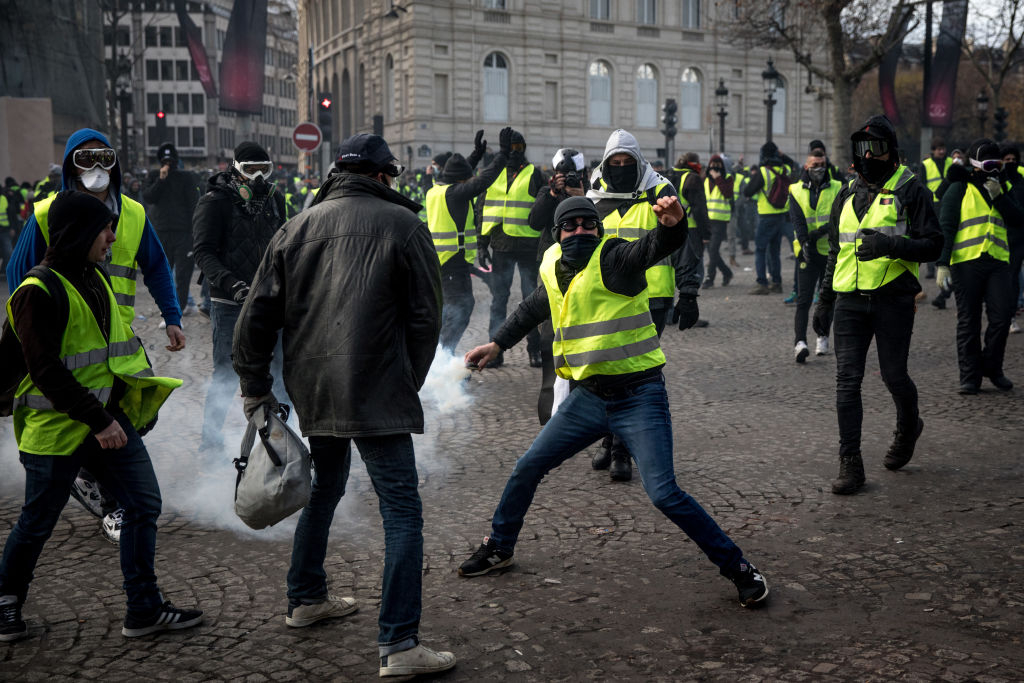
Strasbourg, France. Christmas market. December 11th, 8pm. A man shouting, "Allahu Akbar" ("Allah is the greatest") shoots at passersby, then wounds several with a knife. He murders three people on the spot and wounds a dozen others, some severely. Two will later die of their wounds. The murderer escapes. Two days later, the police shoot him dead. He was known to the police. When members of the General Directorate of Internal Security and some gendarmes came to his home a few hours earlier, he had escaped. Although they knew he was an armed and dangerous Islamist ready to act, and that Christmas markets had been, and could be, likely targets, no surveillance was in place. The murderer, Cherif Chekatt, should, in fact, have been kept off the streets. He was 29 years old, his name was on the list of people reported for terrorist radicalization (FSPRT), and he and had already been sentenced for crimes 27 times. He was nevertheless roaming around free, with no police oversight. His case is similar to that of many jihadi terrorists in France in the last decade. Others include Mohamed Merah, who murdered Jewish children in Toulouse in 2012; Cherif and Said Kouachi, who murdered most of the staff at the satirical magazine Charlie Hebdo in 2015, and Amedy Coulibaly, who murdered people at a kosher supermarket few days later. Successive governments have done exactly nothing to remedy the situation. Instead, they delivered speeches and stationed soldiers about the streets. "Young French people must get used to living with the threat of attacks", then-Prime Minister Manuel Valls said in 2015. Two years later, just before the first round of the presidential elections, Emmanuel Macron, still a candidate, used almost the same words. Terrorism, he said, is "imponderable" and will constitute a "threat that will be part of the daily life of the French for the years to come". French laws are extremely lax. Even serial killers and terrorists are not sentenced to long prison terms. Most prisons have become jihadist recruiting stations. Currently, more than 600 no-go zones are under the control of imams and Muslim gangs. Islamists, apparently "ready to act", number in the thousands. The police simply do not have the personnel or material resources to monitor all of them The only political leaders who have proposed tougher laws against terrorism, or who have said that exceptional measures were needed -- such as a wider use of electronic ankle-bracelets -- to counter increasing threats, come from parties considered "right-wing". The mainstream media immediately branded these leaders as "extremists" and their proposals were dismissed. Macron and his government continue their unfortunate tradition of submitting to political correctness. It seems they prefer to appease extremists rather than confront them. These politicians are undoubtedly aware that more riots could take place. In 2016, the head of the French General Directorate for internal Security, Patrick Calvar, spoke of a high risk of "clashes between communities", perhaps even civil war. These officials evidently understand that the terrorists are engaged in a long war and that it will be difficult to stop them; so they seem to have given in. These officials are no doubt aware that young French Muslims are being radicalized in increasing numbers. The response, however, has been to strengthen Muslim institutions in France. Although these officials also presumably see that Muslim immigration into France continues, and that hundreds of thousands of illegal Muslim migrants are creating increased security concerns, they do nothing to reverse the trend. The number of deportations is rising, but are still rare: slightly more than 26,000 persons were deported in 2017. Meanwhile, more than 150,000 illegal immigrants live in Seine Saint Denis, near Paris. Macron, since becoming President, has repeatedly said that those who call on him to expel illegal immigrants are "xenophobic". Macron and the current government, in fact, have been encouraging more migration: all illegal immigrants in France receive financial assistance if they ask for it, as well as free health care; and they run almost no risk of being deported. Each year, more than 200,000 residence permits are issued (262,000 in 2017), including to illegal immigrants. Many have no marketable skills, some receive for decades the minimum income paid to anyone in difficulty. Social support for migrants, legal or not, adds to the cost of an increasingly expensive welfare system. France today is the most highly taxed country in the developed world: compulsory levies correspond to more than 45% of GDP. Unemployment is high at 9.1%. Typical salaries are both low and stagnant. A public school teacher starting out earns 1,794 euros per month ($2,052). A police officer after a year of service earns even less: 1,666 euros per month ($1,906). Macron, when elected president, promised to boost growth and improve purchasing power. To encourage large and multinational companies to invest in France, he lowered their taxes and eliminated a tax on wealth. As he apparently did not wish to increase the French budget deficit (2.6% in 2017), he created new taxes and increased a few of the taxes paid by the entire population, including fuel taxes. It was in this context that the "yellow vest" ("gilets jaunes") protestors – who have been rioting throughout France for the eight weekends, came into being. They have vowed to keep on demonstrating. The new taxes, plus the increase in existing taxes, have led many people into real financial straits. Many also saw the reduction of taxes on large companies coupled with the removal of the wealth tax for the rich as outrageously unfair. They see perfectly well that a lack of security is spreading, that immigration is exploding and that the government is not providing sufficient law and order. Macron's remarks, such as a comparing "those who are successful and those who are nothing" -- or his assertion that "the life of an entrepreneur is much harder than that of an employee" -- gave him the image of an arrogant upstart who despises the poor and knows nothing about the problems they face. Some of his utterances -- such as, "there is not a French culture" or the French are Gauls"resistant to change" -- led many to believe that he did not even have respect for the French or for France. The proliferation of speed radars on the roads, and the lowering of the speed limit to 80km/h, apart from freeways, as well as a noticeable increase in speeding tickets as a result, also did nothing to help his approval ratings. Finally, an additional increase in fuel taxes sparked a revolt that has not stopped to this day. The first protest by the "yellow vests", which took place on November 17, spontaneously gathered hundreds of thousands of people across the country and had the support of more than 80% of the population. Rather than react quickly and say that he understood the difficulties of millions of French, Macron waited 10 days until a second demonstration, bigger than the first, to respond. He then delivered a speech focusing on the environment and emphasizing that fuel taxes were necessary to fight "climate change". His words appeared totally out of touch with the economic distress felt by the public. Four days later, on December 1, a third demonstration drew even more people than the second. Protestors waved French flags and sang the national anthem. People who spoke on television said that Macron had made fun of them and reminded him of his promises. They demanded his resignation, new elections, and a return of sovereignty to the people. Gangs from the suburbs looted stores and destroyed property. The police were particularly brutal to the protesters, but could not stop the looting or destruction. Macron said nothing. On December 8, the day of the fourth demonstration, Paris was effectively set under siege. Armored vehicles were deployed along the main avenues. Thousands of police officers sealed off access to the neighborhood of the presidential residence, the Élysée Palace. A helicopter waited in the courtyard of the Élysée Palace, in case Macron needed to be evacuated. Looting and destruction began again. When Macron finally decided to say something, on December 10, he announced a slight increase in the minimum wage and the removal of some taxes. He promised to open a "national debate" and announced the need to review the rules for immigration. However, at the time Macron was speaking, one of his emissaries was in Morocco on behalf of France to sign the UN Global Compact for Safe, Orderly and Regular Migration, which defines immigration as "beneficial" for the host countries. Under it, signatory states pledge to "strengthen migrant-inclusive service delivery systems." The next day, the terrorist attack near a Christmas market in Strasbourg took place, in which five people were murdered. The public's anger did not subside. The "yellow vest" protestors who spoke on television the following days said that Macron had evidently not taken the measureof what they were saying. They stated that talking about reviewing the rules for immigration while signing the Global Compact -- without taking into account the opinion of the population -- showed that Macron was a liar. A group of retired generals published an open letter, saying that signing the Global Compact was a further step towards "the abandonment of national sovereignty" and noted that "80% of the French population think that immigration must be halted or regulated drastically". "In deciding alone to sign this pact," the generals wrote, "... You are guilty of a denial of democracy, even treason, with respect the nation". The Minister of Defense, Florence Parly, said that the generals' letter was "inadmissible and unworthy", but did not dispute the arguments it set forth. Again, Macron said nothing. On December 22, when the fifth demonstration of the "yellow vests" took place, even though the protestors were fewer, their anger seemed more intense. Calls for Macron's resignation came from everywhere. A puppet representing Macron was symbolically beheaded by an imitation guillotine. A sculpture representing a yellow hand, resembling the logo of SOS Racism, the oldest organization fighting "racism" and "Islamophobia" in France, was burned. Anti-Semites took the opportunity to offer their usual opinions, but were marginal. Benjamin Griveaux, the government spokesman, however, used their comments to attack the "yellow vest" protestors. He sent a tweet saying that the "yellow vests" were "coward[s], racist[s], anti-Semitic", and of the type that stages coups. Earlier, he had said that whatever happens, Macron would not "change course". Macron seems to hope that weariness will lead the "yellow vests" to give up, but there seems no sign of it yet. On the contrary, the "yellow vests" seem dedicated to bringing him down. Those on television say they are determined to fight "to the end". The economic damage is considerable; the first estimates numbered hundreds of millions of euros. "Macron and his team," wrote Ivan Rioufol, an editorial writer at Le Figaro, recently, "would be wrong to believe that if the mobilization weakens during the Christmas truce, it means they are out of the woods". The author Éric Zemmour described the revolt as the result of the "despair of people who feel humiliated, forgotten, dispossessed of their own country by the decisions of a contemptuous caste". He concluded that he thinks that Macron has lost all legitimacy and that his presidency is over. Radio commentator Jean-Michel Aphatie, said that the presidency and the government "hang on by a thread", and that the letter published by the generals is a strong sign that the French institutions are deeply shaken. "If the police falter," he stressed, "France could quickly slide towards chaos". On December 20, two days before the fifth demonstration of the "yellow vests," police officers organized a protest in front of the Élysée Palace. The vice-president of an organization made up of police officers said that many members are exhausted, feel sympathetic to the revolt and are ready to join it. The next day, the government increased police officers' salaries and paid them millions for overtime -- payments that had been overdue for months. "The authorities are really afraid that the police could turn on them," commentedthe journalist Jean-Michel Aphatie. "It is hard to imagine. It is where we are in France, today". The Macron's popularity is in free fall; it has dropped to 18%. No French president's popularity has dropped so low, so quickly. Flore Santisteban, a professor at the Paris Institute of Political Studies, quoted surveys showing that Macron now crystallizes "an intense hatred, and maybe more than hatred: rage". Many commentators are wondering how Macron will still be able to govern in the coming weeks, and ask if he could be forced to resign and call for early presidential elections. Several news analysts have said that this time, Marine Le Pen, the leader of the right-wing, populist National Rally party, could be elected president. The themes of her presidential campaign in 2017 resembled the claims of the "yellow vest" movement. Macron still says nothing. He is nowhere in sight. His only recent public statements were made in foreign countries: Belgium and Chad. His last public appearance in France was on December 4, in the Massif Central, late in the evening. He went to see the damage done to an official building partly burned by vandals. Although his visit was unannounced, dozens of "yellow vests" arrived, insulted him, and he quickly left. Polls show that Le Pen's National Rally could win the European Parliament elections in May 2019 with 24%-25% of the vote. Another right-wing, nationalist party, Debout la France! (France, Stand Up!) headed by MP Nicolas Dupont-Aignan, and allied to the National Rally party , could get 8%. The total would amount to 32%-33% percent of the vote. Macron's La République En Marche !party, created two years ago, is expected to get only 18% of the vote. Election to the European Parliament has no direct impact on French political life. Such a result, however, would be a scathing disavowal of Macron -- if he manages to stay in power until then. A few months ago, Macron introduced himself as the champion of an open, "progressive" and multicultural Europe and described the defenders of national sovereignty and all those hostile to immigration and multiculturalism, as "lepers" and supporters of "bellicose nationalism" extolling "the rejection of the other". He pretended easily to triumph over them. In July 2017, he hinted that he would rule like the Roman god Jupiter. It did not take long for him to fall from his pedestal. On the evening of December 31, Macron offered the French people his wishes for the year 2019. He did not apologize. He ignored the grievances of the "yellow vest" protesters and their supporters. He merely said that "anger broke out" and that "order will be maintained without indulgence". He described in positive terms all that he had done since becoming President. He added that he would "go forward" in the same direction without changing a thing: "I intend to continue to follow the line that I traced since the first day of my mandate". He described his political opponents as "extremists", "demagogues" and "megaphones of a crowd full of hatred". He again said that the "fight against global warming" is an absolute priority. Many of the "yellow vest" protestors, interviewed on television, appeared upset; some said they had decided not even to listen to the speech. Macron's political opponents criticized him harshly. Nicolas Dupont-Aignan wrote: "Tonight the French had the confirmation that Emmanuel Macron learned nothing from the events of 2018. While his politics brought together more than 75% of the French against him, he appeared determined to continue, in defiance of democracy."Laurence Saillet, of the moderate right party, The Republicans, said: "I feel that while the 'yellow vests' were protesting, he was on another planet... He has not taken the measure of the country's anger. He makes no mea culpa, he even assessed his actions positively, precisely what is rejected by the French."Marine Le Pen tweeted, "This president is an impostor. And a pyromaniac." On January 3, Eric Drouet, one of the main faces of the "yellow vests" movement was arrested by a dozen policeman on his way to the Place de la Concorde in central Paris to light candles to pay tribute to the "yellow vests" wounded or killed since the beginning of the demonstrations. He was peacefully walking on the sidewalk with 15 to 20 of his friends. None of them was shouting or wearing banners, or even a yellow vest. Drouet was indicted for organizing an illegal protest. Macron's political opponents said that Macron was adding more fuel to the fire. On January 4, after the first cabinet meeting of the year, Macron asked government spokesman Benjamin Griveaux to say that "those who continue to protest... are agitators who promote insurrection", and that the government must"go further, in a stronger way". On Saturday January 5, thousands of "yellow vests" protested again, calling for Macron's resignation. They broke down the doors of Griveaux's office building as he fled. By evening, the streets of Paris and other cities looked like battlefieldsonce more. Dr. Guy Millière, a professor at the University of Paris, is the author of 27 books on France and Europe.
© 2019 Gatestone Institute. All rights reserved. The articles printed here do not necessarily reflect the views of the Editors or of Gatestone Institute. No part of the Gatestone website or any of its contents may be reproduced, copied or modified, without the prior written consent of Gatestone Institute.
|
Showing posts with label Yellow Vests. Show all posts
Showing posts with label Yellow Vests. Show all posts
Sunday, January 6, 2019
Update On France




Wednesday, December 12, 2018
The Natives Are Getting Restless
 |  |  |  |  |  |  |  |  |  |  |  |  |  |  |  |
| العربية | Čeština | Dansk | Deutsch | Ελληνικά | English | Español | Français | עברית | Italiano | Nederlands | Polski | Português | Pyccĸий | Slovenčina | Svenska |






France: A Revolt against Europe's Elites?
For years, those of us who write and worry about the rise of Islam in Western Europe have known that eventually, if the governments of these countries did not change course dramatically, something had to give. So far, the natives had, for the most part, been remarkably tame. They had swallowed a lot. Their leaders had filled their countries with huge numbers of immigrants from the Middle East and North Africa, a disproportionate number of whom were making it clear that they had no intention of fully joining or contributing to their host societies but, rather, were content to take, to harm, to damage, and to destroy, and were determined, in the long run, to conquer and rule. No one had ever asked the citizens of Western Europe whether they wanted their countries radically transformed in this manner. This transformation, moreover, was intensifying by the year. At some point, surely, the native peoples of Western Europe would react. But what form would it take? Those of us who are professionally preoccupied with these topics spent untold hours pondering this question. We asked one another: what do you think will happen? Some prophesied Balkanization. Already there were no-go zones – enclaves in and around major cities where "infidels" were unwelcome and where police and fire personnel were routinely pelted with rocks if they dared to intrude. It was easy enough to imagine those areas expanding, their de facto sovereignty under sharia law officially recognized and some kind of relatively stability established. Other observers forecast riots by natives -- not the elites whose personal lives were minimally affected by the Muslim presence in their countries, but the less privileged types whose neighborhoods and schools had become danger zones, whose taxes had been raised repeatedly to bankroll massive payouts to immigrant-group members, and whose doctors and hospitals had been so overburdened by the newcomers that vital treatments were increasingly rationed and waiting times increasingly long. In 2016, the British shocked the world by voting for Brexit, and later the same year Americans pulled off an even bigger stunner by electing Donald Trump to the presidency. Some commentators expected that elections in France, Sweden, and the Netherlands would also yield sensational results, but although there were advances for parties that favor immigration controls, such as Marine Le Pen's National Rally (formerly National Front), the Sweden Democrats, and Geert Wilders's Freedom Party and Thierry Baudet's Forum for Democracy, both in the Netherlands, those gains were smaller than expected. On the other hand, last year the Austrians elected as their Chancellor Sebastian Kurz, a vocal opponent of EU-imposed asylum quotas, and this year the Italian premiership went to Giuseppe Conte, who takes a strong stance against illegal immigrants and has barred migrant ships from Italian ports. The most important news on this front, however, has not been at the ballot box. This year Brits expressed growing outrage over Theresa May's bungled Brexit and, during the summer, took to the streets to protest the illegitimate incarceration of Tommy Robinson, who in that country had become the very face of resistance to Islamization. Furthermore, in recent weeks, citizens of France from across the political spectrum, and mostly hailing from small towns and rural areas, have been engaged not just in standard-issue public protests -- that perennial Gallic recreational activity -- but have been rioting and committing acts of vandalism in Paris and other major cities, despoiling iconic locations such as the Champs-Elysées, forcing the Eiffel Tower and Louvre to close, and even causing damage to the Arc de Triomphe. At first it was reported that the French rioters were angry about a hike in fuel taxes that had been motivated by President Emmanuel Macron's environmental priorities. "The price of gas has become incredible," Ghislain Coutard, credited with starting the so-called Yellow Vests movement, said the other day, then cited friends who "are barely surviving" because of the costs of owning a car. "The smallest problem with the car becomes a catastrophe," he explained. "You have to go into debt and then it never ends." Unfortunately, even after Macron, realizing he had overreached, canceled the tax hike, the rioting continued. Journalists have had trouble getting clear and concise explanations from the rioters of their motives and goals. Perhaps the rioters cannot find the words -- perhaps they are expressing a rage that they have yet to be able to articulate. Or perhaps they are reluctant to speak their minds out loud for fear of being called xenophobes, Islamophobes, or racists. In an interview the other day, the French philosopher Alain Finkielkraut attributed the riots to economic and cultural insecurity on the part of the ethnically French lower and middle classes -- people who have been driven out of the major city centers by rising rents, who have seen their jobs and small businesses destroyed by "green" taxes and regulations, who feel they have lost a power struggle with Muslim immigrants, and who sense that their ruling classes have more sympathy for immigrants than for them. Now the riots have spread to Belgium and the Netherlands. There, too, the rioters' goals can be elusive. The Associated Press quoted one older Dutch women's complaint about high taxes, the housing shortage, and the loss of welfare benefits: "The social welfare net we grew up with is gone," she said. "The government is not there for the people. It is there to protect its own interests." Of course, those "interests" include prioritizing freebies for immigrants at the expense of Dutch people who have put in a lifetime of work. Even today, however, for many Western European natives, it can be easier to be an insurrectionist than to speak honestly about Islam and immigration. Will these riots spread even further? Somehow it is hard to picture ordinary Scandinavians rioting -- they are just too low-key. Their idea of public demonstration is a quiet candlelight vigil. As for Germans, they are too orderly to erupt in spontaneous uprisings. Yes, they are good at marching in lockstep to the orders of some hysterical fascist maniac, but they are not individually inclined to break into violence. Then again, that impression may be wrong. After all, it was quite a surprise to see so many ordinarily polite, even repressed, Britons piling into London squares to voice their solidarity with Tommy Robinson. So maybe these French riots will spread across Western Europe. Maybe this is it -- the start of the Western European public's pushback against the elites' disastrous multicultural and globalist project. Or maybe it is just one more step that is bringing us closer to the continent's day of reckoning. We shall soon find out soon enough. Bruce Bawer is the author of the new novel The Alhambra (Swamp Fox Editions). His book While Europe Slept (2006) was a New York Times bestseller and National Book Critics Circle Award finalist. His other books include A Place at the Table (1993), Stealing Jesus (1997), Surrender (2009), and The Victims' Revolution (2012). A native New Yorker, he has lived in Europe since 1998.
© 2018 Gatestone Institute. All rights reserved. The articles printed here do not necessarily reflect the views of the Editors or of Gatestone Institute. No part of the Gatestone website or any of its contents may be reproduced, copied or modified, without the prior written consent of Gatestone Institute.
|
Subscribe to:
Comments (Atom)