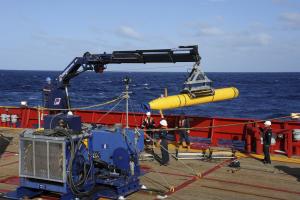
Robotic submarine deployed in search for plane

By MARGIE MASON4 hours ago
PERTH, Australia (AP) — Search crews sent a robotic submarine deep into the Indian Ocean on Monday to begin scouring the seabed for the missing Malaysian airliner after failing for six days to detect any signals believed to be from its black boxes.
Meanwhile, officials were investigating an oil slick about 5,500 meters (3.4 miles) from the area where the last underwater sounds were detected, said Angus Houston, the head of a joint agency coordinating the search off Australia's west coast.
Crews have collected an oil sample and are sending it back to Australia for analysis, a process that will take several days. Houston said it does not appear to be from any of the ships in the area, but cautioned against jumping to conclusions about its source.
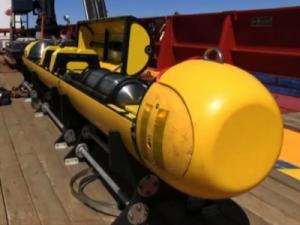
The unmanned underwater vehicle, the Bluefin 21, was launched from the Australian navy ship Ocean Shield, the U.S. Navy said. The autonomous sub can create a three-dimensional sonar map of any debris on the ocean floor.
The move comes after crews picked up a series of underwater sounds over the past two weeks that were consistent with signals from an aircraft's black boxes, which record flight data and cockpit conversations. The devices emit "pings" so they can be more easily found, but their batteries only last about a month and are now believed dead.
"Today is day 38 of the search," Houston told a news conference. "We haven't had a single detection in six days, so I guess it's time to go under water."
Australian Prime Minister Tony Abbott raised hopes last week when he said authorities were "very confident" the four strong underwater signals that were detected were from the black boxes on Flight 370, which disappeared March 8 during a flight from Kuala Lumpur, Malaysia, to Beijing with 239 people on board, mostly Chinese.
But Houston warned that while the signals are a promising lead, the public needs to be realistic about the challenges facing search crews in the extremely remote, deep patch of ocean — an area he called "new to man."
"I would caution you against raising hopes that the deployment of the autonomous underwater vehicle will result in the detection of the aircraft wreckage. It may not," Houston said. "However, this is the best lead we have, and it must be pursued vigorously. Again, I emphasize that this will be a slow and painstaking process."
Houston, a retired Australian chief air marshal, called the search "one of the largest search and rescue, search and recovery operations that I've seen in my lifetime."
The Ocean Shield had been dragging a U.S. Navy device called a towed pinger locator through the water to listen for any sounds from the black boxes' beacons.

The Bluefin sub takes six times longer to cover the same area as the ping locator, and the two devices can't be used at the same time. Crews had been hoping to detect additional signals before sending down the sub, so they could triangulate the source and zero in on where the black boxes may be.
The submarine will take 24 hours to complete each mission: two hours to dive to the bottom, 16 hours to search the seafloor, two hours to return to the surface, and four hours to download the data, Houston said. In its first deployment, it will search a 40-square kilometer (15-square mile) section of seafloor.
The black boxes could contain the key to unraveling the mystery of what happened to Flight 370. Investigators believe the plane went down in the southern Indian Ocean based on a flight path calculated from its contacts with a satellite and an analysis of its speed and fuel capacity. But they still don't know why.
A visual search for debris on the ocean surface continued Monday over 47,600 square kilometers (18,400 square miles) of water about 2,200 kilometers (1,400 miles) northwest of the west coast city of Perth. A total of 12 planes and 15 ships joined the search.
But Houston said the visual search operation will end in the next two to three days. Officials haven't found a single piece of debris confirmed to be from the plane, and he said the chances that any would be found have "greatly diminished."
"We've got no visual objects," he said. "The only thing we have left at this stage is the four transmissions and an oil slick in the same vicinity, so we will investigate those to their conclusion."
Complicating matters further is the depth of the ocean in the search area. The seafloor is about 4,500 meters (15,000 feet) below the surface, which is the deepest the Bluefin can dive. Officials are looking for other vehicles that could help to retrieve any wreckage that might be located.
Searchers are also contending with a thick layer of silt on the bottom that is tens of meters (yards) deep in places, which could hide debris that has sunk.
U.S. Navy Capt. Mark Matthews said the silt poses a challenge, but it does not make the mission impossible.
"Our experience shows that there will be some debris on top of the silt and you should be able to see indications of a debris field," Matthews said. "But every search is different."
A British vessel, the HMS Echo, has equipment that can help map the seafloor in the area, which is more flat and rolling than mountainous, Houston said.
___
Associated Press writers Kristen Gelineau in Sydney and Rod McGuirk in Canberra, Australia, contributed to this report.