Contact Form

Name

Email *

Message *

Showing posts with label chemical weapons attack. Show all posts

Tuesday, April 25, 2017

America Needs To Be The World Leader And Trump Is Making It So But It Does Involve Risk. If Successful, The US Will Once Again Be The One Superpower.

President Trump: Formulating Strategy As He Goes Along
By April 25, 2017


BESA Center Perspectives Paper No. 451, April 25, 2017
EXECUTIVE SUMMARY: Winds of war are blowing in the international arena, and the rhetoric of threats is intensifying. Notwithstanding the claims of critics and opponents of Trump, he has begun to formulate a strategy while responding to threats and crises in Syria and North Korea. The sides are now treading at the edge of the abyss. This approach could achieve effective deterrent results, but also entails considerable risks. Trump has decided to fight the forces of violence and terror in the world, joining forces with allies and using a variety of military and diplomatic measures. If his strategy succeeds, it could stabilize the world order and improve Israel’s strategic position.
The winds of war are beginning to swirl around the world. A check of Google reveals a considerable spike in searches for the term “Third World War.” Crises are besetting the difficult, conflict-ridden regions of the world and complicating relations between the world powers. Those crises have been precipitated by uses and demonstrations of force, including Assad’s chemical-weapons attack on citizens of his country; a retaliatory US strike on the base from which Assad’s planes took off for that attack; a US strike with a particularly deadly bomb on an ISIS stronghold in Afghanistan; threats and warnings of forceful responses by all sides; a military parade, ballistic-missile test, and preparations for a large nuclear test by North Korea, along with maneuvers and the dispatch of large naval forces to the area by the US; consultations and diplomatic meetings at senior levels, particularly in Washington and Moscow; and verbal sparring in the Security Council, along with psychological warfare.
It was clear that hostile countries would soon try to test Donald Trump, a president lacking political and international experience who had made many blunt warnings, some of them contradictory, about his foreign and defense policy. His emphasis on “America First” seemed to suggest that he would take the US into some form of isolationism, leading adversaries to infer that they could push the envelope. But Trump’s reactions, including two surprise military strikes, have turned the tables.
In the crises involving Iran, Syria, and North Korea, the administration has explicitly warned its adversaries: “Don’t test us.” Vice President Mike Pence, who visited South Korea a few days ago, counseled North Korea “not to test [Trump’s] resolve” and added that “all options are on the table,” including the use of military force, to ensure that North Korea cannot launch nuclear-tipped missiles at the US. Although Obama, too, often declared that “all options are on the table,” America’s enemies did not believe him. In the wake of Trump’s strikes in Syria and Afghanistan and dispatch of large forces to Korea, the use of that phrase by him and by others in his administration sounds much more credible.
Iran was the first to test Trump’s mettle. It conducted a ballistic missile test a few days after he entered the White House, violating Security Council Resolution 2231 of July 2015, which endorsed the nuclear agreement with Tehran. Trump responded with warnings and with new sanctions on Iranian senior officials involved in developing the missiles and in terror. Assad was also testing Trump with the chemical attack in the Idlib area. He might have thought that Trump, like Obama, would do nothing. North Korea, too, posed a challenge to Trump when it tested ballistic missiles and prepared to test more destructive nuclear bombs.
Trump’s critics claim he has no strategy and that his actions are arbitrary and incoherent. They have dubbed his policy one of “no strategy.” Indeed, Trump and his senior officials have made contradictory statements. For example, before Assad’s chemical weapons attack, White House Press Secretary Sean Spicer said that “with respect to Assad, there is a political reality that we have to accept.” He added that “the United States has profound priorities in Syria and Iraq, and we’ve made it clear that counterterrorism, particularly the defeat of ISIS, is foremost among those priorities.” After the attack, Secretary of State Rex Tillerson declared that there was no change in the orders of priority of the US.
Yet Nikki Haley, US ambassador to the UN, asserted that there had, in fact, been a change, and that the US wanted a new regime in Syria. Trump spoke of understandings and cooperation with Russia, yet entered into a fierce dispute with Putin over Assad’s behavior. Trump had also characterized China as an adversary during the campaign, but now regards it as a partner in reining in North Korea.
Trump’s opponents have responded by ascribing his moves to extraneous motives, such as his desire to throw off the investigations of his associates’ ties with Russia, to distract from his failure to get Congress to revoke Obamacare, or to paper over his alleged lack of achievements as his one hundredth day in office approaches. But when the adversaries of the US challenge it, evasion of the challenge exacts a high price. Trump’s policy of swift and striking response thus reflects foreign and domestic considerations, not only personal interests.
Opponents also protested that before using force, Trump should have consulted with Congress. They pointed to Obama’s conduct during the crisis over Assad’s 2013 use of chemical weapons, when Obama planned retaliatory strikes but put the decision in Congress’s hands. There are, however, two problems with that contention. First, the War Powers Resolution of 1973 allows a president to use force without congressional approval for 60 days, and he has another 30 days to withdraw forces. He need only inform Congress of the use of force within 48 hours. Trump acted exactly in accordance with this law. Second, in 2013, when Obama transferred the decision to Congress, he was not seeking approval to attack Assad but the opposite. His object was to avoid an operation, as quickly became clear.
The facts on the ground indicate at least the beginnings of strategic thought. What mainly emerges is a return to the position of leadership and involvement that Obama had renounced. Trump defines interests and uses various means to realize them. The chatter about whether or not Trump has a strategy displays widespread confusion about goals and means.
The goals are: destroying ISIS and Islamic terror, ending the war in Syria, reining in North Korea’s nuclear program, and stopping Iran. The means Trump is employing include military operations, threats and warnings, diplomacy, and psychological warfare. To achieve an optimal effect, he is using a combination of these tools.
In Syria, Trump declared that ISIS had to be destroyed first, and then the civil war could be dealt with. After the chemical attack, he adopted a new, two-pronged strategy: a simultaneous struggle against ISIS and the Assad regime. This strategy was evident in the strikes on Assad’s army and on ISIS fighters in Afghanistan.
The strategy that is emerging is aimed at deterring enemies and encouraging cooperation among the world powers. Trump is pressuring Russia to keep Assad in check, and China to keep North Korea in check. Trump invited Chinese president Xi Jinping to meet with him at his private estate in Florida, and later spoke with him by telephone. He asked him to curb North Korea’s nuclear program but warned that, if nothing was done, the US would act on its own. Tillerson met in Moscow with his Russian counterpart, Sergey Lavrov, and with Putin. He both expressed and received a good deal of criticism. Trump also met with NATO secretary Jens Stoltenberg, and, notwithstanding his own past statements, emphasized NATO’s importance. Presumably, the world powers now understand each other better.
American military operations and measures do not stand by themselves. They were planned with great precision, almost certainly well before they were executed. Apart from the damage they inflicted, they conveyed messages. The retaliation against Assad’s chemical attack conveyed messages to Assad himself, to Russia, and to the states that are developing weapons of mass destruction. The message to Assad is that he has to stop his attacks on civilians; the message to Russia is that it cannot do as it pleases in Syria; and the message to states like Iran and North Korea is that the US is prepared to use force to prevent the development and use of nuclear weapons.
The choice of the largest nonnuclear bomb in the American arsenal (the MOAB, or Massive Ordnance Air Blast), which had never before been used operationally, to strike an ISIS stronghold was part and parcel of psychological and communications warfare. It was meant to reinforce the message of American resolve to act against provocative enemies, even with very powerful weapons. The same pertains to the sending of large naval forces, including destroyers carrying Tomahawk missiles like those used against Syria, to the Korean theater, accompanied by warnings that if North Korea keeps developing nuclear weapons and intercontinental missiles to deliver them, and China’s efforts do not bear fruit, the US will respond with a preemptive strike. Last week’s revelations of a test by the US of a nuclear-type bomb was a further signal to North Korea’s unstable leader Kim Jong-Un. These moves have transmitted unmistakable messages.
It may be hard to put confidence in the erratic and inexperienced Trump. But his lineup includes three generals of great talent and military experience: Defense Secretary James Mattis, National Security Adviser Herbert McMaster, and Homeland Security Secretary John Kelly. All three have held senior command positions in all the arenas where the US has fought in recent decades. Mattis and McMaster verge on being military geniuses. Their fingerprints can be seen in the choice of limited means to attack Assad’s army and ISIS. These men, who know what war is and what price it can exact, will not allow Trump to conduct an adventurous military policy. History, however, including that of the Arab-Israeli conflict, is replete with wars that no one wanted and that erupted nonetheless.
The US and its adversaries are at the edge of the abyss. It will require great skill in crisis and risk management, as well as a large degree of rational decision-making, to avoid sliding into it. The potential for deterrence and cooperation among the world powers is still greater than that of the eruption of a Third World War.
President Trump has decided to confront the forces of violence, terror, and disorder in the world while working together with allies and using various military and diplomatic means. Persistent yet flexible implementation of a coherent strategy could stabilize the world order and improve Israel’s strategic position.
This article is based on articles the author published in Israel Hayom on April 7 and in YNET and Globes on April 18, 2017.
Prof. Gilboa is an expert on the US, director of the Center for International Communication, and a senior research associate at the Begin-Sadat Center for Strategic Studies of Bar-Ilan University.
BESA Center Perspectives Papers are published through the generosity of the Greg Rosshandler Family

Friday, January 3, 2014

Where Are The Protesters Crying Out "Obama Lied, People Died"? The Quiet Is Deafening!


  • Text smaller
  • Text bigger
TEL AVIV – After publishing an influential analysis in September that claimed a missile carrying chemical weapons was fired from a Syrian military complex, the New York Times just reported on a new study that, if accurate, would make its analysis an impossibility.
The details are critical because the original study was utilized by the Obama administration in its accusation that Syrian President Bashar al-Assad had committed atrocities against civilians.
On Sept. 17, the Times utilized data released by the United Nations to conduct its own analysis pinpointing the origin of a reported chemical weapons attack on Aug. 21. The attack killed hundreds, including children.
The U.N. report stated its investigation of munitions showed at least two kinds of rockets had been used, an M14 artillery rocket and an unidentified 330-millimeter rocket.
The Times focused on an aspect of the U.N. report: “One annex to the report identified azimuths, or angular measurements, from where rockets had struck, back to their points of origin.”
The Times used the U.N. data and the known distance the rockets can travel – some up to 20 kilometers – to conclude that the origin “pointed directly” to a Syrian military complex.
Reported the Times: “When plotted and marked independently on maps by analysts from Human Rights Watch and by The New York Times, the United Nations data from two widely scattered impact sites pointed directly to a Syrian military complex.”
On Saturday, however, the Times reported on a new study that showed the rockets used had a range of only about three kilometers – far less than the distance assumed by the newspaper’s original analysis putting the Syrian military complex “directly” within range.
The new study was conducted by Massachusetts Institute of Technology professor Theodore A. Postol and Richard M. Lloyd, an analyst at Tesla Laboratories, a military contractor.
The study utilized video and photographic evidence to determine that the rockets used in the attack were taken from the motors of 122-millimeter conventional artillery rockets, or BM-21. The rockets have a distance of less than three kilometers, putting rebel-controlled areas within the firing range.
The Times admitted in the new article about the study that its own trajectory analysis from September based on the original U.N. data could have been wrong.
The Times reported the new, smaller range “would be less than the ranges of more than nine kilometers calculated separately by The New York Times and Human Rights Watch in mid-September, after the United States had dropped its push for a military strike.”
“Those estimates had been based in part on connecting reported compass headings for two rockets cited in the United Nations’ initial report on the attacks,” continued the Times.
The Times noted that the new analysis “could point to particular Syrian military units involved, or be used by defenders of the Syrian government and those suspicious of the United States’ claims to try to shift blame toward rebels.”
The Times further reported that both the Syrian army and the rebels possess BM-21s and that the rockets were not noted in Syria before the rebel-led insurgency.
The new report was published the same day the Times released an extensive investigation of the Sept. 11, 2012, Benghazi attack. The Times investigation claimed al-Qaida or international jihadists were not behind the Benghazi attack and that the attackers were largely motivated by an American-produced, anti-Islam film.
With additional research by Joshua Klein.

Read more at http://www.wnd.com/2014/01/obama-used-papers-bad-chemical-weapons-analysis/#2opparvMRKtKMFlx.99

Thursday, September 5, 2013

US Military Is In Near Revolt Over Syrian Invasion

Military Revolt Against Obama Expands Over Obama’s Plans To Back Al-Qaeda Syrian Rebels

Monday, September 2, 2013 5:22
0

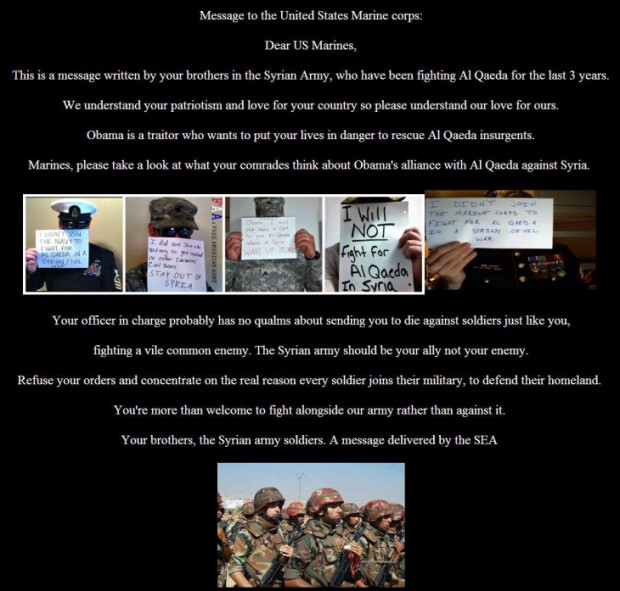
The United States Military revolt against Obama’s plans to fight alongside of Al-Qaeda in Syria are expanding as more and more Americans are awakening to false flag terrorism and Barack Obama’s plans to launch terrorist attacks upon Syria. As US Military members continue to‘Photobomb Obama’, Congress and social media websites, will Barack Obama continue to back the terrorist Al-Qaeda rebels in Syria or will thisrevolt against the ‘Commander in Chief’ plans to fight with Al-Qaeda bring real change and a ‘mass awakening’ of Americans? The story from Infowars is below along with a video report sharing more proof of who really committed the attrocities in Syria, the Al-Qaeda Free Syrian Army rebels whom Obama and Congress are seeking to assist. 


The military revolt against the Obama administration’s plan to launch a potentially disastrous attack on Syria is gathering pace, with both top brass and regular servicemembers expressing their vehement opposition to the United States becoming entangled in the conflict.

The backlash began to spread on social media yesterday with numerous members of the military posting photos of themselves holding up signs stating that they would refuse to fight on the same side as Al-Qaeda in Syria. The photos went viral, with one post alone generating over 16,000 shares on Facebook.

Others have posted their photos on Twitter alongside the hashtag #IdidntJoin.

As the Obama administration prepares to present a draft resolution to lawmakers that is by no means “limited” in its scope and would in fact grease the skids for an open ended war, John Kerry and other State Department officials have signaled that Obama will simply ignore Congress if they vote no and launch the assault anyway.


Wednesday, September 4, 2013

Stop The Blame Game and Give Us The Evidence. Americans Do Not Believe Their Administration

by 
TUCKER REALS / 
CBS NEWS/ August 29, 2013, 1:03 PM

Syria chemical weapons attack blamed on Assad, but where's the evidence?

This image provided by Shaam News Network on Thursday, Aug. 22, 2013, which has been authenticated based on its contents and other AP reporting, purports to show dead bodies after an attack on Ghouta, Syria on Wednesday, Aug. 21, 2013.
This image provided by Shaam News Network on Thursday, Aug. 22, 2013, which has been authenticated based on its contents and other AP reporting, purports to show dead bodies after an attack on Ghouta, Syria on Wednesday, Aug. 21, 2013. / AP/SHAAM NEWS NETWORK
LONDONPrime Minister David Cameron told British lawmakers Thursday that there is "no 100 percent certainty about who is responsible" for the apparent mass-chemical weapons attack on suburban Damascus on Aug. 21.
Nevertheless, Cameron asserted that "from all the evidence we have," his government, along with the Obama administration, had made the "judgment" that "the regime is responsible and should be held to account."
Also just like the Obama administration, however, Cameron's government has yet to explain exactly what the evidence of Assad's culpability is, or where it came from.


Play VIDEO

Russia to send warships to Mediterranean as potential attack on Syria looms


The Prime Minister spoke hours after the British Joint Intelligence Organization (JTI) released a report claiming "a limited but growing body of intelligence" showing that Assad's regime was behind the Aug. 21 attacks, which left at least 355 people dead.
"Some of this intelligence is highly sensitive," the chairman of Britain's Joint Intelligence Committee wrote to Cameron in the open report, "but you have had access to it all."
While Cameron has had access to the intelligence, the rest of the world has not. He did offer one further claim in Parliament on Thursday, however, saying there was "intelligence that regime forces took precautions consistent with chemical weapons use" in the immediate prelude to the Ghouta attacks. He did not explain where that information had come from.
About 4,000 miles to the west, in Washington, the Obama administration was putting the finishing touches on two reports -- the first a classified assessment to be presented to members of Congress; the second, a declassified version for the American public -- meant to lay out the White House's own evidence that Assad's government used chemical weapons.
The White House has claimed to have obtained intercepted phone calls that provide further evidence against the Assad regime, and administration officials also told CBS News that intelligence agencies detected activity at known Syrian chemical weapons sites the week before the Ghouta attack.
Similar activity had been detected before, and the assumption was made that the Syrians were moving things around for security reasons. But last week, the officials told CBS News the most recent activity was being viewed as possible preparation for Wednesday's attack.
With the possible exception of the intercepted phone calls, and the claim by Cameron on Thursday that regime soldiers had taken precautions typical of chemical weapons use, the vast majority of the evidence of Assad regime culpability presented by both Cameron, the Obama administration and their allies in France, Turkey and other nations, is circumstantial in nature.


It hinges largely on the argument, as Cameron put it Thursday, that there are simply "no plausible alternate scenarios."
Below is a look at some of the often-reiterated circumstantial evidence presented by the U.S. and U.K. governments, along with questions which remain unanswered pertaining to that evidence and which skeptics of the legal basis for a military intervention in both countries' legislatures will likely be seeking answers to in the coming days.
"No plausible alternate scenarios"
"There is no credible evidence that any opposition group has used CW (chemical weapons). A number continue to seek a CW capability, but none currently has the capability to conduct a CW attack on this scale."
That quote comes from the British JTI report published Thursday, but it echoes the most often-used argument to pin blame for the Ghouta attacks on Assad's government.
Chemical and biological weapons experts have been relatively consistent in their analysis, saying only a military force with access to and knowledge of missile delivery systems and the sarin gas suspected in Ghouta could have carried out an attack capable of killing hundreds of people.


But no official death toll has been given. The international aid group Doctors Without Borders said it tallied 355 people killed and more than 3,000 displaying symptoms typical of a nerve agent like sarin gas, but no independent organization has yet confirmed that it was sarin gas used in Ghouta. Nor has it been confirmed what the delivery method was.
The international community will hope for clarity on these questions from the U.N. inspectors who have been on the ground in Ghouta this week.
There are other chemical agents which have allegedly been used in Syria since 2012, including far-less-potent organophosphates, which are readily available in the form of industrial insecticides.
It should also be noted that Russia claimed to have provided evidence in July to the U.N. which showed the rebels were behind a sarin gas attack in the village of Khan al-Assal in March 2012.
"It was established that on March 19, the rebels launched an unguided Bashar 3 projectile towards Khan al-Assal controlled by the government forces," Vitaly Churkin, Russian ambassador to the United Nations, told reporters, adding that he intended to share the evidence with the U.S., U.K and France.
The ambassador said the results of the analysis of the gas-laden projectile indicated the Bashar 3 rocket "was not industrially manufactured and was filled with sarin." He said the samples indicated the sarin and the projectile were produced in "cottage industry" conditions.
The absence of chemical stabilizers, which are needed for long-term storage and later use, indicated its "possibly recent production," Churkin said.
The Russian's purported evidence of rebel culpability for the Khan al-Assal attack was never revealed, but neither was the West's purported evidence that the Assad regime did it.
Assad has done it before
"We have assessed previously that the Syrian regime used lethal CW on 14 occasions from 2012 ... A clear pattern of regime use has therefore been established," declared the JTI report in Britain on Thursday.
U.S. intelligence concluded "with some degree of varying confidence" that the Syrian government had twice used chemical weapons, the White House and other top administration officials said on April 25.
However, the officials also said more definitive proof was needed and the U.S. was not ready to escalate its involvement in Syria. The White House disclosed the intelligence in letters to two senators.
"Our intelligence community does assess, with varying degrees of confidence, that the Syrian regime has used chemical weapons on a small scale in Syria, specifically, the chemical agent sarin," the White House said in its letter, which was signed by Obama's legislative director, Miguel Rodriguez.
No tangible evidence has been offered by either the U.S. or Britain to demonstrate what lead to the conclusion that Assad's forces must have been behind the previous suspected chemical attacks, and the U.N. inspection team -- which had its original plans derailed by the unexpected attacks in Ghouta -- has not reached any other sites. Much like the Ghouta attacks, the intelligence behind the accusations that Assad's regime was involved in previous chemical weapons incidents has remained secret.
Assad regime delayed inspections to destroy evidence
Less than five days after the attack in Ghouta, an Obama administration official told CBS News that the Assad regime had essentially blocked a team of United Nations inspectors already in Damascus access to the Ghouta site -- a delay the White House said would make any eventual granting of permission "too late to be credible."
"At this juncture, any belated decision by the regime to grant access to the UN team would be considered too late to be credible, including because the evidence available has been significantly corrupted as a result of the regime's persistent shelling and other intentional actions over the last five days," the official said.
Officials argued that the suspected weapon in question, sarin gas, degrades too quickly and would have been dispersed by the continued shelling in Ghouta to provide useful evidence.
The JTI report issued by the U.K. on Thursday, however, refutes that claim: "There is no immediate time limit over which environmental or physiological samples would have degraded beyond usefulness. However, the longer it takes inspectors to gain access to the affected sites, the more difficult it will be to establish the chain of evidence beyond a reasonable doubt."
Also clashing with the "too late to be credible" claim is the fact that the 20 scientists in Syria to investigate claims of chemical weapons use for the United Nations were only originally sent to inspect incidents which date back as far as March. Those alleged attacks were much smaller in scale, and the remnants of any CW used have had five months to degrade, but the weapons experts still wanted to go and collect samples.
There is also the fundamental claim that Assad's government delayed the inspectors' visit to Ghouta. They have now visited the suburbs on three separate days, and on Tuesday, Syrian Foreign Minister Walid Muallem countered the accusations of a deliberate delay, saying his government only received the request from U.N. disarmament chief Angela Kane to visit the area on Saturday.
"Miss Kane came on Saturday, on Sunday we agreed and on Monday, they (the U.N. inspectors) went to Moadamiyeh (a town in Ghouta). We did not argue about the sites they wanted to visit. We agreed straight away," said Muallem. "How could we be accused of causing a delay?"
© 2013 CBS Interactive Inc. All Rights Reserved.