Contact Form

Name

Email *

Message *

Showing posts with label conserrvative musings. Show all posts

Tuesday, June 9, 2020

The "Kind" Chinese?


Without Apologies, China Is Now on the Move
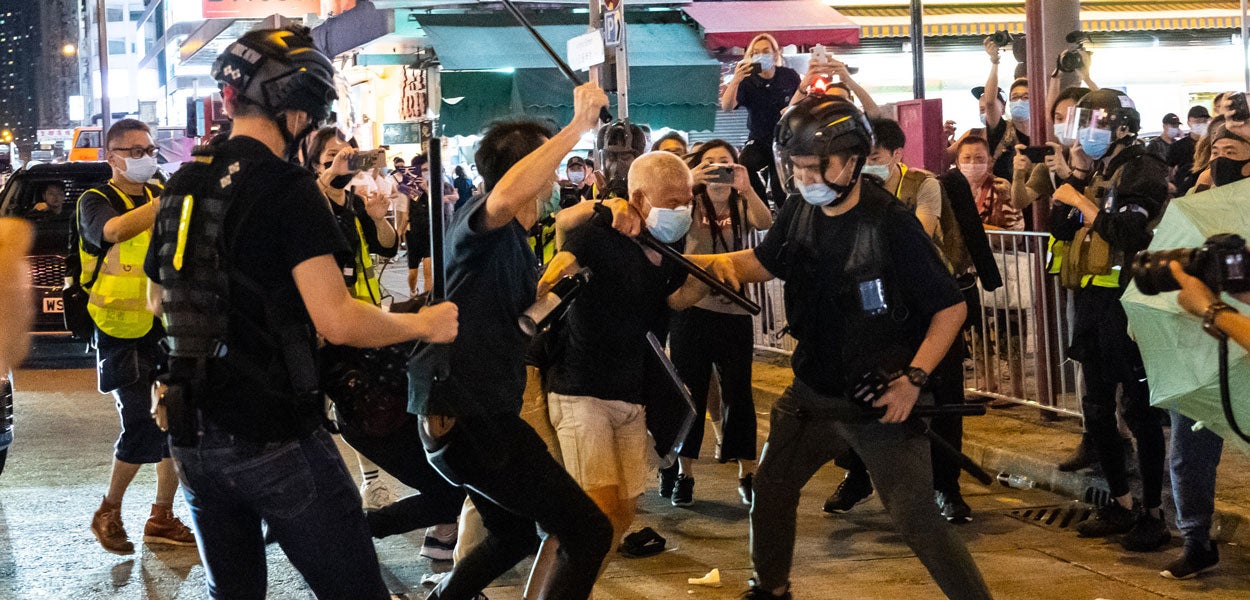
Undercover police arrest participants during a memorial vigil Thursday in Mongkok in Hong Kong, China. Thousands had gathered in Victoria Park to mark the 1989 Tiananmen Square Massacre despite a police ban. (Photo: Billy H.C. Kwok/Getty Images)

George Floyd was killed in
 Minneapolis on May 25
when a police officer used
brutally excessive force to
arrest him.
It was the latest in a string
of high-profile cases
nationwide in which
 citizens, most of them
 African Americans, died
from reckless police force.
Once again, protests over
 police brutality turned
violent and rioting ensued.

The U.S. also is torn apart
over the national mass
quarantine. Liberal blue
 states accused red states
 of recklessly endangering
national health by allowing
 their populations to go
back to work before the
 virus has left.

Red states countered that
 blue states were
 hypocritical in wanting
federal money to subsidize
 their locked-down
 residents while expecting
other states to generate
needed federal revenue.
They also contended that
there was no longer
scientific evidence to justify
 the lockdown.

The nationwide protests
and rioting have
inadvertently adjudicated
 the issue: States cannot
jail the law-abiding barber
 who wears a mask at work, but allow the arsonist without one to roam the streets burning with
impunity.

There is mounting evidence
 that an array of federal
officials had plotted to
disrupt Donald Trump’s
2016 campaign and his
presidential transition,
 leaving Trump supporters
furious.

As the U.S. protested and
bickered, China attempted
to strangle what was left of
 Hong Kong’s enfeebled 
democracy. China’s theory
 seemed to be that if it’s
going to be blamed for the
 spreading virus due to its
 deceit anyway, it might as
 well not let such a
pandemic go to waste.

The Chinese strategy in
 reaction to disclosures
 that it hid vital data about
the virus and exposed the
world to contagion while it
quarantined its own cities has devolved from “So what?” to the current “What exactly are you going to do about it?”

China also decided to ramp up its perennial border confrontations with India, as its forces encroached on Indian soil in the Himalayas. What better way to show the world that a defiant China is dangerous than agitate the world’s largest democracy?

Beijing has warned European nations that if their independent media continued to condemn China, there could be commercial retaliation. A few European journalists still exposed Chinese deceit, even as shaken European Union leaders backtracked and tried to contextualize Chinese misbehavior.

Japan and South Korea worried that China might move on Taiwan. They knew that if China did, only the United States—convulsed by quarantines, riots, and a contentious presidential race—could stand up to Beijing.

For years, China has bullied and waged a virtual commercial war against Asian democracies, such as Japan, South Korea, India, and Australia. It has subverted almost all international trading norms.

The Chinese government assumed that Western elites would get rich by being complicit in China’s cheating and would thus help sell out their own countries. They were mostly right on both counts.

As China westernized its economy, it conned gullible Western officials that eventually it planned to become a useful member of the family of nations.
In truth, China strategically hoarded cash from its asymmetrical trade surpluses. It planted its functionaries throughout transnational organizations and subverted them.
It beefed up its military and planted island bases in international waters. It compromised strategically important nations by investing in their infrastructure through its neocolonial and imperialist multitrillion-dollar Belt and Road Initiative.

China may have been forced by the global epidemic to give up its nice-guy facade. But it has insidiously pivoted from global friend to its new role as overt global villain.
If the world had been anxious over the intentions of a suspiciously nice China, it will become downright terrified of an overtly hostile China.

In other words, China is not wasting the disaster of the Wuhan coronavirus outbreak. It once gained a lot by faking friendliness, but now it seems to think it has no choice but to get even more by being authentically belligerent.

As part of the about-face, China no longer flatters the West in passive-aggressive fashion, but rather shows its disdain for a weak Europe and an increasingly divided U.S.

China’s real message to a fence-sitting world?

While America tears itself apart with endless internal quarreling and media psychodramas, and while Europe appeases its enemies, and while the rest of Asia stays mute, waiting to see who wins, China is now on the move—without apologies.

(C) 2020 TRIBUNE CONTENT AGENCY LLC.

Thursday, December 21, 2017

Is Israel The Staunch Wall?

Who Is the “Staunch Wall” in the Changing Regional System?


BESA Center Perspectives No. 695, December 21, 2017
EXECUTIVE SUMMARY: The Arab proverb “we are with the staunch wall” outlines a path to survival, especially in periods of transition, recommending one to cleave faithfully to the rising force portrayed as a staunch wall. From this point of view, recent events connected with the regional turmoil are bound together, including the Kurdish failure in Kirkuk, the fighting in the Druze village of Khader, the Palestinian reconciliation, and the Saudi-led resignation of the Lebanese prime minister. At the same time, the Israeli “Villa in the Jungle” strategy of entrenchment within its borders disregards the need to find overt and covert routes of intervention that would enhance Israel’s image as a “staunch wall” for its allies.
“We are with the staunch wall” (nahna ma’a al-hait al-waqif) is a well-known Arab proverb. It goes far towards explaining the dynamics of the considerations that guide the players in the Middle East as they navigate the newly emerging regional system. Identifying the staunch wall is the essence of survival, especially for minority groups for whom alliances are a necessity. Such groups must correctly identify the rising powers with which they should align.
The Fighting in Khader
From a Syrian perspective, the fighting that took place in early November in the northern Syrian Golan Heights around the Druze village of Khader was just another event in a long and tumultuous war – but for Israel, it was a significant event. The test for Israel was not of its handling of routine border security, but of its consistent strategy of avoiding active involvement in the civil war in Syria. An immediate intervention was required by Israel’s prime minister (in the middle of a visit to London) in the form of an unprecedented declaration of Israel’s obligation to protect Khader.
The situation has stabilized (until the next such event), but the tension that emerged should trigger an assessment of Israel’s strategic approach at the tail end of the Syrian war. The key question challenging Israel is this: As a regional player, can it provide staunch support for its allies, both nearby and farther afield?
The “staunch wall test” is the logic behind the cooperation of recent years between the villagers of Khader and Hezbollah operatives, who have proven their strength over the course of the war.
The Israeli logic behind its policy of non-involvement brought the Druze citizens of Israel to demand the State’s active intervention to protect their brethren across the border. The Khader battle thus acted as a kind of seismograph for the Israeli government. It highlighted its internal and external strategic dilemma, tested its functioning, and cast a light on its image as a staunch supporter of its allies.
The Kurdish Failure in Kirkuk
The Kurdish struggle for independence also tested the extent of Israel’s strength as a staunch regional supporter in times of crisis. The determination of the Kurdish leader Barzani to hold a referendum on the independence of Kurdistan won public support from Israel, but the Kurds expected more. They could not withstand on their own an Iraqi-Iranian counterattack to their assault on Kirkuk. The Kurds’ dream of political independence, which had been viewed as close to fulfillment, was postponed once again.
Sheer distance limited Israel’s ability to provide military assistance, a point the Kurds understood.  However, there were other dimensions of influence and support where Israel failed to meet Kurdish expectations. Israel’s intimacy with the US largely underlies the image of its strength, and the Kurds expected Israel to endeavor to enlist American military support that could have served as a shield against the Iraqi-Iranian attack.
However, in open defiance, in a lightning operation, the Iraqi army, armed with modern American equipment, and under the direction of the Iranian Revolutionary Guards, presented the US with a fait accompli that rendered moot its intention to pursue a mediator position. The Iranian chief of staff made a point of claiming after the attack that “The US and Israel had plotted to create a second Israel in the Kurdistan Region.” With the successful attack, the Iranians succeeded not only in thwarting the realization of Kurdish independence, but in undermining the status of the US and Israel as staunch regional powers.
The need for active friction beyond the borders of the state
Against the background of Israel’s trauma of “sinking into the Lebanese mud,” and due to practical strategic considerations, Israel has largely refrained throughout the Syrian war from overt military intervention beyond its borders. When Israel has acted in Syria, secretly or openly, it was in the immediate interest of its own defense. As commander of the Northern Corps, I participated in discussions on this issue and concur with the overall policy that was developed.
However, in view of the emerging new order, one should examine how Israel will position its image of power not only as guardian of its own territory and borders, but as an influential force in shaping the regional system.
The discussion of state borders is separate from that of spheres of interest and the range of military action, open and clandestine, that is required for the protection of sovereignty. On this distinction, Major General Harkabi wrote in his book War and Strategy: “States have ‘legal borders’ of their national territory, but they also have ‘strategic borders’, for which they will be prepared to go to war … For example, England argued that its strategic border was the Rhine … “(p. 531). Almost a thousand years ago, England’s wars were fought outside its borders, including the victory over Napoleon at Waterloo and the gamut of its activities in both World Wars.
Prime Ministers David Ben-Gurion and Levi Eshkol acted on this understanding by providing military support for the Kurds, which extended beyond the covert activity of the Mossad to the participation and guidance of the Kurds by Israeli paratroop officers. This support stemmed, of course, from Israel’s need for regional alliances that would extricate it from the isolation imposed on it by the Arab states in those years.
But a meaningful alliance is put to the test in trying times. A readiness to act, even at risk, on behalf of an ally is what bolsters the image of the staunch wall. In view of Israel’s self-perception as a “villa in the jungle,” an effective military system for the defense of its borders was built out of accumulated, longstanding experience. But now, in the face of a reemerging regional system, the need to establish Israel’s security as an influential regional player requires a security discourse that considers new dimensions of logic.
Who now serves as the staunch wall?
After the tumultuous upheavals in Syria, in Iraq, Libya, Yemen, and the Sinai, we are witnessing a tectonic movement in the yet-unsettled and volatile regional system.
The intensity of the upheaval is no less significant than that of the region at the end of WWI, with the collapse of the Ottoman Empire and the division of the area into states according to the Sykes-Picot outline. This is the framework according to which one should interpret the significance of unfolding events. They include the Egyptian-led reconciliation between the Palestinian Authority and Hamas; the Kurdish defeat in Kirkuk; the fighting in Khader village; and the resignation of Lebanese Prime Minister Hariri, led by Saudi Arabia. In all of these, the key regional question comes into relief: Where is the staunch wall in this evolving system? Regional alliances, open and covert, will form only around those who prove themselves steadfast in the new regional order. This issue has great import for Israel’s future.
Maj. Gen. (res.) Gershon Hacohen is a senior research fellow at the Begin-Sadat Center for Strategic Studies. He served in the IDF for forty-two years. He commanded troops in battles with Egypt and Syria. He was formerly a corps commander and commander of the IDF Military Colleges.

Wednesday, May 18, 2016

Europe Descending Again Into A Horror Show


I just returned from a week-long journey through Hell! It began with a visit to the Auschwitz and Birkenau death camps in Poland, as a participant of the March of the Living, following a conference commemorating the 80th anniversary of the Nuremberg Laws and the 70thanniversary of the Nuremberg Trials. My week was consumed with recurring evidence of the worst crime ever perpetrated by human beings on other human beings – the Holocaust.
I traveled from the death camps to several small Polish towns from which my grandparents emigrated well before the Holocaust, leaving behind relatives and friends. During the course of my travels, I discovered the fate of two of my relatives. Hanna Deresiewicz (an original spelling of my family name) was a 16-year-old girl living in the small town of Pilzno when the Nazis arrived; she was separated from her siblings and parents. "The soldiers took several of the most beautiful Jewish girls for sex, and then killed them. [Among those] taken [was] Hanna Deresiewicz, 16."
Another relative named Polek Dereshowitz, served as an "orderly" to the Commandant of Auschwitz when he was 15. He was suspended "from the ringbolts in his office because a flea had been found on one of his dogs." He was later gassed.
This is not the first time I have visited Nazi death camps. I was fully familiar with the statistical evidence of how six million Jews were systematically murdered. I was also familiar with how the Nazi death machine searched out Jews in the furthest corners of Nazi occupied Europe, even as far as the island of Rhodes in the Aegean Sea, and transported them to Auschwitz to gas them. I also knew that this was the only time in human history when people were brought from far distances to camps designed for one purpose only – to kill every possible Jew they could, find no matter where they lived. And I knew that because this was part of a planned genocide of the Jewish People, it was most important to kill every child, woman and man capable of producing future Jews.
But this visit, during which I learned the fate of two young members of my own family, brought the horrors home to me in a manner more personal than any statistic could provide. I was traveling with my wife and daughter, and I repeatedly imagined what it must have felt like for the parents and spouses of the murdered Jews to realize that everything precious to them was being annihilated, and that there would be no one left to morn them or to carry their seed to future generations.
From the old Hell, Poland, I traveled to a new Hell, called Hungary. Budapest is a beautiful city, but it too, provided a hellish end to its Jewish residents in the final months of the Second World War, when Hungarian Nazis turned the Blue Danube into a red mass grave. They shot their Jewish neighbors and dumped their bodies into the Danube River, even as the Nazis were retreating. And now in modern-day Budapest, I was told of the resurgence of Nazism among many ordinary Hungarians. An increasingly popular fascist party, Jobbik, boasts of its anti-Semitism and of its desire to rid Hungary of its few remaining Jews. The Jobbik party in Hungary also hates Israel, and everything else that is a manifestation of Jewishness.
I ended my trip meeting with a Jewish man of Greek background whose grandfather was murdered by the Nazis and who was now being targeted by Greek fascists for his outspoken defense of Israel and the Jewish people. Athens, too, has become a hotbed of Jew-hatred, with is popular fascist Golden Dawn party.


Left: Supporters of Greece's fascist Golden Dawn party. Right: Supporters of Hungary's fascist Jobbik party.

There was not a moment during my visit to Europe that I was not reminded of that continent's sordid history with regard to the Jewish people. Now, many Europeans — the children, grandchildren and great-grandchildren of those who were complicit in the murder of six million Jews — have turned against the nation state of the Jewish People with a vengeance. This time the bigotry emanates mostly from the hard left, but has the support of many on the new fascist hard right. The British Labour Party is as rife with hatred of the Jewish People and Jewish Nation as is the Hungarian fascist Jobbik party. Once again, European Jews are caught between the extremes of the Black and the Red. Extremists on both sides seek the demise of Israel, arguing that there is no place in a world with multiple Muslim and Christian nations for one state that is overtly Jewish in its character. Other Europeans seek to boycott Israel's products, its professors, and its performers. While still others simply apply a double standard to its actions — a standard they apply to no other nation, including their own.
My visit to Europe made one thing unmistakably clear: if there is any group in the world that needs a safe homeland — a sanctuary from bigotry and hatred — it is the Jewish people. When Hitler was willing to expel them from Europe, before deciding to exterminate them, no country — not even the United States or Canada — would give them asylum. Britain closed the doors of what is now Israel to them. They had no place to go. So they were murdered by the Nazis and their willing executioners throughout Europe. There is no group whose history entitles it to a safe and secure homeland more than the Jewish people.
For reasons that are difficult to explain, the hatred of the Jewish people and its nation defies rationality, but it is as real as the gas chambers of Auschwitz-Birkenau and the emerging fascist parties of Greece and Hungary. Jews today continue to be scapegoated in many parts of the world, and their nation state is demonized at the United Nations, on university campuses, in the media and in legislative assemblies. Following the Holocaust, there seemed to be an understanding that Jews would no longer be victimized. Now, less than a century after the Nazis came to power, that moratorium on Jew-hatred seems to have expired, as the memory of the Holocaust grows dim in most parts of the world.
My week-long visit to Hell reaffirmed my commitment to defend Israel's right to exist, to speak out for Israel when it is unfairly attacked, and to defeat its enemies in the marketplace of ideas. We owe nothing less to the victims of the worst crime in the history of humanity — a crime that could not have occurred without the complicity of most of the world. And a crime that will not recur if there is a strong and secure Israel.
Professor Dershowitz is the Felix Frankfurter Professor of Law, Emeritus and author of Taking the Stand: My Life in the Law. This article first appeared on Foxnews.com.

  • Follow Alan M. Dershowitz on Twitter

© 2016 Gatestone Institute. All rights reserved. No part of the Gatestone website or any of its contents may be reproduced, copied or modified, without the prior written consent of Gatestone Institute.

Wednesday, May 28, 2014

Israel Haters/Deniers Comment On Timberlake's Picture Of Himself At The Western Wall In Jerusalem.

Major Pop Star Criticized After Posting Photo of Himself at Jerusalem Holy Site

Justin Timberlake posted a photo online of himself praying at the Western Wall in Jerusalem in advance of his Tel Aviv concert Wednesday night, but was criticized for his use of the word “Israel.”
“The Holy Land… What an experience. I will never forget this day. #Israel,” Timberlake captioned the photo, in which he is seen with his head bent in prayer and hands touching the stones of the last remaining wall of the Second Temple that was destroyed in 70 A.D.
Image via Instagram/justintimberlake
While the landmark is considered the holiest site in Judaism, Timberlake received some negative comments from Palestinian supporters who criticized his caption.
“FYI , it’s called #PALESTINE,” Instagram user remihattab wrote.
“Theres noland called israel be sure of that , its palestine and forever,” user shamasadnan posted.
Israel considers Jerusalem as its united capital, while Palestinians claim east Jerusalem as the capital of a future Palestinian state. The Old City, where the Western Wall is situated, sits in the eastern part of Jerusalem that Israel captured during the 1967 war.
Timberlake’s photo received more than 200,000 “likes” within hours.
Israeli fans answered with supportive messages, including “welcome to the amazing state of Israel…we love you!!!#israel #israelforever #foreverisrael #israelstrong,” from user adidi_g and “Welcome to the promised land!!! Israel it is, Israel it will be always for eternity of days! No other names or countries behind, just Israel!!! Long live Israel forever! #promisedland #israel,” from user yanir.
Organizers of the concert at Tel Aviv’s HaYarkon Park have sold 44,000 tickets to the show. In one example of the excitement that’s been building, farmers in southern Israel named a new melon after Timberlake in honor of his visit.
The Jerusalem Post reported that the “Justin” melon has a sweet taste, a yellow skin, an orange interior and can last for three weeks on the grocery store shelf.
“The farmers at Ein Yahav hope that the melon will also serve as a good-luck charm for Timberlake, bringing him a long, healthy life and continued success in his musical career,” the Post noted.
Amidst the social media bickering, at least one user posted an appeal to accept that Timberlake’s visit is about the music.
“Why are people commenting on this picture,” wrote yuvalattia7. “This isnt about politics or what ur personal views about Israel are. He is there to perform a concert music should unite people dont hate on a country’s people because u dont agree with their governments actions. And even if u do choose to, dont comment on his pictures with hateful messages it wont change the fact that he is there and let him enjoy himself this isnt anything of your business. Thank you.”

Friday, March 14, 2014

Cheapest Way To Develop A New Fighter--Steal The Plans From The US! NSA And CIA Is So Busy Spying On Us, They Ignore Chinese!

Officials: Chinese Spying Helped Develop Stealth Jet

Thursday, 13 Mar 2014 02:29 PM
By Joe Battaglia
Share:
A    A   |
   Email Us   |
   Print   |
   Forward Article  |
U.S. officials and defense analysts have indicated that China's multiyear cyberespionage operation yielded sensitive technology and aircraft secrets which it was able to use in building its new J-20 stealth fighter jet.

The Chinese cyberspying occurred in 2007, when it compromised military contractors Lockheed Martin, Raytheon, and Northrop Grumman, and included stealing plans for the Pentagon's $300 billion Joint Strike Fighter project — the Defense Department's costliest weapons program ever. Designs for nearly two dozen other major weapons systems were also breached, The Washington Post reported.

Other weapons systems accessed by Chinese hackers include the Patriot missile system, Terminal High Altitude Area Defense, and the Army's ballistic missile interceptor program
Aegis.

The Joint Strike Fighter, also known as the F-35 Lightning II, is the most technically challenging weapons program the Pentagon has ever attempted. The plane relies on 7.5 million lines of computer code, which the Government Accountability Office told The Wall Street Journal is more than triple the amount used in the current top Air Force fighter.

For years, China expressed frustration that its military lagged behind the U.S. technologically. While experts were skeptical that the Asian country would be able to field a stealth fighter, it shocked the world in January 2011, showing off a fully functional design.

"You've seen significant improvements in Chinese military capabilities through their willingness to spend, their acquisitions of advanced Russian weapons, and from their cyberespionage campaign," James A. Lewis, a cyberpolicy expert at the Center for Strategic and International Studies, told the the Post. "Ten years ago, I used to call the  [People's Liberation Army] the world's largest open-air military museum. I can't say that now."

China's cost-effective strategy to update its military appears to have been twofold. It purchased some technologies at discounted rates from U.S. Cold War-era rivals such as Russia. Other technologies it simply stole from the United States and built itself.

Stolen data was obtained by a Chinese military unit called a Technical Reconnaissance Bureau based in the Chengdu province. The data was then passed to the state-run Aviation Industry Corp. The Chengdu Aircraft Industry Group, a subsidiary of AVIC, used the stolen data in building the J-20.

In a Jan. 20 article, the Global Times, China's official Communist Party newspaper, bragged about how key technologies used for the F-35 Lightning II were "completely obtained" by the government, according to The Washington TimesThe article stopped short of claiming those technologies were acquired directly from the United States.

Recent photographs published on Chinese websites showing a newer version of the J-20 seem to confirm theft of F-35 data. The new version of the radar-evading aircraft had incorporated several design upgrades since the first demonstrator aircraft was revealed in 2011.

One of its most significant weapons enhancements is a new electro-optical targeting system under its nose. Protruding engine nozzles seen in the earlier version have been hidden in an attempt to further reduce the jet's radar signature. The newest J-20 also appeared with a different radar-absorbing coating.

Du Wenlong, a Chinese Academy of Military Sciences official, told Chinese state television on Feb. 20 that the new J-20's shortened exhaust nozzles and tail and vertical fin modifications were designed to reduce radar detection. He added that a "revolutionary" breakthrough allowed the twin engines to increase both power and reliability.

Richard Fisher, a Chinese weapon systems specialist with the International Assessment and Strategy Center, said the new J-20 was flight-tested on March 1 and demonstrated the enhanced fifth-generation jet fighter features. He termed the implementation of these enhancements to be "very curious."

In 2012, Rep. Michael McCaul, chairman of the House Homeland Security Subcommittee on Oversight, Investigations and Management, warned that cyberattacks, such as the one executed by the Chinese, place the country at risk.

"Make no mistake, America is under attack by digital bombs," McCaul said, according toCBS News.

He added that the theft of $1 trillion in intellectual property was a "serious economic issue," and that the theft of F-35 blueprints would enable China to, "manufacture those planes and then guard against those planes."


Related Stories:
© 2014 Newsmax. All rights reserved.