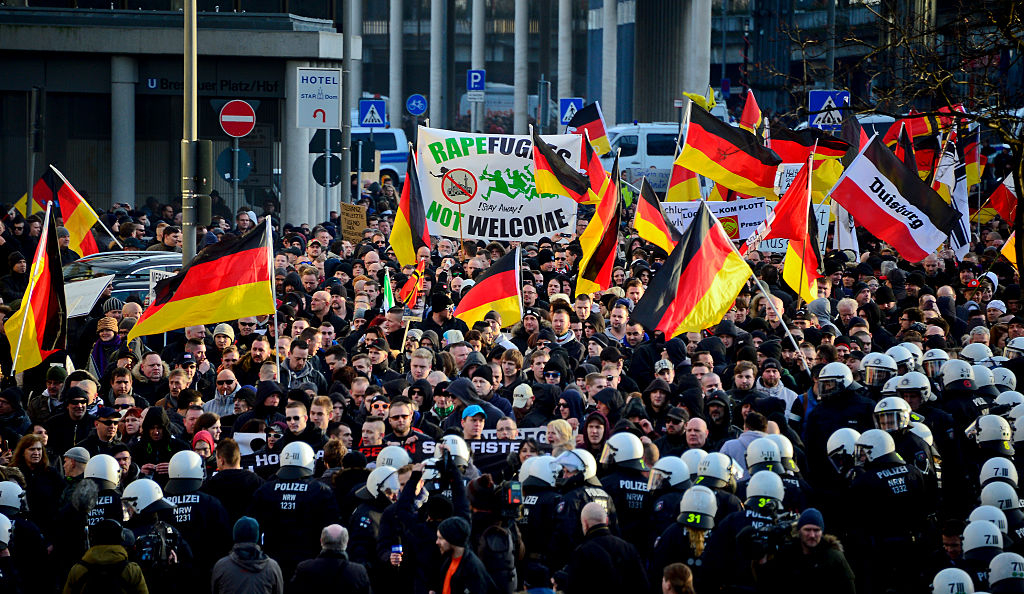
Germany's Migrant Rape Crisis: January 2017Tolerating a "rape culture" to sustain a politically correct stance on mass migration
German authorities are investigating reports that dozens of Arab men sexually assaulted female patrons at bars and restaurants in downtown Frankfurt on New Year's Eve 2016.
The attacks, in which mobs of migrants harassed women in a "rape game" known as "taharrush gamea" (Arabic for "collective sexual harassment"), are said to have mirrored the mass sexual assaults of women in Cologne and other German cities on New Year's Eve 2015.
A report published by Bild on February 5 alleged that some 900 migrants, many of whom were intoxicated, gathered at the central train station in Frankfurt on December 31, 2016. Police blocked their access to the Mainufer, a downtown pedestrian area along the Main River and the site of a large New Year's celebration, so the migrants walked to the Fressgasse, another downtown pedestrian zone known for its restaurants and bars. Witnesses said that groups of up to 50 migrants of "Arab or North African" appearance entered several establishments and began sexually assaulting female patrons. They also stole handbags and jackets, threw bottles and firecrackers, and, for good measure, finished their victims' drinks. Frankfurt Police insist they did not know about the incidents until Bild, the newspaper with the largest circulation in Germany, reported on them. It remains unclear why the victims waited more than a month before coming forward with their complaints. A police spokesperson said the claims are "worrying" and "cannot be excluded." Some say the incidents in Frankfurt harken back to those in Cologne, where police covered up the sexual assaults for several days, apparently to avoid fueling anti-immigration sentiments, until local media reported on them. Others question why no cellphone videos or photographs surfaced on social media to corroborate the claims. Previously, the police in Frankfurt reported only one assault on New Year's Eve: a 30-year-old migrant from Afghanistan attacked a 25-year-old woman at the Mainufer. Frankfurt's Mayor, Peter Feldmann, said: "There is zero tolerance for any abuses. I have great confidence in our police. They should always be contacted immediately. Only then can they do their work." Christoph Schmitt, security spokesman for the ruling Christian Democratic Union (CDU), said: "It is unacceptable that women have been treated this way. If mobs of male refugees are making the city unsafe, then we need more police on the streets and more video surveillance." Mayoral candidate Volker Stein said: "While we had high contingent of police at the Main River, the rest of the city was left to the rampaging hooligans. Whoever behaves in his host country as the reports suggest has not only lost any claim to our hospitality, but also their right to asylum!" Other German cities also reported sexual assaults on New Year's Eve 2016, despite an increased police presence and crowds that were far smaller than on New Year's Eve 2015.
According to Federal Criminal Police Office (Bundeskriminalamt, BKA) data (page 14), in 2013, migrants (Zuwanderer) committed 599 sex crimes, or an average of two a day. In 2014, migrants committed 949 sex crimes, or around three per day. In 2015, migrants committed 1,683 sex crimes, or around five per day. During the first three quarters of 2016, migrants committed 2,790 sex crimes, or around ten per day. In fact, the actual number of migrant-related sex crimes in Germany is at least two or three times higher than the official number. For example, only 10% of the sex crimes committed in Germany appear in the official statistics, according to André Schulz, head of the Criminal Police Association (Bund Deutscher Kriminalbeamter, BDK). In addition, the BKA data includes only crimes that have been solved (aufgeklärten Straftaten). According to police statistics, on average only around half of all crimes committed in Germany in any given year are solved (Aufklärungsquote). Moreover, BKA crime statistics do not include data from North Rhine-Westphalia, the most populous state in Germany and the one with the largest number of migrants, or from Hamburg, the second-largest city in the country. German police also deliberately downplay the true scale of the migrant crime problem by referring to migrant criminals with politically correct euphemisms such as "southerners" (Südländer), men with "dark skin" (dunkelhäutig, dunklere Gesichtsfarbe, dunklem Hauttyp) or a combination of the two: "southern skin color" (südländische Hautfarbe). An even more toxic practice is for police deliberately to omit any references to migrants in crime reports. This lapse makes it impossible for German citizens to understand the true scale of the migrant crime problem. A German nurse, for instance, was sexually assaulted by a mob of migrants in Hamburg on January 7, 2017. The official Hamburg police report, dated January 8, reads as follows: "Robbery in Hamburg-St. George, witnesses wanted!That day, Bild reported a completely different version of the same crime: "Sex Attack on Nurse: A disgraceful crime.Germany's sclerotic justice system, stymied by concerns over privacy, exacerbates the problem by imposing seemingly interminable delays in bringing perpetrators to justice. The following cases are just from January 2017:
Sexual Assaults and Rapes by Migrants in Germany, January 2017January 1. A 23-year-old migrant from Iraq sexually assaulted a 30-year-old woman in Glücksburg. A 24-year-old asylum seeker from Pakistan sexually assaulted a 46-year-old woman in Regensburg. A 31-year-old migrant from Iraq exposed himself to women in Augsburg. Three migrants from Afghanistan sexually assaulted two women in Augsburg. Two migrants from Afghanistan sexually assaulted a 22-year-old woman in Neumarkt. A 19-year-old migrant from Gambia assaulted a 25-year-old woman in Ulm. A "North African" migrant exposed himself to a 29-year-old woman in Ulm.January 1. A "foreign-looking" taxi driver (ausländisches Erscheinungsbild) sexually assaulted a 34-year-old woman in Wiesbaden. A man with an "Eastern European accent" (osteuropäischer Akzent) sexually assaulted a 49-year-old woman in Coesfeld. A "southern European-looking" man sexually assaulted a 42-year-old woman in Hanover. A "dark-skinned" man (dunkle Hautfarbe) sexually assaulted a 19-year-old woman in Trier. A "dark-skinned" man (dunkelhäutig) assaulted a 24-year-old female jogger in Bergkamen. January 2. An "Arabic-looking" man (arabischem Aussehen) accosted three girls aged between 10 and 13 in Rottenburg. A "brown-skinned" man (braunen Hautteint) speaking broken German sexually assaulted a 14-year-old boy in Seckach. Three "southerners" (Südländer) assaulted three girls, ages 14 and 15, in downtown Chemnitz. A man of "Arab origin" (Mann arabischer Herkunft) sexually assaulted an eight-year-old girl at a movie theater in Leipzig. He remains at large. January 2. Three "southern-looking" men (südländisches Erscheinungsbild) sexually assaulted a 29-year-old woman in Taunusstein. January 3. A "southern European-looking" man (südosteuropäisches Aussehen) sexually assaulted a 14-year-old girl on a train near Wesel. January 4. An "Asian-looking" man (asiatisches Aussehen) exposed himself to two women at a bus stop in Stuttgart-Bad Cannstatt. January 5. Two migrants (ages 18 and 19) from Libya were arrested for raping a 22-year-old woman in Neumarkt in der Oberpfalz. A "southern-looking" man (südländisches Aussehen) exposed himself to a 15-year-old girl who was riding her bicycle in Kranenburg. January 6. A 13-year-old migrant from Syria sexually assaulted two girls at a school in Schwerin. Two "southern-looking" men (südländisch Aussehen) sexually assaulted a 16-year-old girl in Linden. The girl was riding a city bus. When she got off at her stop, the two men also got off the bus. She began running but the men caught up with her and attacked her. January 7. A group of five "Black Africans" (Schwarzafrikanern) sexually assaulted a 28-year-old woman in Hamburg. The woman, a nurse at the Asklepios-Klinik St. Georg, was walking to her car after her shift ended when she heard someone screaming for help in an adjacent park. When she went to help she was ambushed by the men and assaulted and robbed. January 7. A 27-year-old migrant from Afghanistan sexually assaulted a 14-year-girl at a public swimming pool in Düsseldorf-Flingern. Two migrants (ages 21 and 39) from Libya sexually assaulted three girls, ages 13 and 14, at the train station in Niederwiesa. A "dark-skinned" man (dunklerer Teint) sexually assaulted a 16-year-old girl in Oberhausen. January 8. A 23-year-old migrant from Syria attempted to rape a 23-year-old woman in Kleve. The woman phoned her father for help after she sensed she was being followed while walking home. The father got on his scooter and was able to rescue his daughter just as the Syrian was dragging her into the bushes. January 8. A 20-year-old migrant from Afghanistan sexually assaulted a 19-year-old woman on a street car in Leipzig. A 21-year-old migrant from Iraq sexually assaulted a 24-year-old woman in the restroom of a discotheque in Bad Segeberg. A "North African-looking" man sexually assaulted a 22-year-old woman in downtown Stuttgart. A "Turkish or North African" man (türkischer oder nordafrikanischer Herkunft) exposed himself to a woman at the train station in Mainz-Kastel. A "dark-skinned" man (dunkler Hautfarbe) sexually assaulted a young woman in Bern (Switzerland). January 9. Four "Arab-looking" men (arabisch aussehend) sexually assaulted a 25-year-old woman at a bus stop in Weiterstadt. Three "southern-looking" men (südländisch aussehende) attempted to rape a 16-year-old girl in Gelsenkirchen. They fled after a passerby intervened to help the girl. January 10. A man speaking broken German exposed himself to a woman in the parking lot of a train station in Ludwigsburg. January 11. A "dark-skinned" man (dunkelhäutigen Mann) sexually assaulted a 22-year-old woman in Lüneburg. A "North African" man sexually assaulted a 30-year-old woman on a train on a train between Gelnhausen and Fulda. A 42-year-old migrant from Libya exposed himself to several women in Schneeberg. A man speaking a foreign language sexually assaulted a 21-year-old woman in Salzgitter. A man speaking German with an accent sexually assaulted a 34-year-old woman in Michelbach. A migrant from Bulgaria sexually assaulted two teenage girls at the train station in Meschede. A man speaking broken German sexually assaulted a woman who was shopping at a supermarket with her young daughter in Aachen. January 12. A 34-year-old migrant from Algeria sexually assaulted a 13-year-old girl at the central train station in Wolfsburg. The perpetrator was arrested after he returned to the same time location the following day. A "dark-skinned" man (dunkelhäutiger Mann) sexually assaulted a 17-year-old woman at the train station Crailsheim. A "dark-skinned" man (dunklere Hautfarbe) sexually assaulted a 45-year-old woman in Düsseldorf. An "Arab-looking" man exposed himself to a woman at a public park in Schwabach. January 13. A "southern- or Arab-looking" man (südländisches oder arabisches Aussehen) sexually assaulted a 17-year-old girl at a train station in Freiburg. A "southern-looking" man (südländisch) exposed himself to two women in Alzey. A 39-year-old migrant from Russia sexually assaulted two women at a subway station in Munich. A man speaking German with a foreign accent assaulted a 27-year-old woman at knifepoint in Raunheim. January 14. A "southern-looking" man (südländisch aussehende Mann) attempted to rape a 23-year-old woman in Karlsruhe-Bulach. Four "southern-looking" men (südländischen Aussehens) tried to assault a young woman in Gießen. A Moroccan migrant was arrested for sexual assault in Speyer. A "southern-looking" man (südländisches Aussehen) sexually assaulted a 15-year-old girl in Kamp-Lintfort. An "Oriental-looking" man (orientalisches Erscheinungsbild) exposed himself to a 68-year-old woman on a bicycle path in Lindenholzhausen. A 21-year-old migrant from Somalia sexually assaulted a 19-year-old woman on a train in Hanau. January 15. A man with a "foreign, unknown dialect" (ausländischen, unbekannten Dialekt) sexually assaulted a woman near the city hall in Metelen. Five migrants from Syria (between 11 and 14 years old) sexually assaulted two girls, aged 12 and 13, at a public swimming pool in Bockum. Two "presumably African" men (mutmaßlichen Afrikaner) sexually assaulted two women near the central train station in Bielefeld. A "southern European" man (Südeuropäer) exposed himself to two women in Ulm. January 16. A man calling himself Ahmed exposed himself to a woman at a bus station in Singen. January 17. A "dark, nearly black-skinned" man (dunkle, fast schwarze Hautfarbe) sexually assaulted an 11-year-old girl on a street car in Magdeburg. January 18. A 30-year-old asylum seeker raped a 31-year-old woman in Dortmund. Two "southern-looking" men (südländisches Aussehen) sexually assaulted a 13-year-old girl in Rastatt. A "southern-looking" man (südländisches Aussehen) sexually assaulted a 17-year-old girl at a bus stop in Salzgitter. A 30-year-old asylum seeker raped a 31-year-old woman in Dortmund. January 19. An "Eastern European-looking" man (osteuropäischem Aussehen) exposed himself to a 27-year-old woman on a train in Stuttgart. A man exposed himself to an 11-year-old girl on a bus in Stuttgart. An "English-speaking" man sexually assaulted a 17-year-old girl at the train station in Crailsheim. January 21. Two men "speaking a foreign language" sexually assaulted two women in Osnabrück. The attackers fled after one of the women used pepper spray on them. A migrant physically assaulted an 18-year-old woman in Uelzen after she rejected his advances. A "southern-looking" man (südländisches Aussehen) sexually assaulted a 23-year-old woman after he followed her off a train in Karlsruhe. An "Arab-looking" man (arabischer Herkunft) assaulted a 27-year-old woman at the train station in Friedrichsdorf. January 22. Two migrants from Algeria sexually assaulted two women in the female restroom of a bar in Schweinfurt. A "dark-skinned" man (dunkelhäutig) assaulted a 20-year-old woman at the central train station in Bochum after she rejected his advances. January 23. A "dark-skinned" man (dunkleren Teint) exposed himself to a 13-year-old girl in Stuttgart-Heumaden. A "dark-skinned" man (dunkelhäutigen Mann) sexually assaulted two women in Minden. January 24. A 44-year-old migrant from Syria was arrested on charges of sexually assaulting more than 20 women in Wetzlar. The man, who among other offenses repeatedly licked unsuspecting women in the face, justified his behavior as a custom from his Arab homeland to show women his affection. January 24. A 26-year-old migrant from Somalia sexually assaulted several women in downtown Gießen. He also exposed himself to a nurse outside the city's Catholic Hospital. A "southern-looking" man (südländisch aussehen) sexually assaulted five women in Karlsruhe. A 14-year-old Turkish boy raped a 13-year-old boy and attempted to rape a 13-year-old girl in Herzogenburg (Austria). January 25. A "southern-looking" man (südländischem Aussehen) exposed himself to a 51-year-old woman in Kamp-Lintfort. January 26. A "dark-skinned" man (dunkelhäutig) assaulted a 46-year-old woman on a train in Stuttgart. After the woman asked the man to take his feet off the seat, he smashed her head against the window. A "southern-looking" man sexually assaulted a 17-year-old woman on a train in Öhringen. A group of 12 "dark-skinned" men (dunklen Teint) assaulted a 16-year-old girl in Gelsenkirchen. January 27. A 25-year-old woman was raped in a female restroom at the Ludwig Maximilian University in Munich. A "southerner" (südländischen Typs) sexually assaulted a 17-year-old girl in Chemnitz-Altendorf. A 27-year-old migrant from Pakistan exposed himself to an 18-year-old woman on a train between Gelsenkirchen and Essen. A migrant (südländischen Migrationshintergrund) exposed himself to a 77-year-old woman in Wangen. January 28. Three "dark-skinned" men (dunkelhäutig) sexually assaulted a 19-year-old woman in Dortmund. Two "dark-skinned" men (dunkelhäutiger Männer) sexually assaulted two 12-year-old girls in Bietigheim-Bissingen. A man speaking a foreign language sexually assaulted a 24-year-old woman in Bonn. A 40-year-old migrant from Morocco sexually assaulted a 41-year-old woman on a train in Düsseldorf. A "southern-looking" man (südländische Erscheinung) sexually assaulted a 20-year-old woman in Hamburg. January 29. A "southern-looking" man (südländischem Aussehen) sexually assaulted a 14-year-old girl in Neubrandenburg. A 23-year-old migrant from Eritrea sexually assaulted several women on a train in Munich. A 36-year-old migrant from Gambia sexually assaulted several woman on a train near Freiburg. A man speaking Turkish sexually assaulted a 26-year-old woman on a train near Dormagen. January 30. Süleyman D., a 25-year-old German of Turkish descent, was arrested for raping one woman and attempting to rape two more at the Ludwig Maximilian University in Munich. A 24-year-old migrant from Armenia sexually assaulted two women on an express train between Hamburg and Kassel. A man speaking broken German exposed himself to three women in Offenbach. January 31. A "dark-skinned" man (dunkelhäutigen) sexually assaulted a 28-year-old woman who was walking with her four-year-old child near the train station in Bad Krozingen. Court Cases involving Migrants Accused of Sexual Crimes, January 2017January 7. Asif M., a 26-year-old asylum seeker from Pakistan, appeared in court on charges he raped one woman and attempted to rape five others in Berlin-Steglitz. He insisted that he was the victim: "As a refugee, it is difficult to find a girlfriend."January 11. Ralph Q., a 24-year-old asylum seeker from Ghana, was sentenced to three years and two months in prison for raping a 15-year-old girl in Duisburg-Neumühl. January 18. A 27-year-old Kosovar was sentenced to one year and ten months of probation for sexually assaulting a 27-year-old woman in Freiburg. The man followed the woman into a restroom at a night club, told her that he was a narcotics detective, forced her to undress and then tried to rape her. January 18. Ali M., a 34-year-old asylum seeker from Syria, was sentenced to four-and-a-half years in prison for raping 15-year-old girl in Bonn-Bornheim. The man plied the girl with drugs and alcohol during at a party at his home. The girl passed out and after the other guests left the party he raped her. The man subsequently tried to bribe the girl into silence. January 19. Qaisar S., a 38-year-old migrant from Pakistan, was sentenced to three years and ten months in prison for raping a 19-year-old woman in Zwickau. The court heard how the man, who has Hepatitis C, bit the woman on the lip in a deliberate effort to infect her with the virus. January 20. The trial began of Abubaker C., a 27-year-old Pakistani man who strangled 70-year-old Maria Müller in her bed in Bad Friedrichshall, and then painted verses from the Koran on her bedroom walls. Prosecutors said the murder was religiously motivated: The Sunni Muslim murdered the woman because she was a devout Roman Catholic. January 21. A 47-year-old asylum seeker from Syria was sentenced to one year and nine months in prison for raping a 44-year-old mentally disabled woman in Soest. The suspect, who has been living in an asylum shelter in Welver at German taxpayer expense since 2003, had 23 previous convictions for offenses including assault, robbery and fare evasion. A neurologist who has attended the Syrian during his 13-year stay in Germany told the court that the man is "untreatable" (Therapieunfähig). "When he is drunk, he is unpredictable," she said. January 23. The trial began of Merwan B., a 29-year-old Tunisian who stabbed to death his 35-year-old ex-girlfriend, Julia B., and their unborn baby. Prosecutors said the couple split after the man refused to take responsibility for the child, but that he later changed his mind after learning that the child would boost his prospects for permanent residency. The woman refused to get back together with him. The prosecutor said: "He did not want to accept this separation. He wanted to kill Julia B. because he could not accept that she would be living in Germany with his child after he was deported." January 23. The trial began of Kashif M., a 32-year-old Pakistani man charged with raping two women, ages 22 and 52, in Chemnitz. January 24. A 21-year-old migrant from Gambia was sentenced to five years in juvenile detention for raping two women in Freiburg and Bad Krozingen. A 36-year-old migrant from Nigeria appeared in court on charges of raping an 18-year-old woman in Neusäß. Soeren Kern is a Senior Fellow at the New York-based Gatestone Institute. Follow him on Facebook and on Twitter.
© 2017 Gatestone Institute. All rights reserved. The articles printed here do not necessarily reflect the views of the Editors or of Gatestone Institute. No part of the Gatestone website or any of its contents may be reproduced, copied or modified, without the prior written consent of Gatestone Institute.
|
Our goal is to have intelligent discussion of the topics of the day. We realize everyone has their opinion and they should be allowed to express it in a discussion forum without calling each other names. We learn from discussion and not from name calling or argument.We use cookies to personalise content and ads, to provide social media features and to analyse our traffic. We also share information about your use of our site with our social media, advertising and analytics partners. See details
Contact Form
Showing posts with label dortmund. Show all posts
Monday, February 13, 2017
Muslims Spreading Their "Love" Throughout Germany Via Rape
Labels:
Berlin,
Bild,
Cologne,
conservative blogs,
conservative musings,
Conservative Tom,
dortmund,
Esssen,
Germany,
Hamburg,
Hanover,
Karlsruhe,
rapes in Germany,
sex crimes in Germany
Friday, October 23, 2015
Instead Of Being Grateful, Refugees Make Demands. Won't Complete Apprentice Programs. Totally Ungrateful.
Germany: Asylum Seekers Make Demands
- "Human traffickers and the media in their home countries are making promises that do not correspond to reality." — Hans-Joachim Ulrich, regional refugee coordinator.
- The migrants said they were angry they were being asked to sleep in a huge warehouse rather than in private apartments. Hamburg officials say there are no more vacant apartments in the city. "The city lied to us. We were shocked when we arrived here," said Syrian refugee Awad Arbaakeat.
- "One of the men, who spoke broken German, said they [a family of asylum seekers from Syria] were not interested in viewing the property because I am a woman... I was taken aback. You want to help and then are sent away, unwanted in your own country." — Aline Kern, real estate agent.
- "A constitutional state cannot allow itself to be blackmailed." — Marcel Huber, Bavarian politician.
- "I man. You woman. I go first." — Muslim male with a full shopping cart at the supermarket.
- An asylum seeker from Somalia successfully sued the German Agency for Migration and Refugees for taking too long to process his application -- 16 months. The agency said it currently has a backlog of 250,000 unprocessed applications.
- Seventy percent of migrants from Afghanistan, Iraq and Syria who were offered apprenticeships fail to complete them. According to the director of the Munich Chamber of Trade, many young migrants believe apprenticeships are beneath them.
Asylum seekers are increasingly using tactics such as hunger strikes, lawsuits and threats of violence in efforts to force German authorities to comply with an ever-growing list of demands.
Many migrants, unhappy with living conditions in German refugee shelters, are demanding that they immediately be given their own homes or apartments. Others are angry that German bureaucrats are taking too long to process their asylum applications. Still others are upset over delays in obtaining social welfare payments.
Although most asylum seekers in Germany have a roof over their head, and receive three hot meals a day, as well as free clothing and healthcare, many are demanding: more money, more comfortable beds, more hot water, more ethnic food, more recreational facilities, more privacy — and, of course, their own homes.
Germany will receive as many as 1.5 million asylum seekers in 2015, including 920,000 in the last quarter of 2015 alone, according to government estimates. This figure is nearly double the previous estimate, from August, which was 800,000 for all of 2015. By comparison, Germany received 202,000 asylum seekers in all of 2014.
With refugee shelters across the country already filled to capacity, and more than 10,000 new migrants entering Germany every day, Germany is straining to care for all the newcomers, many of whom are proving to be ungrateful and impatient guests.
In Berlin, 20 asylum seekers sued the State Agency for Health and Social Welfare (Landesamt für Gesundheit und Soziales, Lageso) in an effort to force local authorities to speed up their welfare payments.
Berlin expects to receive 50,000 asylum seekers in 2015. German taxpayers will spend 600 million euros ($680 million) this year to pay for their upkeep.
Also in Berlin, more than 40 migrants, mostly from Pakistan, seized control over the observation deck of the city's television tower and demanded stays of deportation, jobs, and exemptions from mandatory residence (Residenzpflicht), a legal requirement that asylum seekers reside within certain boundaries defined by local immigration authorities. More than 100 police were deployed to the tower to remove the protesters. After a brief questioning, they were set free. Police said no crime had been committed because the migrants had purchased tickets to the observation deck, some 200 meters (650 feet) above the Berlin.
In the Kreuzberg district of Berlin, more than 400 migrants, mostly from Africa, occupied an abandoned school because they no longer wanted to live in tents in a nearby square. When 900 police arrived to clear the building, some migrants poured gasoline inside the structure and threatened to set themselves on fire, while others threatened to jump off the roof of the building. "We are currently negotiating with local authorities about how to proceed," a Sudanese migrant named Mohammed said. "We will not leave until our demands [amending German asylum laws so they can remain in the country] are met."
In Dortmund, 125 migrants complained about the "catastrophic conditions" at the Brügmann sports facility, which now serves as a refugee shelter. The list of complaints included: bad food, uncomfortable beds and not enough showers.
Just hours after arriving in Fuldatal, 40 asylum seekers from Afghanistan, Pakistan and Syriacomplained about conditions at a refugee shelter there and demanded that they be given their own homes. The regional refugee coordinator, Hans-Joachim Ulrich, said that migrants are coming to Germany with unrealistic expectations. "Human traffickers and the media in their home countries are making promises that do not correspond with reality," he said.
In Hamburg, more than 70 asylum seekers went on a hunger strike in an effort to pressure local authorities to provide them with better housing. "We are on a hunger strike," said Syrian refugee Awad Arbaakeat. "The city lied to us. We were shocked when we arrived here." The migrants said they were angry they were being asked to sleep in a huge warehouse rather than in private apartments. Hamburg officials say there are no more vacant apartments in the city, the second-largest in Germany.
Also in Hamburg, more than 100 migrants gathered in front of the city hall to protest the lack of heating in their tent shelters. City officials said they were caught off guard by the early frost and that all tents would have heating before the winter sets in. According to Hamburg Mayor Olaf Scholtz, some 3,600 migrants would be spending the coming winter in tents due to the lack of alternative housing in the city.
According to Hamburg officials, 35,021 migrants arrived in the city during the first nine months of 2015. During this same period, Hamburg police were dispatched to the city's refugee shelters more than 1,000 times, including 81 times to break up mass brawls, 93 times to investigate physical and sexual assaults, and 28 times to prevent migrants from committing suicide.
Meanwhile, a confidential document that was leaked to the German newspaper Bild revealsthat the Hamburg transit authority (Hamburger Verkehrsverbund, HVV) has ordered ticket inspectors to "look the other way" whenever they encounter migrants who are using public transportation without a ticket. The move ostensibly aims to protect the HVV against "bad press."
According to the leaked document, ticket inspectors should be lenient with asylum seekers because many migrants are "the victims of professional counterfeit ticket scammers" and many others have "barely comprehensible knowledge" of the HVV's tariff structure.
The CDU's transportation expert, Dennis Thering, said the HVV's policy cannot be left unchallenged. "This 'look-the-other-way' policy must be withdrawn. In Hamburg there is the opportunity to purchase discounted HVV tickets, explicitly also for persons who receive benefits under the Asylum Seekers Benefits Act." Every newly arrived refugee receives 149 euros in pocket money every month. This includes 25.15 euros that have been earmarked for the purchase of transport tickets.
In Halle, four security guards were injured when they tried to stop a mob of asylum seekers from Africa and Syria from entering the city's social welfare office before opening hours. The migrants, who were there to pick up their welfare payments, became angry when it appeared to them as though some migrants cut in front of the line. It later turned out that some migrants were there for other business, and thus were not required to stand in line.
In Munich, 30 migrants went on a hunger strike to protest shared accommodations in refugee shelters. Two of the men were rushed to the hospital after losing consciousness. "A constitutional state cannot allow itself to be blackmailed," Bavarian politician Marcel Huber said. "We have zero tolerance for this action."
In Nürnberg, six migrants from Afghanistan, Ethiopia and Iran went on a hunger strike toprotest the rejection of their asylum applications. The men, who are living in a tent in downtown Nürnberg for several months, demanded to speak to local authorities. The asylum applications were rejected six years ago, but the men are still living in Germany.
In Osnabrück, an asylum seeker from Somalia successfully sued the German Agency for Migration and Refugees (Bundesamt für Migration und Flüchtlinge, BAMF) for taking too long to process his application. A judge ordered the BAMF to make a decision on his application within three months or provide him with financial compensation.
The man said he had been waiting for 16 months to get an answer from the BAMF. In its defense, the BAMF said it currently has a backlog of 250,000 unprocessed applications, and this number is expected to skyrocket as more asylum seekers arrive in Germany.
A spokesperson for the court said the ruling set a precedent, and that many more asylum seekers likely would file lawsuits against the BAMF in the near future.
In Walldorf, a town in the state of Baden-Württemberg, a group of migrants demanded that local authorities immediately provide them with private apartments because they were tired of living in a refugee shelter with 200 other asylum seekers. The leader of the group, a 46-year-old refugee from Syria, said he expected more from Germany. It was high time for Germans to begin to "treat us like human beings," he said.
Following up on the complaints, state and local authorities inspected the shelter and found that conditions there were "absolutely acceptable," with cubicles for privacy and plenty of food and clothing.
In Wetzlar, a city in the state of Hesse, migrants threatened to go on a hunger strike in an effort to force local authorities to move them into permanent housing. Local authorities said they delays were due to a quarantine after several migrants were found to be infected with Hepatitis A.
In Zweibrücken, 50 asylum seekers from Syria went on a hunger strike to protest the slow pace of the application approval process. "We can accept the living conditions in the refugee camp, but we need hope," one of the men said. Local officials said the process has collapsed because of the large number of applicants.
Asylum seekers have also gone on hunger strikes in Birkenfeld, Böhlen, Gelsenkirchen,Hannover, Walheim, and Wittenberg.
Meanwhile, teachers at Gemeinschaftsschule St. Jürgen, a grade school in the northern German city of Lübeck, ordered eighth graders to spend a morning at a local refugee shelter and "actively help" the migrants by making their beds, sorting their clothing and working in the kitchen.
Some parents complained that their children are also being asked to bring gifts and food for the migrants, who are already receiving handouts financed by German taxpayers. A woman wrote: "Sometimes I do not even know how I am going to put food on my own table."
Another woman wrote: "This is going too far. Students are supposed to make beds and do cleaning work at a refugee shelter. My friend's 14-year-old son is being asked to do this!!! I am not an agitator and I am tolerant, but this is going way too far. Is there now a new course in Lübeck schools called: Slavery???
The school's principal, Stefan Pabst, said the negative reaction was a "catastrophe." He said that having the children work in a refugee shelter was the best way for them to "understand social behavior." The German newsmagazine, Stern, complained that the dissenting parents belonged to "right-wing circles" and are "spreading their stupid slogans."
In Bad Kreuznach, a family of asylum seekers from Syria made an appointment to view a four-room rental property but refused to view the house because the real estate agent was female. According to real estate agent Aline Kern:
One woman described how Muslim men repeatedly cut in front of her at the supermarket checkout line. "Twice while shopping at a German supermarket I was shown that I am a second-class citizen," she wrote. In one instance, an adult Muslim male with a full shopping cart cut in front of her. In broken German, he said: "I man. You woman. I go first." In another instance, a young Muslim male elbowed the woman while cutting in front of her. "When I said that I would let him go ahead of me if he asked me for permission, I was instructed by his sister that boys do not need to ask, they just demand."
A teacher at a vocational school wrote: "The most problematic students are Muslim males, who do not acknowledge the authority of female teachers and who disrupt the classes."
A mother reported that during a visit to her daughter's school, she approached a fully-veiled female refugee and asked her if she could be of help to her. "A man with a fancy suit and a three-day beard, he seemed like out of a Hugo Boss fashion magazine, said: 'My wife does not speak the language of the unclean.' When I asked him who here was unclean, he said I was. I asked him what that means. He said it was nothing against me personally, because all German women are unclean, and that his wife should not speak the language of the unclean, so that she can remain clean."
Klöckner is now calling for Germany to pass a new law that requires migrants and refugees to integrate into German society. She said: "We need an integration law. We are a liberal and free country. If we give up the foundations of our liberality, we will wake up in a different country."
Klöckner insists that migrants must be informed about German "rules of the game" from the first day they arrive in the country. "The people who want to stay here must, from the first day, accept and learn that in this country religions coexist peacefully and that we cannot use force to resolve conflicts," she said.
In Berlin, more than 150 migrant youths from North Africa and Eastern Europe are occupied as full-time purse-snatchers and pickpockets. Also known as the klau-kids (thief kids), they post their plunder (smart phones, laptops, designer sunglasses) on the Internet to taunt police. A 16-year-old known as Ismat O. has been detained more than 20 times on suspicion of theft, but each time he has been released, only to continue his trade. Walid K. has been arrested more than 10 times, and is also free.
According to the director of the police union in Berlin, Bodo Pfalzgraf, "it is incomprehensible that such serial offenders do not remain in pre-trial detention." Police say the youths are released because German judges are not prepared to issue arrest warrants for so-called petty crimes such as purse-snatching. The youths can only be deported if they have been sentenced to at least three years in prison.
In Bavaria, the Munich Chamber of Trade (Handwerkskammer München und Oberbayern)reported that 70% of migrants from Afghanistan, Iraq and Syria who have been offered apprenticeships fail to complete them. The normal washout rate is 25%. According to the director of the chamber, Lothar Semper, many young migrants believe the apprenticeships are beneath them. "We have to make a tremendous effort to convince young people that they should even begin an apprenticeship," he said. "Many have the expectation of quickly earning a lot of money in Germany."
Many migrants, unhappy with living conditions in German refugee shelters, are demanding that they immediately be given their own homes or apartments. Others are angry that German bureaucrats are taking too long to process their asylum applications. Still others are upset over delays in obtaining social welfare payments.
Although most asylum seekers in Germany have a roof over their head, and receive three hot meals a day, as well as free clothing and healthcare, many are demanding: more money, more comfortable beds, more hot water, more ethnic food, more recreational facilities, more privacy — and, of course, their own homes.
Germany will receive as many as 1.5 million asylum seekers in 2015, including 920,000 in the last quarter of 2015 alone, according to government estimates. This figure is nearly double the previous estimate, from August, which was 800,000 for all of 2015. By comparison, Germany received 202,000 asylum seekers in all of 2014.
With refugee shelters across the country already filled to capacity, and more than 10,000 new migrants entering Germany every day, Germany is straining to care for all the newcomers, many of whom are proving to be ungrateful and impatient guests.
In Berlin, 20 asylum seekers sued the State Agency for Health and Social Welfare (Landesamt für Gesundheit und Soziales, Lageso) in an effort to force local authorities to speed up their welfare payments.
Berlin expects to receive 50,000 asylum seekers in 2015. German taxpayers will spend 600 million euros ($680 million) this year to pay for their upkeep.
Also in Berlin, more than 40 migrants, mostly from Pakistan, seized control over the observation deck of the city's television tower and demanded stays of deportation, jobs, and exemptions from mandatory residence (Residenzpflicht), a legal requirement that asylum seekers reside within certain boundaries defined by local immigration authorities. More than 100 police were deployed to the tower to remove the protesters. After a brief questioning, they were set free. Police said no crime had been committed because the migrants had purchased tickets to the observation deck, some 200 meters (650 feet) above the Berlin.
In the Kreuzberg district of Berlin, more than 400 migrants, mostly from Africa, occupied an abandoned school because they no longer wanted to live in tents in a nearby square. When 900 police arrived to clear the building, some migrants poured gasoline inside the structure and threatened to set themselves on fire, while others threatened to jump off the roof of the building. "We are currently negotiating with local authorities about how to proceed," a Sudanese migrant named Mohammed said. "We will not leave until our demands [amending German asylum laws so they can remain in the country] are met."
In Dortmund, 125 migrants complained about the "catastrophic conditions" at the Brügmann sports facility, which now serves as a refugee shelter. The list of complaints included: bad food, uncomfortable beds and not enough showers.
Just hours after arriving in Fuldatal, 40 asylum seekers from Afghanistan, Pakistan and Syriacomplained about conditions at a refugee shelter there and demanded that they be given their own homes. The regional refugee coordinator, Hans-Joachim Ulrich, said that migrants are coming to Germany with unrealistic expectations. "Human traffickers and the media in their home countries are making promises that do not correspond with reality," he said.
In Hamburg, more than 70 asylum seekers went on a hunger strike in an effort to pressure local authorities to provide them with better housing. "We are on a hunger strike," said Syrian refugee Awad Arbaakeat. "The city lied to us. We were shocked when we arrived here." The migrants said they were angry they were being asked to sleep in a huge warehouse rather than in private apartments. Hamburg officials say there are no more vacant apartments in the city, the second-largest in Germany.
Also in Hamburg, more than 100 migrants gathered in front of the city hall to protest the lack of heating in their tent shelters. City officials said they were caught off guard by the early frost and that all tents would have heating before the winter sets in. According to Hamburg Mayor Olaf Scholtz, some 3,600 migrants would be spending the coming winter in tents due to the lack of alternative housing in the city.
According to Hamburg officials, 35,021 migrants arrived in the city during the first nine months of 2015. During this same period, Hamburg police were dispatched to the city's refugee shelters more than 1,000 times, including 81 times to break up mass brawls, 93 times to investigate physical and sexual assaults, and 28 times to prevent migrants from committing suicide.
Meanwhile, a confidential document that was leaked to the German newspaper Bild revealsthat the Hamburg transit authority (Hamburger Verkehrsverbund, HVV) has ordered ticket inspectors to "look the other way" whenever they encounter migrants who are using public transportation without a ticket. The move ostensibly aims to protect the HVV against "bad press."
According to the leaked document, ticket inspectors should be lenient with asylum seekers because many migrants are "the victims of professional counterfeit ticket scammers" and many others have "barely comprehensible knowledge" of the HVV's tariff structure.
The CDU's transportation expert, Dennis Thering, said the HVV's policy cannot be left unchallenged. "This 'look-the-other-way' policy must be withdrawn. In Hamburg there is the opportunity to purchase discounted HVV tickets, explicitly also for persons who receive benefits under the Asylum Seekers Benefits Act." Every newly arrived refugee receives 149 euros in pocket money every month. This includes 25.15 euros that have been earmarked for the purchase of transport tickets.
In Halle, four security guards were injured when they tried to stop a mob of asylum seekers from Africa and Syria from entering the city's social welfare office before opening hours. The migrants, who were there to pick up their welfare payments, became angry when it appeared to them as though some migrants cut in front of the line. It later turned out that some migrants were there for other business, and thus were not required to stand in line.
In Munich, 30 migrants went on a hunger strike to protest shared accommodations in refugee shelters. Two of the men were rushed to the hospital after losing consciousness. "A constitutional state cannot allow itself to be blackmailed," Bavarian politician Marcel Huber said. "We have zero tolerance for this action."
In Nürnberg, six migrants from Afghanistan, Ethiopia and Iran went on a hunger strike toprotest the rejection of their asylum applications. The men, who are living in a tent in downtown Nürnberg for several months, demanded to speak to local authorities. The asylum applications were rejected six years ago, but the men are still living in Germany.
In Osnabrück, an asylum seeker from Somalia successfully sued the German Agency for Migration and Refugees (Bundesamt für Migration und Flüchtlinge, BAMF) for taking too long to process his application. A judge ordered the BAMF to make a decision on his application within three months or provide him with financial compensation.
The man said he had been waiting for 16 months to get an answer from the BAMF. In its defense, the BAMF said it currently has a backlog of 250,000 unprocessed applications, and this number is expected to skyrocket as more asylum seekers arrive in Germany.
A spokesperson for the court said the ruling set a precedent, and that many more asylum seekers likely would file lawsuits against the BAMF in the near future.
![]()
Groups of migrants across Germany have been launching hunger strikes, demanding more money, more comfortable beds, more hot water, more ethnic food, more recreational facilities, and their own homes. In Berlin (right), 900 police were needed to remove more than 400 migrants who had occupied an abandoned school.
|
In Walldorf, a town in the state of Baden-Württemberg, a group of migrants demanded that local authorities immediately provide them with private apartments because they were tired of living in a refugee shelter with 200 other asylum seekers. The leader of the group, a 46-year-old refugee from Syria, said he expected more from Germany. It was high time for Germans to begin to "treat us like human beings," he said.
Following up on the complaints, state and local authorities inspected the shelter and found that conditions there were "absolutely acceptable," with cubicles for privacy and plenty of food and clothing.
In Wetzlar, a city in the state of Hesse, migrants threatened to go on a hunger strike in an effort to force local authorities to move them into permanent housing. Local authorities said they delays were due to a quarantine after several migrants were found to be infected with Hepatitis A.
In Zweibrücken, 50 asylum seekers from Syria went on a hunger strike to protest the slow pace of the application approval process. "We can accept the living conditions in the refugee camp, but we need hope," one of the men said. Local officials said the process has collapsed because of the large number of applicants.
Asylum seekers have also gone on hunger strikes in Birkenfeld, Böhlen, Gelsenkirchen,Hannover, Walheim, and Wittenberg.
Meanwhile, teachers at Gemeinschaftsschule St. Jürgen, a grade school in the northern German city of Lübeck, ordered eighth graders to spend a morning at a local refugee shelter and "actively help" the migrants by making their beds, sorting their clothing and working in the kitchen.
Some parents complained that their children are also being asked to bring gifts and food for the migrants, who are already receiving handouts financed by German taxpayers. A woman wrote: "Sometimes I do not even know how I am going to put food on my own table."
Another woman wrote: "This is going too far. Students are supposed to make beds and do cleaning work at a refugee shelter. My friend's 14-year-old son is being asked to do this!!! I am not an agitator and I am tolerant, but this is going way too far. Is there now a new course in Lübeck schools called: Slavery???
The school's principal, Stefan Pabst, said the negative reaction was a "catastrophe." He said that having the children work in a refugee shelter was the best way for them to "understand social behavior." The German newsmagazine, Stern, complained that the dissenting parents belonged to "right-wing circles" and are "spreading their stupid slogans."
In Bad Kreuznach, a family of asylum seekers from Syria made an appointment to view a four-room rental property but refused to view the house because the real estate agent was female. According to real estate agent Aline Kern:
"One of the men, who spoke broken German, said they were not interested in viewing the property because I am a woman, I am blonde, and because I looked the men into their eyes. This was inappropriate. My company should send a man to show the property.In Idar-Oberstein, a town in the German state of Rhineland-Palatinate, an imam at a refugee shelter refused to shake the hand of Julia Klöckner, a visiting dignitary, because she is a woman. After Klöckner, the vice-chairwoman of the Christian Democratic Union (CDU), shared her experience with the German newsmagazine Focus, she received more than 800 emails from women across the country describing how they, too, have been mistreated by Muslim migrants.
"I was taken aback, annoyed. One wants to help and then are sent away unwanted in your own country."
One woman described how Muslim men repeatedly cut in front of her at the supermarket checkout line. "Twice while shopping at a German supermarket I was shown that I am a second-class citizen," she wrote. In one instance, an adult Muslim male with a full shopping cart cut in front of her. In broken German, he said: "I man. You woman. I go first." In another instance, a young Muslim male elbowed the woman while cutting in front of her. "When I said that I would let him go ahead of me if he asked me for permission, I was instructed by his sister that boys do not need to ask, they just demand."
A teacher at a vocational school wrote: "The most problematic students are Muslim males, who do not acknowledge the authority of female teachers and who disrupt the classes."
A mother reported that during a visit to her daughter's school, she approached a fully-veiled female refugee and asked her if she could be of help to her. "A man with a fancy suit and a three-day beard, he seemed like out of a Hugo Boss fashion magazine, said: 'My wife does not speak the language of the unclean.' When I asked him who here was unclean, he said I was. I asked him what that means. He said it was nothing against me personally, because all German women are unclean, and that his wife should not speak the language of the unclean, so that she can remain clean."
Klöckner is now calling for Germany to pass a new law that requires migrants and refugees to integrate into German society. She said: "We need an integration law. We are a liberal and free country. If we give up the foundations of our liberality, we will wake up in a different country."
Klöckner insists that migrants must be informed about German "rules of the game" from the first day they arrive in the country. "The people who want to stay here must, from the first day, accept and learn that in this country religions coexist peacefully and that we cannot use force to resolve conflicts," she said.
In Berlin, more than 150 migrant youths from North Africa and Eastern Europe are occupied as full-time purse-snatchers and pickpockets. Also known as the klau-kids (thief kids), they post their plunder (smart phones, laptops, designer sunglasses) on the Internet to taunt police. A 16-year-old known as Ismat O. has been detained more than 20 times on suspicion of theft, but each time he has been released, only to continue his trade. Walid K. has been arrested more than 10 times, and is also free.
According to the director of the police union in Berlin, Bodo Pfalzgraf, "it is incomprehensible that such serial offenders do not remain in pre-trial detention." Police say the youths are released because German judges are not prepared to issue arrest warrants for so-called petty crimes such as purse-snatching. The youths can only be deported if they have been sentenced to at least three years in prison.
In Bavaria, the Munich Chamber of Trade (Handwerkskammer München und Oberbayern)reported that 70% of migrants from Afghanistan, Iraq and Syria who have been offered apprenticeships fail to complete them. The normal washout rate is 25%. According to the director of the chamber, Lothar Semper, many young migrants believe the apprenticeships are beneath them. "We have to make a tremendous effort to convince young people that they should even begin an apprenticeship," he said. "Many have the expectation of quickly earning a lot of money in Germany."
Soeren Kern is a Senior Fellow at the New York-based Gatestone Institute. He is also Senior Fellow for European Politics at the Madrid-based Grupo de Estudios Estratégicos / Strategic Studies Group. Follow him on Facebook and on Twitter. His first book, Global Fire, will be out in early 2016.
© 2015 Gatestone Institute. All rights reserved. No part of this website or any of its contents may be reproduced, copied or modified, without the prior written consent of Gatestone Institute.
Subscribe to:
Comments (Atom)