Contact Form

Name

Email *

Message *

Showing posts with label financial cliff. Show all posts

Wednesday, December 19, 2012

Help Wanted: Leaders In Washington


As an indication of where the country is, the following blog reports on a poll that Americans do not want cuts in benefits but do favor an increase in taxation. We would like to know more about the survey, however, we think it is fairly safe to assume that the respondents who said they wanted an increase in taxes, wanted the increase on someone else. 

Americans are acting like spoiled children who want everything but do not want to do anything to get it.  "I want my benefits but don't tax me more--tax those wealthy guys!" seems to be the mantra of the day.

Whether we go over the cliff or not, makes little difference if we do not change the way we think about the benefits the government provides us. We simply cannot afford them anymore. Without bottom line cuts, in many cases very deep cuts, this country will sooner or later have to bankrupt itself or have others do it for us.

The time has come for our leadership to explain the mess we are in and stop politicizing the crisis. We need real solutions, not sound bites.  Are you listening Washington?

Conservative Tom


Poll: Americans Want A Fiscal Cliff Deal Without Spending Cuts

December 19, 2012 by  
Poll: Americans Want A Fiscal Cliff Deal Without Spending Cuts
PHOTOS.COM
A new poll indicates that a majority of Americans want to have their cake and eat it, too.
An ABC News-Washington Post poll released yesterday indicates that a majority of Americans want to avoid the coming fiscal cliff, but are largely opposed to necessary spending cuts that would emerge from an agreement between President Barack Obama and Congress.
Respondents to the poll indicated that they favor a mixture of tax hikes and spending cuts in averting the financial calamity. They, however, remained opposed to any cuts to military or Medicaid spending. Sixty-five percent of those polled said that the Federal government should work out a deal that both raises taxes and cuts spending. But 55 percent of the same respondents said that lawmakers should avoid cuts to military spending and 68 percent opposed Medicaid cuts.
The poll also indicated that broader entitlement reforms are unpopular with the majority of Americans. Sixty percent of those polled said they are against raising the Medicare eligibility age; the same number did not support restructuring Social Security to slow rate increases.
Thirty-one percent of the respondents described themselves as Democrats, 24 percent Republicans and 38 percent claimed to be independents

Wednesday, December 12, 2012

Cliff Threatens More Than US Finances

The financial crisis, while very important, threatens more than just the country's finances. If allowed to occur, it will destroy "the American Spirit" that made America what it is. 

What is the American Spirit? It is the nebulous dream of becoming successful based on your own work ethic and brains and not who your parents were or where you were born. It is the reason that immigrants have come to these shores. It is the story that every parent has told their child, that you can be or do anything you desire. It is the "house on the hill" about which Reagan spoke.

Those of us who were born here don't realize how special a place this country is and how important this feeling of American spirit is. It is what distinguishes America from every country in the world. 

We have always been a bunch of mutts here. None of us have titles or owe their place in society due to their lineage.  We revel in our independence, our freedoms and our "can do" attitude. All of which could be lost if we go over the cliff.

The following post by Jon Kraushar says it very well. Take the time to read it and let  us know what you think.

Conservative Tom


Forget the fiscal crisis, Obama's plans threaten our American spirit

  • obama_fiscalboehner_111612.jpg
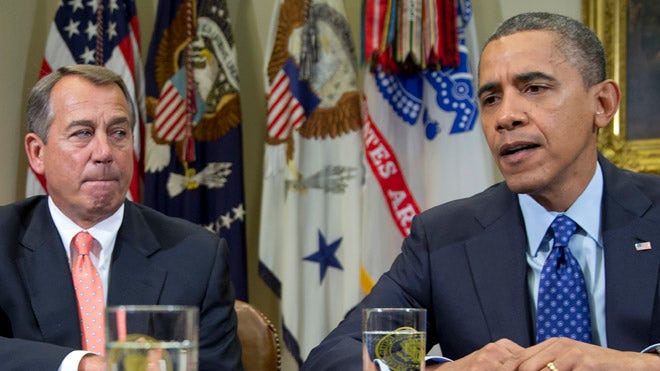
    Nov. 16, 2012: President Obama and House Speaker John Boehner meet at the White House. (AP)
America faces a philosophical "cliff" even more dangerous than the impending "fiscal cliff."
The highest stake in the game of chicken between President Obama and the Republicans isn’t money—it is mindset.
Throughout its history, America has been richer or poorer in money. But what has made our country so exceptional, from its founding, has been a constant store of philosophical wealth. In America, a person’s wealth (whether material or spiritual) used to be defined by a dedication to the virtue of striving.
What made every American great was a belief in potential—a belief that there are no limits to what an individual can produce for him (or her) self, instead of relying on a government to give away, take away and redistribute. It was a belief that abundance is virtually limitless in human capability, but it is unvirtuously limited by big government.
President Obama is trying to transform America from a society of aspiration to a society of envy.
-
In Obama’s new abnormal America, the national diet for many citizens is changing from high fiber ambition for upward mobility to high fat consumption of an ever-expanding gravy boat of entitlements, ladled out by ceaseless government spending. 
As The Heritage Foundation points out, “Today, more people than ever before—67.3 million Americans, from college students to retirees to welfare beneficiaries—depend on the federal government for housing, food, income, student aid, or other assistance once considered to be the responsibility of individuals, families, neighborhoods, churches, and other civil society institutions.” 
Federal entitlements consume 62 percent of federal outlays—the highest level in our nation’s history. The Declaration of Independence that created America is being distorted into a Declaration of Dependency encouraged by President Obama. This is not just a crisis of the wallet. It is a crisis of the soul.
What is happening now—the way in which Mr. Obama really wants to “fundamentally transform America”—is that he wants to use the fiscal cliff to propel us over a far more perilous philosophical cliff, which is bottomless in its destructive depth.
I can only conclude that the president is trying to transform America from a society of aspiration to a society of envy—and if that happens, America risks falling into a philosophical poverty that could starve our country’s uniqueness to death.
People who love our country should be advocating that we become an Opportunity Society. Resentment of achievement, resentment of success, resentment that people differ in their capabilities and acquisitions, fosters a Misfortune Society. That is a zero sum society, where anyone’s striving and accomplishment necessarily turns someone else into a victim. And in a Misfortune Society, victims must be made whole with pieces taken from so-called “unfair” victors, to be poured into more government spending and more entitlements to insure that voters keep “investing” in the big government that subsidizes them.
There is a difference between fair share and sharing fairly. America has a progressive system of the fair share that citizens give up to government, regardless of whether it is in the form of money or government control.
But President Obama wants to stretch that fair share to an unfair point.  Instead of citizens admiring success and thinking that with a combination of hard work and limitless opportunity they, too, could achieve the heights of others, Mr. Obama wants to create a citizenry that's indignant about the success of others. He wants people to believe that someone else’s wealth or possessions of any kind must be punished by being diminished and redistributed, according to the president's standards of “fairness.”
What is lost in this warfare of extraction is that you can confiscate and redistribute money or any other kinds of resources. But you cannot insure that wealth and resources will grow and perpetuate unless people have the philosophy—the mindset and attitude—that they will leverage opportunity to personally produce more and more of what they desire. Just as you cannot tax and spend your way to prosperity, you cannot tax and spend away the innate ambition of Americans and expect prosperity to flourish. 
America can survive falling off the fiscal cliff. But America cannot survive as the engine of hope, change, growth and leadership for the world if it falls down the philosophical cliff that President Obama wants to create.


Read more: http://www.foxnews.com/opinion/2012/12/11/forget-fiscal-crisis-obama-plans-threaten-our-american-spirit/#ixzz2Erf3fWlJ

Tuesday, November 27, 2012

The Real US Debt


For those who think that the current proposals to "solve" the debt crisis will do so, read the following article. If you cannot sleep tonight, don't blame us, blame those who put us in this position--all previous Representatives, Senators and Presidents.  They ALL are to blame!  

Our suggestion that since we know who caused the problem, they should be forced to give us all the benefits they gave themselves starting with retirement pay,  health insurance, special parking perks, Secret Service protection etc. etc.

Agree? Disagree? Let us know.

Conservative Tom


Why $16 Trillion Only Hints at the True U.S. Debt

A decade and a half ago, both of us served on President Clinton's Bipartisan Commission on Entitlement and Tax Reform, the forerunner to President Obama's recent National Commission on Fiscal Responsibility and Reform. In 1994 we predicted that, unless something was done to control runaway entitlement spending, Medicare and Social Security would eventually go bankrupt or confront severe benefit cuts.
Eighteen years later, nothing has been done. Why? The usual reason is that entitlement reform is the third rail of American politics. That explanation presupposes voter demand for entitlements at any cost, even if it means bankrupting the nation.
A better explanation is that the full extent of the problem has remained hidden from policy makers and the public because of less than transparent government financial statements. How else could responsible officials claim that Medicare and Social Security have the resources they need to fulfill their commitments for years to come?
As Washington wrestles with the roughly $600 billion "fiscal cliff" and the 2013 budget, the far greater fiscal challenge of the U.S. government's unfunded pension and health-care liabilitBuies remains offstage. The truly important figures would appear on the federal balance sheet—if the government prepared an accurate one.
But it hasn't. For years, the government has gotten by without having to produce the kind of financial statements that are required of most significant for-profit and nonprofit enterprises. The U.S. Treasury "balance sheet" does list liabilities such as Treasury debt issued to the public, federal employee pensions, and post-retirement health benefits. But it does not include the unfunded liabilities of Medicare, Social Security and other outsized and very real obligations.
As a result, fiscal policy discussions generally focus on current-year budget deficits, the accumulated national debt, and the relationships between these two items and gross domestic product. We most often hear about the alarming $15.96 trillion national debt (more than 100% of GDP), and the 2012 budget deficit of $1.1 trillion (6.97% of GDP). As dangerous as those numbers are, they do not begin to tell the story of the federal government's true liabilities.
The actual liabilities of the federal government—including Social Security, Medicare, and federal employees' future retirement benefits—already exceed $86.8 trillion, or 550% of GDP. For the year ending Dec. 31, 2011, the annual accrued expense of Medicare and Social Security was $7 trillion. Nothing like that figure is used in calculating the deficit. In reality, the reported budget deficit is less than one-fifth of the more accurate figure.
Why haven't Americans heard about the titanic $86.8 trillion liability from these programs? One reason: The actual figures do not appear in black and white on any balance sheet. But it is possible to discover them. Included in the annual Medicare Trustees' report are separate actuarial estimates of the unfunded liability for Medicare Part A (the hospital portion), Part B (medical insurance) and Part D (prescription drug coverage).
As of the most recent Trustees' report in April, the net present value of the unfunded liability of Medicare was $42.8 trillion. The comparable balance sheet liability for Social Security is $20.5 trillion.
Were American policy makers to have the benefit of transparent financial statements prepared the way public companies must report their pension liabilities, they would see clearly the magnitude of the future borrowing that these liabilities imply. Borrowing on this scale could eclipse the capacity of global capital markets—and bankrupt not only the programs themselves but the entire federal government.
These real-world impacts will be felt when currently unfunded liabilities need to be paid. In theory, the Medicare and Social Security trust funds have at least some money to pay a portion of the bills that are coming due. In actuality, the cupboard is bare: 100% of the payroll taxes for these programs were spent in the same year they were collected.
In exchange for the payroll taxes that aren't paid out in benefits to current retirees in any given year, the trust funds got nonmarketable Treasury debt. Now, as the baby boomers' promised benefits swamp the payroll-tax collections from today's workers, the government has to swap the trust funds' nonmarketable securities for marketable Treasury debt. The Treasury will then have to sell not only this debt, but far more, in order to pay the benefits as they come due.
When combined with funding the general cash deficits, these multitrillion-dollar Treasury operations will dominate the capital markets in the years ahead, particularly given China's de-emphasis of new investment in U.S. Treasurys in favor of increasing foreign direct investment, and Japan's and Europe's own sovereign-debt challenges.
When the accrued expenses of the government's entitlement programs are counted, it becomes clear that to collect enough tax revenue just to avoid going deeper into debt would require over $8 trillion in tax collections annually. That is the total of the average annual accrued liabilities of just the two largest entitlement programs, plus the annual cash deficit.
Nothing like that $8 trillion amount is available for the IRS to target. According to the most recent tax data, all individuals filing tax returns in America and earning more than $66,193 per year have a total adjusted gross income of $5.1 trillion. In 2006, when corporate taxable income peaked before the recession, all corporations in the U.S. had total income for tax purposes of $1.6 trillion. That comes to $6.7 trillion available to tax from these individuals and corporations under existing tax laws.
In short, if the government confiscated the entire adjusted gross income of these American taxpayers, plus all of the corporate taxable income in the year before the recession, it wouldn't be nearly enough to fund the over $8 trillion per year in the growth of U.S. liabilities. Some public officials and pundits claim we can dig our way out through tax increases on upper-income earners, or even all taxpayers. In reality, that would amount to bailing out the Pacific Ocean with a teaspoon. Only by addressing these unsustainable spending commitments can the nation's debt and deficit problems be solved.
Neither the public nor policy makers will be able to fully understand and deal with these issues unless the government publishes financial statements that present the government's largest financial liabilities in accordance with well-established norms in the private sector. When the new Congress convenes in January, making the numbers clear—and establishing policies that finally address them before it is too late—should be a top order of business.
Mr. Cox, a former chairman of the House Republican Policy Committee and the Securities and Exchange Commission, is president of Bingham Consulting LLC. Mr. Archer, a former chairman of the House Ways & Means Committee, is a senior policy adviser at PricewaterhouseCoopers LLP.

Sunday, November 4, 2012

Be Scared--Be Very Scared


If you had any concerns before, this following article should scare the bloody   h---  out of you.  

Regardless of your political persuasion, we need to get this financial crisis under control before it all blows up!

Conservative Tom


The authors are senior fellows at Stanford University's Hoover Institution. They have served in various federal government policy positions in the Treasury Department, the Office of Management and Budget and the Council of Economic Advisers.
A version of this article appeared September 17, 2012, on page A19 in the U.S. edition of The Wall Street Journal, with the headline: The Magnitude of the Mess We're In.                                  
Copyright 2012 Dow Jones & Company, Inc. All Rights Reserved

September 16, 2012, 7:03 p.m. ET

The Magnitude of the Mess We're In

The next Treasury secretary will confront problems so daunting that even Alexander Hamilton would have trouble preserving the full faith and credit of the United States.

By George P. Shultz, Michael J. Boskin, John F. Cogan, Allan H. Meltzer and John B. Taylor

Sometimes a few facts tell important stories. The American economy now is full of facts that tell stories that you really don't want, but need, to hear.

Where are we now?

Did you know that annual spending by the federal government now exceeds the 2007 level by about $1 trillion? With a slow economy, revenues are little changed. The result is an unprecedented string of federal budget deficits, $1.4 trillion in 2009, $1.3 trillion in 2010, $1.3 trillion in 2011, and another $1.2 trillion on the way this year. The four-year increase in borrowing amounts to $55,000 per U.S. household.


The amount of debt is one thing. The burden of interest payments is another. The Treasury now has a preponderance of its debt issued in very short-term durations, to take advantage of low short-term interest rates. It must frequently refinance this debt which, when added to the current deficit, means Treasury must raise $4 trillion this year alone. So the debt burden will explode when interest rates go up. 


The government has to get the money to finance its spending by taxing or borrowing. While it might be tempting to conclude that we can just tax upper-income people, did you know that the U.S. income tax system is already very progressive? The top 1% pay 37% of all income taxes and 50% pay none. 
Did you know that, during the last fiscal year, around three-quarters of the deficit was financed by the Federal Reserve? Foreign governments accounted for most of the rest, as American citizens' and institutions' purchases and sales netted to about zero. The Fed now owns one in six dollars of the national debt, the largest percentage of GDP in history, larger than even at the end of World War II. 


The Fed has effectively replaced the entire interbank money market and large segments of other markets with itself. It determines the interest rate by declaring what it will pay on reserve balances at the Fed without regard for the supply and demand of money. By replacing large decentralized markets with centralized control by a few government officials, the Fed is distorting incentives and interfering with price discovery with unintended economic consequences. 


Did you know that the Federal Reserve is now giving money to banks, effectively circumventing the appropriations process? To pay for quantitative easing—the purchase of government debt, mortgage-backed securities, etc.—the Fed credits banks with electronic deposits that are reserve balances at the Federal Reserve. These reserve balances have exploded to $1.5 trillion from $8 billion in September 2008. 


The Fed now pays 0.25% interest on reserves it holds. So the Fed is paying the banks almost $4 billion a year. If interest rates rise to 2%, and the Federal Reserve raises the rate it pays on reserves correspondingly, the payment rises to $30 billion a year. Would Congress appropriate that kind of money to give—not lend—to banks? 


The Fed's policy of keeping interest rates so low for so long means that the real rate (after accounting for inflation) is negative, thereby cutting significantly the real income of those who have saved for retirement over their lifetime. 


The Consumer Financial Protection Bureau is also being financed by the Federal Reserve rather than by appropriations, severing the checks and balances needed for good government. And the Fed's Operation Twist, buying long-term and selling short-term debt, is substituting for the Treasury's traditional debt management.


This large expansion of reserves creates two-sided risks. If it is not unwound, the reserves could pour into the economy, causing inflation. In that event, the Fed will have effectively turned the government debt and mortgage-backed securities it purchased into money that will have an explosive impact. If reserves are unwound too quickly, banks may find it hard to adjust and pull back on loans. Unwinding would be hard to manage now, but will become ever harder the more the balance sheet rises. 


The issue is not merely how much we spend, but how wisely, how effectively. Did you know that the federal government had 46 separate job-training programs? Yet a 47th for green jobs was added, and the success rate was so poor that the Department of Labor inspector general said it should be shut down. We need to get much better results from current programs, serving a more carefully targeted set of people with more effective programs that increase their opportunities. 


Did you know that funding for federal regulatory agencies and their employment levels are at all-time highs? In 2010, the number of Federal Register pages devoted to proposed new rules broke its previous all-time record for the second consecutive year. It's up by 25% compared to 2008. These regulations alone will impose large costs and create heightened uncertainty for business and especially small business. 


This is all bad enough, but where we are headed is even worse. 


President Obama's budget will raise the federal debt-to-GDP ratio to 80.4% in two years, about double its level at the end of 2008, and a larger percentage point increase than Greece from the end of 2008 to the beginning of this year.


Under the president's budget, for example, the debt expands rapidly to $18.8 trillion from $10.8 trillion in 10 years. The interest costs alone will reach $743 billion a year, more than we are currently spending on Social Security, Medicare or national defense, even under the benign assumption of no inflationary increase or adverse bond-market reaction. For every one percentage point increase in interest rates above this projection, interest costs rise by more than $100 billion, more than current spending on veterans' health and the National Institutes of Health combined.

Worse, the unfunded long-run liabilities of Social Security, Medicare and Medicaid add tens of trillions of dollars to the debt, mostly due to rising real benefits per beneficiary. Before long, all the government will be able to do is finance the debt and pay pension and medical benefits. This spending will crowd out all other necessary government functions. 


What does this spending and debt mean in the long run if it is not controlled? One result will be ever-higher income and payroll taxes on all taxpayers that will reach over 80% at the top and 70% for many middle-income working couples. 


Did you know that the federal government used the bankruptcy of two auto companies to transfer money that belonged to debt holders such as pension funds and paid it to friendly labor unions? This greatly increased uncertainty about creditor rights under bankruptcy law. 


The Fed is adding to the uncertainty of current policy. Quantitative easing as a policy tool is very hard to manage. Traders speculate whether and when the Fed will intervene next. The Fed can intervene without limit in any credit market—not only mortgage-backed securities but also securities backed by automobile loans or student loans. This raises questions about why an independent agency of government should have this power. 


When businesses and households confront large-scale uncertainty, they tend to wait for more clarity to emerge before making major commitments to spend, invest and hire. Right now, they confront a mountain of regulatory uncertainty and a fiscal cliff that, if unattended, means a sharp increase in taxes and a sharp decline in spending bound to have adverse effect on the economy. Are you surprised that so much cash is waiting on the sidelines? 
What's at stake? 


We cannot count on problems elsewhere in the world to make Treasury securities a safe haven forever. We risk eventually losing the privilege and great benefit of lower interest rates from the dollar's role as the global reserve currency. In short, we risk passing an economic, fiscal and financial point of no return. 


Suppose you were offered the job of Treasury secretary a few months from now. Would you accept? You would confront problems that are so daunting even Alexander Hamilton would have trouble preserving the full faith and credit of the United States. Our first Treasury secretary famously argued that one of a nation's greatest assets is its ability to issue debt, especially in a crisis. We needed to honor our Revolutionary War debt, he said, because the debt "foreign and domestic, was the price of liberty." 

History has reconfirmed Hamilton's wisdom. As historian John Steele Gordon has written, our nation's ability to issue debt helped preserve the Union in the 1860s and defeat totalitarian governments in the 1940s. Today, government officials are issuing debt to finance pet projects and payoffs to interest groups, not some vital, let alone existential, national purpose.
 
The problems are close to being unmanageable now. If we stay on the current path, they will wind up being completely unmanageable, culminating in an unwelcome explosion and crisis. 

The fixes are blindingly obvious. Economic theory, empirical studies and historical experience teach that the solutions are the lowest possible tax rates on the broadest base, sufficient to fund the necessary functions of government on balance over the business cycle; sound monetary policy; trade liberalization; spending control and entitlement reform; and regulatory, litigation and education reform. The need is clear. Why wait for disaster? The future is now.