 |  |  |  |  |  |  |  |  |  |  |  |  |  |  |  |
| العربية | Čeština | Dansk | Deutsch | Ελληνικά | English | Español | Français | עברית | Italiano | Nederlands | Polski | Português | Pyccĸий | Slovenčina | Svenska |






The Burning of Notre Dame and the Destruction of Christian Europe
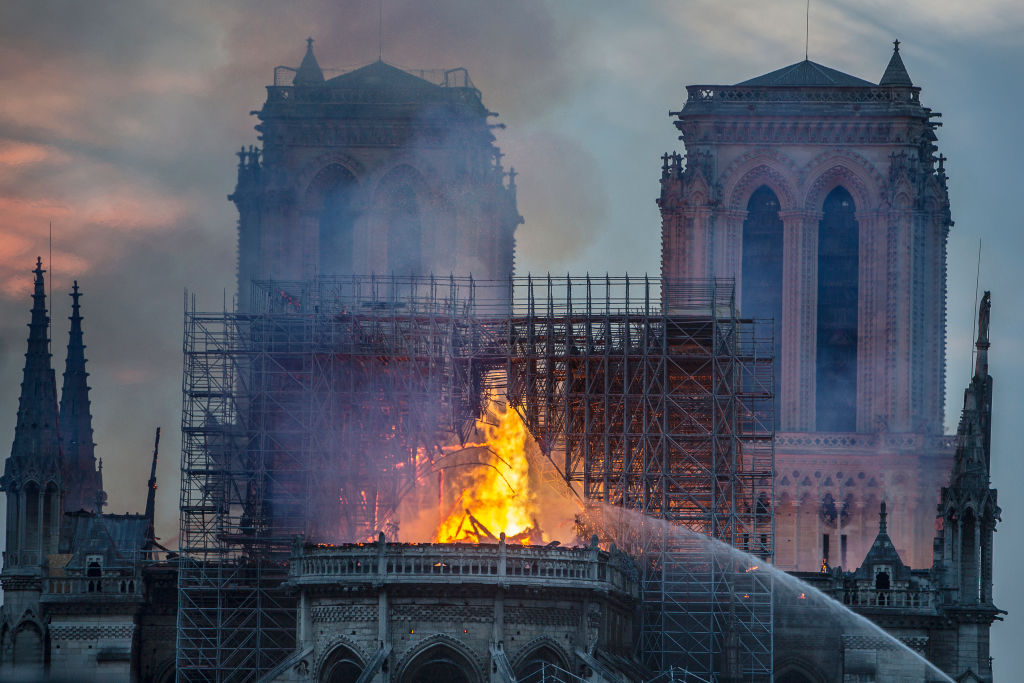
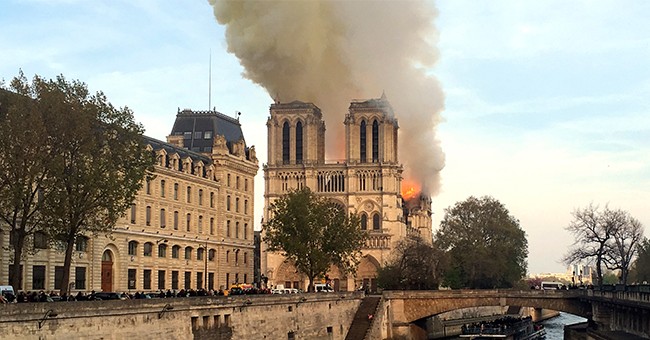
The fire that destroyed much of the Notre Dame Cathedral in the heart of Paris is a tragedy that is irreparable. Even if the cathedral is rebuilt, it will never be what it was before. Stained glass windows and major architectural elements have been severely damaged and the oak frame totally destroyed. The spire that rose from the cathedral was a unique piece of art. It was drawn by the architect who restored the edifice in the nineteenth century, Eugène Viollet-le-Duc, who had based his work on 12th century documents. In addition to the fire, the water needed to extinguish the flames penetrated the limestone of the walls and façade, and weakened them, making them brittle. The roof is non-existent: the nave, the transept and the choir now lie in open air, vulnerable to bad weather. They cannot even be protected until the structure has been examined thoroughly, a task that will take weeks. Three major elements of the structure (the north transept pinion, the pinion located between the two towers and the vault) are also on the verge of collapse. Notre Dame is more than 800 years old. It survived the turbulence of the Middle Ages, the Reign of Terror of the French Revolution, two World Wars and the Nazi occupation of Paris. It did not survive what France is becoming in the 21st century. The cause of the fire has so far been attributed to "an accident," "a short circuit," and most recently "a computer glitch." If the fire really was an accident, it is almost impossible to explain how it started. Benjamin Mouton, Notre Dame's former chief architect, explained that the rules were exceptionally strict and that no electric cable or appliance, and no source of heat, could be placed in the attic. He added that an extremely sophisticated alarm system was in place. The company that installed the scaffolding did not use any welding and specialized in this type of work. The fire broke out more than an hour after the workers' departure and none of them was present. It spread so quickly that the firefighters who rushed to the spot as soon as they could get there were shocked. Remi Fromont, the chief architect of the French Historical Monuments said: "The fire could not start from any element present where it started. A real calorific load is necessary to launch such a disaster". A long, difficult and complex investigation will be conducted. The possibility that the fire was the result of arson cannot be dismissed. Barely an hour after the flames began to rise above Notre Dame -- at a time when no explanation could be provided by anyone -- the French authorities rushed to say that the fire was an "accident" and that "arson has been ruled out." The remarks sounded like all the official statements made by the French government after attacks in France during the last decade. In November 2015, on the night of the massacre at the Bataclan Theater in Paris, in which jihadists murdered 90 people, the French Department of the Interior said that the government did not know anything, except that a gunfight had occurred. The truth came out only after ISIS claimed responsibility for the slaughter. In Nice, after the truck-attack in July 2016, the French government insisted for several days that the terrorist who crushed 86 people to death was a "man with a nervous breakdown". In 2018, Sarah Halimi's murderer, who recited verses from the Quran while torturing his victim, was declared "mentally disturbed" and held in a psychiatric institution immediately after his arrest. He will most likely never face a court. On April 8, Alain Finkielkraut and 38 other intellectuals published a text saying that her murderer must not escape justice. The text had no effect. The fire at Notre Dame took place less than three years after a "commando unit" of jihadi women, later arrested, tried to destroy the cathedral by detonating cylinders of natural gas. Three days before last week's fire, on April 12, the leader of the jihadis, Ines Madani, a young French convert to Islam, was sentenced to eight years in prison for creating a terrorist group affiliated with the Islamic State. The Notre Dame fire also occurred at a time when attacks against churches in France and Europe have been multiplying. More than 800 churches were attackedin France during the year 2018 alone. Many suffered serious damage: broken, beheaded statues, smashed tabernacles, feces thrown on the walls. In several churches, fires were lit. On March 5, the Basilica of St. Denis, where all but three of the Kings of France are buried, was vandalized by a Pakistani refugee. Several stained-glass windows were broken, and the basilica's organ, a national treasure built between 1834 and 1841, was nearly wrecked. Twelve days later, on March 17, a fire broke out at Saint Sulpice, the largest church in Paris, causing serious damage. After days of silence, the police finally admitted that the cause had been arson. For months, jihadist organizations have been issuing statements calling for the destruction of churches and Christian monuments in Europe. Notre Dame was repeatedly named as a primary target. Despite all that, the Cathedral was not adequately protected. A couple of young men, who entered the Cathedral at night, climbed on the roof last November and shot a video that they then put on YouTube. Many messages were posted by people with Muslim names on social media -- Twitter, Facebook, the website of Al Jazeera -- expressing a joy to see an important Christian symbol destroyed. Hafsa Askar, a migrant from Morocco and the vice president of the National Union of Students of France (UNEF), the main student organization in France, published a tweet saying, "People are crying on little pieces of wood... it's a delusion of white trash". French President Emmanuel Macron, who had never even mentioned the attacks on Saint Denis or Saint Sulpice, quickly went to Notre Dame and declared, "Notre Dame is our history, our literature, our imagination". He totally left out cathedral's religious dimension. The next evening, he said that Notre Dame would be rebuilt in five years: it was a bold statement. Many commentators interpreted his words as dictated by his will desperately to try to regain the confidence of the French people after five monthsof demonstrations, riots and destruction stemming from his ineffective handling of the "Yellow Vests" uprising. (On March 16, much of the Champs-Élysées was damaged by rioters; repairs have barely begun.) All experts agree that it will almost certainly take far longer than five years to rebuild Notre Dame. Macron strangely added that the cathedral would be "more beautiful" than before -- as if a badly damaged monument could be more beautiful after restoration. Macron went on to say that the reconstruction would be a "contemporary architectural gesture". The remark raised concern, if not panic, among defenders of historic monuments, who now fear that he may want to add modern architectural elements to a jewel of Gothic architecture. Again, he totally left out the cathedral's religious dimension. Macron's attitude is not surprising. From the moment he became president, he has kept himself away from any Christian ceremony. Most of the presidents who preceded him did the same. France is a country where a dogmatic secularismreigns supreme. A political leader who dares to call himself a Christian is immediately criticized in the media and can only harm a budding political career. Nathalie Loiseau -- the former director of France's National School of Administration and the leading candidate on the electoral list of Macron's party, "Republic on the Move," for the May 2019 European Parliament elections -- was recently photographed exiting a church after mass, which led to a media debate on whether her church attendance is a "problem." The results of French secularism are visible. Christianity has been almost completely wiped out from public life. Churches are empty. The number of priests is decreasing and the priests that are active in France are either very old or come from Africa or Latin America. The dominant religion in France is now Islam. Every year, churches are demolished to make way for parking lots or shopping centers. Mosques are being built all over, and they are full. Radical imams proselytize. The murder, three years ago, of Jacques Hamel, an 85-year-old priest who was slaughtered by two Islamists while he was saying mass in a church where only five people (three of them old nuns) were present, is telling. In 1905, the French parliament passed a law decreeing that all the properties of the Catholic Church in France were confiscated. Churches and cathedrals became property of the State. Since then, successive governments have spent little money to maintain them. Those churches that have not been vandalized are in poor condition, and most cathedrals are in poor condition, too. Even before the devastating fire, the Archdiocese of Paris stated that "it can't afford all the repairs" that Notre Dame needed, "estimated at $185 million." According to CBS News, in a March 20, 2018 report: "The French government, which owns the cathedral, has pledged around $50 million over the next decade, leaving a bill of $135 million. To raise the rest, Picaud helped launch the Friends of Notre-Dame of Paris Foundation. It works to find private donors both in France and across the Atlantic.On the evening of the fire at Notre Dame, hundreds of French people gathered in front of the burning cathedral to sing Psalms and pray. They seemed suddenly to understand that they were losing something immensely precious. Following the fire, the French government decided to start collecting donationsfrom private individuals, businesses and organizations for reconstruction; more than one billion euros have poured in. French billionaires promised to pay large sums: the Pinault family (the main owners of the retail conglomerate Kering) promised 100 million euros, the Arnault family (owners of LVMH, the world's largest luxury-goods company), 200 million euros, the Bettencourt family (owners of L'Oréal), also 200 million. Many on the French "left" immediately said that wealthy families had too much money, and that these millions would be better used helping the poor than taking care of old stones. For the foreseeable future, the heart of Paris will bear the terrible scars of a fire that devastated far more than a cathedral. The fire destroyed an essential part of what is left of the almost-lost soul of France and what France could accomplish when the French believed in something higher than their own day-to-day existence. Some hope that the sight of the destroyed cathedral will inspire many French people to follow the example of those who prayed on the night of the disaster. Michel Aupetit, Archbishop of Paris, said on April 17, two days after the fire, that he was sure France would know a "spiritual awakening". Others, not as optimistic, see in the ashes of the cathedral a symbol of the destruction of Christianity in France. The art historian Jean Clair said that he sees in the destruction of Notre Dame an additional sign of an "irreversible decadence" of France, and of the final collapse of the Judeo-Christian roots of Europe. An American columnist, Dennis Prager, wrote: "The symbolism of the burning of Notre Dame Cathedral, the most renowned building in Western civilization, the iconic symbol of Western Christendom, is hard to miss.Another American author, Rod Dreher, noted: "This catastrophe in Paris today is a sign to all of us Christians, and a sign to all people in the West, especially those who despise the civilization that built this great temple to its God on an island in the Seine where religious rites have been celebrated since the days of pagan Rome. It is a sign of what we are losing, and what we will not recover, if we don't change course now."For the moment, nothing indicates that France and Western Europe will change course. Dr. Guy Millière, a professor at the University of Paris, is the author of 27 books on France and Europe.
© 2019 Gatestone Institute. All rights reserved. The articles printed here do not necessarily reflect the views of the Editors or of Gatestone Institute. No part of the Gatestone website or any of its contents may be reproduced, copied or modified, without the prior written consent of Gatestone Institute.
|