Contact Form

Name

Email *

Message *

Showing posts with label obama recovery. Show all posts

Thursday, December 8, 2016

Obama Recovery Is A Mirage


GALLUP CEO CLAIMS THERE IS NO ECONOMIC RECOVERY


Economy photo
Photo by frankieleon 
The U.S. Council on Competitiveness asked Gallup to conduct, pro bono, a comprehensive study of U.S. growth and productivity for the Council’s 30th anniversary.
Chairman Jim Clifton enthusiastically said yes, and describes his findings…
A Gallup senior economist led the study. Top Gallup experts and esteemed external senior scientists reviewed it to ensure statistical and theoretical accuracy and objectivity.
Conventional wisdom — as reported in many major newspapers and media — tells us the U.S. economy is “recovering.” Well-meaning economists, academics and government officials use the term “recovery” when discussing the economy, implying that growth is getting stronger.
The study, released today, finds there is no recovery. Since 2007, U.S. GDP per capita growth has been 1%.
The Great Recession may be over, but America is dangerously running on empty.
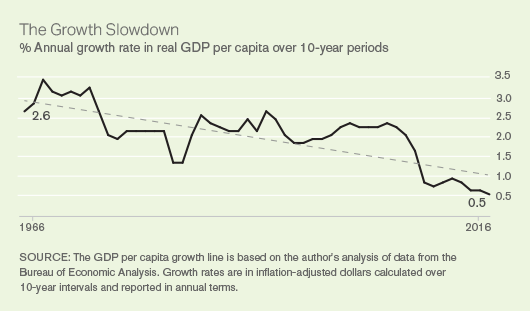
20161202_GrowthSlowdown_chart
Think of our country as a company, America Inc., which has more than 100 million full-time employees, with about $18 trillion in sales and $20 trillion of debt. The most serious problem facing it is no growth. In addition, America Inc. has three soaring expenses threatening to bankrupt the company and its shareholder-citizens: healthcare, housing and education.
As this report notes, in 1980, these three sectors accounted for 25% of total national spending — today, they account for more than 36%. They also account for most of the total measured inflation over the same period. And without inflation in these sectors, real annual productivity — defined as GDP per capita growth — would have been an estimated 3.9% instead of 1.7%.
My own opinion is that America Inc. is too big to “turn around” like one would a company or any other organization. There is no quick fix to something this huge and complex. But there is a long-term fix, which is to get GDP increasing to 3% and higher while slowing the increasing costs of healthcare, housing and education.
When real growth returns, productivity will increase, and America Inc.’s empty tank will refill.
* * *
Full report below (please note that if you are unsatisfied with this study please report Gallup to The Washington Post for being a Russian puppet..)

Monday, June 23, 2014

Home Sales Down, Wages Down--You Call This A Recovery?

Mortgage Bankers: 2014 Home Sales to Fall for 1st Time in 4 Years

Thursday, 19 Jun 2014 06:54 PM

Share:
  Comment  |
   Contact Us  |
  Print  
|  A   A  
Sales of new and existing homes in the U.S. will fall in 2014 for the first time in four years, the Mortgage Bankers Association said in a forecast Thursday.The MBA lowered its outlook to 5.28 million homes — a decline of 4.1 percent from the previous year. The industry group also said mortgage lending for purchases would total $595 billion this year, down 8.7 percent from 2013, and the first retreat in three years, according to Thursday’s MBA projection.
Rising home prices and stagnant wages make it difficult for Americans to get mortgages amid tight credit standards. The median price of an existing home gained 11.5 percent last year, second only to the 12 percent gain in 2005, the highest on record, according to the National Association of Realtors. The median U.S. household income rose less than 1 percent in 2013, according to data from Sentier Research LLC in Annapolis, Maryland.
“Even though we’re technically in a recovery, household income is lower now than it was in the recession,” said Gordon Green, a Sentier partner who formerly directed the Census Bureau office that compiles wage statistics. “It makes it a lot harder to buy a house.”
© Copyright 2014 Bloomberg News. All rights reserved.


Tuesday, May 13, 2014

Economy Cannot Grow Due To The Heavy Weight Put On It By Government Regulations. Stats Show Stall!

The Obama Recovery: U.S. Economy May HaveShrunk In First Quarter Of 2014

May 13, 2014 by  
 16 24
 
 1 89

It will be May 29 before the U.S. Department of Commerce updates its estimate of how the Nation’s Gross Domestic Product (GDP) performed during the first fiscal quarter of 2014, but it’s looking more and more likely that the worth of what the U.S. is producing has declined for the first time since the middle of 2009.
The Wall Street Journal reported today that fresh data from the Commerce Department on retail sales and business inventories, the latter of which grew slugglishly in March. That information, combined with an earlier Commerce GDP report of anemic 1st-quarter growth, set off a series of negative estimates from five major fund management firms, all of which anticipate an imminent announcement that the economy has, in fact, contracted.
“A couple weeks ago, the Commerce Department said U.S. economic output expanded at a seasonally adjusted annual rate of 0.1% in the first three months of the year. A near-stall for the economy, for sure, but at least it wasn’t worse,” WSJ observed, before offering this:
Based on more up-to-date figures, including the March trade data released last week, private forecasters now expect gross domestic product contracted in the first quarter for the first time in three years.
The latest evidence came Tuesday, when the Commerce Department released reports on retail sales and business inventories. Retail sales in February and March were revised up, but business inventories grew less in March than the agency had assumed in its GDP calculations.
Incorporating the new data, J.P. Morgan Chase on Tuesday estimated GDP contracted at a 0.8% rate in the first quarter. Macroeconomic Advisers put the contraction at 0.7%. Barclays Capital predicted a 0.6% decline. Pierpont Securities estimated output fell at a 0.4% rate. Action Economics estimated a 0.2% decline.
Any of those estimates, if correct, will mark the first time the U.S. economy has contracted since President Obama’s first year in office.
The GDP shrank by 2.8 percent in 2009, and has “recovered” marginally since, with annual growth margins of 2.5 percent (2010), 1.8 percent (2011), 2.8 percent (2012) and 1.9 percent (2013). Under President Clinton in the 1990s, the GDP routinely saw annual gains in excess of four percent, followed by a roller coaster ride for eight years under President Bush, whose best year came in 2004, when the GDP grew by 3.8 percent.