Contact Form

Name

Email *

Message *

Showing posts with label religious Freedom Restoration Act. Show all posts

Thursday, April 9, 2015

When The Government Forces You To Do Something Or Not To Do Something , Is That Not Tyranny?

Indiana Freedom of Religion

washington prayingThe Indiana law known as the Religious Freedom Restoration Act is intended to give citizens protection from federal coercion and encroachment upon religious conscience.  It is intended specifically to protect conscientious objectors from participating in acts contrary to their religiously held beliefs and to allow them to seek relief against the violators of their religious conscience.  In truth there is a flaw in this apparently well-intended law. And here it is from the text of the law itself:
“Sec. 6. A state action, or an action taken by an individual based upon a state action, may not substantially burden a person’s right to the exercise of religion, even if that burden results from a law or policy of general applicability unless the state or political subdivision of the state demonstrates that applying that burden to the person’s exercise of religion is: (1) essential to further a compelling government interest…”
This law, like many other 1st dilence150x150Amendment Preservation Acts creates a loophole for the government to justify their violations.  These acts change the First Amendment standard from “shall not abridge” to the government CAN abridge as long as they can show “a compelling government interest” for their infringements.  It is the same loophole that the government uses to justify circumventing the 4th Amendment to read your emails and collect your internet and phone data: a compelling government interest in national security.
According to this law, the government could perhaps argue they have a “compelling government interest” to prevent discrimination against ALL classes of people, and viola! the act is meaningless.  As a result this law actually gives legal justification for the very violations it was created to prevent!
Who Will Watch The Watchmen 400This is the danger of compensating for an unbounded GOVERNMENT exercising a power contrary to Liberty and freedom of conscience. While it is the rightful remedy for states to intercede for its citizens, it is very dangerous when it is not done properly.  We may just set up new precedents to further weaken the liberties we are attempting to protect.
What we desperately need is more constitutional education and fewer laws.
As a side note:  I believe anyone has the right to discriminate against me for the color of my skin, my religion, or even the smell of my perfume if they so choose. I trust Liberty.  I believe in the free market system.  I never trust the government to have the power to force someone to do or not do something.  I believe I have the Liberty to go somewhere else.  I do not have a RIGHT to shop anywhere I want.  But if a store owner discriminates against me, I reserve the right to boycott and encourage all my friends to boycott this business into bankruptcy.  
Comparing the “white only” issues of the 50s & 60s is a misapplication of circumstances.  The “white only” discriminations were a result of a law created BY government prohibiting service based upon race.  
In truth, there is no difference between a government using the force of law to prohibit a business owner from serving someone than a government using the force of law to require a business owner to serve someone.  Either way it is tyranny.
Here is a more in depth explanation if you like: http://goo.gl/oqxylz

Tuesday, April 7, 2015

Bravo To Courtney Hoffman.She Has Guts! Will Probably Be Condemned By Fellow Gays, Which Illustrates The Sad State Of Affairs In This Country!

Gay Woman Who Donated $20 to Christian-Owned Indiana Pizzeria Reveals Why She Took Bold Stand

A gay woman who donated $20 to Memories Pizza in Walkerton, Indiana, is speaking out about her decision to take a stand in support of all Americans’ right to live their lives according to their beliefs.
Courtney Hoffman was one of thousands of people who donated over $842,000 to the Christian owners of the pizzeria last week after a high volume of online threats caused the business to temporarily close its doors. The outrage ensued after the owners told a local news crew that they would happily serve gay people in its restaurant, but would refuse to cater a gay wedding.
Courtney Hoffman (Facebook)
That’s why Hoffman’s donation stood out. While she clearly disagrees with the owners’ beliefs, she still supports their right to operate their business based on those beliefs. In addition to her $20 donation to Memories Pizza, Hoffman wrote:
“As a member of the gay community, I would like to apologize for the mean spirited attacks on you and your business. I know many gay individuals who fully support your right to stand up for your beliefs and run your business according to those beliefs. We are outraged at the level of hate and intolerance that has been directed at you and I sincerely hope that you are able to rebuild.”
Kris Cruz, a radio host and producer of “The Jeff Adams Show,” was the first person to flag Hoffman’s donation. He then contacted her through Facebook and she agreed to join them on the air Monday.
Cruz started with the “big question” — Why did she do it?
“My girlfriend and I are small business owners, and we think there is a difference between operating in a public market space and then attaching the name of your business to a private event,” she said. “Like, if we were asked to set up at an anti-gay marriage rally, I mean, we would have to decline.”
Listen to the interview via “The Jeff Adams Show” and JA Creative New Media (interview starts at around 16:55):
Hoffman said she and her girlfriend operate a small kettle corn stand.
When the disturbing threats of violence were made against the pizzeria, Hoffman said the “horrible, hate-filled attacks” did not reflect the gay community that she has come to know and love.
“The gay community that we know knows full well what it’s like to be condemned for doing nothing but living your life according to your beliefs,” she added. “We know so many gay individuals that fully support the freedom of living your life according to your beliefs and feel that freedom extends to everyone, even the people that we don’t agree with.”
Though she admitted she was nervous to have so much attention on her, Hoffman also said the responses to her donation have been “so positive and amazing.” But more than anything, Hoffman said she’d like to see people become more tolerant in general.
“There’s this tendency to group people together — they are either one thing or they are another,” she said. “I just think there’s a lot of room for differences and similarities between all of these businesses, all of these communities, and if we can remember that differences don’t equal maliciousness, and try to find what we have in common — you know, the ands instead of the ors. Maybe we can move beyond threats of violence and have open discussions of the things that we don’t agree on.

Friday, April 3, 2015

Isn't It Funny That Liberals Demand Tolerance For Their Positions But Are Totally Intolerant For Anyone Who Believes Differently.

Bill Donohue: Indiana Proof Liberals Are Real 'Masters of Intolerance'

Thursday, 02 Apr 2015 11:35 AM
By Melissa Clyne
Americans need to understand the "profound difference" between refusing to serve a gay person and the right to a moral and religious conviction that gay marriage is wrong, Catholic League President Bill Donohue said Thursday during an appearance onNewsmax TV's "America's Forum" where he discussed the furor over Indiana's Religious Freedom Restoration Act.

"There's a profound difference between saying to a person 'I'm not going to serve you a cake, pizza or a drink because you're gay,' " Donohue explained.

Story continues below video.


"Those people should not have the right to do that, but you're asking people now to put aside their sincerely held convictions and say that I have to participate and affirm by being able to say that I want two men to get married and providing your birthday cake. I don't think bakers should have to put a Nazi insignia on a birthday cake for somebody anti-Semite. I don't think that an African American baker should have to put the 'N' word on a cake for some white racist and so on.
"Eighty percent of Americans are Christian. This is Holy Week and what are we talking about? The 1.6 percent of Americans who are gay and their rights trumping the religious rights of people when in fact gay rights and straight rights are not mentioned in the Constitution, but religious liberty is encoded in the First Amendment."

Following public outrage over Indiana enacting the law, the state has amended it to clarify that service providers may not use it as a legal defense for refusing to provide services, goods, facilities or accommodations and may not discriminate based on race, color, religion, ancestry, age, national origin, disability, sex, sexual orientation, gender identity or United States military service.

Donohue noted that the "hypocrisy is sickening" when it comes to those protesting the law, which is already a federal statute with a state version existing in many places around the country.

"San Francisco is rallying against Indiana and I had to sue San Francisco because of its anti-Catholicism about nine years ago," Donohue said. "Who are these people who come to the table clean like Snow White? Barack Obama voted for the same law when he was a state senator in Illinois."

The left, he said, "are the masters of intolerance."

"The whole thing is bizarre, but most Americans are in favor, as we've seen last January in an AP poll, people are in favor of people saying I don't have to participate in affirming you when it comes to serving people on the basis of business," he said.
"Anti-Semites, racists and anti-gay people should not be able to force people who are Jewish, black or gay to provide for services in terms of offending them. They can opt out, they can always go down the block and find somebody else. That's what a market economyis all about."

Related Stories: 
© 2015 Newsmax. All rights reserved.

Thursday, April 2, 2015

Pizza Place In Indiana Forced To Close Due To Religious Freedom Restoration Act

Indiana Pizza Place

Forced to Close Doors

After Refusing to Cater Gay Wedding

4/1/2015 1:59 PM PDT BY TMZ STAFF
EXCLUSIVE
0401-memories-pizza-closed-FACEBOOK-01Memories Pizza -- the first Indiana business to declare it would refuse LGBT business -- got blasted on the Internet and by phone, but the owner says there's been a huge misunderstanding ... sorta.
Kevin O’Connor tells TMZ he's had to temporarily close his business after he told a reporter he would refuse to cater a gay wedding under Indiana's new Religious Freedom Restoration Act. O'Connor says he was immediately flooded by threatening phone calls, and social media postings.
O'Connor wants to clear up one thing: He says he would never deny service to gay people in his restaurant. However, due to his religious beliefs, he does not believe in gay marriage ... and that's why he wouldn't service one.
Meanwhile, he says the threats have been serious enough that he's closing his pizza joint ... at least until the dust settles. 
Indiana's controversial law has raised a lot of questions, not the least of which is ... what gay wedding would hire a pizza place to cater?


Read more: http://www.tmz.com/2015/04/01/memories-pizza-closes-indiana-deny-service-gay-wedding/#ixzz3WB9C3fOj

What Does The Indiana Law Say? Does It Allow Discrimination Against Gays and LGBT?

Q&A on Indiana: Would Restaurants Be Allowed to Turn Away LGBT Customers?

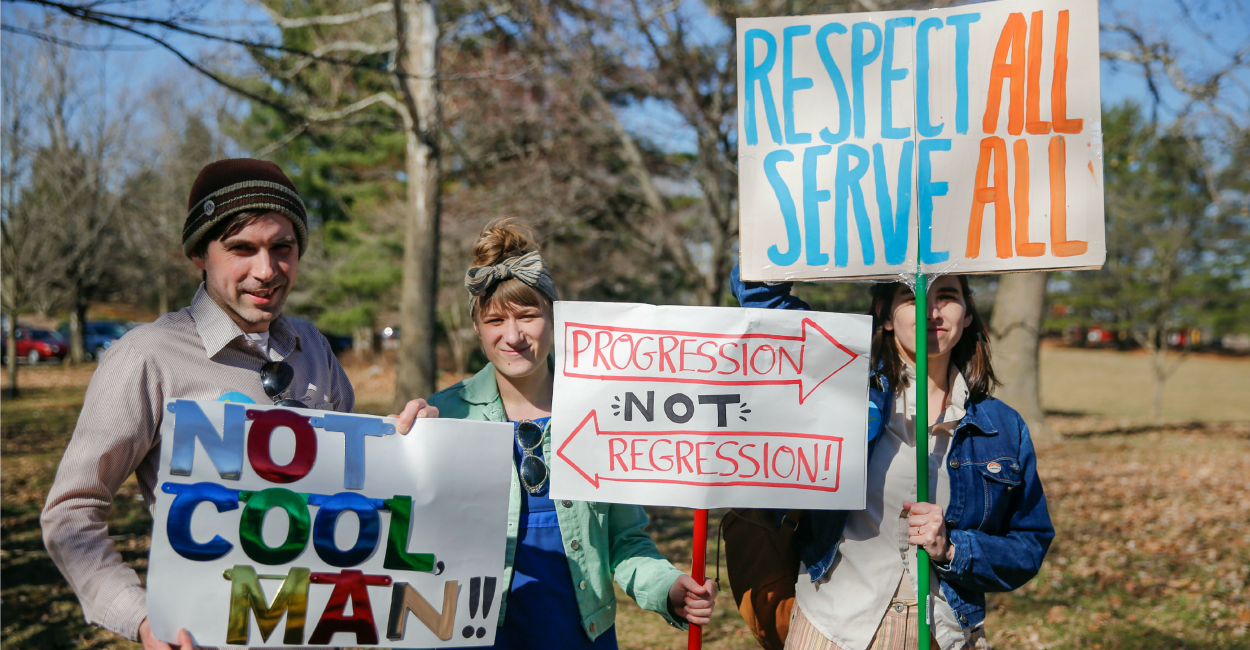
Matt Tobey, left, and Lisa Dorazewski, center, who are co-owners of Rainbow Bakery, and Erin Tobey, right, hold signs protesting Indiana's Religious Freedom Restoration Act. (Photo: Jeremy Hogan/Polaris/Newscom)
Does the Indiana Religious Freedom Restoration Act allow business owners to put their beliefs above the rights of their employees or customers?
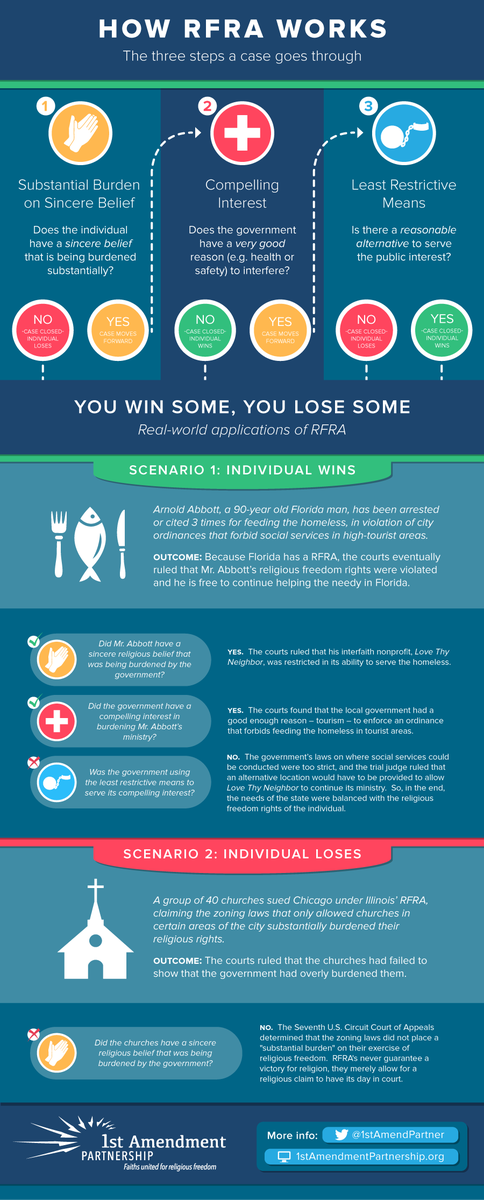
No, the Indiana Religious Freedom Restoration Act protects the rights of all citizens. This law treats all American citizens equally. It ensures that people of all faiths have the right to live out their beliefs at home, in worship and at work, without unnecessary government coercion. The Indiana Religious Freedom Restoration Act simply says that if the government is going to substantially burden religious exercise it must prove it is doing so for a compelling governmental interest and in the least restrictive way possible.
Indiana’s religious freedom law protects citizens from government coercion—it places the burden of proof on the government if it is going to violate liberty. For over 20 years, the federal government has lived by this standard—the Religious Freedom Restoration Act of 1993 passed unanimously in the House, with 97 votes in the Senate, and was signed into law by Bill Clinton. Today, there are a total of 30 states that live under that same standard through statute or court precedent.
Does this law give businesses a “license to discriminate”?
Ever feel like the only difference between the New York Times and Washington Post is the name? We do.
Try the Morning Bell and get the day's most important news and commentary from a team committed to the truth in formats that respect your time...and your intelligence.
No. In the more than 20 years that Religious Freedom Restoration Acts have been on the books, we haven’t seen the kind of absurd hypotheticals that opponents are just now conjuring up.
In reality, Religious Freedom Restoration Acts protect religious freedom for all Americans, in cases that have nothing to do with current political debates. For example, Religious Freedom Restoration Acts have provided protection for Sikhs, Muslims, Jews, Native Americans, among many others. They have protected the freedom of a Sikh woman to carry religious articles of her faith at work, allowed a Native American boy to wear long hair at school, and ensured a Christian ministry could continue serving recently released prisoners.
Importantly, Religious Freedom Restoration Acts aren’t ablank check to do whatever one wants in the name of religion. Not every Religious Freedom Restoration Act plaintiff has won. Sometimes, the government can show it has a compelling interest in burdening religious freedom—ensuring public safety, for instance. But Religious Freedom Restoration Acts ensure that government must meet a high bar before coercing religious believers.
People say Indiana’s law allows individuals to sue each other, not just the government, and it defines “person” to include corporations. Is Indiana’s law significantly different from the federal Religious Freedom Restoration Act and other state Religious Freedom Restoration Acts?
No, Indiana’s Religious Freedom Restoration Act is not significantly different from the federal Religious Freedom Restoration Act or other state Religious Freedom Restoration Acts. Indiana’s Religious Freedom Restoration Act states clearly what multiple federal courts have interpreted federal Religious Freedom Restoration Act to mean. It is not ambiguous and those who are describing it as an ominous new development with untold consequences are misreading the plain text of the law and the long legal history of Religious Freedom Restoration Act’s commonsense protections.
Indiana’s law is very similar in substance to both the federal religious freedom law and the other 19 states that have enacted Religious Freedom Restoration Acts. Religious Freedom Restoration Acts prohibit the government from substantially burdening religious exercise unless thegovernment can show a compelling interest and does so through the least restrictive way possible. These protectionsapply to individual people and to the organizations they form—be they schools, charities or businesses. The Indiana law does allow corporations to sue the government—but so does the federal Religious Freedom Restoration Act. Indiana’s law does not allow private citizens to sue each other. The Religious Freedom Restoration Act protects religious liberty in all spheres of life, as the Supreme Court reminded us last year when it protected the Green family and Hahn family—who run Hobby Lobby and Conestoga Wood—against the coercive Department of Health and Human Services mandate.
A number of courts, as well as the Obama administration, have argued that those protections at the federal level can apply in cases between two private individuals. As constitutional law professor, Josh Blackman, explains “four Courts of Appeals, covering nearly half the states in the Union, and the Obama Justice Department, have stated that RFRA [Religious Freedom Restoration Act] can be asserted as a defense in a private case seeking the enforcement of federal law.”
Won’t the Indiana Religious Freedom Restoration Act allow business owners to refuse service to LGBT people?
No, and no one is interested in refusing to serve gays and lesbians simply because of their sexual orientation. And no one has ever successfully used Religious Freedom Restoration Act to defend such actions. As law professor and religious liberty expert Douglas Laycock—a same-sex marriage supporter—notes:
I know of no American religious group that teaches discrimination against gays as such, and few judges would be persuaded of the sincerity of such a claim. The religious liberty issue with respect to gays and lesbians is about directly facilitating the marriage, as with wedding services and marital counseling.
Religious liberty concerns typically stem from those involved in the wedding industry being penalized by the government because they declined to participate in a same-sex wedding ceremony.
There are now numerous cases of photographers, florists, cake makers and farmers being forced to participate in celebrating same-sex weddings in violation of their belief that marriage is the union of a man and a woman. These are citizens who have no problem serving gays and lesbians but do object to celebrating same-sex weddings.
Religious liberty isn’t an absolute right. Religious liberty doesn’t always trump other values or rights. Religious liberty is balanced with concerns for a compelling state interest that’s being pursued in the least-restrictive means possible. The Indiana Religious Freedom Restoration Act, like all similar laws, doesn’t determine the outcome of a particular case. It simply provides a way for citizens to go into court to have their individual case reviewed by a court.
Wouldn’t the Indiana Religious Freedom Restoration Act allow a Muslim business owner to refuse service to women not wearing a hijab?
It depends. All the Religious Freedom Restoration Act does is say that Muslims get the same religious liberty protections as all other Americans and deserve their day in court. All Americans, regardless of their faith background, should be free to run their businesses, charities or houses of worship in accordance with their religious beliefs. There may be times when those religious beliefs conflict with a compelling government interest—ensuring public safety, for instance, which has been used as an argument against the hijab. Such a case would have to go to court and the evidence be weighed either way. Americans’ freedom is best protected when the state must show it has a compelling interest, pursued in the least restrictive way possible, before coercing or penalizing religious believers.
The way we’ve learned to live in a pluralistic society, with diverse religious and moral opinions, is to have a balancing test like the one the Religious Freedom Restoration Act provides.
Why does Indiana (or any state) need a Religious Freedom Restoration Act if there’s already a federal Religious Freedom Restoration?
The federal Religious Freedom Restoration Act protects against federal government violations of religious liberty, and state Religious Freedom Restoration Acts protect against state violations. Citizens need protection at both levels of government.
rfrainfographic