Contact Form

Name

Email *

Message *

Showing posts with label toyota. Show all posts

Friday, January 6, 2017

Another Victory For Trump And He Is Not Even President


Toyota Stock Hits A Pothole After Trump Rebukes Japanese Automaker

... suffered a setback on Wall Street ...

 Print

Although Toyota sought to stem the damage from President-elect Donald Trump’s Thursday tweet denouncing the construction of a new plant in Mexico, the Japanese automaker suffered a setback on Wall Street.

Toyota Motor said will build a new plant in Baja, Mexico, to build Corolla cars for U.S. NO WAY! Build plant in U.S. or pay big border tax.

Trump posted Thursday that Toyota would pay a hefty “border tax” if it didn’t build the plant in the United States.

Back in September, Toyota announced that it would spend $150 million at the Baja plant to boost output of its Tacoma pickup truck. The company has also said it seeks to invest $1 billion in a new Corolla plant at Guanajuato that would produce 200,000 vehicles per year for sales throughout North America. The plant would employ 2,000 people.
Trump’s fingers had barely stopped sending the tweet when Wall Street felt its impact.


My new favorite thing is watching the stock charts of companies immediately after Trump tweets, here’s Toyota. https://twitter.com/realDonaldTrump/status/817071792711942145 …


Toyota shares began plummeting almost instantly, causing an initial drop of around $1.2 billion in value.
The stock price finished the day down 0.75 points, or 0.62 percent.
Experts expect the stock price will rebound over time, as happened before to Boeing when Trump tweeted criticism over the cost of the new Air Force One.


Toyota later issued a statement insisting its Mexico plans would not hurt employment in the United States.
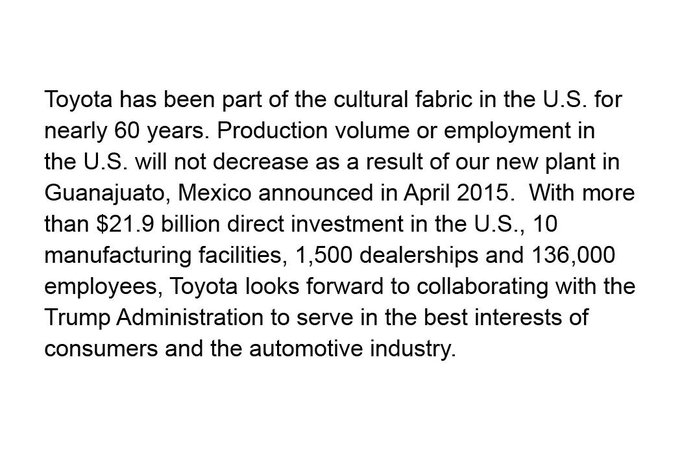


Statement in response to the President Elect's recent comment. Please visit http://toyota.us/2ig6QQ4  for more information

“Toyota has been part of the cultural fabric in the U.S. for nearly 60 years,” the statement read. “Production volume or employment in the U.S. will not decrease as a result of our new plant in Guanajuato, Mexico announced in April 2015,” it said in part of a statement released on Twitter.
Trump’s jab at Toyota followed a campaign promise that he would attack automakers that either invest or move jobs outside of America. Ford, which was the subject of many of Trump’s campaign comments, recently said it will not build a planned plant in Mexico. General Motors, which was criticized by Trump earlier this week for building the Chevrolet Cruze in Mexico while laying off Ohio workers, responded by saying that the model made in Mexico had minimal U.S. sales and that the layoffs were due to market factors in the U.S.
One expert said whether Trump wins or loses his battles with the auto giants, the fact that he is fighting them resonates politically with one key group.
“Trump’s attack tweets against different companies may seem pretty random, but look closer. When he calls out Carrier, Ford, GM, Lockheed-Martin, Boeing, etc., all of the companies he’s targeting have something in common: They’re either unionized companies or in generally unionized industries,” wrote Jake Novak on CNBC, who said Trump’s “protectionist and border security message, which became evident right from the first day he announced his campaign, clearly spoke to union rank-and-file members across the country.”
When Trump fights for union jobs, he increases his support among union members, undercutting a traditional base of the Democratic Party, Novak wrote.
“Expect this to continue throughout his presidency. And all it takes is a look at the election map to see why. Trump’s siphoning of union support from the Democrats brought him a narrow election victory, it’s only logical that he’ll do what it takes to siphon yet more to ensure more support and a bigger re-election margin in the coming years,” he added.
What do you think?

Thursday, January 5, 2017

Another Fake Story, Devious And Pure Lies.


Trump seems determined to raise car prices

Rick Newman
Columnist
Yahoo Finance


Trump seems determined to raise car prices
If incoming President Donald Trump gets his way, a subcompact car is likely to cost more in a few years.
Trump has now called out Toyota (TM) for plans to move production of its Corolla economy car from plants in Mississippi and Ontario, Canada to a new factory it’s building in Mexico. The threat, of course, came in a tweet:

Toyota Motor said will build a new plant in Baja, Mexico, to build Corolla cars for U.S. NO WAY! Build plant in U.S. or pay big border tax.

This comes after Trump criticized Ford (F) for a similar plan to move production of the Focus subcompact from Michigan to Mexico, and General Motors (GM) for building a tiny number of Chevy Cruze hatchbacks in Mexico. (Most Cruze models are built in Ohio.)
Trump has clearly decided the auto industry is a fat target, since automakers have probably invested more in Mexico in recent years than any other type of company. But Trump’s attacks threaten to upend rational production plans the automakers have spent years putting into place, while also risking unintended consequences likely to harm consumers.
Higher prices for compact cars
If Trump actually managed to force automakers to move production from Mexico or other low-cost countries to the United States, there’s no way around the fact it would raise prices for car buyers. That, in turn, could reduce auto sales, which would reduce car-industry jobs. Or, it might give automakers even stronger incentives to replace workers with robots and other forms of technology, in order to keep a lid on prices and make sure they don’t lose out to other manufacturers with cost advantages.
Workers who feel harmed by the offshoring of US jobs might cheer Trump’s attacks on Big Auto, but in some important ways those attacks are misdirected. Japan-based Toyota, for instance, has invested more in US production than any other foreign automaker. It claims 10 US manufacturing facilities and 136,000 American employees. The Camry sedan is one of the most “American” cars on US roads, with an engine and transmission made in the United States and final assembly at factories in Kentucky and Indiana. The Sienna minivan is close behind. In a statement following Trump’s tweet, Toyota said its US employment will not decline when it moves Corolla production to the new factory in Guanajuato, Mexico (not in Baja, as Trump mistakenly claimed).
Relentless pressure on costs has led most automakers to Mexico, where they generally build compacts and subcompacts. Mexican workers earn about one-fifth what their American counterparts earn, and most automakers can’t make money on small cars made in the United States. The profit margin on small cars is often tiny and sometimes negative. Since labor is a bigger portion of costs on small, cheap cars than on larger, costlier ones, producing in Mexico lets automakers keep quality up while delivering the low prices consumers demand. That’s why most automakers are moving small-car production south of the border while refocusing US production more on expensive products with bigger product margins, as well as engineering, design and R&D.
Trump’s tactic of picking off one automaker at a time for criticism is bad economics. Moving production of any good from Mexico to the United States will raise its cost, and Trump is basically saying Toyota should absorb higher costs while other carmakers that still build in Mexico should enjoy a cost advantage. Ford, for instance, recently announced new investments in the United States, which Trump approved with a tweet–but it still plans to move production of the Focus to Mexico. The Focus and Corolla are direct competitors, and Trump seems to be picking the Focus as the marketplace winner by suggesting only the Corolla should be built by more expensive US labor.
A more rational approach would be for Trump to adopt new policies that apply to all automakers equally, which he might eventually do. After all, he’s not even president yet. Across-the-board rules would at least spread the pain more or less equally among all producers. But higher costs industrywide almost always get passed on to consumers, at least in part. This is why most economists hate tariffs and tariff-like measures: They raise costs to the end user while reducing disposable income and generally depressing the economy.