Contact Form

Name

Email *

Message *

Wednesday, January 1, 2014

Another Obama Lie--al-Qaeda Is Far From Dead!

2013 Marked a Comeback for al-Qaida

Image: 2013 Marked a Comeback for al-QaidaAl-Qaida claimed responsibility for a Dec. 5 attack on the Yemeni defense ministry that killed 52 people, saying the complex hosted U.S. personnel behind drone strikes against its militants.
Tuesday, 31 Dec 2013 11:17 AM
By Lisa Barron
Share:
A    A   |
   Email Us   |
   Print   |
   Forward Article  |
As controversy continues to swirl around the New York Times' report claiming al-Qaida was not behind the Benghazi attacks, there is plenty of evidence to suggest the terrorist organization and its affiliates were responsible for some of the deadliest violence of 2013.

The resurgence of the group founded by Osama bin Laden was so pronounced that the Obama administration stepped back from its assertions that his death spelled the end of it, saying instead that only the core leadership in Pakistan had been contained, reports Politico Magazine

The year started with a jihadist retaliation for France's military intervention in northern Mali, an operation that led to the death of at least 39 foreign hostages at Algeria's In Amenas gas complex, notes the publication.

The following day, Jan. 17, a series of explosions on buses in predominantly Shiite areas of Iraq killed 19 people and injured more than 100.

Al-Qaida in Iraq has in fact accelerated the pace of its attacks since the pullout of U.S. troops at the end of 2011, culminating in a surge of violence in mid-2013 that has led to roughly 800 civilian deaths a month, according to the Council on Foreign Relations.

At the same time, the group has spread into neighboring Syria, where it calls itself the Islamic State of Iraq and Greater Syria, fighting against both the regime of President Bashar al-Assad and other opposition factions, according to the council.

And a report published this month by the International Center for the Study of Radicalism indicates there are up to 11,000 foreign fighters from 74 nations involved in the Syrian conflict.

"The concern is that the al-Qaida networks of the future are being created in this jihadist melting pot," Paul Cruickshank, a terrorism analyst who has specialized in studying al-Qaida, told CNN.

Al-Qaida in the Arabian Peninsula, or AQAP, headquartered in Yemen, is thriving as well, reports the network, which said it has learned about recent intercepts of messages between senior operatives in that country.

"There are multiple indications that al-Qaida in the Arabian Peninsula is plotting attacks both within Yemen, against U.S. and Western structures, and overseas," Seth Jones, an analyst at Rand Corp., told CNN.

The al-Qaida faction in Somalia, al-Shabab, also had a prolific year, most notably carrying out a bloody assault in September on Nairobi's Westgate Mall that killed 67 and injured at least 175.

Al-Qaida's future capabilities have been helped in part by a series of jailbreaks in three different countries, the most significant one taking place on July 21 at Iraq's notorious Abu Ghraib prison that freed about 500 jihadist prisoners, reports Politico magazine.

A week later, prison riots and an outside attack freed more than 1,100 inmates from Benghazi's Kuafiya prison, while some 250 prisoners escaped during a jailbreak in Pakistan on July 30.

As for the implications for Americans, the leaders of both the House and Senate intelligence panels maintained earlier this month that the country is not as safe as it was a year ago.

Speaking on CNN's "State of the Nation," Senate Intelligence Committee Chairwoman Dianne Feinstein said, "I think terror is up worldwide, the statistics indicate that, the fatalities are way up.

"The numbers are way up. There are new bombs, very big bombs, trucks being reinforced for those bombs. There are more groups than ever and there's huge malevolence out there."

Asked whether he thought so as well, House Intelligence Committee Chairman Mike Rogers, said, "Oh, I absolutely agree that we're not safer today for the same very reasons."

Related stories:
© 2013 Newsmax. All rights reserved.


Read Latest Breaking News from Newsmax.com http://www.newsmax.com/Newsfront/al-qaida-attacks-2013-terrorism/2013/12/31/id/544556#ixzz2p6KmGjLM
Urgent: Should Obamacare Be Repealed? Vote Here Now!

As Long As Republicans Continue To Fight, They Will Allow Democrats To Win 2014 Election.


Dems, GOP seek to define issue for 2014 elections


Associated Press

Andrew Romanoff
.
View gallery

  • .
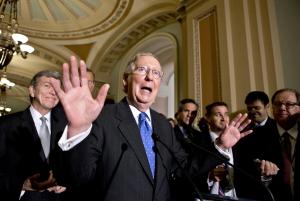
WASHINGTON (AP) — In a competitive district east of Denver, Democrat Andrew Romanoff is counting on voter anger at a divided and ineffectual Congress to help him unseat three-term Republican Rep. Mike Coffman.
"I must have blinked and missed it," the challenger said of the House's work this past year. "It's become a punch line to call this the least productive Congress in history or to joke 'how do you tell when Congress is in session or on vacation, it's hard to tell the difference.'"
Ten months to next year's midterm elections, Democrats are determined to make Congress' slim production of fewer than 60 laws and plenty of incompletes — on immigration, gun control, tax reform and basic spending bills — a defining issue, heaping much of the blame on the GOP-led House for obstructing President Barack Obama's second-term agenda.
Republicans dismiss criticism about a sparse record and insist that the driving issue in 2014 will be the impact of Obama's health care law, with a raft of canceled insurance policies, higher premiums and an endless cycle of problems.
"Voters are more motivated when something is taken away from them," Rep. Greg Walden, R-Ore., head of the campaign committee to elect Republicans, said this past fall during the woes of the health care website's startup.
Walden's Democratic counterpart, Rep. Steve Israel of New York, has his own assessment: "Voters are paying members of Congress to do a job, to get things done, not to just sit back and obsess about repealing a single law."
The election will decide who is right and who controls Congress for the last two years of Obama's presidency.
The GOP has held the House majority since January 2011 and is widely expected to maintain that edge in next November's contests. Congressional officials and outside political experts point to the drag of Obama's low approval ratings, the troubled health care law and the traditional losses for the president's party in midterm elections.
Republicans insist they will expand their 232-201 majority — there are currently two vacancies — but no one expects the gains of 2010 when the GOP notched 63 Democratic seats and captured House control. Past Republican wins and redrawn congressional lines have reduced the universe of competitive seats.
The GOP has seven top targets, including the all-but-certain pickup in Utah with seven-term Democratic Rep. Jim Matheson's retirement, and 26 other seats they've focused on to expand their majority. Democrats are looking at some three dozen potential takeaways, including open seats in northern Virginia and Iowa with the retirements of 17-term Republican Rep. Frank Wolf and 10-term Rep. Tom Latham.
Republicans repeatedly have tried to unseat long-time Democrats in Republican-leaning districts, such as five-term Rep. John Barrow in Georgia, nine-term Rep. Mike McIntyre in North Carolina and 12-term Rep. Collin Peterson in Minnesota. All three lawmakers, however, survived the tea party-driven Republican wave of 2010 and redistricting changes in 2012.
The more likely incumbents to fall are first-term Democrats who barely won their seats in a high-turnout, presidential year.
Democrats see takeover possibilities in Pennsylvania, Indiana, Nevada and California as well as open seats in New Jersey, where Rep. Jon Runyan of the 2010 class decided against another term, and Arkansas, where Rep. Tom Cotton is running for the Senate. One of the party's top recruits is James Lee Witt, who served as director of the Federal Emergency Management Agency in the Clinton administration and is pursuing the Arkansas seat.
Any Democratic hopes of limiting expected Republican gains center on districts like Colorado's 6th, a suburban Denver stretch that includes Aurora and Littleton. Democrats redrew the boundaries and the district's population of 748,467 people now includes 150,540 Hispanics, 71,290 African-Americans and 41,644 Asian-Americans, according to the latest U.S. Census figures.
A changing demographic with a more diverse population is one reason why Obama prevailed, 52-47 percent, over Republican nominee Mitt Romney in 2012. Coffman, a conservative Republican, won Colorado with just 48 percent of the vote, two percentage points ahead of his Democratic rival.
Democrats are determined to highlight immigration, the stalled legislation in the House and Coffman's evolution on the issue. One of their top recruits is Romanoff, the former speaker of the Colorado House who served four terms in the legislature.
The son and grandson of immigrants from Eastern Europe, Romanoff backs the bipartisan, Senate-passed bill that would provide a path to citizenship for most of the 11 million immigrants living in the U.S. illegally and tighten U.S. borders. He criticized the Republican-led House's inaction on the bill and GOP leaders' preference for a piecemeal approach rather than comprehensive legislation.
"Congress is more interested in playing political games," Romanoff said in a recent interview.
Coffman, once a hard-liner on immigration who complained about the so-called DREAM Act and who introduced a bill allowing locales to use English-only ballots, has changed and now favors a path to citizenship for young immigrants brought to the country by their parents.
"While we are a nation of immigrants, our policies regarding immigration are dysfunctional," Coffman said earlier this year in pressing for action. He said legislation "must show compassion to the families that have been here regardless of their immigration status."
Democrats have already highlighted the one vote on immigration in the House, a June 6 vote for an amendment that would have barred money for implementing Obama's 2012 policy to let some young immigrants remain in the United States. Coffman voted for the measure in an outcome that was largely along party lines, 224-201.
On health care, Coffman said Republican talk about repealing the law isn't sufficient when facing the electorate.
"There's no doubt we have to come up with alternatives that we can all coalesce around," he said, suggesting a series of bills, including insurance reforms.
Romanoff is talking about a fix, too. But he also focuses on preventive care measures and the law's prohibition on denying coverage for pre-existing conditions, popular elements that Democrats like to highlight.
Both candidates have sufficient funds for the race. Romanoff reported $1.3 million cash on hand in the latest filing with the Federal Election Commission, Coffman reported $1.2 million.

Americans Think Things Will Improve But Obama's Popularity Drops


DIGITS: By the numbers, 2013 a year to forget?


Associated Press

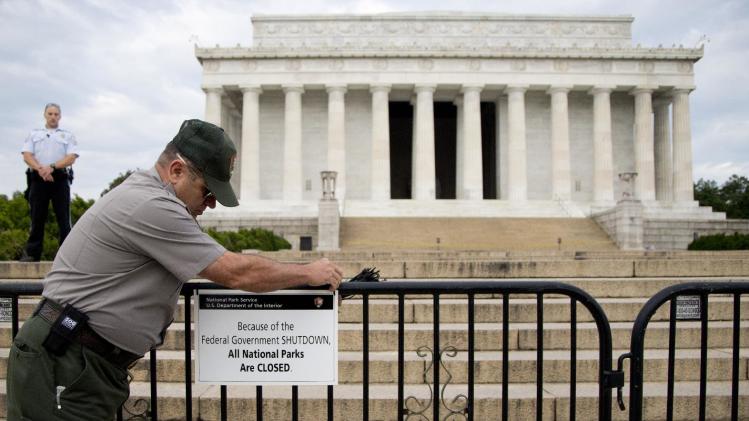
FILE - This Oct. 1, 2013 file photo shows a US Park Police officer watching at left as a National Park Service employee posts a sign on a barricade closing access to the Lincoln Memorial in Washington. About half of Americans expect 2014 to be a better year than 2013, according to the recent AP-Times Square New Year’s Eve poll, and judging by the standard questions pollsters use to measure the public mood, it doesn’t seem like it could be much worse. (AP Photo/Carolyn Kaster, File)
.
View gallery

FILE - This Oct. 1, 2013 file photo shows a US Park Police officer watching at left as a National Park Service employee posts a sign on a barricade closing access to the Lincoln Memorial in Washington. About half of Americans expect 2014 to be a better year than 2013, according to the recent AP-Times Square New Year’s Eve poll, and judging by the standard questions pollsters use to measure the public mood, it doesn’t seem like it could be much worse. (AP Photo/Carolyn Kaster, File)
About half of Americans expect 2014 to be a better year than 2013, according to the recent AP-Times Square New Year's Eve poll. And judging by the typical questions pollsters use to measure the public mood, it doesn't seem like it could be much worse.
A look at how the public rated the nation's performance in 2013:
RIGHT DIRECTION? NOT QUITE YET
Whether people think the nation is heading the right way or the wrong way is a basic measure of optimism that pollsters have used for decades to gauge the public mood. In AP-GfK polling this year, few thought the United States had found the right path.
The December AP-GfK poll showed the share of Americans who feel the nation is heading in the right direction rebounded to 34 percent from its October low of 22 percent, but it's not clear yet whether that's a directional shift or just a temporary recovery — what Wall Street calls a dead-cat bounce.
On average in this year's AP-GfK polls, 33 percent said the country was heading the right way, down from 38 percent in 2012 but about on par with the 2011 average of 32 percent. That 2011 figure marked the low point of President Barack Obama's time in office.
This year, average "right direction" numbers among Republicans (10 percent) and independents (24 percent) are at new lows for Obama's term, but Democrats buoy this year's figure with 54 percent saying the nation is on the right path, a bit above 2011's average of 47 percent.
OBAMA'S APPROVAL FALLS
Obama's approval ratings shifted notably this year, landing in negative territory on average for the first time in his presidency. In AP-GfK polling conducted this year that averaged the president's approval rating, 46 percent approved of the president's job performance, while 50 percent disapproved.
This year marks the first substantial dip in the president's approval since 2010. After a well-regarded first year (58 percent approval on average in 2009), Obama's approval rating dipped to 50 percent in 2010, then generally held steady — 51 percent on average approved in 2011, 52 percent in 2012.
LITTLE LOVE FOR CONGRESS
About 82 percent of Americans disapproved of the way Congress handled its job this year, according to an average of AP-GfK polls. That's 20 points higher than average disapproval rate in 2009 and the worst since the inception of the AP-GfK poll in 2008. In a rare show of party unity, disapproval of Congress topped 80 percent among both Democrats (83 percent) and Republicans (87 percent).
THE ECONOMIC BRIGHT SPOT?
One positive note: More now say the economy is in good shape than have at any prior point in Obama's tenure, though the rating remains fairly anemic. Overall, 26 percent on average described the economy as "good" in this year's polling, up from an average of 23 percent in 2012, 17 percent in 2011, 19 percent in 2010 and an abysmal 11 percent in 2009.
Still, people don't hold much hope for the economy's prospects. Asked to look ahead a year, 37 percent of Americans in the December AP-GfK poll said they thought the general economic situation would worsen, while 33 percent thought it would improve. And while 32 percent thought the number of unemployed Americans would drop, 36 percent thought more people would lose jobs than get them in 2014.
___
AP-GfK Polls: http://www.ap-gfkpoll.com

Trains Carrying Oil Explodes So Buffet Buys Company To Improve Oil Flow In Pipes. Are We About To See The Keystone Pipeline Authorized?

Buffett's Berkshire Hathaway to Buy Phillips 66 Unit for Around $1.4 Billion

Monday, 30 Dec 2013 06:40 PM

Share:
A    A   |
   Email Us   |
   Print   |
   Forward Article  |
Warren Buffett's Berkshire Hathaway Inc. struck a deal to buy a Phillips 66 business that makes chemicals to improve the flow potential of pipelines for around $1.4 billion of stock.

Phillips 66 said on Monday that Berkshire will pay for the unit, Phillips Specialty Products Inc, using about 19 million shares of Phillips 66 stock that it currently owns.

"I have long been impressed by the strength of the Phillips 66 business portfolio," Buffett said in a statement. "The flow improver business is a high-quality business with consistently strong financial performance."

The exact number of shares Berkshire will pay for the unit will be determined by their price on the closing date, the companies said.

James Hambrick, CEO of Berkshire's specialty chemicals unit Lubrizol Corp, will oversee the business, Buffett said. Berkshire bought Lubrizol for about $9 billion in 2011.

Phillips 66 CEO Greg Garland said the company decided to sell the business because Berkshire Hathaway made a strong offer. He said the company will now focus its growth on its oil and natural gas transportation and processing business, as well as its other chemicals businesses.

Phillips 66 said it expects the Phillips Specialty Products unit to have about $450 million of cash and cash equivalents on its balance sheet at closing. It expects the deal to close in the first half of 2014.

Berkshire favors larger companies with consistent earnings power and easy-to-understand businesses.

In June, it paid $12.3 billion for half of ketchup maker H.J. Heinz Co., and in May said it paid $2.05 billion for the 20 percent it did not already own of Israeli toolmaker Iscar.

Earlier this month, Berkshire's MidAmerican Energy unit paid $5.6 billion for the Nevada utility NV Energy Inc.

Omaha, Neb.-based Berkshire still has the capacity to make one or more large purchases, which Buffett calls "elephants."

Berkshire ended September with $42.08 billion of cash and equivalents, and generates significant cash from the insurance operations for which it is perhaps best known.
© 2013 Thomson/Reuters. All rights reserved.