Contact Form

Name

Email *

Message *

Showing posts with label Iranian attack. Show all posts

Friday, February 24, 2012

Is Iran Soon To Go Nuke?


The latest report for the International Atomic Energy Agency (IAEA) indicates that the Iranians are either way ahead of plans or are bluffing their way much the same as Saddam did ten years ago. Is it a bluff? If so, it is a dangerous one.

The IAEA report makes it very clear they are concerned, especially in light of military uses of the nuclear program.  We quote: 

"51. The Agency continues to have serious concerns regarding possible military dimensions to Iran’s nuclear
programme, as explained in GOV/2011/65. Iran did not provide access to Parchin, as requested by the 
Agency during its two recent visits to Tehran, and  no agreement was reached with Iran on a structured 
approach to resolving all outstanding issues in connection with Iran’s nuclear programme."

This report cannot calm the feelings in Tel Aviv.  If anything, it has to make the situation even worse. Washington should also be concerned.

Scary, at best. Deadly at worst.

Conservative Tom


New IAEA report shows Iran expands nuclear enrichment at Natanz

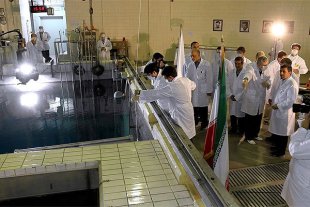
Iran President Mahmoud Ahmadinejad touring Tehran's research reactor Feb. 15, 2012. (AFP/Getty)A new UN atomic watchdog agency report raises concerns about Iran's expansion of enrichment activities, as well as its continued foot-dragging in refusing to answer questions about suspected military dimensions of its nuclear program. But the new assessment also hinted at possible technical problems Iran is experiencing, nuclear experts said.
The 11-page report (.pdf), issued by the Vienna-based International Atomic Energy Agency (IAEA) Friday, comes as the international community is considering how to respond to Iran's expressed readiness to resume negotiations on its nuclear program. It also comes on the heels of the IAEA's expression of frank disappointment over being denied a visit to the Parchin military base at the conclusion of their two-day trip to Iran this week. Agency inspectors want to determine if a building on the site was used to carry out tests of an explosive device.
The agency's latest report shows that Iran has rapidly expanded the number of centrifuges installed at its main Natanz uranium enrichment facility, reaching 9,000 today compared to 6,000 last fall. (It's not clear that all of the installed machines are operating, the agency said.) Still, the assessment offers hints that Iran is having trouble with its more advanced centrifuges. Nuclear experts speculated that because of international sanctions Iran may be having trouble procuring the steel needed for the more advanced centrifuge models.
In the meantime, nuclear experts are puzzled by aspects of Iran's behavior at a more sensitive nuclear enrichment site: the Fordow facility built deep in a mountain near Qom, which is considered less vulnerable to possible military strikes.
Among the concerns for nuclear watchdogs, Iran keeps changing its declared work plan for the facility, which Iran did not disclose until the international community detected it in 2009.
"The sheer fact they keep changing it raises questions about why it was originally built," Paul Brannan, an Iran nuclear expert with the Institute for Science and International Security, told Yahoo News in an interview Friday.
While Iran has placed the outer casings of 2,000 older-generation centrifuges at the Fordow site, according to the new IAEA report, it has not installed the actual machines. Brannan said he found that behavior "strange."
"By only installing the outer casings and not the whole machines, they may be sending a warning about what they intend to do," he said. "Either way, it's not clear whether or not they actually have the capability to install the entire machines in those numbers."
"Is it a bluff?" he continued. The Iranians "know how significant Fordow is. If they put in the two thousand machine casings, but not the actual machines, it is sending a signal."
Israel considers Iran's enrichment activities at Fordow a particular cause of alarm, because it believes the facility is less vulnerable to Israeli air strikes given its placement in a fortified bunker in a mountain.

Wednesday, February 22, 2012

Will Obama Insist That Netanyahu Not Strike Iran?


It appears as if things are going from hot to hotter  in the Iran-Israel confrontation.  Iran continues to increase the tensions by enriching uranium towards weapons grade and Israel will not stand for the Iranians getting the bomb. It is not pretty.


The US and the world has little influence on Iran and it appears as if it has no intention of changing its ways.  UN inspectors are back in the country after having been previously  repelled from the sites, so once again the "world peace" organization fails in its mission. Why do we continue to support it?

Netanyahu is coming to the US sometime in early March and is expected to be confronted by Obama not to  strike Iran.  We believe that in the next two weeks there will be extreme pressure exerted against the PM.  As the following article illustrates, the pressure is already being used by the Administration.

We expect that Netanyahu has the ability to withstand the pressure, however, will it send a message to Israel's enemies that the country is all alone in its fight. If that is the message the Iranians receive, we will see a ratcheting up of actions by them to further en-flame the conflict.

Will it become a shooting war or just a skirmish?  Tell us what you think as we have not decided if Iran is all bluster or if it is for real.

Conservative Tom


Obama to Try and Talk Netanyahu Out of Iran Strike

Unknown - DEBKAfile,  February 20th, 2012

White House National Security Adviser Tom Donilon faced an acrimonious Prime Minister Binyamin Netanyahu in two hours of stormy conversation in Jerusalem Sunday, Feb. 19, according to updates reaching senior US sources in Washington. The main bones of contention were Iran's continuing enrichment of uranium and its ongoing relocation of production to underground sites.
Israeli officials declined to give out any information on the conversation. Some even refused to confirm it took place.
According to debkafile's sources, Netanyahu accused the Obama administration of drawing Iran into resuming nuclear negotiations with world powers by an assurance that Tehran would be allowed to continue enriching uranium up to 5 percent in any quantity, provided it promised not to build an Iranian nuclear weapon. The prime minister charged that this permit contravened US administration guarantees to Israel on the nuclear issue and, moreover left Tehran free to upgrade its current 20 percent enrichment level to 90 percent weapons grade. This Israel cannot tolerate, said Netanyahu, so leaving its military option on the ready.
He warned the US National Security Adviser that no evidence whatsoever confirms Washington's claim that Tehran intends suspending enrichment and other nuclear advances when negotiations begin. Quite the contrary: Even before the date was set, Iran started working at top speed to build up its bargaining chips by laying down major advances in its nuclear program as undisputed facts.
Tehran now claims to have progressed to self-reliance in the production of 20 percent-enriched uranium, the basis for the weapons grade fuel, in unlimited quantity. Once the talks are underway, Netanyahu maintained, there would be no stopping the Iranians without stalling the negotiating process. Going by past experience, Tehran would use dialogue as an extra fulcrum for its impetus toward weapon production without interruption.
Monday, Donilon and his delegation meet Defense Minister Ehud Barak.
The mission of this high-powered US delegation in Israel takes place to the accompanied of a resumed US media campaign for discouraging Israeli military action against Iran's nuclear installations.
Sunday, Gen. Martin Dempsey, Chairman of the Joint US Chiefs of Staff, offered this opinion to CNN: “Israel has the capability to strike Iran and delay the Iranians probably for a couple of years. But some of the targets are probably beyond their reach.”
Monday's New York Times carried an assessment by “American defense officials and military analysts close to the Pentagon” under the caption, “Iran Raid Seen as a Huge Task for Israel Jets.” debkafile's military sources report the main argument, dredged up from the past and long refuted, is that Israeli Air Force bombers cannot cover the distance to Iran without in-flight refueling.
That array of “analysts” apparently missed the CNN interview and therefore contradicted the assessment of America's own top general that “Israel has the capability to strike Iran…”
Reality has meanwhile moved on. Four events in the last 24 hours no doubt figured large in the US delegation's talks with Israeli leaders:
1. Monday, the IAEA sent to Tehran its second team of monitors this month for another attempt to gain access to nuclear facilities hitherto barred by the Iranians. The inspectors will also demand permission to interview scientists which according to a list drawn up at the agency's Vienna headquarters hold key positions in their nuclear program.
2. The Russian Chief of Chaff Gen. Nikolai Makarov estimated that the attack on Iran would be “coordinated” by several governments and “a decision would be made by the summer.”
3. Moscow recalled Russian aircraft carrier Admiral Kutznetsov from the Syrian port of Tartus to its home base at Severomorsk on the Kola Peninsula.
4. Turkey is beinding over backward to assure Iran that data collected by the US missile shield radar stationed at its Kurecik air base will not shared with Israel. It is especially anxious not to annoy Tehran after foreign minister Ali Akbar Salehi announced that the resumed nuclear talks with the five Permanent Security Council members and German (P5+1) would be held in Istanbul.
However, the Iranians certainly know exactly what is going on after watching the recent joint US-Israeli radar test which demonstrated that Israel is fully integrated in the missile shield radar network and that the US radar station in the Israeli Negev interfaces with its station in Turkey and Israel's Arrow missile Green Pine radar.
When he visited Ankara last week, NATO Secretary-General Anders Fogh Rasmussen assured his Turkish hosts that “Intelligence data collected within the missile defense system will not be shared with third countries. It will be shared with the allies within our alliance.”
His statement was quite accurate – except for the fact that the radar stations collecting the intelligence data are not controlled by NATO but by US military teams, both of which, including the Turkish-based radar, are integrated and coordinated with Israeli radar and missile interceptors

Wednesday, January 11, 2012

Will We Lose The Next War Without Firing A Shot?

The first battle of the next war may be the only battle so says Cynthia E. Ayers. She is talking about an EMP attack on the US and the devastation, demoralization and destruction such an event would have.  This is really scary stuff.


With this article and previous ones we have posted to this site, you should be getting a perspective on this issue that is missing in the mainstream media. We are uninformed about this threat yet the threat is real in light of the Iranian missile test and their work to make a nuclear weapon.  Will the Iranian threat come together or will another adversary take advantage of our lack of preparation to launch a preemptive strike? We hope that neither does however, we must be prepared.  Are you?

If you would not mind sharing, what plans have you made to protect your family in the event of an EMP attack?  Or are you playing ostrich, like the rest of us? We want to know.


Conservative Tom


The First Battle of the Next War

Cynthia E Ayers - Family Security Matters,  January 11th, 2012

Iran’s clerical leaders consider their country to be in a state of war with the United States—in fact, this has been the case since the 1979 Islamic Revolution. Needless to say, the U.S. has never officially acknowledged being “at war” with Iran—and has certainly never prosecuted regional operations in such a manner that could be classified as “war” in the classical sense. Indeed, few—even among our elected elite—understand the nuances of the shari’a-based Islamic “just war” doctrine followed so closely by Iran’s leaders. This renders us blind, deaf and dumb to escalations that have become the “norm” in the one-sided, protracted conflict (verbal and physical) being waged against us. It leaves us with only history to fall back on in efforts to determine the point of acceleration to full-scale war.

From the perspective of the United States, a “first battle” with Iran has not yet occurred. Unfortunately, political correctness and political expediencies have made even the most tenuous predictions of what a future war might look like virtually impossible to openly consider. The tendency to prepare for a “first battle” under the assumption that our military will always begin fighting the next war in much the same way as they prosecuted the last battle of the most recent war is so well known as to be discussed derisively—like a torpedo to be used against our own strategic planners regardless of any recognition as to how difficult it may be to envisage the future.

Discussion of the United States being involved in a future war has actually been labeled by former Defense Secretary Robert Gates as “next-war-itis.”  Indeed, those who agree with Secretary Gates seem to believe that the future will consist of a long-term defensive posture against much smaller, ill-defined enemies who will continue to act in a random, asymmetric context—thus counterinsurgency training should (in their opinion) replace planning for peer-against-peer scenarios.

Pictured left – An artist’s impression of an EMP attack.

Our expectations—created by an understandable desire for peace—keep us, as a nation, from confronting reality. We tend to collectively ignore any indication that others have more than a benign self-interest at heart. We have dismissed warnings from Iran as “bluster.” We have made excuses for the nuclear activities of North Korea by claiming they were the result of an ill and unpredictable leader’s desire for international recognition and/or capitalistic reward.  Warnings from Russia and China of support to Iran in the event of war with the west have been loosely regarded as rhetoric meant to retain agreements specific to resources (e.g. oil), and the support given to both Iran and Russia by Venezuela has been virtually ignored by main-stream media.  Reports of Russian strategic bomber bases and Iranian missile sites in Venezuela are disquieting enough; but when combined with (open-source) intelligence that Venezuela is facilitating the smuggling of Hezbollah and IRGC agents across the U.S.-Mexican border, something more than denial on our part should be considered.

There are those who justify their dismissive nature by touting the strength of American forces and the historical resilience of the American people. Given the threat of conventional weapons, or even a more invasive threat of WMD used in major cities, these would be excellent rationalizations. The fact is, however, that our enemies know exactly how to take us down—instantaneously. Our own lack of an objective, comprehensive discussion of our vulnerabilities does not alter the fact that we are, indeed, highly vulnerable.

Given an unprotected electric grid, the detonation of one or more nuclear weapons at high altitude over the continental U.S. would result in an electromagnetic pulse (EMP) that could effectively remove the United States as an actor on the world stage, long-term. If used as a first-strike weapon, it could end the war for us before we were even able to participate in a “first battle” of the conventional sense. Many smaller conflicts may ensue, fought at the tactical/civilian level within the affected area, but as an initiator of a true “first battle” in a larger war, an EMP would most probably assure immediate victory for an aggressor.

It is encouraging that at least a few of our political, bureaucratic, and military leaders comprehend the potential for a large-scale, devastating “first-strike” against the United States; and it is equally encouraging to learn that a small number of brave congressmen take the threat of internal bad-actors so seriously as to pass a resolution “expressing the sense of the House” that the National Strategy for Counterterrorism include “Iran’s growing presence and activity in the Western Hemisphere.” The two issues are linked.

It is becoming apparent that the stage is being set. The ever-present question is: will U.S. leaders allow the mainstream media and those in positions capable of negatively influencing the masses to carry on in a willfully and masochistically blind manner while sadistically deriding those who have long been trying to warn the populace? Are those at the top levels who have been reticent about speaking the truth so worried about risking their “credibility” (which, in this media-savvy world can so easily be called into question, based only on the agendas of politically-biased influencers) that they are willing to risk the lives of hundreds of millions?

Like the concept of “mutually assured destruction,” the public has come to rely on the collective “wisdom” of our senior leaders because of some underlying sense that they would not want to be held accountable for poor strategic planning. But in a post-EMP world, who would know of any pre-event miscalculations—and who would be around long enough to care? Could it be possible that some of our leaders (to include those in private utilities) have been negligent in protecting our grid due to a self-centered reluctance to risk public discussions of “worst-case” (a.k.a. reality-based) scenarios combined with a certainty that any attempt to assign responsibility, post-event, would be decades away?

John Shy, in America’s First Battles: 1776-1965, tells us that “the first battle almost guarantees that inexperience will be paid for in blood.”  We have, as a nation, never experienced a catastrophic collapse of our infrastructure—and thus have developed no real understanding of how to equip ourselves for such an event. Shy further notes:

“More glaring than poorly trained troops in a first-battle problem is the weakness of command-and-control. Virtually every case study emphasizes the lack of realistic large-scale operational exercises before the first battle, exercises that might have taught commanders and staffs the hard, practical side of their wartime business as even the most basic training introduces it to the soldier at the small-unit level. Virtually every case study indicates that the results of confusion, demoralization, and exhaustion at the command and staff level are at best bloody, at worst irremediable—a more crippling defect even than combat units falling apart . . .”

In the event of a U.S. (continental)-wide EMP attack, the troops in the “first-battle problem” will be mostly civilians—without having the benefit of pre-war knowledge, exercises, or training. There will be little, if any, command-and-control. There will be a great deal of “confusion, demoralization, and exhaustion.”

If there is to be a “next war” (or the Western perception of such), it will presumably be with Iran, given tensions subsequent to the release of the September 2011 IAEA report on Iran’s nuclear program.  With declarations of support for Iran by Russia, China, and Venezuela, escalation could be incredibly quick (if not instantaneous).

The Congressional EMP Commission noted that our potential adversaries (specifically, Iran, Russia, China, and North Korea) already know exactly what an EMP attack would do. According to EMP commissioners and other experts, over two-thirds (possibly up to 90%) of our population could be dead within the first year after a major EMP event. They have acknowledged that our very sovereignty would be at stake. Are we willing to take a chance that the first battle of the next war will be something other (something less) than an EMP first-strike against us? Or are we willing to concede that the first battle of the next war might, in fact, be our very last battle? Once hit, if our electric grid has not been hardened, the question of who ultimately wins the bigger war will be irrelevant for those left to survive in a long-term “grid-down” environment.

Family Security Matters Contributing Editor Cynthia E. Ayers is currently Vice President of EMPact Amercia. She recently retired from the National Security Agency after over 38 years of federal service, including 8 years at the U.S. Army War College’s Center for Strategic Leadership.
Bookmark and Share

Wednesday, November 16, 2011

Saudis Warn Israel


As a followup of the article we posted yesterday regarding Iran and an Israeli attack, we found this article interesting in that the Saudis do not want it to happen.  We present this article as more information for you to make your own decisions.


Is Iran having a bomb a fait accompli?  Will it happen regardless of what the United Nations or United States say or do?  I sure do hope not.  The people who run the country are not stable, logical thinking people who care about themselves and their countrymen.  We believe Iran would welcome an attack as an excuse to release its minions to attack and destroy any enemy in the Middle East and the West. 

What are your opinions?


Saudi Prince Warns Israel Not to Attack Iran

Saudi Prince Turki al-Faisal warned an attack on Iran's nuclear program would only strengthen Tehran's resolve.
By Gavriel Queenann
First Publish: 11/16/2011, 2:34 PM

Prince Turki
Prince Turki
Wikimedia Commons
Turki al-Faisal said Monday a military attack on Iran aimed at halting itsnuclear program could have catastrophic consequences – and would only strengthen Tehran's determination to continue nuclearprogress.
"Such an act I think would be foolish and to undertake it I think would be tragic," the Saudi prince said.
"If anything it will only make the Iranians more determined to continuenuclear progress. It will rally support for the government among the population, and it will not end the program. It will merely delay it if anything," he said.
Turki's comments were broadly taken as a veiled message to Israel, whose media has been afire with speculation over a potential strike on Iran's nuclear program. Iranian officials have, for over a decade, called for Israel's destruction saying it is a "one bomb state."
On November 4, Israeli President Shimon Peres said that an attack on Iran was becoming increasingly more likely.
In reply senior Iranian officials described the threats as "foolish" remarks, and warned that friends and allies of the Islamic Revolution would destroy Israel before it can make the slightest military move against Iran.
Defense Minister Ehud Barak has said, however, that Israelis - and Iranians - overestimate the damage Tehran can inflict on the Jewish state and should not be dissuaded from action by threats from the Islamic Republic.
Turki – a former director of Riyahd's intelligence services and diplomat – is expected to become Saudi Arabia's next foreign minister.
A reputed Saudi hawk, Turki has been a strong opponent of Iranian moves to gain hegemony in the Persian Gulf and Middle East - and has warned, should Tehran obtain nuclear weapons, Riyahd will follow suit.
It is unclear, in the absence of military action, how Turki expects Iran's nuclearambitions to be curtailed.
Meanwhile, reports have emerged the US is considering arming Qatar with huge bunker buster bombs, raising the possibility of an American-Israel-Arab attack on Iran.