Turkey Uses ISIS as Excuse to Attack Kurds
 |  |

- It appears as if the Turkish government is using ISIS as a pretext to attack the PKK (Kurdistan Workers' Party).
- Turkey just announced that its air base at Incirlik will soon be open to coalition forces, presumably to fight ISIS. But the moment Turkey started bombing, it targeted Kurdish positions in Iraq, in addition to targeting ISIS positions in Syria.
- In Turkey, millions of indigenous Kurds are continually terrorized and murdered, but ISIS terrorists can freely travel and use official border crossings to go to Syria and return to Turkey; they are even treated at Turkish hospitals.
- If this is how the states that rule over Kurds treat them, why is there even any question as to whether the Kurds should have their own self-government?
Turkey's government seems to be waging a new war against the Kurds, now struggling to get an internationally recognized political status in Syrian Kurdistan.
On July 24, Turkish media sources reported that Turkish jet fighters bombed Kurdish PKK (Kurdistan Workers' Party) bases in Qandil, in Iraqi Kurdistan, as well as the Islamic State (ISIS) in Syria.
Turkey is evidently unsettled by the rapprochement the PKK seems to be establishing with the U.S. and Europe. Possibly alarmed by the PKK's victories against ISIS, as well as its strengthening international standing, Ankara, in addition to targeting ISIS positions in Syria, has been bombing the PKK positions in the Qandil mountains of Iraqi Kurdistan, where the PKK headquarters are located.
There is no ISIS in Qandil.
As expected, many Turkish media outlets were more enthusiastic about the Turkish air force's bombing the Kurdish militia than about bombing ISIS. "The camps of the PKK," they excitedly reported, "have been covered with fire."
It appears as if Turkey's ruling Justice and Development Party (AKP) is using ISIS as a pretext to attack the PKK. Ankara just announced that its air base at Incirlik will soon be open to coalition forces, presumably to fight ISIS, but the moment Turkey started bombing, it targeted Kurdish positions. Those attacks not only open a new era of death and destruction, but also bring an end to all possibilities of resolving Turkey's Kurdish issue non-violently.
Prime Minister Ahmet Davutoglu announced that
Shortly after military operations against the PKK started, access to the websites of pro-Kurdish newspapers and news agencies was denied "by decree of court." These websites -- including Fırat News Agency (ANF), Dicle News Agency (DIHA), Hawar News Agency (ANHA), Ozgur Gundem newspaper, Yuksekova News, Rudaw and BasNews -- are still blocked in Turkey.
ISIS, meanwhile, has not so far made any statement regarding Turkey's so-called bombings of ISIS in any of its media outlets.
Had Turkish military attacked the PKK alone, and not in addition to attacking ISIS, it would probably have received widespread international condemnation. So to add "legitimacy" to its attacks against the Kurdish PKK -- whose affiliate Democratic Union Party (PYD) in Syria and its armed wing, the Kurdish People's Defense Units (YPG) have been resisting ISIS and other Islamist terrorist groups since 2013 -- Turkey declared that it will also attack ISIS. This would give it cover for its attacks against Kurdish fighters.
In 2014, Turkey's President Recep Tayyip Erdogan described the plan he wanted to carry out in Syria and Iraq: "The problem in Syria should be taken into account. Iraq too should be considered similarly. Moreover, there needs to be a solution that will also deal with the Syrian wing [PYD] of the separatist terrorist organization [PKK]."
The AKP government, dissatisfied with the results of last month's parliamentary elections, also seems to want to hold new elections, to push the mainly Kurdish HDP Party below the required 10% threshold, and thus force them out of parliament. Perhaps the government thinks that bombing the PKK will generate Turkish nationalist enthusiasm that will work in the AKP's favor to help it regain a majority in early elections.
Apparently, Turkey does not need Kurdish deputies in its parliament. Apparently, the state prefers to slaughter or arrest the Kurds -- as it has done for decades. Why hold talks and reach a democratic resolution when you have the power to murder people wholesale?[1]
Sadly, Turkey has preferred not to form a "Turkish-Kurdish alliance" to destroy ISIS. First, Turkey has opened its borders to ISIS, enabling the growth of the terrorist group. And now, at the first opportunity, it is bombing the Kurds again. According to this strategy, "peace" will be possible only when Kurds submit to Turkish supremacism and abandon their goal of being an equal nation.
In the meantime, Mevlut Cavusoglu, Turkish minister of foreign affairs, said that the Incirlik air base in Turkey has not yet been opened for use by the U.S. and other coalition forces, but that it will be opened in the upcoming period.
Kurdish forces, therefore, are the only forces that are truly resisting the Islamic State.
They have been repressed by Baghdad and murdered by Turkey and Iran.
If this is how the states that rule over Kurds treat them, why is there even any question as to whether the Kurds should have their own self-government?
As a result of the ISIS attacks in the region, the Kurdish PKK -- as well as its Syrian Kurdish affiliate, Democratic Union Party (PYD) and its armed wing, Kurdish People's Defense Units (YPG) -- have emerged as the America's most effective battlefield partners against ISIS. Ever since ISIS became a major force in Syria, the U.S. has apparently relied heavily on YPG to stop ISIS from advancing. According to Henri Barkey, a former State Department specialist on Turkey, "The U.S. has become the YPG's air force and the YPG has become the U.S.'s ground force in Syria."
The blast took place while the activists were making a statement to the press in the garden of a cultural center. At least 100 others, mostly university students, were wounded. (Graphic video of the explosion)
The suicide bomber was identified through DNA testing, according to reports in the Turkish news media. Seyh Abdurrahman Alagoz was reportedly a 20-year-old Turkish university student, recently returned from Syria, and believed to have had ties to ISIS.
Alagoz targeted a meeting 300 secular activists, members of the Federation of Socialist Youth Associations (SGDF), who gathered at a cultural center in the province of Urfa, opposite the Kurdish town of Kobane in Syrian Kurdistan. As part of an effort to rebuild Kobane, they were preparing to provide aid, give toys to the children there and build a hospital, school, nursery, children's park, library and a memorial forest for those who had lost their lives in Kobane.
"Work on the building of hospitals and schools needs to be done," Oguz Yuzgec, the co-president of the federation, said before the explosion. "One of the things we will do is to build a children's park in Kobane. We will name it after Emre Aslan, who died fighting in Kobane. We are collecting toys. We will participate in the construction of the nursery that the canton of Kobane is planning to build. We have the responsibility of helping the nursery function. We need everybody who knows how to draw and can teach children."
Mazlum Demirtas, a survivor of the attack, said: "The main one responsible for this incident is the state of Turkey, the AKP fascism, the AKP dictatorship. ... It attacked us with its gunmen and gangs. Since yesterday, parents have been collecting the dismembered body parts of their children. They are trying to identify the dismembered bodies. This is called fascism, inhumanity and barbarity."
Pinar Gayip, another survivor of the attack, said in a telephone interview on the pro-government Haberturk TV that, "Instead of helping the wounded, the murderer-police of the murderer-AKP threw tear gas at the vehicles with which we carried the wounded." She was taken off the air.
All across Turkish Kurdistan, there were protests condemning the massacre and the government's alleged involvement in it. Police in Istanbul used plastic bullets and water cannons against people who gathered to remember those murdered in Suruc.
The Turkish authorities briefly blocked access to Twitter last Wednesday to prevent the people from viewing photos of the bombing in Suruc. Officials admitted that Turkey had asked Twitter to remove 107 URLs (web addresses) with images related to the bombing; before the ban, Twitter had already removed 50.
Selahattin Demirtas, the co-chair of the pro-Kurdish Peoples' Party (HDP), said that state surveillance activities were intensive in Suruc, and that the intelligence service was recording the identity of everyone traveling to and from Suruc.
As Demirtas's own convoy had recently not been permitted to enter Suruc, he emphasized the extent of state surveillance in the town, and said that nobody could argue that someone could have managed to infiltrate the crowd and carry out the suicide attack without state support.
"Today, we have witnessed in Suruc yet again what an army of barbarity and rape, an army that has lost human dignity, can do," Demirtas said. "Those who have been silent in the face of ISIS, who have not dared even raise their voice to it, as well as the officials in Ankara who threaten even the HDP every day but caress the head of ISIS, are the accomplices of this barbarity."
In the meantime, Mehmet Gormez, the head of the Turkish Presidency of Religious Affairs (Diyanet), announced on its Twitter account that the perpetrators of the Suruc attack do not have religion.
However, three days before the massacre in Suruc, about 100 Islamists -- alleged to be ISIS sympathizers -- had performed mass Islamic Eid prayers in Istanbul. They demanded Islamic sharia law instead of democracy. ISIS sympathizers had performed the same Eid prayers at the same place the year before, as well.
Over the border in Syrian Kurdistan, shortly after the blast in Suruc, a suicide bomber detonated a car bomb at a checkpoint in Kobane. Two Kurdish fighters were killed in the explosion, according to Rami Abdel Rahman, director of the Syrian Observatory for Human Rights.
Last month, a deadly blast hit the Kurdish province of Diyarbakir in Turkey, during an election rally of the pro-Kurdish HDP that was attended by tens of thousands of people. Just before the HDP co-chair Selahattin Demirtas was going to speak, two bombs exploded at different places. Four people were killed, and more than 100 people are estimated to have been wounded. One of the wounded, Lisa Calan, 28, a Kurdish art director from Diyarbakir, lost both legs in the explosion.
As the wounded were being carried to hospitals, police used tear gas against people trying to run from the area in panic
The bomber was reported to be a member of ISIS.
The Denizli governor's office issued a written statement on 5 March:
The U.S. government cooperates with oppressive regimes -- including the terrorist regime of Iran, under which Kurds are forced to live -- to the detriment of the Kurds, to the detriment other persecuted peoples, and to the detriment of the future of the West.
Many Middle Eastern regimes are ruled by Islamist, often genocidal governments -- so there is not much to expect from them in terms of human rights and liberties.
The Kurds need real support, real arms and real recognition. Otherwise, there does not seem to be much difference between the dictatorial, genocidal Middle Eastern regimes and the West, which used to represent democracy and freedom.
[1] The so-called "peace process" was reportedly started in 2012 and through it, Kurds and the Turkish government were to resolve the Kurdish issue through negotiations.)
On July 24, Turkish media sources reported that Turkish jet fighters bombed Kurdish PKK (Kurdistan Workers' Party) bases in Qandil, in Iraqi Kurdistan, as well as the Islamic State (ISIS) in Syria.
Turkey is evidently unsettled by the rapprochement the PKK seems to be establishing with the U.S. and Europe. Possibly alarmed by the PKK's victories against ISIS, as well as its strengthening international standing, Ankara, in addition to targeting ISIS positions in Syria, has been bombing the PKK positions in the Qandil mountains of Iraqi Kurdistan, where the PKK headquarters are located.
There is no ISIS in Qandil.
As expected, many Turkish media outlets were more enthusiastic about the Turkish air force's bombing the Kurdish militia than about bombing ISIS. "The camps of the PKK," they excitedly reported, "have been covered with fire."
It appears as if Turkey's ruling Justice and Development Party (AKP) is using ISIS as a pretext to attack the PKK. Ankara just announced that its air base at Incirlik will soon be open to coalition forces, presumably to fight ISIS, but the moment Turkey started bombing, it targeted Kurdish positions. Those attacks not only open a new era of death and destruction, but also bring an end to all possibilities of resolving Turkey's Kurdish issue non-violently.
Prime Minister Ahmet Davutoglu announced that
"a second wave operation against Daesh [ISIS] in Syria was started. Just after that, a very comprehensive operation was carried out against the camps of the terrorist organization PKK in northern Iraq. I am glad that the targets were hit with great success. We have given instructions to start a third wave operation in Syria and a second wave operation in Iraq."The "great success" of the Turkish military has brought much damage and injury to even Kurdish civilians -- including children. The Kurdish newspaper Rudaw reported that two Kurdish villagers in Duhok's Berwari region were carried to hospital in the aftermath of a Turkish artillery bombardment in the Amediye region. One of the victims was 12 years old. The second victim lost a leg in an airstrike. Four members of the PKK were killed and several others were injured.
Shortly after military operations against the PKK started, access to the websites of pro-Kurdish newspapers and news agencies was denied "by decree of court." These websites -- including Fırat News Agency (ANF), Dicle News Agency (DIHA), Hawar News Agency (ANHA), Ozgur Gundem newspaper, Yuksekova News, Rudaw and BasNews -- are still blocked in Turkey.
ISIS, meanwhile, has not so far made any statement regarding Turkey's so-called bombings of ISIS in any of its media outlets.
Had Turkish military attacked the PKK alone, and not in addition to attacking ISIS, it would probably have received widespread international condemnation. So to add "legitimacy" to its attacks against the Kurdish PKK -- whose affiliate Democratic Union Party (PYD) in Syria and its armed wing, the Kurdish People's Defense Units (YPG) have been resisting ISIS and other Islamist terrorist groups since 2013 -- Turkey declared that it will also attack ISIS. This would give it cover for its attacks against Kurdish fighters.
In 2014, Turkey's President Recep Tayyip Erdogan described the plan he wanted to carry out in Syria and Iraq: "The problem in Syria should be taken into account. Iraq too should be considered similarly. Moreover, there needs to be a solution that will also deal with the Syrian wing [PYD] of the separatist terrorist organization [PKK]."
The AKP government, dissatisfied with the results of last month's parliamentary elections, also seems to want to hold new elections, to push the mainly Kurdish HDP Party below the required 10% threshold, and thus force them out of parliament. Perhaps the government thinks that bombing the PKK will generate Turkish nationalist enthusiasm that will work in the AKP's favor to help it regain a majority in early elections.
Apparently, Turkey does not need Kurdish deputies in its parliament. Apparently, the state prefers to slaughter or arrest the Kurds -- as it has done for decades. Why hold talks and reach a democratic resolution when you have the power to murder people wholesale?[1]
Sadly, Turkey has preferred not to form a "Turkish-Kurdish alliance" to destroy ISIS. First, Turkey has opened its borders to ISIS, enabling the growth of the terrorist group. And now, at the first opportunity, it is bombing the Kurds again. According to this strategy, "peace" will be possible only when Kurds submit to Turkish supremacism and abandon their goal of being an equal nation.
In the meantime, Mevlut Cavusoglu, Turkish minister of foreign affairs, said that the Incirlik air base in Turkey has not yet been opened for use by the U.S. and other coalition forces, but that it will be opened in the upcoming period.
Kurdish forces, therefore, are the only forces that are truly resisting the Islamic State.
They have been repressed by Baghdad and murdered by Turkey and Iran.
If this is how the states that rule over Kurds treat them, why is there even any question as to whether the Kurds should have their own self-government?
As a result of the ISIS attacks in the region, the Kurdish PKK -- as well as its Syrian Kurdish affiliate, Democratic Union Party (PYD) and its armed wing, Kurdish People's Defense Units (YPG) -- have emerged as the America's most effective battlefield partners against ISIS. Ever since ISIS became a major force in Syria, the U.S. has apparently relied heavily on YPG to stop ISIS from advancing. According to Henri Barkey, a former State Department specialist on Turkey, "The U.S. has become the YPG's air force and the YPG has become the U.S.'s ground force in Syria."
* * *
Attacks on the Kurds were already under way last week. On July 20, a bomb attack in the Kurdish town of Suruc (Pirsus) in Turkey killed 32 people during a meeting of young humanitarian activists, who were discussing the reconstruction of the neighboring Kurdish town of Kobane.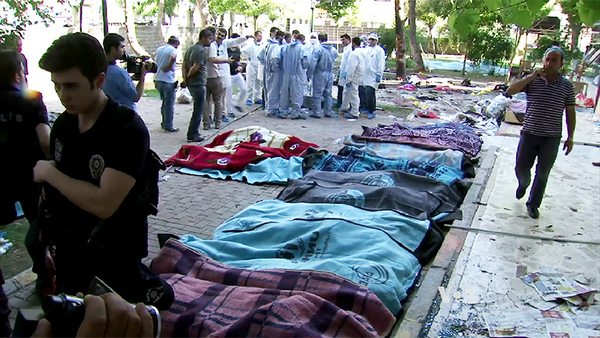
The scene of the suicide bombing in Suruc, Turkey. An ISIS suicide bomber murdered 32 people and wounded more than 100 others in a July 20 attack on Kurdish humanitarian activists. (Image source: VOA video screenshot)
|
The blast took place while the activists were making a statement to the press in the garden of a cultural center. At least 100 others, mostly university students, were wounded. (Graphic video of the explosion)
The suicide bomber was identified through DNA testing, according to reports in the Turkish news media. Seyh Abdurrahman Alagoz was reportedly a 20-year-old Turkish university student, recently returned from Syria, and believed to have had ties to ISIS.
Alagoz targeted a meeting 300 secular activists, members of the Federation of Socialist Youth Associations (SGDF), who gathered at a cultural center in the province of Urfa, opposite the Kurdish town of Kobane in Syrian Kurdistan. As part of an effort to rebuild Kobane, they were preparing to provide aid, give toys to the children there and build a hospital, school, nursery, children's park, library and a memorial forest for those who had lost their lives in Kobane.
"Work on the building of hospitals and schools needs to be done," Oguz Yuzgec, the co-president of the federation, said before the explosion. "One of the things we will do is to build a children's park in Kobane. We will name it after Emre Aslan, who died fighting in Kobane. We are collecting toys. We will participate in the construction of the nursery that the canton of Kobane is planning to build. We have the responsibility of helping the nursery function. We need everybody who knows how to draw and can teach children."
Mazlum Demirtas, a survivor of the attack, said: "The main one responsible for this incident is the state of Turkey, the AKP fascism, the AKP dictatorship. ... It attacked us with its gunmen and gangs. Since yesterday, parents have been collecting the dismembered body parts of their children. They are trying to identify the dismembered bodies. This is called fascism, inhumanity and barbarity."
Pinar Gayip, another survivor of the attack, said in a telephone interview on the pro-government Haberturk TV that, "Instead of helping the wounded, the murderer-police of the murderer-AKP threw tear gas at the vehicles with which we carried the wounded." She was taken off the air.
All across Turkish Kurdistan, there were protests condemning the massacre and the government's alleged involvement in it. Police in Istanbul used plastic bullets and water cannons against people who gathered to remember those murdered in Suruc.
The Turkish authorities briefly blocked access to Twitter last Wednesday to prevent the people from viewing photos of the bombing in Suruc. Officials admitted that Turkey had asked Twitter to remove 107 URLs (web addresses) with images related to the bombing; before the ban, Twitter had already removed 50.
Selahattin Demirtas, the co-chair of the pro-Kurdish Peoples' Party (HDP), said that state surveillance activities were intensive in Suruc, and that the intelligence service was recording the identity of everyone traveling to and from Suruc.
As Demirtas's own convoy had recently not been permitted to enter Suruc, he emphasized the extent of state surveillance in the town, and said that nobody could argue that someone could have managed to infiltrate the crowd and carry out the suicide attack without state support.
"Today, we have witnessed in Suruc yet again what an army of barbarity and rape, an army that has lost human dignity, can do," Demirtas said. "Those who have been silent in the face of ISIS, who have not dared even raise their voice to it, as well as the officials in Ankara who threaten even the HDP every day but caress the head of ISIS, are the accomplices of this barbarity."
In the meantime, Mehmet Gormez, the head of the Turkish Presidency of Religious Affairs (Diyanet), announced on its Twitter account that the perpetrators of the Suruc attack do not have religion.
However, three days before the massacre in Suruc, about 100 Islamists -- alleged to be ISIS sympathizers -- had performed mass Islamic Eid prayers in Istanbul. They demanded Islamic sharia law instead of democracy. ISIS sympathizers had performed the same Eid prayers at the same place the year before, as well.
Over the border in Syrian Kurdistan, shortly after the blast in Suruc, a suicide bomber detonated a car bomb at a checkpoint in Kobane. Two Kurdish fighters were killed in the explosion, according to Rami Abdel Rahman, director of the Syrian Observatory for Human Rights.
Last month, a deadly blast hit the Kurdish province of Diyarbakir in Turkey, during an election rally of the pro-Kurdish HDP that was attended by tens of thousands of people. Just before the HDP co-chair Selahattin Demirtas was going to speak, two bombs exploded at different places. Four people were killed, and more than 100 people are estimated to have been wounded. One of the wounded, Lisa Calan, 28, a Kurdish art director from Diyarbakir, lost both legs in the explosion.
As the wounded were being carried to hospitals, police used tear gas against people trying to run from the area in panic
The bomber was reported to be a member of ISIS.
* * *
In Turkey, millions of indigenous Kurds are continually terrorized and murdered, while ISIS terrorists can freely travel and use official border crossings to go to Syria and return to Turkey; they are even treated at Turkish hospitals. Emrah Cakan, for instance, a Turkish-born ISIS commander wounded in Syria, got medical treatment at the university hospital in Turkey's Denizli province in March.The Denizli governor's office issued a written statement on 5 March:
"The treatment of Emrah C. at the Denizli hospital was started upon his own application. The procedural acts concerning his injury were conducted by our border city during his entry to our country and they still continue. And his treatment procedures continue as a part of his right to benefit from health services just like all our other citizens have."The "compassion" and hospitality that many Turkish institutions have for ISIS members is not even hidden. The silence of the West is mystifying and disappointing.
The U.S. government cooperates with oppressive regimes -- including the terrorist regime of Iran, under which Kurds are forced to live -- to the detriment of the Kurds, to the detriment other persecuted peoples, and to the detriment of the future of the West.
Many Middle Eastern regimes are ruled by Islamist, often genocidal governments -- so there is not much to expect from them in terms of human rights and liberties.
The Kurds need real support, real arms and real recognition. Otherwise, there does not seem to be much difference between the dictatorial, genocidal Middle Eastern regimes and the West, which used to represent democracy and freedom.
Uzay Bulut, born and raised a Muslim, is a Turkish journalist based in Ankara.
[1] The so-called "peace process" was reportedly started in 2012 and through it, Kurds and the Turkish government were to resolve the Kurdish issue through negotiations.)


![[Graphic] Latest Report About ISIS Killing Superstar Won’t Sit Well With ISIS](http://madworldnews.com/wp-content/uploads/isidkellekesmekobani11.jpg)