Contact Form

Name

Email *

Message *

Showing posts with label Dempsey. Show all posts

Monday, July 20, 2015

Israel Is A Real Asset To The US, If Only Our Fearless Leader Would Realize It.


Israel: Security Asset for the United States


More important than planning for combat is planning for the strengthening of democracies.
We cannot make democracies out of Iraq or Libya or Syria, but when democratic countries are united, the world becomes a safer place for all.
In a volatile region so vital to the U.S., where other states cannot be relied upon, it would be foolish to disengage — or denigrate — an ally such as Israel. The war against terrorists and the states that harbor and support them will be long and hard, and success will depend in no small measure on the allies who stand with us and with whom we stand.
Perhaps you think the war is over. Perhaps you think that if Iran becomes a “friend” of the United States and the possibility of an American-led war against the Islamic Republic recedes, the need for a militarily capable ally such as Israel also recedes. Maybe the U.S. doesn’t want to associate with the “militaristic” Jewish State. That’s quite possible from the vantage point of July 2015 and if you think the only reason to befriend anyone is for the military advantages it brings to the relationship.
But there is a reason military-to-military cooperation between the U.S. and Israel has remained almost untouchable, and the American military proudly touts its relationship with Israel.
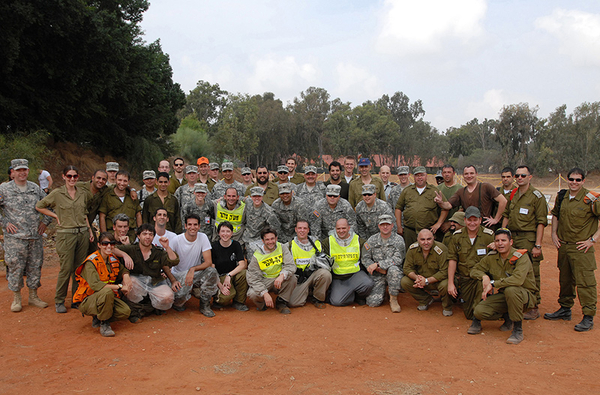
image: http://www.gatestoneinstitute.org/pics/large/1157.jpg
U.S. and Israeli soldiers during the Juniper Cobra 10 joint training exercise, in Israel, Oct. 21, 2009. (Image source: Spc. Zachary R. Fehrman/Ohio National Guard Public Affairs)
With the President of the United States behaving as if Iran can be an ally and a pro-Western player, it might help to recall the “quick reference guide” to the capabilities Israel brings to U.S.-Israel security cooperation, first published by JINSA in 1979, detailing that Israel has:
  • A secure location in a crucial part of the world
  • A well-developed military infrastructure
  • The ability to maintain, service, and repair U.S.-origin equipment
  • An excellent deep-water port in Haifa
  • Modern air facilities
  • A position close to sea-lanes and ability to project power over long distances
  • A domestic air force larger than many in Western Europe and possessing more up-to-date hardware
  • Multilingual capabilities, including facility in English, Arabic, French, Farsi and the languages of the (former) Soviet Union
  • Combat familiarity with Soviet/Russian style tactics and equipment
  • The ability to assist U.S. naval fleets, including common equipment
  • The ability to support American operations and to provide emergency air cover
  • A democratic political system with a strong orientation to support the United States and the NATO system.
In 1996, R&D capabilities and intelligence cooperation were added. Post 9-11, urban counterterror training was added.
Nothing has been deleted.
After the 2003 allied invasion of Iraq, American military personnel were being introduced to Israel’s bomb-sniffing dogs. The U.S. wanted such dogs, but the training period is fairly long. The IDF made Israeli dogs available, but they only took commands in Hebrew. There were some interesting scenes in Baghdad.
Chairman of the U.S. Joint Chiefs Martin Dempsey is one of many American military officers willing to praise Israel’s concern for enemy civilian casualties. Dempsey sent a senior American delegation to Israel to learn tactics after last summer’s Gaza war.
But more important than planning for combat is planning for the strengthening of democracies. We cannot make democracies out of Iraq or Libya or Syria, but when democratic countries are united, the world becomes a safer place for all. As I wrote in 2006,
“Israel and the United States are drawn together by common values and common threats to our well-being. The proliferation of weapons of mass destruction across the Middle East and Asia, and the ballistic missile technology to deliver systems across wide areas require cooperation in intelligence, technology and security policy. Terrorism and the origins and dissemination of violent Islamic radicalism also need to be addressed multi-laterally when possible.
“In a volatile region so vital to the U.S., where other states cannot be relied upon, it would be foolish to disengage — or denigrate — an ally such as Israel. The war against terrorists and the states that harbor and support them will be long and hard, and success will depend in no small measure on the allies who stand with us and with whom we stand.”
The message was good in 1979, better in 2006 and better yet in 2015.
Reprinted with author’s permission from Gatestone Institute

Read more at http://www.breakingisraelnews.com/45355/israel-security-asset-for-the-united-states-opinion/#SwQZy5MjFQ70tHL8.99

Wednesday, May 20, 2015

Why Don't We Just Hand Over Military Equipment To ISIS. They Are Getting It As They Capture City After City Anyway!

Iraqis abandoned US-supplied equipment in Ramadi

Associated Press 
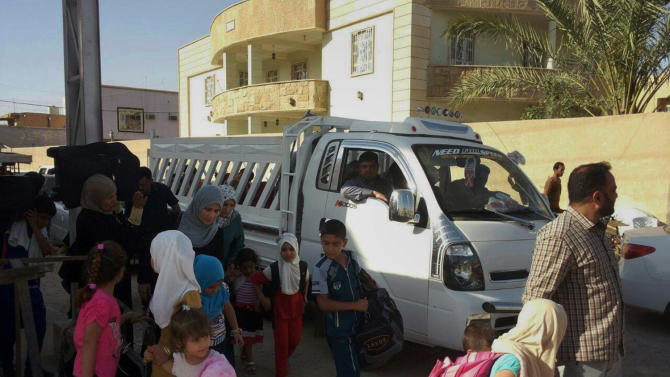
Civilians flee their hometown of Ramadi, the capital of Iraq's Anbar province, 115 kilometers (70 miles) west of Baghdad, Monday, May 18, 2015. Islamic State militants searched door-to-door for policemen and pro-government fighters and threw bodies in the Euphrates River in a bloody purge Monday after capturing the strategic city of Ramadi, their biggest victory since overrunning much of northern and western Iraq last year. (AP Photo)
.
View gallery
  • .
  • .
WASHINGTON (AP) — Iraqi troops abandoned dozens of U.S military vehicles, including tanks, armored personnel carriers and artillery pieces when they fled Islamic State fighters in Ramadi on Sunday, the Pentagon said Tuesday.
A Pentagon spokesman, Col. Steve Warren, estimated that a half dozen tanks were abandoned, a similar number of artillery pieces, a larger number of armored personnel carriers and about 100 wheeled vehicles like Humvees. He said some of the vehicles were in working condition; others were not because they had not been moved for months.
This repeats a pattern in which defeated Iraq security forces have, over the past year, left behind U.S.-supplied military equipment, prompting the U.S. to destroy them in subsequent airstrikes against Islamic State forces.
Asked whether the Iraqis should have destroyed the vehicles before abandoning the city in order to keep them from enhancing IS's army, Warren said, "Certainly preferable if they had been destroyed; in this case they were not."
Warren also said that while the U.S. is confident that Ramadi will be retaken by Iraq, "It will be difficult."
The fall of Ramadi has prompted some to question the viability of the Obama administration's approach in Iraq, which is a blend of retraining and rebuilding the Iraqi army, prodding Baghdad to reconcile with the nation's Sunnis, and bombing Islamic State targets from the air without committing American ground combat troops.
"The president's plan isn't working. It's time for him to come up with overarching strategy to defeat the ongoing terrorist threat," House Speaker John Boehner said.
White House spokesman Josh Earnest said President Barack Obama has always been open to suggestions for improving the U.S. approach in Iraq.
"It's something that he's talking about with his national security team just about every day, including today," Earnest said.
Derek Harvey, a retired Army colonel and former Defense Intelligence Agency officer who served multiple tours in Iraq, says that while the extremist group has many problems and weaknesses, it is "not losing" in the face of ineffective Sunni Arab opposition.
"They are adaptive and they remain well armed and well resourced," Harvey said of the militants. "The different lines of operation by the U.S. coalition remain disjointed, poorly resourced and lack an effective operational framework, in my view."
One alternative for the Obama administration would be a containment strategy — trying to fence in the conflict rather than push the Islamic State group out of Iraq. That might include a combination of airstrikes and U.S. special operations raids to limit the group's reach. In fact, a Delta Force raid in Syria on Friday killed an IS leader known as Abu Sayyaf who U.S. officials said oversaw the group's oil and gas operations, a major source of funding.
Officials have said containment might become an option but is not under active discussion now.
Gen. Martin Dempsey, the top U.S. military officer, issued a written statement Monday that suggested Ramadi will trigger no change in the U.S. approach.
"Setbacks are regrettable but not uncommon in warfare," Dempsey said. "Much effort will now be required to reclaim the city."
It seems highly unlikely that Obama would take the more dramatic route of sending ground combat forces into Iraq to rescue the situation in Ramadi or elsewhere. A White House spokesman, Eric Shultz, said Monday the U.S. will continue its support through airstrikes, advisers and trainers.
The administration has said repeatedly that it does not believe Iraq can be stabilized for the long term unless Iraqis do the ground fighting.
___
Associated Press writers Alan Fram and Nedra Pickler contributed to this report.

Wednesday, October 15, 2014

Will US Keep Supporting Kurds If They Lose Kobani? If Support Is Humanitarian, What Happens When It No Longer Is?

U.S. says ISIS made ‘substantial gains’ in Iraq

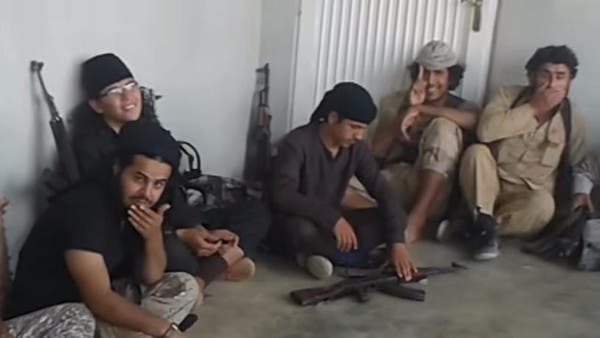
A group of ISIS militants take a break in an undisclosed location in Syria. (picture grab from YouTubevideo)
Militants of the Islamic State of Iraq and Syria (ISIS) have scored “substantial gains” in Iraq despite a continuous U.S.-led air campaign, a senior U.S. official said on Wednesday.
The group “has made substantial gains in Iraq,” and it will take time to build up local forces that could defeat them in Syria and Iraq, John Allen, a retired four-star U.S. general, told reporters, according to AFP.
Although the Iraqi government and Kurdish forces succeeded in halting or pushing back ISIS in some key areas including around Mosul dam, the militant group had “tactical momentum” in other areas, Allen said.
He acknowledged the United States and its allies were most concerned with the situation in Iraq, where the U.S. army had to call in Apache helicopters last week to prevent ISIS from seizing Baghdad’s international airport.
In an interview on ABC’s “this week” on Sunday, Chairman of the Joint Chiefs of Staff Gen. Martin Dempsey said: “They were within 20 or 25 kilometers [of Baghdad airport] and had they overrun the Iraqi unit, it was a straight shot to the airport. So we’re not going to allow that to happen; we need that airport.”
Allen said “the emergency in Iraq right now is foremost in our thinking,” admitting that it was too early to say which side has the upper hand.
“I’d be careful about assigning a winner -- winner or a loser,” said Allen, the former commander of NATO forces in Afghanistan.
Speaking after a tour of the Middle East in which Allen spoke to coalition partners and Iraqi leaders, the presidential envoy emphasized that military power alone would not be enough to defeat ISIS -- a point often made by the White House.
Allen said “the key and the main takeaway from this trip was that we all agree that while the military side is important to the outcome, it is not sufficient in and of itself.”
At the moment the plan was “to take those steps that are necessary, with the forces that we have available and the air power that we have at our fingertips” to buy time to train and arm Iraqi security forces.
The goal was to give Iraq’s new Prime Minister Haidar al-Abadi “the opportunity to build a stable government that is inclusive.”

Humanitarian air strikes

Speaking about the air campaign around the Syrian city of Kobane, which ISIS militants have been battling to take, Allen said it was “for humanitarian purposes” only to relieve defenders of the town and give them time to organize.
“We are striking the targets around Kobane for humanitarian purposes. I’d be very reluctant to attempt to assign ... a term like ‘a strategic target,’ or ‘a strategic outcome,’” Allen said.
“Clearly ... given the circumstances associated with the defense of that town, there was a need for additional fire support to go in to try to relieve the defenders and to buy some white space, ultimately, for the reorganization on the ground,” he added.
“We have picked up the tempo and the intensity of the air strikes in order to provide that white space.”
The Pentagon said Wednesday that those airstrikes have killed “several hundred” ISIS fighters in and around Kobane, but that ISIS could still seize the besieged strategic Syrian town.
“We believe that we have killed several hundred ISIL fighters in and around Kobane,” Pentagon spokesman John Kirby told reporters, adding that the majority of the city’s population has fled as jihadists continued to pour into the region in an attempt to take the town.

Friday, September 19, 2014

Where Are The Analysts Who Studied Our Vietnam Loss? Why Are We Making The Same Mistakes In Iraq?

Clapper: ISIS, Like Viet Cong, Surprise With 'Will to Fight'

Image: Clapper: ISIS, Like Viet Cong, Surprise With 'Will to Fight'(Stringer/Reuters/Landov)
Friday, 19 Sep 2014 07:56 AM
By Melissa Clyne
Share:
  Comment  |
   Contact Us  |
  Print  
|  A   A  

While U.S. officials were spot on in predicting the Islamic State’s (ISIS) “prowess and capability” and the Iraqi military’s “deficiencies,” there was a gaping hole in the assessment: Predicting its will to fight, National Security Director James Clapper toldWashington Post opinion writer David Ignatius.

“That’s always a problem,” Clapper said. “We didn’t do it in Vietnam. We underestimated the Viet Cong and the North Vietnamese and overestimated the will of the South Vietnamese.

"In this case, we underestimated ISIL [the Islamic State] and overestimated the fighting capability of the Iraqi army. ... I didn’t see the collapse of the Iraqi security force in the north coming. I didn’t see that. It boils down to predicting the will to fight, which is an imponderable.”

Clapper discussed with Ignatius the United States’ new National Security Strategy, unveiled Thursday at a Washington intelligence conference, reported by the Associated Press.

At the summit, Clapper bemoaned budgets cuts, leaks, and an expectation that “intelligence can be collected with no risk of embarrassment upon discovery and no threat to anyone’s civil liberties.


“We call this immaculate collection,” he joked, according to the AP.

Relying on other nations to make “substantive contributions” in the fight against ISIS is a first for the U.S., Clapper told Ignatius, characterizing this new “paradigm” as a “test.”

“We haven’t done this before,” he said. “We have always built around a major force contributed by the U.S. We’re going to try a different approach. ... At this point, I am reluctant to make predictions about how it will turn out.”

President Barack Obama has boldly stated he will not commit ground troops to the fight, reiterated during a speech Wednesday at the U.S. Central Command in Tampa, Florida.

“I will not commit you, and the rest of our armed forces, to fighting another ground war in Iraq," he assured the troops.

But Clapper and other intelligence officials have remained silent on the subject. A senior intelligence official requesting anonymity told Ignatius that it’s really too soon to make that call.

“If I were head analyst, I don’t think I’d make a call yet,” he said. “I haven’t fit together the contributions that each of the coalition members might make.”

Joint Chiefs of Staff Chairman, Gen. Martin Dempsey, told Congress this week that he is leaving all options on the table, according to USA Today.

“To be clear, if we reach the point where I believe our advisers should accompany Iraqi troops on attacks against specific ISIL targets, I will recommend that to the president," said Dempsey.


Clapper did not have a time line for defeating ISIS, other than noting that the militants pose a “strategic threat ... long term given their actions and their statements about the inevitability of confrontation with the U.S.”

He also didn’t know when they might have the “networks and capabilities” to attack on U.S. soil.


Related Stories:
© 2014 Newsmax. All rights reserved


Saturday, July 12, 2014

What Happened In Benghazi? Military Leaders Who Were NOT There Testify.

Testimony Reveals What Military Did While Benghazi Post Burned

Image: Testimony Reveals What Military Did While Benghazi Post Burned A vehicle in flames after it was set on fire inside the U.S. consulate compound in Benghazi on Sept. 11, 2012. (Getty Images)
Saturday, 12 Jul 2014 09:20 AM

Share:
  Comment  |
   Contact Us  |
  Print  
|  A   A  
One by one, behind closed doors in Washington, D.C.,, military officers explained what they did and didn't do the night the U.S. diplomatic post in Benghazi, Libya, burned.
Together their 30 hours of testimony to congressional investigators gives the fullest account yet of the military's response to the surprise attacks that killed the U.S. ambassador and three other Americans the night of Sept. 11, 2012, and early the next morning.
Transcripts of the interviews, with some names and classified information blacked out, were released Wednesday
The nine officers, including retired Gen. Carter Ham, then the head of the military's U.S. Africa Command, described making on-the-fly decisions with only sparse information about the crisis unfolding at a diplomatic post and the nearby CIA compound.

None of them was in Benghazi. The closest? Some were 600 miles away in Tripoli, the Libyan capital; others gave orders from command headquarters in Germany or Washington.
They did not witness what went on in the White House or at the State Department. Ex-Secretary of State Hillary Rodham Clinton, former Defense Secretary Leon Panetta and others have testified about Benghazi. More hearings are coming.
The nine officers shed light on the nature of the attacks; speculation that the military was ordered to "stand down" from helping Americans; suggestions that the U.S. should have rushed jets or a special operations team to Benghazi; and early misperceptions that the attack began as a protest over an anti-Islam video.
Some lingering questions about the Benghazi attacks and what the officers told the House Armed Services Committee and the House Oversight and Government Reform Committee this year:
_____
DID MILITARY LEADERS INITIALLY BELIEVE THE TROUBLE RESULTED FROM A STREET PROTEST?
Some heard that, some didn't; nothing was clear about events on the ground at first.
One of the earliest reports came from Ambassador Chris Stevens, who told his deputy in a phone call cut short: "We're under attack."
"We started calling it an attack from inception," said Army Lt. Col. S.E. Gibson, who was at the U.S. Embassy in Tripoli. "We never referred to it as anything else."
Another military official in Tripoli, whose name was withheld, said he wasn't sure how to interpret that word — "attack" — at first.
He had heard about protesters who scaled the walls of the U.S. Embassy in Cairo earlier that night. "It could be, you know, vandals are attacking," he said.
Retired Vice Adm. Charles "Joe" Leidig Jr., deputy commander of AFRICOM, said he was awoken in the night at his headquarters in Germany with word that "there had been protesters, and they had overrun the facility in Benghazi."
But Ham, who was alerted while visiting the Pentagon, said he heard no mention of protesters.
So he's sure he didn't pass on anything like that when he informed Panetta and Gen. Martin Dempsey, chairman of the Joint Chiefs of Staff, of the attack. Dempsey and Panetta personally took word to President Barack Obama at the White House.
Speaking for the Obama administration, then-U.N. Ambassador Susan Rice appeared on Sunday talk shows five days later and suggested the attacks were born from regional protests against an anti-Islamic video. The administration later recanted that position but never thoroughly articulated what they believe happened. Republicans say Obama soft-pedaled a terrorist attack to protect his re-election.
Over the two days when the attacks were occurring, there was "very, very little discussion that I can recall about why did this happen." Ham said. "There just wasn't time for that, frankly."
____
WAS A FOUR-MAN TEAM HEADED FOR BENGHAZI ORDERED TO STAND DOWN?
Technically, no, the team was not ordered, as some have asserted, to stand by as militants attacked Americans 600 miles away. But they were told not to go to Benghazi and instead to stay and protect personnel in Tripoli. In hindsight, the attacks were over by then, anyway.
The special operations officer leading that team and the commander who gave him the order both told investigators that it was the right decision.
The team, led by Gibson, was in Tripoli to help train Libyan special forces. When the Benghazi attack began, Gibson's first duty was to protect the embassy in Tripoli amid fears that it also would be targeted. He helped evacuate the staff to a classified, more-secure location. Once he felt they were safe on the morning of Sept. 12, Gibson was ready to rush to Benghazi to help.
One Libyan plane carrying a six-man U.S. security team already had taken off. Gibson wanted his group on the second chartered flight. He called the special operations command center for Africa to say they were heading to the airport.
He was told, "Don't go. Don't get on that plane."
"Initially, I was angry," he recalled. "Because a tactical commander doesn't like to have those decisions taken away from him. But then once I digested it a little bit, then I realized, OK, maybe there was something going on. Maybe I'm needed here for something else."
Rear Adm. Brian Losey, who gave the order, said he needed Gibson's team in Tripoli in case trouble started there.
Although some Republican lawmakers have suggested the team might have helped repel attackers in Benghazi, their flight would have arrived after the final assault that killed two CIA contractors.
Losey dismissed the notion that the foursome could have been much help in Benghazi, where Americans already were moving to the airfield for evacuation with the aid of Libyan forces and the U.S. security team from the first plane. Losey noted that Gibson's group consisted of a communications specialist, a medic and a weapons operator with his foot in a cast.
"That's not a security team," Losey said. Sending them in "didn't make a lot of sense."
Gibson said if his group had flown to Benghazi, their flight would have crossed paths with the first plane as it returned bearing wounded Americans. Because they stayed, his medic was there to meet two seriously injured people at the Tripoli airport. The medic is credited with saving one's life.
___
RIGHT OR WRONG, WASN'T THAT AN ORDER TO "STAND DOWN"?
Not according to Losey and Gibson.
Civilians might say that Losey ordered Gibson to stand down from his race to the scene. But Losey and Gibson say in their military parlance, standing down means ceasing operations.
"It was not a stand-down order," Gibson said. "It was not, 'Hey, time for everybody to go to bed.' It was, you know, 'Don't go. Don't get on that plane. Remain in place.'"
"It was never an order to stand down," Losey said. "It was an order to remain in place and continue to provide your security role in Tripoli."
___
DID CLINTON GIVE A "STAND DOWN" ORDER, AS SOME REPUBLICANS HAVE THEORIZED?
"No," said Losey.
"I never received any orders from the secretary of state or heard of any orders from the secretary of state," said Leidig, also based in Stuttgart, Germany.
"No," said Ham, who commanded the Africa operations. "And we would not receive direct communications from the secretary of state."
Ham said no one else ordered him to stand down, either, and no one tried to stop him from helping the Americans in Benghazi any way he could.
"The conversation really was more along lines of, you know, 'What do you need? What can we do?'" he said. "And every request for forces that I asked of the secretary of defense was approved."
___
WHAT DID THE MILITARY DO TO HELP?
Following the first report of trouble about 9:40 p.m. local time on Sept. 11, officials began looking for military planes that could head to Benghazi for evacuations. None would be available for hours.
An unmanned drone already in Libya was quickly sent to survey the situation at the diplomatic post. Nighttime darkness limited its usefulness.
Two military members — both from Special Forces — were in the six-man team that flew from Tripoli to Benghazi around midnight and aided with the defense and evacuation of the CIA base.
An Air Force C-17 transport plane flew the Benghazi evacuees from Tripoli to Germany the night of Sept. 12, about 24 hours after the attacks began.
A U.S. anti-terror team sent from Spain arrived in Tripoli after the evacuees had gone.
Two military teams — one in Croatia and the other in the U.S. — prepared to go but, as the situation changed, weren't brought to Libya. They would have arrived too late.
Not until the morning of Sept. 12 was the 31st Fighter Wing in Aviano, Italy, ordered to get four F-16 jets and four pilots ready to respond if needed. The call to Benghazi never came.
___
WHY DIDN'T THEY SCRAMBLE THE F-16 FIGHTERS?
Military leaders decided early on that jets armed with 500-pound bombs were unsuited for the chaotic crisis in an urban area.
"Ultimately, it was my decision that said no, not the right response in this circumstance," Ham said.
He didn't have anyone on the ground to provide target information for airstrikes. He didn't want to harm innocent people or risk inflaming more Libyans to join the attack. He believed some militants had missiles capable of downing a plane.
"Had I made a different decision, had strike aircraft deployed, we don't really know what the outcome would have been," Ham said. "Maybe it would have been positive, but maybe it would have got shot down. Maybe it would have killed civilians."
Brig. Gen. Scott Zobrist, then the wing commander at Aviano, had similar worries. He said that, even if called right away, it would have taken 20 hours to get jets to Benghazi from the base in Italy normally used for training flights.
Pilots would have to be recalled from their homes, bombs loaded onto planes, the 1,000-mile route planned. The jets would need refueling along the way, which meant coordinating with tanker planes stationed in England — something that typically takes days to plan.
___
COULD THE MILITARY HAVE DONE MORE?
Perhaps.
In hindsight, Ham said, he should have reached out to his Libyan contacts and other U.S. officials to get Americans evacuated from Benghazi faster. That might have saved the two lives that were lost hours after the first attack at the diplomatic post.
While the evacuation from Benghazi was being planned by the embassy and the CIA, Ham said, he switched his focus toward gearing up a possible hostage rescue mission, because the ambassador was still missing.
Meanwhile, surviving U.S. personnel were gathered at the CIA base in Benghazi. Ham said he believed they were relatively safe. He and other military leaders said they weren't told that the CIA compound already had come under gunfire and rocket-propelled grenade attacks in the middle of the night.
The U.S. security team that arrived at the Benghazi airport after midnight was detained by Libyan officials for several hours. That delayed the evacuation, Ham said, and "allowed sufficient time for the second attack to be organized and conducted."
During that attack, around 5 a.m., mortar fire killed two CIA security contractors on the roof and wounded other Americans.
Less than an hour later, the evacuation of all American personnel from Benghazi began.

© Copyright 2014 The Associated Press. All rights reserved. This material may not be published, broadcast, rewritten or redistributed.