Exclusive: NYT White House correspondent Glenn Thrush’s history of bad judgment around young women journalists
Several women told Vox about their experiences with the star reporter, and the Times has suspended him pending an investigation.
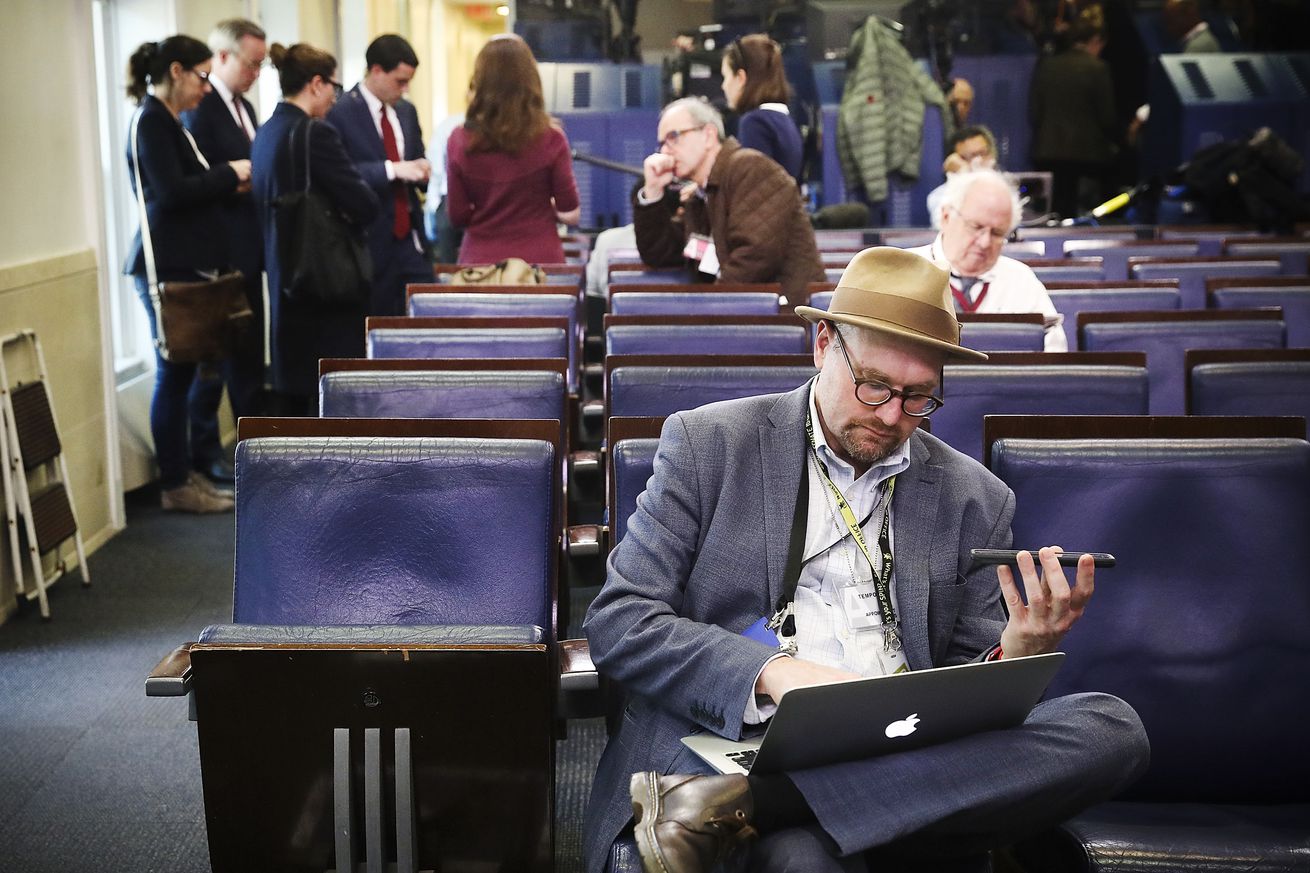
New York Times reporter Glenn Thrush in the White House briefing room on February 24.
Mark Wilson/Getty Images
Sexual harassment claims against yet another powerful man in media inspired New York Times White House correspondent Glenn Thrush to post an impassioned note on his Facebook page in October, calling on his fellow journalists to stand by women entering the field.
In the post, which linked to an article about the latest accusations against political journalist Mark Halperin, Thrush wrote, “Young people who come into a newsroom deserve to be taught our trade, given our support and enlisted in our calling — not betrayed by little men who believe they are bigger than the mission.”
It was a noble statement — but some Washington journalists I spoke to say it rings hollow, given Thrush’s own behavior with young women in the industry.
“He kept saying he’s an advocate for women and women journalists,” a 23-year-old woman told me, recounting an incident with Thrush from this past June. “That’s how he presented himself to me. He tried to make himself seem like an ally and a mentor.”
She paused. “Kind of ironic now.”
Thrush, 50, is one of the New York Times’s star White House reporters whose chronicles of the Trump administration recently earned him and his frequent writing partner Maggie Haberman a major book deal.
Thrush and the young woman met at her colleague’s going-away party at a bar near the Politico newsroom, she told me,and shared a few rounds of drinks in a booth. The night, she said, ended on a Washington street corner, where Thrush left her in tears after she resisted his advances.
The encounter was troubling enough to the woman that her friend Bianca Padró Ocasio, also 23 and a journalist, confronted Thrush about his behavior via text message the next day.
“I want to make sure you don’t lure young women aspiring journalists into those situations ever again,” she texted. “So help me out here. How can I do that?”
/cdn.vox-cdn.com/uploads/chorus_asset/file/9716549/Untitled_1.jpg)
Bianca Padró Ocasio confronted Glenn Thrush over text message about his behavior the night before with her friend, a 23-year-old journalist. Some messages have been redacted to protect the friend’s privacy.
Screenshots courtesy of Bianca Padró Ocasio
Thrush was apologetic but defensive.
“I don’t lure anybody ever,” he wrote, according to screenshots provided by Padró Ocasio. “I got drunk because I got some shitty health news. And I am acutely aware of the hurdles that young women face in this business and have spent the better part of 20 years advocating for women journalists.”
If Thrush is acutely aware of what young women face in the business of political journalism, he should also know it’s because he himself is one of the problems women face. Five years ago, when Thrush and I were colleagues at Politico, I was in the same bar as Padró Ocasio’s friend — perhaps the same booth — when he caught me off guard, put his hand on my thigh, and suddenly started kissing me. Thrush says that he recalls the incident differently.
Three young women I interviewed, including the young woman who met Thrush in June, described to me a range of similar experiences, from unwanted groping and kissing to wet kisses out of nowhere to hazy sexual encounters that played out under the influence of alcohol. Each woman described feeling differentlyabout these experiences: scared, violated, ashamed, weirded out. I was — and am — angry.
Details of their stories suggest a pattern. All of the women were in their 20s at the time. They were relatively early in their careers compared to Thrush, who was the kind of seasoned journalist who would be good to know. At an event with alcohol, he made advances. Afterward, they (as I did) thought it best to stay on good terms with Thrush, whatever their feelings.
“I apologize to any woman who felt uncomfortable in my presence, and for any situation where I behaved inappropriately. Any behavior that makes a woman feel disrespected or uncomfortable is unacceptable,” Thrush said in a statement emailed to me on November 19.
In interviews with about 40 people in and around media who know Thrush, I got a picture of a reporter whose title doesn’t capture his power and stature. People who’ve worked with him say he can get a writer’s name in front of the right editor, if he wants. Newsroom leaders care what he thinks. Some reporters said Thrush had usedhis connections to help them land jobs or develop new sources.
When just sitting at a bar with a powerful man comes at a price
The downfall of Hollywood titan Weinstein has been a catalyst for a movement to stamp out workplace harassment, particularly the variety to pits powerful men against much less powerful women. They are facing consequences for their behavior like never before, including men in media. Halperin lost a coveted book deal. NPR news chief Michael Oreskes resigned. Leon Wieseltier lost funding for his new magazine. And Lockhart Steele, the editorial director of Vox Media, Vox’s parent company, was firedfor misconduct.
Thrush wasn’t my boss at Politico. He was a reporter and I was an editor. We were on different teams and hardly crossed each other’s paths. But he was an incredibly influential person in the newsroom and in political journalism, a world I was still trying to break into in a meaningful way at the time.
It wasn’t that Thrush was offering young women a quid pro quo deal, such as sex in exchange for mentorship. Thrush, just by his stature, put women in a position of feeling they had to suck up and move on from an uncomfortable encounter.
What happened at the bar was bad. What happened next was worse.
On that night five years ago, I joined Thrush and a handful of other reporters for a few rounds at the Continental, a Politico hangout in Rosslyn, Virginia. At first, nothing seemed strange, until the crowd had dwindled down to Thrush, me, and one other female colleague.
Thrush tossed a $20 bill at her and told her to take a cab and leave us, “the grown-ups,” alone. He slid into my side of the booth, blocking me in. I was wearing a skirt, and he put his hand on my thigh. He started kissing me. I pulled myself together and got out of there, shoving him on my way out.
In the morning, Thrush sent me an apologetic email. I didn’t save it, but I recall it as similar to the one he would later send to Padró Ocasio’s friend in June. He said he was sorry, but he didn’t say for what, exactly.
A few hours later, I saw him in deep conversation with a number of men I worked with. My gut told me something was up. I worried he was covering his tracks by spreading a rosy version of the night. As many people told me in the course of reporting this story, Thrush is a talker — or, as many put it, “a bullshitter.” He likes to hear gossip, and he likes to spread it.
Gradually, things in the office started to change for me. Certain men in the newsroom, I thought, started to look at me differently. Some of their comments seemed a bit too familiar or were outright offensive. I had a nagging sense that I just wasn’t as respected as I used to be.
I started to think maybe I shouldn’t be in journalism if I couldn’t hang in a tough newsroom. I found myself on edge, nervous and anxious all the time. I started to believe I had brought this all on myself.
In the course of reporting this story, I was told by a male reporter who’d worked at Politico at the time that my instinct was right. He said that the day after that night at the bar, Thrush told him about the incident, except with the roles reversed. I had come onto him, the reporter said Thrush told him, and he had gently shut it down.
In a statement, Thrush denied that he disparaged me to colleagues at Politico. He said that “the encounter described [in this story] was consensual, brief, and ended by me.”
The source said that Thrush frequently told versions of this story with different young women as the subject. He would talk up a night out drinking with a young attractive woman, usually a journalist. Then he’d claim that she came onto him. In his version of these stories, Thrush was the responsible grown-up who made sure nothing happened.
There was no conventional HR office at Politico at the time (a VP of human resources position was created there in 2016). So I brought my concern about the night to an experienced colleague right after the incident. When I believed rumors were damaging my standing in the office a few months later, I told a very senior editor. I was under the impression that nothing could be done. Neither person works at Politico anymore. A spokesperson for Politico, Brad Dayspring, said that no complaint ever reached the general counsel’s desk.
Women have a very different story to tell
One former Politico staffer told me that she’d become worried about her reputation after an encounter with Thrush sometime in the winter of 2012-’13. The scene was, again, a Politico going-away party. She said she and Thrush spoke most of the night, until they ended up the last two of the party left in the bar. She says she’d had a lot to drink and Thrush offered her a ride home.
Her recollection of the details is fuzzy, but one way or another, he ended up in her place.
“I had alcohol blur,” she says. But Thrush was far from being the grown-up who preventedthings from going too far; instead, she says, she was the one to raise objections. “I remember stopping him at one point and saying, ‘Wait, you’re married.’” After that, she says, he left almost immediately. “I remember that by the time he left, I didn’t have much clothes on.”
The woman says she was struggling at Politico at the time, and she wondered if gossip might have made her situation worse. “I don’t know if he told other male reporters or editors. Did that shade their opinion of me? There’s no way to know.”
She says she doesn’t believe she was pressured or that she’s a victim.
But she also says she wants others to know about what happened.
“The only regret I have is not telling more women. I told two. What if I had told five?”
One of the two women she told at the time shared with me her recollection of the conversation. “I remember she kept reemphasizing that they were both really drunk, that it was consensual,” the friend said. “And she did not believe it was an assault. But I do remember she was very rattled and upset and ashamed of what she saw as her role in it.”
Another woman described to me a 2013 Politico party that she attended in her early 20s. She said she was standing alone, Thrush came up to talk to her, and suddenly he leaned in and landed a wet kiss on her ear.
“It all happened very quickly. And he leaned in very quickly,” she said. “At the time, I remember thinking … adults sometimes kiss each other on the cheek. Then sometimes they miss and slobber on your ear. It was my way of thinking this wasn't as weird as I thought.”
Over time, the “whisper network” of warnings about Thrush has grown louder
A 21-year-old woman arrived in Washington last year to intern in a journalism organization. She heard from people who don’t even work with Thrush to be careful. An employee at the Washington Post told her about him when she first arrived. A few months later, she says, a reporter at Roll Call warned her about him, too. She passed on the intel to four other female interns.
Multiple young women journalists I spoke to said that they’d heard serious warnings about Thrush from friends. The word among women just starting in Washington, they said, is to be careful if you meet him at an event with alcohol, or if he sends you a direct message on Twitter. (Thrush suspended his Twitter account in September, saying it was too much of a distraction.)
There’s something endearing and inspiring about interns who self-organized to guard themselves and each other against advances offered under guise of praise and professional advice — but there’s also something sad about a world in which the savvy move is to teach a young woman not to trust an older man who has something nice to say about her work.
And whispers don’t fix everything. When Bianca Padró Ocasio’s friend found herself at the bar with Thrush in June, with him asking her to leave and go to another bar with him, she went to the bathroom and texted Padró Ocasio and another female friend, both of whom were also in journalism.
“I’m drunk,” she texted, as saved screenshots of the messages show. “I’m nervous about this Glenn situation.”
The friends urged her to call an Uber.
“I am,” she responded. “I need to go home.”
“Who else is there??” one friend asked. “Is there a woman you can uber home with?”
Instead, the woman ended up leaving the bar with Thrush, who suggested they walk off some of their drinking — get some fresh air.
He repeatedly tried to take her hand as they walked, she recalls, but she kept pulling it away. They crossed the Key Bridge from the Virginia neighborhood where Politico’s office is located into Georgetown. He led her down an incline to a dimly lit path along the old C&O Canal bed. He kissed her, she says, and she panicked. Then her phone rang, jolting her. It was Padró Ocasio.
“I felt very protective of her,” Padró Ocasio said, describing the call. “I thought, she’s drunk right now. If I don’t do something, I’m not going to forgive myself.”
The young woman ordered an Uber — the receipt shows it was about 11 pm — and says she planned to call Padró Ocasio back once inside the car. In the few minutes she waited, she said, Thrush walked back over to her and started to kiss her again. She began to cry. When Thrush saw, he abruptly walked off, waving his hand flippantly, and left her alone to wait for her ride, she said.
/cdn.vox-cdn.com/uploads/chorus_asset/file/9716603/Screen_Shot_2017_11_19_at_2.08.34_PM.jpg)
Glenn Thrush sent an apologetic email to a woman who had met him at a going-away party. She described an unwanted encounter with him, but felt she had to send a cordial reply and stay on good terms.
Courtesy of the young woman on the email thread
Padró Ocasio’s friend received an email from Thrush the next morning with the subject line, “Nice meeting you!” followed by, “(And apologies?).” She responded congenially. “It was nice meeting you too! (And no worries haha).” She also met him a few weeks later at a tea shop near the White House, a meeting they’d discussed the night at the bar. Thrush sent her a few critiques of her stories. She said she feels that despite her misgivings, she has to stay on good terms with him since he is connected.
“I hate feeling obligated to make him think I think everything is fine,” she said. “It’s been this thing hanging over me. I feel like I have to be nice to this person just because he knows people.”
In his emailed statement, Thrush said that the night in June with the young woman was the last time he’s had a drink.He wrote:
The June incident [described above] was a life-changing event [for me]. The woman involved was upset by my actions and for that I am deeply sorry.Over the past several years, I have responded to a succession of personal and health crises by drinking heavily. During that period, I have done things that I am ashamed of, actions that have brought great hurt to my family and friends.I have not taken a drink since June 15, 2017, have resumed counseling and will soon begin out-patient treatment for alcoholism. I am working hard to repair the damage I have done.
“I feel really strongly about not creating a toxic environment”
In the course of his text dialogue with Padró Ocasio about the incident with her friend, Thrush wrote, “I feel really strongly about not creating a toxic environment.”
Back at Politico years ago, Thrush’s behavior contributed to a toxic environment I experienced. Dozens of people told me that Politico has changed dramatically since Carrie Budoff Brown took over a year ago as the publication’s editor. Multiple men and women who work for her say her standards are high and she has no time for the kind of behavior I described.
Budoff Brown was at the going-away party in June where Thrush was in the booth with the 23-year-old woman. She told me she noticed them talking but, like other attendees I talked to, she didn’t know that anything happened afterward.
“I was disappointed in Glenn but had no reason to think that anything would progress beyond the bar that night,” she said. “And I am saddened to learn in the course of your reporting that it did.”
“Great journalism and great business require a great workplace. My colleagues and I have worked hard to nurture a newsroom where people are supportive, good to each other, and where mutual respect is the way of life. We have zero tolerance for anything else.”
/cdn.vox-cdn.com/uploads/chorus_asset/file/9716619/GettyImages_645016982.jpg)
New York Times reporter Glenn Thrush inside the White House briefing room on February 24.
Mark Wilson/Getty Images
By the time of the June incident, Thrush was gone from Politico anyway — off to the New York Times, which has hired many of Politico’s top reporters over the years. But now he will be on hiatus pending a Times investigation that was sparked by my reporting for this story.
"The behavior attributed to Glenn in this Vox story is very concerning and not in keeping with the standards and values of The New York Times,” said Eileen Murphy, the senior vice president of communications for the New York Times, in a written statement. “We intend to fully investigate and while we do, Glenn will be suspended. We support his decision to enter a substance abuse program. In the meantime, we will not be commenting further.”
It’s the Times itself, of course, that has done so much to spark the current conversation around harassment with its exposés on Harvey Weinstein and Louis C.K. There’s probably no loftier perch in all of political journalism from which one could teach the trade and enlist young women into the calling — or, as the case may be, betray them.


 Subscribe to feed


