Contact Form

Name

Email *

Message *

Showing posts with label Mullahs. Show all posts

Monday, June 4, 2018

The Mullahs Should Be Afraid


hackers taking control of monitors at Mashhad Airport in northeast Iran, displaying messages in support of the protests.
Hackers took control of monitors at Mashhad Airport in northeast Iran, displaying messages in support of a movement to overthrow the mullah-led regime.
Members of a growing grass-roots movement in Iran seeking to overthrow the mullah-led Islamic regime are emboldened by new sanctions imposed this week by the United States on top of the canceling of the nuclear agreement.
The evidence can be seen in Twitter posts by Iranians with the hash tag #FreeIran2018, which declare support for the U.S. move Wednesday and report bold acts of civil disobedience and major protests intended ultimately to foster revolution.
Javad Hamida‏ wrote Wednesday: “I am an Iranian, And I welcome the sanctions against the tortuous and oppressive organs of the Iranian people, By the US government.”
Maryam Rajavi,‏ the leader of the People’s Mujahedin of Iran, an organization trying to overthrow the government, and the president-elect of the National Council of Resistance of Iran, wrote that the “mullahs’ religious fascism in #Iran is fleeting, devoid of any future. The people of Iran are seeking the overthrow of the entire Velayat-e Faqih regime,” referring to the Islamic government.
Thursday night in the town of Zarrin-Shahr, a city of 56,000 in central Iran, “young supporters of a free Iran” set fire to a picture on a sidewalk of Iran’s supreme leader, Ayatollah Khamenei.
The man who shot video of the act, which was distributed via Twitter, can be heard saying, according to an English translation: “Dictator, say hello to your end.”
At Iran’s second busiest airport, hackers took over video monitors to display messages supporting the revolt.

M. Hanif Jazayeri‏ posted a video Thursday marking the 10th day of a nationwide strike by truck drivers, noting they are “refusing to deliver loads as #IranProtests persist.”
“Workers are often not paid for months. They now realize there’s more to be gained by striking, he said.
Rajavi‏ wrote that the truck drivers strike “is an example of the Iranian people’s will to do away with the mullahs’ corrupt tyranny and achieve freedom and popular sovereignty.”


Read more at http://www.wnd.com/2018/06/tweets-from-iran-reveal-growing-revolution/#HkoyYmshqHUrfCTr.99

Sunday, October 29, 2017

Are We Foolishly Trying To Stop The Leaks In The Dike?

  • It isn't only Niger. American troops are deployed in more than 150 countries, working with local partners to help them become better soldiers and meet their own threats. What is happening in Niger is happening in all the countries of the second tier of Africa -- volatile and insecure countries of mixed Christian, Muslim and traditional indigenous religions. American soldiers are there to help governments more effectively control their own territory and borders, reducing the likelihood of transnational jihad.
  • Iran's massive infusion of funds supports Sunni Hamas, al-Qaeda, ISIS, Boko Haram and others. Instability, chaos, anti-Americanism, anti-Westernism, and anti-Christianism are what Iran seeks -- and they are what Sunni jihadists seek. In Iraq and Syria, ISIS did the destabilizing and Iran reaped the benefits.
At the end of White House Chief of Staff John Kelly's moving briefing about the four American Special Forces soldiers killed in Niger earlier in October, he took questions. The first was, "Why are we in Niger?"
The question was too narrow; it isn't only Niger. Tens of thousands of American troops are deployed in more than 150 countries, working with America's local partners to help them become better soldiers and meet their own threats. We are on every continent except Antarctica. While we are unlikely to ever know precisely who killed the four soldiers, what is happening in Niger is happening in all the countries of the second tier of Africa -- volatile and insecure countries of mixed Christian, Muslim and traditional indigenous religions. American soldiers are there to help governments more effectively control their own territory and borders, reducing the likelihood of transnational jihad.

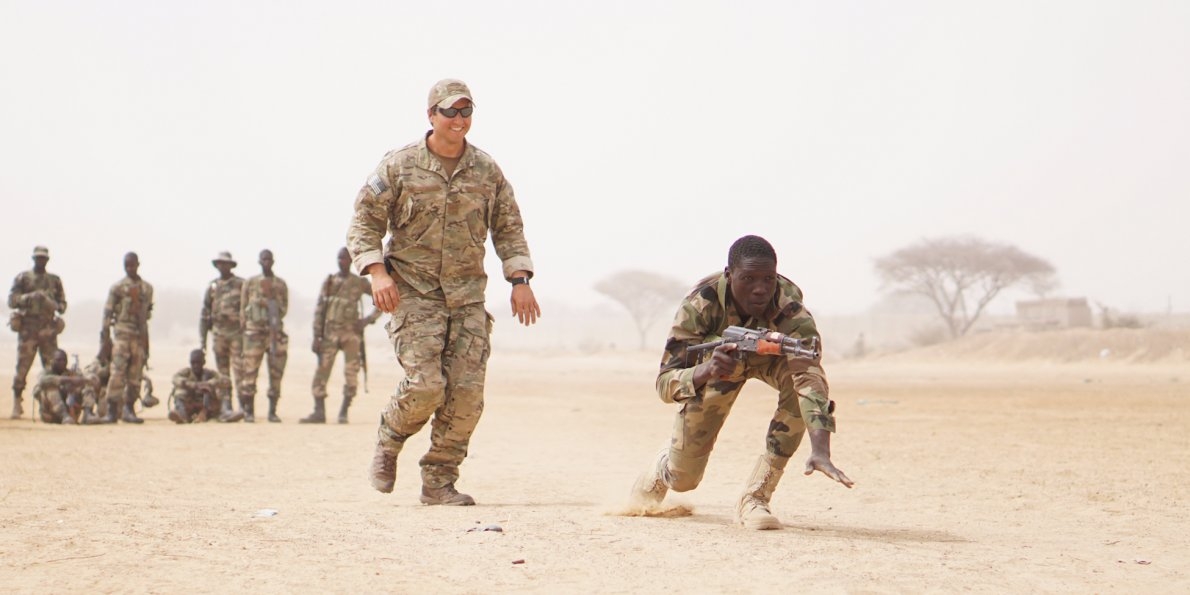
A U.S. Army Special Forces weapons sergeant observes a Nigerien soldier in a drill during Exercise Flintlock 2017 in Diffa, Niger, March 11, 2017. (U.S. Army photo by Spc. Zayid Ballesteros)

Two broad forces are shaking the Middle East and Africa: Sunni jihadist radicalism embodied by ISIS and al-Qaeda along with smaller groups; and Shiite supremacism controlled and financed by Iran. Iran's arms transfers to Africa are well documented, as is Iran's support for Sunni jihad, including incubating both al-Qaeda and ISIS. Separately and together, they threaten not only countries, but also the Red Sea and the Mediterranean Sea, the two prime waterways that allow countries, including Israel and Egypt, to pursue trade with Asia and Europe.
The mullahs in Iran are not Iranian or Persian nationalists, they are Shiite supremacists. When the Ayatollah Khomeini returned to Tehran in 1979 after fourteen years of exile, he condemned all nationalism as "sherk," which means associating other beings or things with God. He said what mattered was Islam, not Iran or any other country, according to the Iranian journalist Amir Taheri, Chairman of Gatestone Europe. Khomeini declared war on the United States, on Israel, and on the West. The declaration was real and has military as well as political implications, but it was also a way of deflecting attention from Iran's declaration of war on Sunni Islam.
It was a bold move, because although Shiites are the majority in Iran and Iraq (though not in Syria), they represent less than 15% of Muslims world-wide. Iran's primary targets are the Sunni governments of Saudi Arabia, which controls the holy sites in Mecca and Medina, and Egypt, the historic intellectual center of Sunni Islam.
The 2003 overthrow of the secular-but-Sunni president of Iraq, Saddam Hussein, allowed the majority Shiite Iraqi population to rule, but the precipitous American military withdrawal in 2012 allowed Iran to move steadily into areas of more influence. Iranian-sponsored Shiite militias are now inside the Iraqi national military pushing against the Kurds in the north. In Syria, Iranian-sponsored militias are pushing Sunnis north and out of the country on behalf of the Shiite/Alawite regime of Bashar al-Assad.
But while American focus has been on Iranian expansionism to the north and west of Iran -- a "Shiite crescent" over the tops of American allies Saudi Arabia, Jordan and Israel -- less attention has been paid to Iranian activity to the south of those countries, through the Red Sea and into Africa toward the Mediterranean.
Following naval harassment of U.S. ships in the Persian Gulf, Iran announced that it will "defend its interests" in the Red Sea, using its position as benefactor of the Houthis in Yemen as a starting point. If successful, this would allow Iran to threaten the Red Sea and the Bab-el-Mandeb Strait, the access point for Saudi Arabia, Israel, Jordan, and Egypt to the Gulf of Aden and then to the Indian Ocean and to Asia.
Iran ships weapons to and through Eritrea and Somalia on the Red Sea coast. This is important because U.S. Expeditionary Forces are based in Djibouti, which juts out into the sea. North of Djibouti and our forces is Eritrea; south of Djibouti and our forces is Somalia. Well-armed and unstable, they present a problem for the Americans.
Iran's interests are not limited to the countries along the coast.
The other waterway that concerns the United States, Israel and the West is the Mediterranean Sea. The countries along the north coast of the Mediterranean are European, all of which are in NATO. The countries facing them along the south shore of the Mediterranean, along the northern African coast, are Sunni Muslim, and, except Libya, partners in NATO's Mediterranean Dialogue. The arrangement helps keep the Mediterranean calm and free for shipping. The 2011 ouster of Libya's Moammar Qaddafi caused chaos in a previously stable -- if repressive -- country. Released weapons and fighters resulted in war in Mali, which had been an ally of the United States and France. Additional instability would make NATO's arrangements less effective and provide additional routes for African migrants seeking to reach Europe.
One way to make North Africa less stable is to make the row of countries just beneath it less stable. Chad, Mali, Somalia, Eritrea, Sudan, and yes, Niger, are all targets.
They are, to be sure, as much targets of Sunni jihad as they are of Iran, but Iran's massive infusion of funds supports Sunni Hamas, al-Qaeda, ISIS, Boko Haram and others. Iran's support for al-Qaeda goes back to the early 1990s. Instability, chaos, anti-Americanism, anti-Westernism, and anti-Christianism are what Iran seeks -- and they are what Sunni jihadists seek. In Iraq and Syria, ISIS did the destabilizing and Iran reaped the benefits.
General Kelly made a sober, passionate defense of American military honor and sacrifice. It is incumbent on the rest of us -- including journalists -- to understand where our troops serve and sacrifice, including why Niger.
Shoshana Bryen is Senior Director of the Jewish Policy Center.
© 2017 Gatestone Institute. All rights reserved. The articles printed here do not necessarily reflect the views of the Editors or of Gatestone Institute. No part of the Gatestone website or any of its contents may be reproduced, copied or modified, without the prior written consent of Gatestone Institute

Monday, October 12, 2015

The Iranian Mullahs And The Rest Of The World Have Come To Agreement. Nuclear Deal Opens The Door To Trade, Will Not Stop Nuclear Development And That Obama Is Feckless, Incompetent, And Will Do NOTHING.

Sometime this week, President Obama is scheduled to sign an executive order to meet the Oct. 15 "adoption day" he has set for the nuclear deal he says he has made with Iran. According to the president's timetable the next step would be "the start day of implementation," fixed for Dec. 15.
But as things now stand, Obama may end up being the only person in the world to sign his much-wanted deal, in effect making a treaty with himself.
The Iranians have signed nothing and have no plans for doing so. The so-called Joint Comprehensive Plan of Action (JCPOA) has not even been discussed at the Islamic Republic's Council of Ministers. Nor has the Tehran government bothered to even provide an official Persian translation of the 159-page text.
The Islamic Majlis, the ersatz parliament, is examining an unofficial text and is due to express its views at an unspecified date in a document "running into more than 1,000 pages," according to Mohsen Zakani, who heads the "examining committee."
"The changes we seek would require substantial rewriting of the text," he adds enigmatically.
Nor have Britain, China, Germany, France and Russia, who were involved in the so-called P5+1 talks that produced the JCPOA, deemed it necessary to provide the Obama "deal" with any legal basis of their own. Obama's partners have simply decided that the deal he is promoting is really about lifting sanctions against Iran and nothing else.
So they have started doing just that without bothering about JCPOA's other provisions. Britain has lifted the ban on 22 Iranian banks and companies blacklisted because of alleged involvement in deals linked to the nuclear issue.
German trade with Iran has risen by 33 percent, making it the Islamic Republic's third-largest partner after China.
China has signed preliminary accords to help Iran build five more nuclear reactors. Russia has started delivering S300 anti-aircraft missile systems and is engaged in talks to sell Sukhoi planes to the Islamic Republic.
France has sent its foreign minister and a 100-man delegation to negotiate big business deals, including projects to double Iran's crude oil exports.
Other nations have also interpreted JCPOA as a green light for dropping sanctions. Indian trade with Iran has risen by 17 percent, and New Delhi is negotiating massive investment in a rail-and-sea hub in the Iranian port of Chah-Bahar on the Gulf of Oman. With help from Austrian, Turkish and United Arab Emirates banks, the many banking restrictions imposed on Iran because of its nuclear program have been pushed aside.
"The structures of sanctions built over decades is crumbling," boasts Iranian President Hassan Rouhani.
Meanwhile, the nuclear project is and shall remain "fully intact," says the head of Iran's Atomic Energy Agency, Ali Akbar Salehi.
"We have started working on a process of nuclear fusion that will be cutting-edge technology for the next 50 years," he adds.
Even before Obama's "implementation day," the mullahs are receiving an average of $400 million a month, no big sum, but enough to ease the regime's cash-flow problems and increase pay for its repressive forces by around 21 percent.
Last month, Iran and the P5+1 created a joint commission to establish the modalities of implementation of an accord, a process they wish to complete by December 2017 when the first two-year review of JCPOA is scheduled to take place and when Obama will no longer be in the White House. (If things go awry Obama could always blame his successor or even George W Bush.)
Both Obama and his Secretary of State John Kerry have often claimed that, its obvious shortcomings notwithstanding, their nuke deal with the "moderate faction" in Tehran might encourage positive changes in Iran's behavior.
That hasn't happened.
The mullahs see the "deal" as a means with which Obama would oppose any suggestion of trying to curb Iran.


"Obama won't do anything that might jeopardize the deal," says Ziba Kalam, a Rouhani adviser. "This is his biggest, if not the only, foreign policy success."
If there have been changes in Tehran's behavior they have been for the worst. Iran has teamed up with Russia to keep Bashar al-Assad in power in Syria, mocking Obama's "Assad must go" rhetoric. More importantly, Iran has built its direct military presence in Syria to 7,000 men. (One of Iran's most senior generals was killed in Aleppo on Wednesday.)
Tehran has also pressured Iraqi Premier Haidar al-Abadi's weak government to distance itself from Washington and join a dubious coalition with Iran, Russia and Syria.
Certain that Obama is paralyzed by his fear of undermining the non-existent "deal" the mullahs have intensified their backing for Houthi rebels in Yemen. Last week a delegation was in Tehran with a long shopping list for arms.
In Lebanon, the mullahs have toughened their stance on choosing the country's next president. And in Bahrain, Tehran is working on a plan to "ensure an early victory" of the Shiite revolution in the archipelago.
Confident that Obama is determined to abandon traditional allies of the United States, Tehran has also heightened propaganda war against Saudi Arabia, now openly calling for the overthrow of the monarchy there.
The mullahs are also heightening contacts with Palestinian groups in the hope of unleashing a new "Intifada."
"Palestine is thirsty for a third Intifada," Supreme Guide Khamenei's mouthpiece Kayhan said in an editorial last Thursday. "It is the duty of every Muslim to help start it as soon as possible."
Obama's hopes of engaging Iran on other issues were dashed last week when Khamenei declared "any dialogue with the American Great Satan" to be" forbidden."
"We have no need of America" his adviser Ali-Akbar Velayati added later. "Iran is the region's big power in its own right."
Obama had hoped that by sucking up to the mullahs he would at least persuade them to moderate their "hate-America campaign." Not a bit of that.
"Death to America" slogans, adoring official buildings in Tehran have been painted afresh along with US flags, painted at the entrance of offices so that they could be trampled underfoot. None of the US citizens still held hostages in Iran has been released, and one, Washington Post stringer Jason Rezai, is branded as "head of a spy ring "in Tehran. Paralyzed by his fear of undermining the non-existent deal, Obama doesn't even call for their release.
Government-sponsored anti-American nationwide events are announced for November, anniversary of the seizure of the US Embassy in Tehran. The annual "End of America" week-long conference is planned for February and is to focus on "African-American victims of US police" and the possibility of "self-determination for blacks."
According to official sources "families of Black American victims" and a number of "black American revolutionaries" have been invited.
Inside Iran, Obama's "moderate partners" have doubled the number of executions and political prisoners. Last week they crushed marches by teachers calling for release of their leaders. Hundreds of trade unionists have been arrested and a new "anti-insurrection" brigade paraded in Tehran to terrorize possible protestors.
The Obama deal may end up as the biggest diplomatic scam in recent history.
*This article was first published in the New York Post.
© 2015 Gatestone Institute. All rights reserved. No part of this website or any of its contents may be reproduced, copied or modified, without the prior written consent of Gatestone Institute.

Thursday, October 1, 2015

Any Change In Iran Requires A Totally New Cast Of Actors. To Expect The Mullahs To Change Is Insane.