Contact Form

Name

Email *

Message *

Showing posts with label Red Sea. Show all posts

Sunday, October 29, 2017

Are We Foolishly Trying To Stop The Leaks In The Dike?

  • It isn't only Niger. American troops are deployed in more than 150 countries, working with local partners to help them become better soldiers and meet their own threats. What is happening in Niger is happening in all the countries of the second tier of Africa -- volatile and insecure countries of mixed Christian, Muslim and traditional indigenous religions. American soldiers are there to help governments more effectively control their own territory and borders, reducing the likelihood of transnational jihad.
  • Iran's massive infusion of funds supports Sunni Hamas, al-Qaeda, ISIS, Boko Haram and others. Instability, chaos, anti-Americanism, anti-Westernism, and anti-Christianism are what Iran seeks -- and they are what Sunni jihadists seek. In Iraq and Syria, ISIS did the destabilizing and Iran reaped the benefits.
At the end of White House Chief of Staff John Kelly's moving briefing about the four American Special Forces soldiers killed in Niger earlier in October, he took questions. The first was, "Why are we in Niger?"
The question was too narrow; it isn't only Niger. Tens of thousands of American troops are deployed in more than 150 countries, working with America's local partners to help them become better soldiers and meet their own threats. We are on every continent except Antarctica. While we are unlikely to ever know precisely who killed the four soldiers, what is happening in Niger is happening in all the countries of the second tier of Africa -- volatile and insecure countries of mixed Christian, Muslim and traditional indigenous religions. American soldiers are there to help governments more effectively control their own territory and borders, reducing the likelihood of transnational jihad.

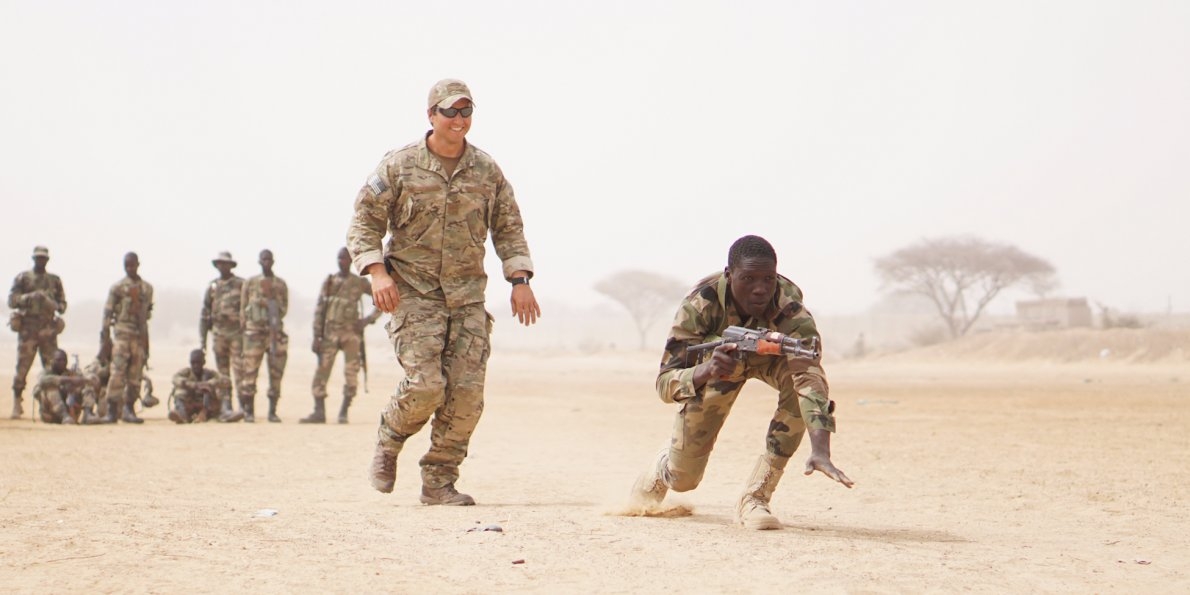
A U.S. Army Special Forces weapons sergeant observes a Nigerien soldier in a drill during Exercise Flintlock 2017 in Diffa, Niger, March 11, 2017. (U.S. Army photo by Spc. Zayid Ballesteros)

Two broad forces are shaking the Middle East and Africa: Sunni jihadist radicalism embodied by ISIS and al-Qaeda along with smaller groups; and Shiite supremacism controlled and financed by Iran. Iran's arms transfers to Africa are well documented, as is Iran's support for Sunni jihad, including incubating both al-Qaeda and ISIS. Separately and together, they threaten not only countries, but also the Red Sea and the Mediterranean Sea, the two prime waterways that allow countries, including Israel and Egypt, to pursue trade with Asia and Europe.
The mullahs in Iran are not Iranian or Persian nationalists, they are Shiite supremacists. When the Ayatollah Khomeini returned to Tehran in 1979 after fourteen years of exile, he condemned all nationalism as "sherk," which means associating other beings or things with God. He said what mattered was Islam, not Iran or any other country, according to the Iranian journalist Amir Taheri, Chairman of Gatestone Europe. Khomeini declared war on the United States, on Israel, and on the West. The declaration was real and has military as well as political implications, but it was also a way of deflecting attention from Iran's declaration of war on Sunni Islam.
It was a bold move, because although Shiites are the majority in Iran and Iraq (though not in Syria), they represent less than 15% of Muslims world-wide. Iran's primary targets are the Sunni governments of Saudi Arabia, which controls the holy sites in Mecca and Medina, and Egypt, the historic intellectual center of Sunni Islam.
The 2003 overthrow of the secular-but-Sunni president of Iraq, Saddam Hussein, allowed the majority Shiite Iraqi population to rule, but the precipitous American military withdrawal in 2012 allowed Iran to move steadily into areas of more influence. Iranian-sponsored Shiite militias are now inside the Iraqi national military pushing against the Kurds in the north. In Syria, Iranian-sponsored militias are pushing Sunnis north and out of the country on behalf of the Shiite/Alawite regime of Bashar al-Assad.
But while American focus has been on Iranian expansionism to the north and west of Iran -- a "Shiite crescent" over the tops of American allies Saudi Arabia, Jordan and Israel -- less attention has been paid to Iranian activity to the south of those countries, through the Red Sea and into Africa toward the Mediterranean.
Following naval harassment of U.S. ships in the Persian Gulf, Iran announced that it will "defend its interests" in the Red Sea, using its position as benefactor of the Houthis in Yemen as a starting point. If successful, this would allow Iran to threaten the Red Sea and the Bab-el-Mandeb Strait, the access point for Saudi Arabia, Israel, Jordan, and Egypt to the Gulf of Aden and then to the Indian Ocean and to Asia.
Iran ships weapons to and through Eritrea and Somalia on the Red Sea coast. This is important because U.S. Expeditionary Forces are based in Djibouti, which juts out into the sea. North of Djibouti and our forces is Eritrea; south of Djibouti and our forces is Somalia. Well-armed and unstable, they present a problem for the Americans.
Iran's interests are not limited to the countries along the coast.
The other waterway that concerns the United States, Israel and the West is the Mediterranean Sea. The countries along the north coast of the Mediterranean are European, all of which are in NATO. The countries facing them along the south shore of the Mediterranean, along the northern African coast, are Sunni Muslim, and, except Libya, partners in NATO's Mediterranean Dialogue. The arrangement helps keep the Mediterranean calm and free for shipping. The 2011 ouster of Libya's Moammar Qaddafi caused chaos in a previously stable -- if repressive -- country. Released weapons and fighters resulted in war in Mali, which had been an ally of the United States and France. Additional instability would make NATO's arrangements less effective and provide additional routes for African migrants seeking to reach Europe.
One way to make North Africa less stable is to make the row of countries just beneath it less stable. Chad, Mali, Somalia, Eritrea, Sudan, and yes, Niger, are all targets.
They are, to be sure, as much targets of Sunni jihad as they are of Iran, but Iran's massive infusion of funds supports Sunni Hamas, al-Qaeda, ISIS, Boko Haram and others. Iran's support for al-Qaeda goes back to the early 1990s. Instability, chaos, anti-Americanism, anti-Westernism, and anti-Christianism are what Iran seeks -- and they are what Sunni jihadists seek. In Iraq and Syria, ISIS did the destabilizing and Iran reaped the benefits.
General Kelly made a sober, passionate defense of American military honor and sacrifice. It is incumbent on the rest of us -- including journalists -- to understand where our troops serve and sacrifice, including why Niger.
Shoshana Bryen is Senior Director of the Jewish Policy Center.
© 2017 Gatestone Institute. All rights reserved. The articles printed here do not necessarily reflect the views of the Editors or of Gatestone Institute. No part of the Gatestone website or any of its contents may be reproduced, copied or modified, without the prior written consent of Gatestone Institute

Wednesday, August 23, 2017

China Expanding Its International Influence

China in the Red Sea: The Djibouti Naval Base and the Return of Admiral Zheng He

By August 23, 2017


BESA Center Perspectives Paper No. 567, August 23, 2017
EXECUTIVE SUMMARY: Last month, the Chinese established their first-ever military-naval base outside the Asia-Pacific region, in Djibouti. The establishment of the base is an expression of the “Maritime Silk Road” policy intended to exert Chinese presence in the Indian Ocean and into the Mediterranean. The establishment of the Djibouti base also reflects Beijing’s recent celebration of Zheng He, the 15th century admiral, whose voyages in the South China Sea and Indian Ocean have come to symbolize Chinese power and a Chinese-led global order. 
On July 11, ships carrying military personnel set sail from the Chinese naval base in Zhanjiang for the Horn of Africa. Their destination was Djibouti, where China has opened its first overseas naval base. According to the Chinese Xinhua news agency, the base is intended to “ensure China’s performance of missions, such as escorting, peace-keeping and humanitarian aid in Africa and west Asia. The base will also be conducive to overseas tasks including military cooperation, joint exercises, evacuating and protecting overseas Chinese and emergency rescue, as well as jointly maintaining security of international strategic seaways.” According to the agreement between Beijing and Djibouti, which is valid at least until 2026, the base may contain as many as 10,000 troops.
The establishment of the Djibouti base is an important steppingstone in China’s departure from its traditional focus on the East Asian-Pacific region and an expression of its expanding interests in Africa and the Middle East. It may also be seen as a culmination of Premier Xi Jinping’s “One Road-One Belt” strategy, which seeks to establish land and sea routes across Asia and the Indian Ocean. More specifically, it corresponds with China’s initiative to construct a “Maritime Silk Road” built around “a string of pearls”: a series of Chinese footholds around the Indian Ocean and into the Persian Gulf and Red Sea.
While the “One Road-One Belt” initiative is usually understood to be primarily economic in nature, the Djibouti base is clearly an act of Chinese power projection. The military nature of the base has been emphasized by the Global Times, a Chinese state-run newspaper. A recent editorial stressed the fact that the base “is not a commercial resupply point” but rather a military installation containing Chinese troops.
At the same time, the Chinese media have been careful to note that the establishment of the base does not imply a drive towards world hegemony, laying their emphasis instead on its potential role in protecting Chinese peacekeeping missions. News of the Djibouti base has nevertheless been the cause of some alarm in Washington as the base is located only a few miles from Camp Lemonnier, the largest American base in the region and the only permanent American base in Africa.
The establishment of the base follows several years of increasing Chinese involvement in Africa and the Middle East. Clearly, it is crucial for Beijing to protect its flow of resources. Half the oil imported by China goes through the Mandeb Strait, and most Chinese exports to Europe are transported through the Gulf of Aden and Suez Canal. Chinese funding is being used across the region to build infrastructure, such as a modern rail link between Nairobi and Mombasa.
In addition to Beijing’s economic aid and commercial involvement in Africa, the region is also home to thousands of Chinese workers. In 2013, China sent a warship and military transport aircraft to evacuate some 35,000 Chinese citizens from Libya following the overthrow of Muammar Qaddafi.  According to Taiwanese political analyst Lai Yueqian, the Libyan crisis was a major element leading to the decision to establish the Djibouti base.
The relatively swift overthrow of Qaddafi by the western powers (against China’s will) meant that Beijing was faced with the urgent task of evacuating its citizens as well as the loss of over $1 billion of investment. As a result, China began to increase its presence in the region. In 2015, the Chinese navy conducted exercises with its Russian counterpart in the Mediterranean. This year, while en route to another joint Russian-Chinese exercise in the Baltic, Beijing conducted a live fire drill in the Mediterranean.
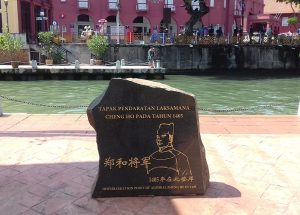
The Chinese vision of a new maritime Silk Road is closely related to the official celebration of Zheng He, the early 15th century admiral who brought China fame and power through his voyages in Southeast Asia and across the Indian Ocean to Africa. According to Christina Lin, the building of land and sea bridges across Eurasia and Africa contains a deeply symbolic element, referred to by Lin as the “Zheng He narrative.” Zheng He’s voyages are frequently noted as a symbol of a world order based on trade rather than violence and controlled by the benevolent hegemony of the Chinese Imperial court.
In Chinese publications of recent years, Zheng He’s fleets are glorified as a tool of regional economic growth, scientific research, peaceful cultural exchange, and universal friendship. It is worth noting that while Zheng He’s voyages collected treasures (such as the famous giraffe brought back for the Imperial Court from Africa), its main objective was to display Ming power and dominance  and to collect tribute from local rulers. Indeed, a number of rulers who refused to recognize the hegemony of the Chinese Emperor were punished and taken back to China as prisoners.
Zheng is particularly poignant as he is often perceived as both a testament to Chinese greatness and a symbol of China’s missed opportunities. The dismantling of his ships and shipyards by the Ming emperors is widely perceived as one of the causes of the gradual decline of Chinese power and the eventual rise of the West. The reference to Zheng He and the Silk Routes can therefore be seen as an implication that the mistake made 500 years ago is now being corrected, as the Middle Kingdom returns to its former centrality.
Thus, it would seem to be more than a coincidence that the recent embarkation of ships to Djibouti occurred on the same date that Admiral Zheng He first set sail on his famous voyages over 600 years ago. While the supremacy of Zheng He’s fleet may still be far off, the new base on the coast of Africa seems to mark a declaration of larger intentions.
Dr. Gideon Elazar is a lecturer at Bar-Ilan University and a postdoctoral fellow at Ben-Gurion University specializing in Asian Studies.

Sunday, February 7, 2016

US Being Outplayed In The Middle East--We Are Being Shut Out

  • The EU-Turkey agreement of 25 November, which provided Turkey with 3 billion euros over two years in order to stop the flow of refugees to Europe, has not achieved that goal. Speaking privately, EU officials complain that Turkey has not taken any concrete measures to reduce the flow of refugees. In our assessment, Turkey will continue to prevaricate on steps to stem the flow of refugees as pressure on the EU to give more concessions.
  • During the coming year there will certainly be further terrorist attacks that will push European public opinion further to the right.
  • We assess that Iran will continue in indirect channels with a parallel nuclear program, realized long before the 10-year target of the JCPOA.
  • The demand for unification of Kurdistan -- Iraqi and Syrian -- will also begin to be heard. It is highly likely that Russia will take advantage of the trend and support the Kurds, effectively turning an American ally into a Russian one.
The announcement by the IAEA that Iran has fulfilled its obligations according to the Joint Comprehensive Plan of Action (JCPOA) has triggered "Implementation Day" and the removal of the nuclear-related sanctions on Iran. The JCPOA, however, did not deal with Iran's ballistic missile program, and the sanctions related to it are still nominally in force. These sanctions are minor and will not have any real effect on the Iranian missile program. The missile program will mature during this period and will include Ghadr missiles with ranges of 1,650-1,950 km, which may be capable of carrying nuclear warheads.
The question now is: whither the Iranian nuclear program? After the lifting of sanctions, and taking into account the impracticality of "snap-back" of sanctions, we assess that Iran will now initiate a parallel nuclear program. This will, of course, be far slower than the program that was dismantled by the JCPOA, but it will be realized long before the 10-year target of the JCPOA. One possibility for Iran to continue its nuclear program is through North Korea. The wording of the JCPOA is ambiguous on nuclear Iranian nuclear cooperation with other countries that are not a party to the agreement. North Korea could produce the whole chain of nuclear weapons and put it at Iran's disposal in return for Iranian funding. North Korea would certainly profit economically from such collaboration and would not risk further sanctions. Such cooperation would be difficult to detect, and even if detected, may not reach the threshold of a material breach of the JCPOA.
The most immediate reward that Iran will receive is the release of frozen Iranian funds ($100-$150 billion). In addition, Iran may now market oil stored offshore in tankers (about 50 billion barrels) and is preparing to increase its production by 500 thousand bpd (from 2.8 million bpd). It is doubtful that Iran can truly increase its production as planned. Even if it does, the addition of Iranian oil is likely to drive prices down even further, counter-balancing much of the potential profit. Sanctions relief also is not a quick fix for the Iranian economy. While it removes legal impediments for investment and business in Iran, the risks that Western companies will face due to residual non-nuclear sanctions (that may be enhanced and enforced by a future American administration), lack of government protection, corruption, and the weakness of the Iranian market cannot be removed by decree. Therefore, European banks and investors may not hurry to invest in Iran at the levels needed to jump-start the Iranian economy after years of sanctions.
The Iranian regime's goal is not only to block the path to the reformists or reformist-minded, but also to the extremists on the right to Supreme Leader Ali Khamenei. Such a balance could help the Iranian system maintain its "centrist" orientation and guarantee the continuity in the event of Khamenei's death and the appointment of a new successor (or a triumvirate of several potential leaders). It will also facilitate the eventual takeover of the regime by the Islamic Revolutionary Guards Corps (IRGC) after the demise of Khamenei. The backing that the Guardian Council received from the Supreme Leader for the results of its vetting process, in the face of Rouhani's condemnation of the disapproval of almost all reformists, is also indicative of the balance of power in the regime.
The Iranian seizure of two US Navy patrol boats on January 12 and the publication of drone pictures of a US Navy aircraft carrier underlined the sense of immunity that Iran has achieved. These actions should be seen in the context of Iran's attempt to change the rules of the game in the Persian Gulf, while testing the waters of American tolerance and sending to Saudi Arabia and the Gulf States an indirect message that Iran is ready and willing to risk conflict with the US and that the US is a paper tiger that cannot be relied upon in a confrontation between the Gulf States and Iran. In our assessment, Iran will continue with shows of force such as seizing of naval vessels of Saudi Arabia and the Gulf States, stop and search operations of commercial vessels en route to the Gulf States, naval exercises -- including missile tests close to Gulf sea-lanes and to the territorial waters of the Gulf States -- in international waterways that implicitly interrupt and threaten shipping in the Gulf, "spooking" of Gulf aircraft and even false flag operations of mining, piracy or attacks by proxies in the Gulf and the Red Sea along the Yemeni coast. We may expect as a result possible frontier skirmishes on the shared littoral borders of Iran and Saudi Arabia, gas fields and disputed islands and in the international waters of the Gulf.

The Iranian seizure of two US Navy patrol boats on January 12 underlined the sense of immunity that Iran has achieved.

Saudi Arabia is drawing up its own map of interests and areas of influence that it is projecting as "no-go zones" for Iran -- a Saudi "Monroe Doctrine" for the region. The most critical of these are: Yemen (due to the potential for threatening the Bab al-Mandeb Straits), subversion in the Gulf States (primarily Bahrain), the Strait of Hormuz and the international waters of the Gulf. To this list one must add the obvious: any Iranian-inspired or -planned attack on the Saudi homeland itself -- government facilities, oil installations etc. -- would be perceived as crossing a red line. While neither Saudi Arabia nor Iran is interested in direct conflict, and both would prefer to continue to work through proxies and in areas outside their respective sovereign territories, the dynamic nature of the situation can easily lend itself to misreading of such red lines and such miscalculation may lead to direct confrontation between them. While all-out direct war between Iran and Saudi Arabia remains a low probability, this assessment should be revisited again in the near future.
In Syria, American positions have undergone a strategic shift that reflects the new balance of power created by the Russian intervention. On the military side, the Russian presence imposes a heavy constraint on the American activities, and U.S. officials caution that the success of the Ramadi operation will not be followed by a concerted effort to roll back the "Islamic State" in the Syrian theater. In regards to a political solution, the US has accepted the Russian-Iranian four-point-plan that envisages Bashar al-Assad remaining in office during a transition period and being allowed to run for President in "internationally supervised elections". In our assessment, the Syrian opposition and their Arab supporters cannot accept any blueprint that would leave any doubt regarding Bashar al-Assad relinquishing power before any process begins. These developments will only feed the sense of the Sunni Arabs that the United States has turned its back on them and is supporting Iranian-Russian hegemony in the region. On this background, the prospects that the Syrian "peace talks" in Geneva will achieve any progress towards resolution or even mitigation of the civil war are close to nil.
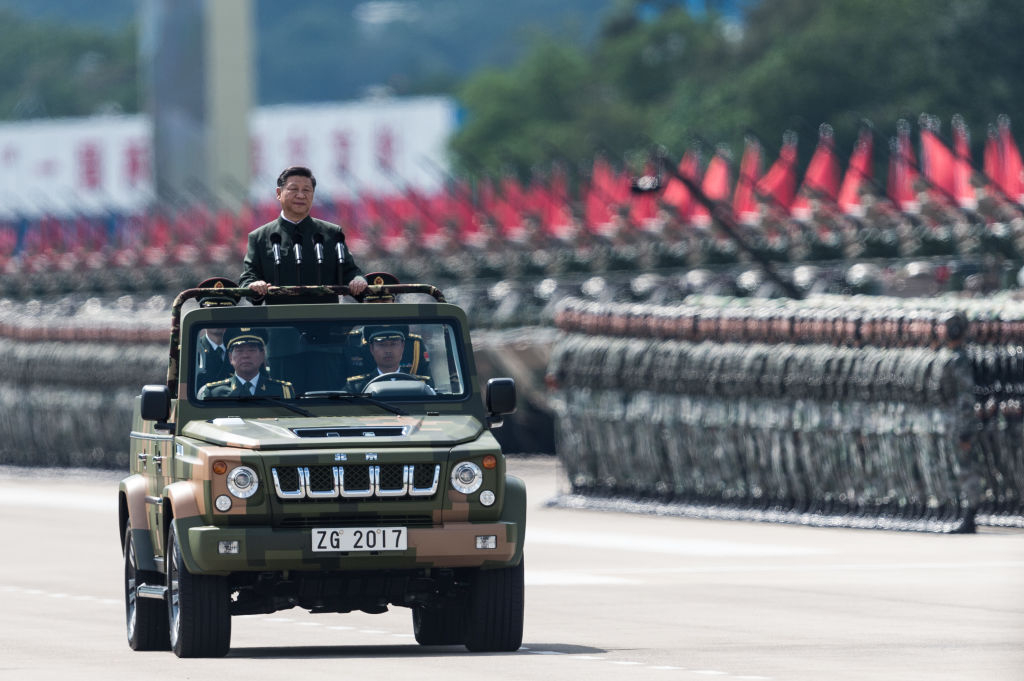
Last month's visit by Chinese President Xi Jin Ping to Saudi Arabia, Egypt and Iran was the first such visit of a Chinese President in the region since 2002, and the first foreign head of state to visit Iran since the announcement of "Implementation Day" of the JCPOA. The Chinese emphasis in all the visits was on economic cooperation, development and stability, but above all -- in an implicit stab at the US and Russia -- emphasizing that China does not seek proxies, to fill a power vacuum or hegemony in the region. The leitmotif of the visit was the integration of the Middle Eastern partners (i.e. the Arabs in general and Iran) into China's "Belt and Road Initiative." In spite of the inclusion of Iran in the visit, President Xi took care not to offend the Arabs. The agreements with Saudi Arabia included nuclear cooperation in a scope far greater than that which was offered to Iran, and the joint statement reflected the Saudi position on Yemen, stating, "both sides stressed support for the legitimate regime of Yemen."
The "Arab Policy Paper" published on the eve of the visit stresses China's commitment to "non-intervention and opposition to interference in the affairs of other countries". This is seen by the Arab policy communities as a sign of implicit Chinese support for their position vis-à-vis Iran's activities in the region, though they would have welcomed more explicit statements of support. There is no expectation in the region that China is going to play the "Big Power" card in the region. Taking sides in this conflict would be out of character for China. Saudi Arabia and the other Arab states will attempt to convince China to refrain from demonstrations of rapprochement with Iran and to support the Arab positions vis-à-vis Iranian provocations in the Gulf, Syria and Yemen. While China may show a slight implicit leaning towards the Arab position on these issues, it is not likely to take a clear anti-Iranian/pro-Arab position in the near future.
The European Union-Turkey agreement of 25 November, which provided Turkey with 3 billion euros over two years in order to stop the flow of refugees to Europe, has not achieved that goal. Speaking privately, EU officials complain that Turkey has not taken any concrete measures to reduce the flow of refugees. In our assessment, Turkey will continue to prevaricate on steps to stem the flow of refugees as pressure on the EU to give more concessions. Turkey has already signaled that the sum will not suffice for the task of maintaining the refugees inside Turkey alone, and certainly not for other security measures such as blocking the border with Turkey to prevent passage to and fro of "Islamic State" foreign fighters.
Aside from the 3 billion euros, the EU commitments will also not be easily implemented; visa waivers for Turkish citizens in general will encounter massive opposition within the EU. The road to Turkish accession to the EU must also go through complex negotiations on various aspects of compatibility of Turkey to the standards of the EU. All these discussions will encounter a veto by Cyprus, pending a peace deal with Turkish-occupied Northern Cyprus. This veto may be resolved if a referendum on unification of Cyprus takes place and supports re-unification later this year. However, the real obstacle towards Turkish accession is not technical or due to the Cyprus question; it revolves around the shift in European public opinion towards absorption of immigrants from Muslim countries. During the coming year, there will certainly be further terrorist attacks that will push European public opinion further to the right. Under these circumstances, Turkish accession or even visa waiver will be very unlikely.
In our assessment, the trend towards Kurdish independence will eventually lead to an independent Iraqi Kurdistan. The events in Syrian Kurdistan will also affect the pace and direction of the independence movement in Iraq's Kurdistan Regional Government (KRG). Unification of the parts of Syrian Kurdistan in the face of Turkish opposition and under Russian protection will give impetus to the demand to create a political fait accompli of independence in Iraqi Kurdistan. As the principle of Kurdish independence in Iraq gains more and more support and becomes a reality, the irredentist demand for unification of Kurdistan -- Iraqi and Syrian -- will also begin to be heard. This is the fulfillment of the Kurdish nightmare that Turkey has always feared. With the deterioration of relations between the AKP government and the Turkish Kurds inside Turkey, such a political reality of independent Kurdistan will add fire to the flames of the Kurdish rebellion in southern Turkey. It is highly likely that Russia will take advantage of the trend and support the Kurds, effectively turning an American ally into a Russian one. If this happens, the US will have lost an important potential ally in the new map of the Middle East.
The large number of players on the ground that may take a part in the campaign for Mosul will only complicate the campaign further and -- if the city or part of it is retaken, will increase the chances of internal fighting between the components of the ad-hoc alliance of Iraqi government forces, Shiite militias, Sunni militias, Kurdish Peshmarga, Turks and American forces.
On this background, the Syrian "Peace Talks" in Geneva started (29 January) as "proximity talks" in which the UN representatives shuttle between the rooms of the opposing parties. The Saudi supported High Negotiations Committee (HNC) of the Syrian opposition ceded their original conditions -- cessation of the attacks on civilians -- though they refuse to meet with the regime representatives while the latter refuse to meet with "terrorists". The Syrian regime representation is low-level as an indication that there is no intention to hold real negotiations. Furthermore, the Kurdish Democratic Union Party (PYD), whose military wing, the YPG, is the most effective fighting force on the ground against the "Islamic State," were not included in the opposition delegation because of the Turkish threat to boycott the Geneva negotiations if it participates. Under these conditions, the prospects that the talks will achieve any progress towards resolution or even mitigation of the civil war are close to nil.
Dr. Shmuel Bar is a senior research fellow at the Samuel Neaman Institute for National Policy studies at the Technion in Haifa, Israel, and a veteran of Israel's intelligence community.
© 2016 Gatestone Institute. All rights reserved. No part of the Gatestone website or any of its contents may be reproduced, copied or modified, without the prior written consent of Gatestone Institute.

Thursday, September 17, 2015

Fences Becoming A Tool To Prevent Danger In Israel. They Work!


From: jpost.com, Udi Segal

Analysis: Fear of ISIS takeover of Jordan drives Israel to build eastern border fence


Prime Minister Benjamin Netanyahu overlooks site of work on eastern security fence.
(photo credit: Chaim Tzach/GPO)
In a white tent set up not far from the border with Jordan – very similar to the tent that hosted the ceremony for the signing of the peace treaty with Jordan 21 years ago in Ein Evrona, the small Arava town just a few kilometers north of Eilat – a number of army officers, environmental experts, and intelligence officials gathered for a meeting that included a surprise stop by Prime Minister Benjamin Netanyahu, Defense Minister Moshe Ya’alon, and Transportation Minister Yisrael Katz.
Twenty-one years after the signing of the Israeli-Jordanian peace treaty, the border between the two countries has proven to be the quietest, albeit the least maintained from a financial standpoint, of any of Israel’s frontiers.  Nonetheless, the prime minister was given the latest intelligence data that surveyed possible future threats.
In years past, Hamas operatives from Gaza sought to enter the Sinai Peninsula, from where they would seek to infiltrate Israel in order to carry out attacks. That route was closely watched by Israeli intelligence experts until the completion of the fence along the Egyptian border. The barrier has almost completely sealed Israel off from drug smugglers, African refugees and economic migrants, women traffickers, and, of course, terrorists.
Nowadays, the fence has proven to be a necessity given the fact that some violent Beduin tribes from Sinai have joined Islamic State. It allows Israel to better prepare in dealing with a hostile Islamist element currently fighting the Egyptian authorities in an area that is supposed to be demilitarized as per the terms of the Israeli-Egyptian peace treaty. These elements can just as easily try to do harm to Israel as part of its campaign against President Abdel Fattah el-Sisi, either in an attempt to undermine the cold peace with Israel or simply out of an Islamist ideology that loathes Jews.
Now that the Gaza-Sinai-Israel path has been blocked off, the terrorists will seek an alternate route. It begins in Gaza, continues into Sinai, and, from there, heads further east into Jordan. Then the route takes a northward turn along the rusty, barbed-wire fence that runs along the frontier with Israel.
Initially, it will be criminals seeking to smuggle in drugs, contraband, and women. Intelligence officials are now warning that terrorists are soon to follow.
This is exactly what Netanyahu wanted to hear – a reason justifying his decision to build a fence. The first section of the fence will stretch from the Red Sea resort town of Eilat to Timna. Initially, the pretext for the fence was to build a barrier that would defend the airport that is expected to be built there. Overall, however, this is the Netanyahu Doctrine – build a high fence to keep the bad neighbors out, or neighbors that could turn bad later on.
Israel is entering a sensitive, problematic situation diplomacy-wise. Everyone knows the real reason behind the building of this fence – the very real fear that Jordan will collapse. This scenario is not far-fetched. In fact, it is Israel’s nightmare.
The Jordanians have protected the border effectively and admirably since 1994. It has proven its worth both from an intelligence standpoint as well as its security capabilities, with no infiltrations by armed terrorists. But given the wave of Islamism in the region, it’s doubtful Jordan can survive as presently constituted. It’s a subject that’s completely taboo, certainly among senior defense and government officials, but it’s the bitter truth (at least, potentially).
Amos Gilad, the head of the Defense Ministry’s diplomatic-security branch, spoke of the regional turbulence during a lecture on counterterrorism at a conference hosted by the Interdisciplinary Center in Herzliya. He speculated that the brutality and unscrupulousness of ISIS would drag the United States and the West into a bitter war.
He argued that if ISIS – which is currently operating in Iraq and Syria – were to be forced out of its current positions by the rebels or troops loyal to Bashar Assad, its next move would most likely be to head south toward Jordan. Gilad noted that Jordan currently shares a border with ISIS from the east and al-Qaida from the north. Al-Qaida has taken control of swathes of the Golan Heights, so Israel is also mired in this mess.
Qasem Soleimani, the head of the Iranian Revolutionary Guards’ “Quds Force,” has spoken recently of opening up an eastern front against Israel from within Jordan. It was also learned recently that the Hashemite kingdom apprehended a number of individuals suspected to have ties with Hezbollah. Add it all up and what we have brewing is a Sunni-Shi’ite showdown right in our own backyard.
On the Israeli Right, there are those who murmur that Jordan is Palestine, but it would be more accurate to say that Jordan may soon become ISIS-stan. That’s why Israel not only needs a fence, but it also needs a quiet, discreet diplomatic initiative that will help King Abdullah gain some much-needed domestic stability.
As has usually been the case, when it comes to defense and security matters, Israel is efficient, active, and productive. But on the diplomatic level, it has failed whenever it has needed to step up to the plate and strengthen the moderate Arab camp.
The fence needs to be complemented by a diplomatic element. There needs to be something positive, something that signals good-neighborliness and partnership, not just fear and isolation. That’s because a fence pegs Jordan as a potential threat, and this message needs to be softened and camouflaged. A joint water pipeline, which was announced earlier this year, is a step in the right direction, but more needs to be done. Much more.
If Netanyahu’s plans are to be fully realized, then Israel will have to deal with another potential landmine – a fence that will run from the Dead Sea northward until the tripartite border with Jordan and Syria. Not only would this be a fence, but it would also be a clear political and diplomatic statement – Israel is demarcating its eastern border. Period.
Such a move would serve as a pretext for a diplomatic crisis that could perhaps trigger a military confrontation. Israel would then need the support of the United States, or, at least its tacit approval. For that, it needs direct channels of communication, mutual understanding, and a respect for one’s sensibilities. These are elements that are lacking in the relationship between Netanyahu and US President Barack Obama.
The occupant of 1600 Pennsylvania Avenue sees Netanyahu – to some extent, justifiably so – as a prophet of doom, an eternal pessimist cowed by fear who has no idea how to generate hope. Netanyahu, for his part, says that everything that has taken place in the region is proof that caution and circumspection come true in the Middle East. He sees Obama as a naive liberal who is afraid of conflict while giving the most dangerous Islamic power in the region an opening to threaten Israel. The statements made this week by Supreme Leader Ali Khamenei of Iran served as further confirmation of Netanyahu’s fears.
One of the disadvantages of this “man the barricades” approach is that while Israel is so preoccupied with the Islamist tsunami from beyond its borders, it is not mindful enough of what is taking place right under its nose. Even though his threat to resign sounds ridiculous, Mahmoud Abbas has one foot out the door. If he does quit, he would set a remarkable precedent – never has an Arab leader quit. Never. They either die while in office, or are killed or toppled.
On the one hand, Israel is complacent. Operation Protective Edge, the quiet summer along the southern front, the sense that its deterrent policy is working for the time being, and the well-founded sense that there is a sense of fatigue among those thinking of armed conflict against Israel – all of these factors combine to create a feeling of immunity.
But there’s something bubbling underneath the surface. Now its manifestations are limited to instances of firebombings and stone-throwing. I predict that the tensions that are festering due to the real, justified fear that the situation is stuck and there is no light at the end of the tunnel, combined with the economic distress and the wind of Islamist revolution sweeping through the region – which most Israelis are unaware of – will lead to another complex, perhaps even violent, dilemma.
This is where we need not just a fence, but a clear delineation of what it is that Israel wants and where it wishes to go in this delicate period that is liable to become explosive and bloody.
The writer is Channel 2's top political analyst.