Contact Form

Name

Email *

Message *

Showing posts with label Quds Force. Show all posts

Thursday, September 17, 2015

Fences Becoming A Tool To Prevent Danger In Israel. They Work!


From: jpost.com, Udi Segal

Analysis: Fear of ISIS takeover of Jordan drives Israel to build eastern border fence


Prime Minister Benjamin Netanyahu overlooks site of work on eastern security fence.
(photo credit: Chaim Tzach/GPO)
In a white tent set up not far from the border with Jordan – very similar to the tent that hosted the ceremony for the signing of the peace treaty with Jordan 21 years ago in Ein Evrona, the small Arava town just a few kilometers north of Eilat – a number of army officers, environmental experts, and intelligence officials gathered for a meeting that included a surprise stop by Prime Minister Benjamin Netanyahu, Defense Minister Moshe Ya’alon, and Transportation Minister Yisrael Katz.
Twenty-one years after the signing of the Israeli-Jordanian peace treaty, the border between the two countries has proven to be the quietest, albeit the least maintained from a financial standpoint, of any of Israel’s frontiers.  Nonetheless, the prime minister was given the latest intelligence data that surveyed possible future threats.
In years past, Hamas operatives from Gaza sought to enter the Sinai Peninsula, from where they would seek to infiltrate Israel in order to carry out attacks. That route was closely watched by Israeli intelligence experts until the completion of the fence along the Egyptian border. The barrier has almost completely sealed Israel off from drug smugglers, African refugees and economic migrants, women traffickers, and, of course, terrorists.
Nowadays, the fence has proven to be a necessity given the fact that some violent Beduin tribes from Sinai have joined Islamic State. It allows Israel to better prepare in dealing with a hostile Islamist element currently fighting the Egyptian authorities in an area that is supposed to be demilitarized as per the terms of the Israeli-Egyptian peace treaty. These elements can just as easily try to do harm to Israel as part of its campaign against President Abdel Fattah el-Sisi, either in an attempt to undermine the cold peace with Israel or simply out of an Islamist ideology that loathes Jews.
Now that the Gaza-Sinai-Israel path has been blocked off, the terrorists will seek an alternate route. It begins in Gaza, continues into Sinai, and, from there, heads further east into Jordan. Then the route takes a northward turn along the rusty, barbed-wire fence that runs along the frontier with Israel.
Initially, it will be criminals seeking to smuggle in drugs, contraband, and women. Intelligence officials are now warning that terrorists are soon to follow.
This is exactly what Netanyahu wanted to hear – a reason justifying his decision to build a fence. The first section of the fence will stretch from the Red Sea resort town of Eilat to Timna. Initially, the pretext for the fence was to build a barrier that would defend the airport that is expected to be built there. Overall, however, this is the Netanyahu Doctrine – build a high fence to keep the bad neighbors out, or neighbors that could turn bad later on.
Israel is entering a sensitive, problematic situation diplomacy-wise. Everyone knows the real reason behind the building of this fence – the very real fear that Jordan will collapse. This scenario is not far-fetched. In fact, it is Israel’s nightmare.
The Jordanians have protected the border effectively and admirably since 1994. It has proven its worth both from an intelligence standpoint as well as its security capabilities, with no infiltrations by armed terrorists. But given the wave of Islamism in the region, it’s doubtful Jordan can survive as presently constituted. It’s a subject that’s completely taboo, certainly among senior defense and government officials, but it’s the bitter truth (at least, potentially).
Amos Gilad, the head of the Defense Ministry’s diplomatic-security branch, spoke of the regional turbulence during a lecture on counterterrorism at a conference hosted by the Interdisciplinary Center in Herzliya. He speculated that the brutality and unscrupulousness of ISIS would drag the United States and the West into a bitter war.
He argued that if ISIS – which is currently operating in Iraq and Syria – were to be forced out of its current positions by the rebels or troops loyal to Bashar Assad, its next move would most likely be to head south toward Jordan. Gilad noted that Jordan currently shares a border with ISIS from the east and al-Qaida from the north. Al-Qaida has taken control of swathes of the Golan Heights, so Israel is also mired in this mess.
Qasem Soleimani, the head of the Iranian Revolutionary Guards’ “Quds Force,” has spoken recently of opening up an eastern front against Israel from within Jordan. It was also learned recently that the Hashemite kingdom apprehended a number of individuals suspected to have ties with Hezbollah. Add it all up and what we have brewing is a Sunni-Shi’ite showdown right in our own backyard.
On the Israeli Right, there are those who murmur that Jordan is Palestine, but it would be more accurate to say that Jordan may soon become ISIS-stan. That’s why Israel not only needs a fence, but it also needs a quiet, discreet diplomatic initiative that will help King Abdullah gain some much-needed domestic stability.
As has usually been the case, when it comes to defense and security matters, Israel is efficient, active, and productive. But on the diplomatic level, it has failed whenever it has needed to step up to the plate and strengthen the moderate Arab camp.
The fence needs to be complemented by a diplomatic element. There needs to be something positive, something that signals good-neighborliness and partnership, not just fear and isolation. That’s because a fence pegs Jordan as a potential threat, and this message needs to be softened and camouflaged. A joint water pipeline, which was announced earlier this year, is a step in the right direction, but more needs to be done. Much more.
If Netanyahu’s plans are to be fully realized, then Israel will have to deal with another potential landmine – a fence that will run from the Dead Sea northward until the tripartite border with Jordan and Syria. Not only would this be a fence, but it would also be a clear political and diplomatic statement – Israel is demarcating its eastern border. Period.
Such a move would serve as a pretext for a diplomatic crisis that could perhaps trigger a military confrontation. Israel would then need the support of the United States, or, at least its tacit approval. For that, it needs direct channels of communication, mutual understanding, and a respect for one’s sensibilities. These are elements that are lacking in the relationship between Netanyahu and US President Barack Obama.
The occupant of 1600 Pennsylvania Avenue sees Netanyahu – to some extent, justifiably so – as a prophet of doom, an eternal pessimist cowed by fear who has no idea how to generate hope. Netanyahu, for his part, says that everything that has taken place in the region is proof that caution and circumspection come true in the Middle East. He sees Obama as a naive liberal who is afraid of conflict while giving the most dangerous Islamic power in the region an opening to threaten Israel. The statements made this week by Supreme Leader Ali Khamenei of Iran served as further confirmation of Netanyahu’s fears.
One of the disadvantages of this “man the barricades” approach is that while Israel is so preoccupied with the Islamist tsunami from beyond its borders, it is not mindful enough of what is taking place right under its nose. Even though his threat to resign sounds ridiculous, Mahmoud Abbas has one foot out the door. If he does quit, he would set a remarkable precedent – never has an Arab leader quit. Never. They either die while in office, or are killed or toppled.
On the one hand, Israel is complacent. Operation Protective Edge, the quiet summer along the southern front, the sense that its deterrent policy is working for the time being, and the well-founded sense that there is a sense of fatigue among those thinking of armed conflict against Israel – all of these factors combine to create a feeling of immunity.
But there’s something bubbling underneath the surface. Now its manifestations are limited to instances of firebombings and stone-throwing. I predict that the tensions that are festering due to the real, justified fear that the situation is stuck and there is no light at the end of the tunnel, combined with the economic distress and the wind of Islamist revolution sweeping through the region – which most Israelis are unaware of – will lead to another complex, perhaps even violent, dilemma.
This is where we need not just a fence, but a clear delineation of what it is that Israel wants and where it wishes to go in this delicate period that is liable to become explosive and bloody.
The writer is Channel 2's top political analyst.

Saturday, April 11, 2015

If General Keane Is Correct, Obama Has Been Playing The World For Chumps. Why Would He Be Doing This Unless He Wants The Western World Defeated?

Tougher Sanctions Necessary to Force Iran to Change Its Terrorist Ways

Friday, 10 Apr 2015 07:19 PM


If recent news accounts are to be believed, the framework of agreement between the U.S. and Iran is on the rocks.

Iran’s top officials, Supreme Leader Ali Khamenei and President Hassan Rouhani, are saying economic sanctions must end immediately and that UN inspectors will not be granted unfettered access to military installations and nuclear construction sites.

But this may be nothing more than Iranian domestic political spin. And as long as there’s a potential deal, a critical point needs to be made: There is no provision for, or even discussion of, putting political restraints on Iran. That is, there is nothing in this deal that would force Iran to change its terrorist ways. Iran will continue to be the number-one state sponsor of terrorism in the Middle East, no matter what the deal.

How can this be?

Writing in the Wall Street Journal, Henry Kissinger and George P. Shultz make a crucial point: “Absent the linkage between nuclear and political restraint, America’s traditional allies will conclude that the U.S. has traded temporary nuclear cooperation for acquiescence to Iranian hegemony.” (Italics mine.)

Put another way, there could be a U.S.-Iran deal that postpones Iran’s nuclear weaponization for ten or more years.
Latest News Update

But tomorrow, and the day after, and the day after that, Iran will continue to sponsor its terrorist proxies, like Hamas in Gaza and Hezbollah in Lebanon, keep proxy troops in Syria, continue its efforts to take over Iraq, further its designs on Yemen, and confront Sunni Saudi Arabia.

And don’t forget, the U.S. has labeled Iran’s own Quds Force and Revolutionary Guard as terrorists.

Kissinger and Shultz write, “Iranian or Iranian client forces are now the pre-eminent military or political element in multiple Arab countries . . . With the recent addition of Yemen as a battlefield, Tehran occupies positions along all of the Middle East’s strategic waterways and encircles archrival Saudi Arabia, an American ally.”

No one doubts these facts. Iran wants to dominate the Middle East. And it will not acknowledge the rights of the sovereign state of Israel. So the question is: Why is the U.S. not including political- and terrorist-restraint clauses in any Iran deal?

This is why economic sanctions are crucial. Western-nation sanctions are slowly but surely smashing the Iranian economy. We have effectively stopped the flow of money and oil for Iran. The Iranian budget, which dominates the state-run economy, needs $130 a barrel. Today’s $50 price is an economic killer.

So why doesn’t Team Obama directly link a removal of economic sanctions with a clear pullback of Iran’s terrorist activities and march to Middle East dominance? That’s a dailylinkage — one that is observable. And since we know Iran won’t agree to this, why aren’t President Obama and Secretary of State John Kerry working to tighten sanctions on Iran rather than push through a bad nuke deal?

Make no mistake, the nanosecond sanctions are lifted U.S. and Western investment will pour into Iran. Looser financial sanctions will put an estimated $50 billion into Iran’s economy. And a number of European oil companies will jump to develop the world’s fourth-largest proven oil reserve and second-biggest national-gas reserve.

Italy’s Eni, Royal Dutch Shell, France’s Total, Norway’s Statoil, German’s Siemens, and French car companies Peugeot and Citroën are ready to move. It’s reported that Boeing is looking to do business in Iran. HP and Google have been exploring contracts and licenses in Iran. Other major U.S. and European Internet companies have been approached by Iranian officials. And financial-service and credit card companies will move in quickly.

And if American officials really believe treaty violations can be countered by a “snap-back,” they’d better think again. These complex sanctions, which took so long to put together, will never be effectively revived.

General Jack Keane believes President Obama has had a grand-bargain vision for Iran since 2009. The nuclear deal is just one part of it. That’s why Obama gave no help to the million Iranian reformers who marched in protest of the phony 2009 elections. That’s why Obama didn’t help the Syrian rebels, why he’s had such a cold relationship with Israel, why he gave speeches blaming America for Arab unrest, and why until very recently he didn’t give any help to Egyptian president al-Sisi.

Obama believes in détente with Iran as a pathway to U.S. disengagement from the region. But Iran is our enemy, whether the president believes it or not. And if we cut deals that allow Iran to continue its terrorist and hegemonic activities, the Obama administration will have created an unbelievable Middle East powder keg, setting the stage for a conflict that could possibly dwarf any we’ve seen before.

This is the worst U.S. foreign policy of my lifetime. It may be the worst in America history.

To find out more about Lawrence Kudlow and read features by other Creators Syndicate writers and cartoonists, visit the Creators Syndicate web page at www.creators.com.

© Creators Syndicate Inc.


Monday, March 2, 2015

Iran, If Allowed To Become Nuclear, Will Pose A Danger, Not Only To The Middle East, But To Europe And Potentially, The US.

The essential problem with the would-be deal is that it will leave Iran with an enhanced ability to enrich uranium -- an ability that can lead Iran to nuclear weapons production in a relatively short time.
The purpose of an agreement is to push Iran away from the ability to make nuclear weapons.
According to reports surfacing from the talks, the proposed arrangement will likely leave a good portion of Iran's known centrifuges, which enrich uranium, intact.
Such a deal fails to provide any guarantee that this same infrastructure will not later be used to get Iran quickly to the nuclear weapons production stage.
An agreement that would be acceptable to Israel is one in which Jerusalem would have sufficient time to respond in case Iran violates its agreement.
Under the terms of what seems to be the current agreement, however, the amount of time needed might not be adequate -- meaning that Israel may not be able to consider itself bound by the agreement.
Israel does not oppose the idea of an agreement, but it opposes the particular one apparently being advanced in the diplomatic talks.
Meanwhile, Iran continues to develop its arsenal of ballistic missiles, which could carry these nuclear warheads.
Iranian officials boast of controlling four Arab capitals.
The emerging Iran nuclear deal spells trouble.
For the past several months, Israeli security officials have privately been expressing concern over the emerging deal between the Obama Administration and the Iranian regime over Tehran's nuclear program.
Defense officials familiar with the complex threat posed by Iran's nuclear ambitions have sought to stay clear of political statements, instead offering straightforward explanations as to why the deal, as it appears to be forming, will pose an extremely serious problem for the security of Israel and other Middle Eastern states in the path of Iran's seemingly hegemonic aspirations.
Leaving aside the many technical details that are part of the wider picture of Iran's nuclear activities, the essential problem with the would-be deal is that it will leave Iran with an enhanced ability to enrich uranium -- an ability that can lead Iran to nuclear weapons production in a relatively short time.
The purpose of an agreement is to push Iran away from the ability to make nuclear weapons. Israel does not oppose the idea of an agreement, but it opposes the particular formula apparently being advanced in diplomatic talks.
The strength or weakness of any agreement rests on how long it would give the U.S. or Israel to respond in case Iran violates the agreement. An agreement that would be acceptable to Israel is one in which Jerusalem would have sufficient time to respond in case Iran violates it.
Under the terms of what seems to be the current proposal, however, the amount of time needed might not be adequate -- meaning that Israel may not be able to consider itself bound by the agreement.
According to reports surfacing from the talks, the proposed arrangement will likely leave a good portion of the Islamic Republic's large number of known centrifuges, which enrich uranium, intact.
For Israel, this negative development has all the potential to turn a critical strategic security threat into an existential one. Such a deal gives Iran's nuclear infrastructure an international license and seal of approval, but fails to provide any guarantee that this same infrastructure will not later be used to get Iran quickly to the nuclear weapons production stage.
It seems clear at this stage that both Tehran and Washington want an agreement; Iran wishes to lift crippling economic sanctions that helped force it to the negotiations table, and President Barack Obama seems keen on leaving behind a legacy of international diplomacy as a mechanism to solve conflicts.
The idea that Iran is about to abandon its vision of having nuclear weapons, or that it sees an agreement with poor terms as anything other than a temporary halt of the march to the nuclear bomb, is just not realistic.
Iran's Supreme Leader Ayatollah Khamenei remains committed to the idea of an Iranian-Shi'ite empire that dominates the region. Iran and its network of highly armed proxies -- active in Iraq, Yemen, Lebanon, Syria, and engaged in active subversion in many other countries -- already have contributed enormously to the Middle East's dangerous instability and fueled its escalating conflicts. Iran seems to hope that it will one day be able to use these proxies to promote its expansionist regional agenda under a nuclear umbrella.
At the same time, Khamenei appears to recognize the many constraints that Iran faces today, which stand between it and a nuclear capability. These constraints include (according to international media reports) a string of covert operations that have hampered Iran's nuclear progress, international economic sanctions, and the credible Israeli threat of military force at this time. As a result, Iran today has apparently stopped short of moving to the nuclear weapons production stage.
What has not stopped is Iran's large-scale uranium enrichment program. Centrifuges continue to spin, and the number of centrifuges continues to multiply. Research and development on newer, more effective centrifuges continues apace. Iran's ability to enrich uranium is growing at a troubling pace. Its Arak facility, which can be used to create plutonium as an alternative path to nuclear weapons, is also active.

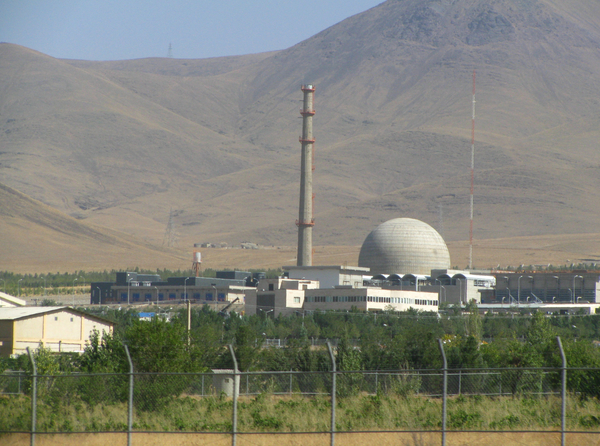
The Arak heavy water reactor, in Iran, is capable of producing plutonium. (Image source: Wikimedia Commons)

Iran now must decide whether or not to slow down its nuclear program in exchange for a respite from sanctions. If the reports on the generous terms being offered to it by the Obama Administration are true, it will be difficult for Iran to avoid the enticement of a deal that leaves it in possession of the components needed to break through rapidly to nuclear weapons production, at a future time of its choosing.
Meanwhile, Iran continues to develop its arsenal of ballistic missiles, which could carry these nuclear warheads. It already possesses some 400 ballistic missiles that can reach Israel, and it is working on building longer-range solid fuel missiles that have a range of between 2000 to 2500 kilometers.
In addition to these, Iran is expanding its regional proxy network. Hezbollah, in southern Lebanon, is the world's most highly armed terror entity, with an arsenal of over 100,000 rockets and missiles pointed at Israel. Many of these, including a growing number of guided missiles, are being produced at Hezbollah's request by Iran's weapons industries, and smuggled into Lebanon via an international weapons network controlled by the Quds Force of Iran's Islamic Revolutionary Guards Corps.
Hezbollah, with Iran's help, has recently been expanding from southern Lebanon into southern Syria, seeking to set up a second base there to threaten Israel.
Iran has tightened its control over the regime of Syrian President Bashar Assad in Damascus; Assad has become completely dependent on Iran for his survival.
Iran's domination of the Shi'ite Iraqi regime has also grown dramatically in recent months, as Baghdad's dependence on Iran to save it from the (Sunni) Islamic State has risen.
Iran now controls the Yemenite capital of Sana'a, after Iranian-backed Houthi rebels conquered the city. The Houthis can now threaten the Bab-El-Mandeb Strait, a key strategic waterway through which passes four percent of the world's oil.
Iranian officials boast of controlling four Arab capitals: Beirut, Damascus, Baghdad and Sana'a.
These developments and the emerging nuclear deal do not have just Israel concerned. Egypt, Saudi Arabia, and the small Gulf states are equally, if not more, alarmed.
Meanwhile in Gaza, Hamas, which is recovering from the war it began last summer against Israel, is once again moving closer into the Iranian orbit. Palestinian Islamic Jihad in Gaza has always remained a firm Iranian puppet.
Khamenei has openly declared his intention to arm Palestinian terror groups in the West Bank.
These developments mean that a "bad" nuclear deal -- one that would allow Iran to retain a substantial uranium enrichment infrastructure -- would not only legitimize Iran's status as a threshold nuclear state, but also boost what seems to be the Islamic Republic's relentless drive to spread its influence throughout the Middle East and beyond.

Monday, June 16, 2014

Like Sarah Palin Said Let Them Fight And Let G-d Decide. We Should NOT Get Involved In Iraq, Period. We Tried, We Failed, Now Let Nature Take Over.

Second Front Opens in the Sunni-Shia War

They should be left to bleed one another white.‬
by
JONATHAN SPYER
June 15, 2014 - 4:16 pm
The Islamic State in Iraq and the Levant (ISIL) organization swept into the city of Mosul in western Iraq last week.  No one has any right to be surprised. ‬
ISIL has held a large swath of western Iraq since January – including the city of Fallujah.  The organization was clearly planning a larger scale offensive action into Iraq. ‬
In January it had carried out a strategic withdrawal from large swaths of Idleb and Aleppo provinces in Syria. This was intended to consolidate its lines in northern Syria, so as to move fighters out toward Iraq.  ISIL controls a contiguous bloc of territory stretching from western Iraq up through eastern and northern Syria to the Turkish border. ‬
Its “Islamic State” is already an existing, if precarious fact, no longer a mere aspiration.  So, like a state at war, it moves its forces to the front where they are most needed‬.
The rapid collapse of Nouri al-Maliki’s garrison in Mosul in the face of the ISIL assault should also come as no surprise.  These forces are hollow. ‬
Saddam Hussein maintained a huge army by coercion. Shirkers and deserters could expect to be executed. But Maliki’s army consists of poorly paid conscripts and often corrupt officers.  The Shia among them in Mosul saw no reason to fight and die for what seemed to them to be Sunni, alien territory.  Sunni officers among the garrison, meanwhile, may well have been working with ISIL itself or with one of the other Sunni Islamist or nationalist formations fighting alongside them. ‬
So what will happen now?  The pattern of developing events is already clear, and much may be learned from the experience of Syria. ‬
Bashar Assad, when rebellion broke out against him in March 2011, sought to use his huge conscript army to crush it.  But the Syrian dictator rapidly found out that his supposedly 295,000-strong army was largely a fiction.  Sunni conscripts refused to engage against the rebels, and Bashar was able to make use only of certain units composed largely of members of his own Alawi sect — units such as the Republican Guard and the 4th Armored Division. ‬
How did Assad address this problem? The answer is that he didn’t — Iran did. ‬
Realizing that their Syrian ally was facing defeat because of an absence of reliable manpower, the Quds Force of the Iranian Revolutionary Guards Corps stepped in to effectively create a new, sectarian military for the Assads.  In addition, Iran introduced its various regional paramilitary proxies into the Syrian battlefield. ‬
By mid-2013, the new, sectarian infantry force trained by the Quds Force and Hizballah – named the National Defense Force – was beginning to be deployed against the Syrian rebellion.  In addition, Hizballah, and Iraqi Shia volunteers of Sadrist and other loyalties began to fill the gaps in manpower for Assad. ‬
These units turned the tide of the Syrian war.  But they have brought Assad survival, not victory.  The dictator rules over only about 40% of the territory of what was once Syria.  The rest is under the control of ISIL, the Kurds, and the Sunni Arab rebels. ‬
It is likely that a similar pattern will now emerge in Iraq.  Quds Force commander Qassem Suleimani has been in Baghdad since Friday.  He is in the process of organizing Iraqi Shia volunteers, who in the months to come are likely to be transformed into a sectarian military force resembling the Syrian National Defense Force. ‬
In addition to the new volunteers, Iraqi Shia militiamen in Shia southern Iraq and in Syria are flocking toward the battlefront, eager to do battle with ISIL on their home soil. ‬
These hastily assembled forces, along with the reliable elements of Maliki’s military, are likely to prove sufficient to defend the capital and perhaps to prevent further gains by ISIL, which may have over-reached itself.  But the new, openly sectarian Shia forces behind Maliki are unlikely to succeed in re-taking the entirety of ISIL’s territorial gains in Anbar and Ninewah provinces. ‬
Iran is a leading world expert in the creation of proxy sectarian military forces.  But given the demographic balance in present day Iraq, and in Syria, Iran’s assistance is likely to ensure the survival of the non-Sunni population only in a part of the country in question.  That is – ISIL and Iran’s intervention into Iraq may well portend the de facto partition of that country, and its plunging into a prolonged conflict, along the lines of what is currently taking place in Syria. ‬
Indeed, given the players engaging in Iraq, it is more sensible to see the Syrian civil war and the renewed Iraq conflict as different battlefronts in a single, sectarian war — in which Sunni and Shia/Alawi forces are clashing.  The latter are backed crucially by Iran. The former receive far less systematic and determined backing from a variety of sources, including private elements in the Gulf and perhaps the intelligence services of a number of Gulf states.
Only in Lebanon, which lacks a native Sunni military tradition, have the Iranian proxy forces managed to secure near complete military domination of the country.  In the very different and far more consequential contexts of Iraq and Syria, Sunni rebellion and Iranian reaction are likely to produce the fracturing of the countries in question along sectarian lines. ‬
The Kurds, possessors of a strong, largely secular nationalist tradition and identity, may emerge as major winners from this process of fragmentation, in the context both of Syria and Iraq (as witnessed by the rapid gains made by the Iraqi Kurdish Peshmerga forces in recent days). ‬
As for the warring Arab Islamic sects, they are set to continue to battle one another, with ready foreign help, over the ruins of the countries once known as Iraq and Syria. This war is just beginning.  Any attempts to portray either of the warring sides as “anti-terrorist” or “pro-western” should be stubbornly resisted.  Acceptance of such definitions is the entry hall to new policy failures and wasted lives.  ISIL and the Quds Force differ in organizational structure, but are similarly anti-western — and similarly vile. They should be left to bleed one another white.‬