Is the Israeli-Palestinian Conflict the “Middle East Conflict”?
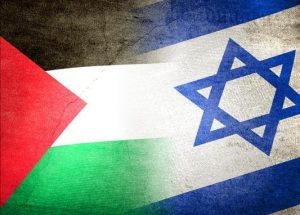
Flags image by Cole Baratte via coleinone.wordpress.com
BESA Center Perspectives Paper No. 685, December 15, 2017
EXECUTIVE SUMMARY: Is the Israel-Palestinian conflict equivalent to “the Middle East conflict,” as UN and EU officials and agencies and major media outlets characterize it? Of course not. The conflict is not nearly as lethal as many others and long ago became parochial compared to the conflicts in Syria, Iraq, and Yemen.
“Can Trump Solve the Middle East Conflict?” ran the headlines in al-Jazeera in July 2017. A year earlier, The New York Times ran an article on students and the Middle East conflict that referred exclusively to the conflict between Israel and the Palestinians.
The media are hardly alone in conflating the Israeli-Palestinian standoff with the Middle East conflict. They take their cue from UN officials and institutions and other international bodies. In a statement similar to those of many of his predecessors, in August 2017, UN Secretary-General António Guterres “reiterated his call for a political solution to the Middle East conflict.” The UN’s official news site on the Middle East deals exclusively with news related to the Israeli-Palestinian conflict. The Quartet, the political forum comprised of the US, Russia, the EU, and the UN, which came into existence in 2002 in Madrid to bring peace to the area, is officially known as the Middle East Quartet.
Does the conflation of the Israeli-Palestinian conflict with the Middle East conflict reflect reality? Not at all. Not only is the Israeli-Palestinian conflict one of many conflicts in the Middle East (true even when it was a conflict principally between Israel and Arab states), but it is not nearly one of the deadliest or most explosive. In fact, relatively speaking, the conflict between Israel and the Palestinians is not very violent, which may be one of the reasons it has persisted so long.
A cursory comparison with contemporary conflicts in the Middle East brings this point home. During the first intifada, the second intifada, the three rounds of violence between Hamas and Israel in the past decade, and the intermittent waves of low intensity violence, 2,000 Israeli civilians and security personnel and 11,000 Palestinians have been killed (the majority in the second intifada). To this one might add about fifty foreigners killed in acts of terrorism against Israelis. All told, the total casualty figures, including both sides, do not exceed 14,000 over the past twenty years, or 700 annually.
Compare this with the 200,000 deaths in the Syrian civil war, a conflict that is only six years old. True, the Syrian population is more than double that of the combined Israeli and Palestinian populations in the Holy Land. Nevertheless, the death rate proportionately has been fifteen times higher. Despite the Syrian government’s success against the rebels (achieved with considerable help from Iran, Hezbollah, Iraqi and Afghani Shiite fighters, and Russian airpower), the end of the civil war is nowhere in sight. Is the Israeli-Palestinian conflict really the Middle East conflict?
Why isn’t the internecine Iraqi conflict the Middle East conflict? According to Iraq Watch, over 100,000 Iraqis were killed during the eight years of massive US military presence in the country. To those one might add the 4,000 US troops and civilians who met their death there. On a proportionate basis, the Iraqi conflict is (and persists in being) at least five times more lethal than the Israeli-Palestinian conflict. And again, despite the gains made by the Iraqi Federal Army and the Iranian-controlled Shiite militias in the war against ISIS, an end to the internecine war between Sunnis and Shiites in Iraq is nowhere in sight. The brutality of the Shiite militias in the “occupied” Sunni areas of Iraq increases the likelihood that variations on ISIS will rise once again.
The same is probably true of the conflicts in Libya and Yemen, where few bother to churn the terrible numbers. In these arenas, too, the end of violence is nowhere in sight. This is not to mention the “persistent, enduring and explosive” (all adjectives used to conflate the Israeli-Palestinian conflict with the Middle East) wars of Sudan, the duration of which is almost as long as the Israeli-Palestinian conflict.
But perhaps body count is not the only metric to be used when judging the centrality of a conflict. Perhaps foreign involvement ought to be considered.
It’s certainly true that the Israeli-Palestinian conflict commands foreign attention, but it does not command foreign involvement. Whereas the conflict between Israel and the Arab states during the superpower rivalry ran the risk of igniting World War III, the Israeli-Palestinian conflict long ago became parochial. The last time any Arab state or foreign organization became involved in the Israeli-Palestinian conflict was 35 years ago, when the Syrian army tried to stop the Israeli advance into Lebanon in 1982. In 2006, Hezbollah conducted the longest military campaign to have been conducted against Israel since Israel’s War of Independence – and the Palestinians stood on the sidelines. Hezbollah returned the favor during the rounds of clashes between Israel and Hamas in 2008, 2012, and 2014. Its soldiers remained in the barracks.
As the Israeli-Palestinian trajectory has become increasingly parochial, the trajectories of the other regional conflicts have gone in the opposite direction: They began as local civil wars but evolved into regional and international conflagrations. The Syrian, Iraqi, and Yemeni conflicts have become three-tiered conflicts – civil or sectarian wars at their base, proxy wars between regional rivals (Iran, Saudi Arabia, and, to a lesser extent, Turkey), and arenas of international contest among world powers. The same Hezbollah that stayed home during the high points of violence between Israel and the Palestinians took to the battlefields of Syria on Iran’s behalf to prop up the Assad regime.
The Israeli-Palestinian conflict is the Middle East conflict? Give me a break!
Prof. Hillel Frisch is a professor of political studies and Middle East studies at Bar-Ilan University and a senior research associate at the Begin-Sadat Center for Strategic Studies.


