Contact Form

Name

Email *

Message *

Showing posts with label Tehran. Show all posts

Wednesday, March 28, 2018

The Obama Administration Is Up To Its Ears In Corruption. No Wonder They Keep Throwing "Trump LIes" To The Press

STUNNING! FBI informant dropped Obama BOMBSHELL on Monday

The biggest scandal from former President Barack Obama’s eight years in office just added a new twist, thanks to a whistleblowing FBI informant — and it’s a story the mainstream media desperately wants to cover-up.
The Uranium One deal authorized by former Secretary of State Hillary Clinton and overseen by Obama was even more dirty than most people believe.

That’s according to William Douglas Campbell, a former FBI informant on Russia under the Obama administration. Campbell told The Hill on Monday that he provided mountains of evidence to the FBI that Russia was illegally assisting Iran’s nuclear weapons program — which was ignored by the Obama administration while Clinton signed off on Uranium One deal with Russia.
The FBI insider claims that Moscow was stealing secret copies of international monitoring reports on Iran’s nuclear program and sending them to the Ayatollah. Additionally, Russia was providing expertise and equipment to the Islamic dictatorship — which the Obama administration ignored.
At the same time, millions in dollars from this “same king of payment network” was laundering bribes between Moscow and American lobbyists working to win support from Hillary during Obama’s terms in office.
Former President Bill Clinton was also accepting hundreds of thousands of dollars in “speaker fees” from Moscow during this same time period.

“The people I was working with had been briefed by Moscow to keep a very low profile regarding Moscow’s work with Tehran. Moscow was supplying equipment, nuclear equipment, nuclear services to Iran,” Campbell said during his interview. “And Moscow, specifically the leadership in Moscow, were concerned that it would offset the strategy they had here in the United States if the United States understood the close relationship between Moscow and Tehran.”
“Campbell worked from 2008 to 2014 as an undercover informant inside Rosatom, Russia’s state-controlled nuclear giant, while posing as a consultant. He helped the FBI put several Russian and U.S. executives in prison for a bribery, kickback, money laundering and extortion scheme,” The Hill reported. “He said he became concerned the United States was providing favorable decisions to the Russian nuclear industry in 2010 and 2011 — clearing the way for Moscow to buy large U.S. uranium assets and to secure billions in nuclear fuel contracts — even as he reported evidence of Moscow’s help to Iran.”
In other words, the Obama administration was told by Campbell that Russia was actively trying to arm Iran with nuclear weapons. At the same time, the Clintons were accepting hundreds of thousands of dollars and also signing over control of 20 percent of our nation’s strategic nuclear reserve. Obama later shipped 400 million of dollars of taxpayer money to Tehran as part of his controversial nuclear deal with the Islamic dictatorship.

“I got no feedback. They took the reports and the reports, I assume, went to specific people assigned to analyze the reports and that was the last I heard of it,” Campbell said on his warnings to the FBI.
Democrats pushed back on Campbell’s credibility following his testimony in front of the Senate Judiciary Committee earlier this year. Republicans disagree, however.
White House Press Secretary Sarah Huckabee Sanders even told Fox News that, “if anyone colluded for a foreign government in [the 2016 presidential] election, it was the Clinton campaign — the Democrats.”
She’s right. If the mainstream media is looking for a Russian collusion narrative, they need to stop talking about Russia’s Facebook ad campaign in 2016.

The legacy media owes the American people the truth about Hillary and Obama’s dirty dealings with Russian dictator Vladimir Putin and their connections to Tehran.

Monday, January 1, 2018

Things Get Worse In Iran

Photo
A protester raised her fist amid the smoke of tear gas at the University of Tehran on Saturday.CreditAgence France-Presse — Getty Images
TEHRAN, Iran — Nationwide protests in Iran saw their most violent night as "armed protesters" tried to overrun military bases and police stations before security forces repelled them, bringing the death toll in the unrest to at least 12, state television reported Monday.
The demonstrations, the largest to strike Iran since its disputed 2009 presidential election, began Thursday in Mashhad over economic issues and have since expanded to several cities, with some protesters chanting against the government and the supreme leader, Ayatollah Ali Khamenei. Hundreds of people have been arrested.
Iranian state television aired footage of a ransacked private bank, broken windows, overturned cars and a firetruck that appeared to have been set ablaze. It reported that clashes Sunday night killed 10 people.
"Some armed protesters tried to take over some police stations and military bases but faced serious resistance from security forces," state TV reported. It did not say where those attacks occurred.
Later Monday, state TV said clashes killed six people in the western town of Tuyserkan, 295 kilometers (185 miles) southwest of Tehran. It said clashes in the town of Shahinshahr, 315 kilometers (195 miles) south of Tehran, killed three more. It did not say where the 10th person was killed.ntinue reading the main story
Earlier on Monday, the semi-official ILNA news agency quoted Hedayatollah Khademi, a representative for the town of Izeh, as saying two people died there Sunday night.
He said the cause of death wasn't immediately known, though authorities later described one of the deaths as the result of a personal dispute. Many in Izeh, some 455 kilometers (280 miles) southwest of Tehran, have hunting rifles in their homes.
Two protesters also were killed during clashes late Saturday in Doroud, some 325 kilometers (200 miles) southwest of Tehran in Lorestan province, authorities earlier said.
On Sunday, Iran blocked access to Instagram and the popular messaging app Telegram used by activists to organize. President Hassan Rouhani acknowledged the public's anger over the Islamic Republic's flagging economy, though he and others warned that the government wouldn't hesitate to crack down on those it considers lawbreakers.
That was echoed Monday by Iranian judiciary chief Ayatollah Sadegh Larijani, who urged authorities to confront rioters, state TV reported.
"I demand all prosecutors across the country to get involved and approach should be strong," he said.
Rouhani also stressed Monday that Iran "has seen many similar events and passed them easily."
U.S. President Donald Trump, who has been tweeting in support of protesters in Iran, continued into the New Year, describing the country as "failing at every level despite the terrible deal made with them by the Obama Administration."
"The great Iranian people have been repressed for many years," he wrote. "They are hungry for food & for freedom. Along with human rights, the wealth of Iran is being looted. TIME FOR CHANGE!"
Israeli Prime Minister Benjamin Netanyahu, calling the protesters "brave" and "heroic," said in a video posted to YouTube on Monday that the protesters sought freedom, justice and "the basic liberties that have been denied to them for decades."
He criticized the Iranian regime's response to the protests and also chided European governments for watching "in silence" as the protests turn violent.
While some have shared Trump's tweets, many in Iran distrust him as he's refused to re-certify the nuclear deal and as his travel bans have blocked Iranians from getting U.S. visas.
State TV also has reported that some protesters invoked the name of the U.S.-backed shah, who fled into exile just before Iran's 1979 Islamic Revolution and later died.
Iran's economy has improved since its 2015 nuclear deal with world powers, which saw Iran limit its enrichment of uranium in exchange for the end of some international sanctions. Tehran now sells its oil on the global market and has signed deals to purchase tens of billions of dollars' worth of Western aircraft.
That improvement has not reached the average Iranian, however. Unemployment remains high, and official inflation has crept up to 10 percent again. A recent increase in egg and poultry prices by as much as 40 percent, which a government spokesman has blamed on a cull over avian flu fears, appears to have been the spark for the economic protests.
While the protests have sparked clashes, Iran's paramilitary Revolutionary Guard and its affiliates have not intervened as they have in other unauthorized demonstrations since the 2009 election.
It wasn't immediately clear if the Guard would change its posture given the reported attacks on police stations and military bases. In Tehran on Monday, streets were calm, though a heavy police presence was noticeable to passers-by.
Guard commander and Deputy Chief of Staff of Iran's Armed Forces Brig. Gen. Massoud Jazayeri said Monday that Trump's support of the protesters "indicates planning by the U.S. for launching a new sedition in Iran."
___
Gambrell reported from Dubai, United Arab Emirates.

Thursday, December 7, 2017

The Middle East Is Chaotic

The Chaotic Arab World Has Nothing to Offer Israel


BESA Center Perspectives Paper No. 677, December 7, 2017
EXECUTIVE SUMMARY: Israel should not do the bidding of the divided and bankrupt Arab world and strive to contain Tehran’s hegemonic ambitions at an exorbitant human and material cost. Nor should it trust its Arab neighbors to offer genuine peace once the Iranian threat is eliminated. 
Behavioral science recognizes two types of response to tense or threatening situations facing loosely connected groups. The first is characterized by the group’s uniting under a charismatic leader who radiates power, wisdom, organizational acumen, and the ability to protect his followers. Provided such a leader is available, this kind of group forms a united front and prepares for the struggle against the looming threat. The opposite occurs when there is no such leader to be found. In the resulting mayhem, members betray one another and try to escape to the other side in order to save themselves. In that second scenario, the individuals in the group couldn’t care less if the rest of the group goes to hell.
The second scenario is an exact description of the current situation in the Arab world, in which Iran has become a major threat. After years of trying to extend its control over the Arab nations, Tehran’s hegemonic ambitions grew by leaps and bounds when the two major world powers joined forces to empower it. Under President Obama, US actions strengthened Iran, allowed it to develop nuclear weapons (the real meaning of the 2015 agreement), ignored its ballistic missile development program, handed it vast sums of money, and allowed it to sign lucrative contracts – all while ignoring Tehran’s  involvement in local wars and support for world terror.
Moscow has been Tehran’s partner for years through a complex array of agreements and joint initiatives. It supplied nuclear power stations for electricity production, thereby granting the Iranians the ability to acquire knowledge and experience in nuclear science; handed over its missile technology; worked with Iran to regulate the world natural gas market (Russia, Iran, and Qatar are the world’s three largest gas suppliers); and joined forces with Tehran in the Syrian civil war in an attempt to save the Assad regime.
The EU followed the US and Russia in their promotion of Iranian interests, encouraging its members to join the lucrative Iranian contract-signing queue. (In truth, a good number of European states already had a history of ignoring economic sanctions imposed on Tehran by the West.) US Intelligence knew exactly what was going on but said nothing – or, to be more accurate, was silenced by the Obama administration.
Other economic giants took part in the Iran festival. China never quite understood why it should limit is economic ties to Tehran; nor did India find it a problem to maintain wide-ranging business interests in the country.
The Arab world, from Iraq in the east to Morocco in the west, from Syria in the north to Yemen in the south, has been noting the growing Shiite advance with undisguised apprehension. Sunni Muslim states such as Turkey and Pakistan (in fact, most Sunni Muslims) are anxious, but are reacting to the situation by collapsing instead of unifying and working together.
This collapse is both internal and external in every country, resulting in endless arguments about how each nation should react to the state of emergency. The question is whether it is better to act against Iran in some way – economically, politically, militarily – or end the problem by yielding to Tehran and saving lives.
Qatar threw in the towel years ago. The emirate shares a gigantic gas field with Iran, where they produce gas in partnership and share the huge profits. Qatar’s behavior infuriates the Saudis because the emirate is Arab, Sunni, and Wahhabi, as is the Saudi royal family, but has nevertheless stabbed the Saudis in the back. Saudi furor at Qatar’s support for the Muslim Brotherhood and for the shenanigans of Al Jazeera are nothing compared to its anger over Qatari cooperation with Iran.
The Sunni minority in Iraq, once the country was freed in 2003 by the US-led international coalition from Saddam Hussein’s brutal dictatorship, saw the government handed over to the Shiite majority on a silver platter (made in the West and covered in the blood of American and Western soldiers) before being caught in the Iranian net. Tehran now controls politicians, parties, army officers, militias, and industries in Iraq. It has thus reestablished the hegemony it had in eastern Mesopotamia before the Arabs defeated the Sassanian Persian Empire’s forces in Qadisiya, a city in southern Iraq, in November 636 – 1,381 years ago.
The Persians never forgave the Arabs for this defeat. The ayatollahs see Iran’s takeover of Iraq as an act of historic justice and long overdue revenge on the Arabs, whom they continue to consider primitive illiterates.
Syria, another Arab state, became an Iranian stooge after being totally destroyed by a blood-soaked civil war that led to the deaths of over half a million people, most of whom were Sunni. They died so Shiite Islam could annex their land as well. The Iranians owe a debt of gratitude to the Russian and Christian unbelievers who did the dirty work of eliminating the opposition, right down to its women and children.
Lebanon, another Arab state with a large Shiite population (possibly the majority by now due to its own demographics and the flight of Sunni Muslims, Christians, Druze, and Alawites from its borders) has an armed-to-the-teeth, Iranian-created and -controlled militia, Hezbollah, the fighting strength of which is greater than that of the Lebanese army. Iran has effectively controlled Lebanon for 35 years. The world knew, watched, and remained silent.
Yemen, another Arab state with a large Shiite population, was never really united. It was always divided by the different tribal, ethnic, and ideological loyalties of its population. That allowed Tehran to establish a state within a state with a well-equipped army that took over the capital and exiled the country’s president and government to Saudi Arabia. Iran now threatens international navigation in the Red Sea and the Mandeb Straits, essential passages connecting Europe, the Persian Gulf (with its oil and gas), and eastern Asia, with its merchandise and raw products.
Iran has even infiltrated the Palestinian Authority by supporting the Islamic Jihad and Hamas terror organizations. ErdoÄŸan’s Turkey, too, has joined the list of states that do Tehran’s bidding and try to find favor in its eyes.
Iran has managed to gain control over the entire Muslim east, country by country, despite tough sanctions imposed by the West. In the process, it has caused much tension in Saudi Arabia, Egypt, Jordan, the Emirates, Israel, and other Mediterranean states. That tension has a negative effect on the internal workings of these states, and the recent Saudi purges are a corollary of it.
An acrimonious debate is raging within the Saudi royal family on the way the monarchy has responded to the Iranian threat in general and the Iranian takeover of Yemen in particular, a development that poses an immediate threat to the Saudis, who have had rockets launched in their direction. The war in Yemen, like the support for the defeated Syrian rebels, has cost the Saudi treasury billions of dollars so far and if continued, will leave the country on the verge of bankruptcy.
Concurrent with this debate is the controversy over Saudi succession. Crown Prince Muhammad, son of the reigning monarch Salman, is 32 years old and has no administrative, political, or military expertise. There is a slew of much older cousins who have a good deal more experience than he does in the economic, administrative, and political spheres. In a traditional tribal society, age, experience, maturity, and a suitable personality are what make someone a legitimate leader, and Muhammad is not legitimate in the eyes of many of his cousins. It is quite possible that a putsch is in the making. He has, however, won the first round by arresting or eliminating several potential critics.
Tehran’s pressure on Riyadh destabilizes the monarchy. That is what is happening in Lebanon as well, where the airing of the government’s internal problems led Prime Minister Hariri to resign (temporarily). The situation in Iraq is also far from tranquil; angry arguments are raging about continued Iranian interference in the running of the country.
In response to the state of internal and inter-Arab mayhem, the Saudis called an emergency meeting of the Arab League foreign ministers. The Arab League is powerless. This paralytic organization has been unable to save a single Syrian, Iraqi, Yemenite, Libyan, Algerian, or Sudanese Arab in all the years of civil strife that have ravaged those countries.
Many Israelis have been encouraging their government to enter into an accord with the “Moderate Sunni Nations” because “Israel is not the problem, it is the solution.” This is based on a deep lack of understanding of the Arab way of doing things and complete ignorance about what is really going on in the countries surrounding Israel.
The only conclusion Israel should reach from the Middle East’s sad state of affairs is this: There is no one to rely on in the splintered Sunni Arab world, a world that is incapable of uniting against the Iranian threat. The Arabs betray one another, and some of them are tied to Tehran with every fiber of their beings. Are they really going to be loyal to whatever agreement they make with the Jews? They may ask the Israelis to save them from the clutches of the Iranian threat, but after they have done so at a high cost to their own sons and daughters, citizens, infrastructure, and cities, that “Moderate Sunni Axis” will treat the Jewish state exactly as it treated the Iraqi Kurds after they shed the blood of over a thousand male and female fighters to rescue the Arabs from ISIS. They threw them and their aspirations for independence into the dustbin of petty politics, interests, cynicism, and treachery.
Israel’s fate will be just the same once the Iranian threat has been eliminated from whatever is left of the destroyed, bankrupt, and divided Arab world. Israel should not spend a plug nickel in the quest for peace with a world as fragmented as the Arab world. Not one square centimeter of land for a worthless piece of paper containing the word “peace.”
Israel should ask the Arabs a single question: What are you giving us in exchange for our agreeing to make peace with you? The answer is clear. Apart from poverty, hatred, treachery, neglect, cynicism, and hypocrisy, the Arab world has nothing to offer Israel, because these are its only commodities. These are Israel’s neighbors, and when Israelis begin to understand this, they will be capable of dealing with those neighbors as they should.
An earlier version of this article, translated by Rochel Sylvetsky, was published by Arutz Sheva
Dr. Mordechai Kedar is a senior research associate at the Begin-Sadat Center for Strategic Studies. He served for 25 years in IDF military intelligence specializing in Syria, Arab political discourse, Arab mass media, Islamic groups, and Israeli Arabs, and is an expert on the Muslim Brotherhood and other Islamist groups.
BESA Center Perspectives Papers are

Tuesday, October 10, 2017

Iran Nuke Deal Causing More Problems

President Trump will address U.S. policy toward Iran on Thursday, doubtless focusing on his decision regarding Barack Obama's badly flawed nuclear deal. Key officials are now briefing Congress, the press and foreign governments about the speech, cautioning that the final product is, in fact, not yet final. The preponderant media speculation is that Trump's senior advisers are positioning him to make a serious mistake, based on their flawed advice. Wishful thinking about Iran's mullahs, near-religious faith in the power of pieces of paper, and a retreat from executive authority are hallmarks of the impending crash.
In short, Obama's Iran nuclear deal is poised to become the Trump-Obama deal. The media report that the president will not withdraw from the Joint Comprehensive Plan of Action (JCPOA), but instead, under the misbegotten Corker-Cardin legislation, will "decertify" that it is in America's national interest. Congress may then reimpose sanctions, or try somehow to "fix" the deal. Curiously, most of the suggested "fixes" involve repairing Corker-Cardin rather than the JCPOA directly.
Sure, give Congress the lead on Iran. What could go wrong? Whatever the problem with Iran, Congress is not the answer. No president should surrender what the Constitution vests uniquely in him: dominant power to set America's foreign policy. In the iconic Federalist Number 70, Alexander Hamilton wrote insightfully that "decision, activity, secrecy and dispatch" characterize unitary executive power, and most certainly not the legislative branch. President Trump risks not only forfeiting his leading national-security role, but paralysis, or worse, in the House and Senate.
If Congress really wants to "fix" Corker-Cardin, the best fix is total repeal. The substantive arguments for decertifying but not withdrawing are truly Jesuitical, teasing out imagined benefits from adhering to a deal Iran already treats with contempt. Some argue we should try provoking Iran to exit first, because our withdrawal would harm America's image. This is ludicrous. The United States must act in its own self-interest, not wait around hoping Iran does us a favor. It won't. Why should Tehran leave (or even modify) a deal advantageous beyond its wildest imagination?
This "shame" prediction was made against Washington's 2001 unilateral withdrawal from the Anti-Ballistic Missile Treaty, and proved utterly false. America's decision to abrogate the hallowed "cornerstone of international strategic stability" produced nothing like the storm of opprobrium Anti-Ballistic Missile Treaty adherents predicted. No nuclear arms race followed. Instead, withdrawal left the United States far better positioned to defend itself against exactly the threats Iran and others now pose.
Some say that trashing the deal will spur Iran to accelerate its nuclear-weapons program to rush across the finish line. Of course, before the JCPOA, Iran was already party to the Nuclear Non-Proliferation Treaty, which barred it from seeking or possessing nuclear weapons, but which it systematically violated. JCPOA advocates are therefore arguing that although one piece of paper (a multilateral treaty, no less) failed to stop Iran's nuclear quest, the JCPOA, a second piece of paper, will do the trick, with catastrophic consequences if we withdraw. Ironically, these same acolytes almost invariably concede the JCPOA is badly flawed and needs substantial amendment. So they actually believe a third piece of paper is required to halt Iran. Two are not enough. This argument flunks the smile test: Burying Iran in paper will not stop its nuclear program.
Iran's ability to "rush" to have nuclear weapons existed before the deal, exists now, and would exist if America withdrew. The director of the Atomic Energy Organization of Iran said recently it would take a mere five days for Iran to resume its pre-deal level of uranium enrichment. This rare case of regime honesty demonstrates how trivial and easily reversible Iran's JCPOA concessions were. What alone deters an Iranian "rush" is the threat of preemptive U.S. or Israeli military strikes, not pieces of paper.
Nor will U.S. withdrawal eliminate valuable international verification procedures under the JCPOA. In fact, these measures are worse than useless for nonproliferation purposes, although they serve Iran well. By affording the appearance of effective verification, they camouflage Iran's active, multiple violations of United Nations Security Council Resolution 2231: on uranium-enrichment levels, advanced-centrifuge research, heavy-water production and missile programs. The International Atomic Energy Agency recently admitted explicitly it has no visibility whatever into weapons and ballistic-missile work underway on Iran's military bases.

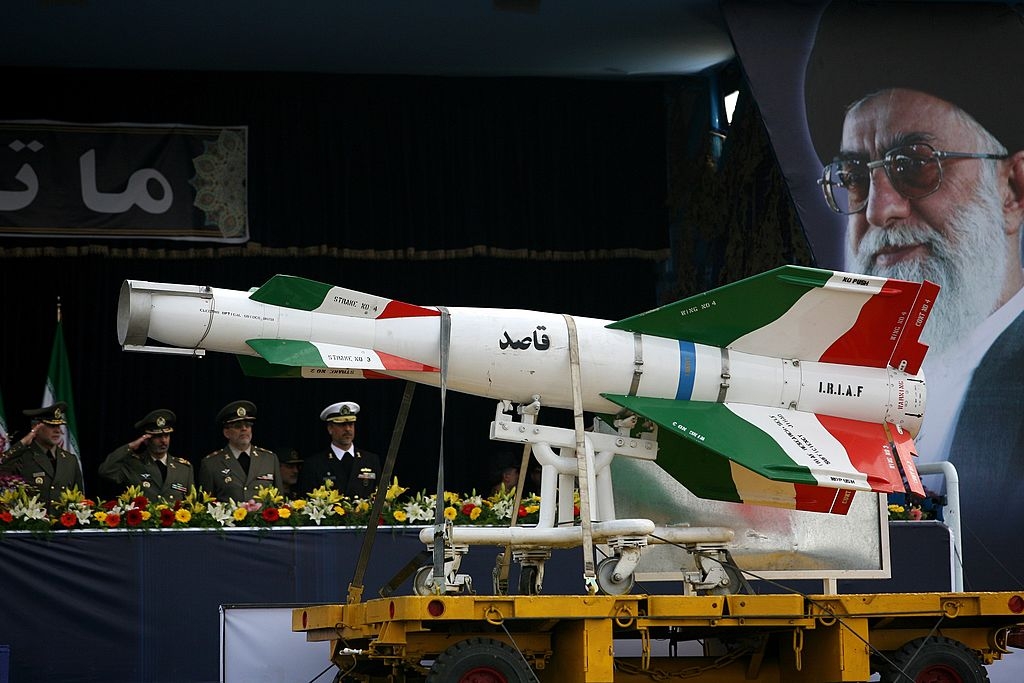
The International Atomic Energy Agency recently admitted explicitly it has no visibility whatever into weapons and ballistic-missile work underway on Iran's military bases. Pictured: An Iranian surface to surface missile, on display at an army day military parade in Tehran, Iran. (Photo by Majid/Getty Images)

It is simple common sense that Iran would not conduct easily discoverable weapons-related work at already-known nuclear sites like Natanz and Esfahan. Warhead design and the like are far more likely at military sites like Parchin where the IAEA has never had adequate access. No wonder the IAEA is now barred from Parchin.
It is not just weapons-related work the JCPOA fails to uncover. Substantial uranium-enrichment production and research are also far more likely at undeclared sites inside Iran or elsewhere, like North Korea. This is the lesson Tehran learned after Israel destroyed the nuclear reactor under construction by North Koreans in Syria in 2007.
Nor will abrogating the deal somehow induce Iran to become more threatening in the Middle East or in supporting global terrorism than it already is with the JCPOA in force. Consider Tehran's belligerent behavior in the Persian Gulf, its nearly successful effort to create an arc of control from Iran through Iraq and Syria to Lebanon, threatening Israel, Jordan and the Arabian Peninsula, and its continued role as the world's central banker of international terrorism. The real issue is how much worse Iran's behavior will be once it gets deliverable nuclear weapons.
I have previously argued that only U.S. withdrawal from the JCPOA can adequately protect America from the Iranian nuclear threat. Casuistry deployed to persuade President Trump to stay in the deal may succeed this Thursday, but it does so only at grave peril to our country. This is no time to let our guard down.
John R. Bolton, former U.S. Ambassador to the United Nations, is Chairman of Gatestone Institute, a senior fellow at the American Enterprise Institute, and author of "Surrender Is Not an Option: Defending America at the United Nations and Abroad".
This article first appeared in The Hill and is reprinted here with the kind permission of the author.
  • Follow John R. Bolton on Twitter
© 2017 Gatestone Institute. All rights reserved. The articles printed here do not necessarily reflect the views of the Editors or of Gatestone Institute. No part of the Gatestone website or any of its contents may be reproduced, copied or modified, without the prior written consent of Gatestone Institute.