Contact Form

Name

Email *

Message *

Showing posts with label UN Human Rights Commission. Show all posts

Thursday, April 23, 2015

Colleges Are The Breeding Ground For Anti-Israel War!

A generation of students is growing up learning to tolerate -- and consider normal -- bias, falsehood, prejudice, and the runaway politicization of teachers and student thugs permitting only one-sided arguments.
America's President Barack Obama has declared war on Israel. The animosity between Obama and his administration toward Israel and its newly re-elected leader, Prime Minister Benjamin Netanyahu, has been growing for years; it reached crisis point after Netanyahu's address to the U.S. Congress and news of his resounding victory in the March elections.
This does not mean that the United States, as a whole, shares this animosity or is bent on abandoning a vulnerable and beleaguered democracy to its host of violent and uncompromising predators. Polls show it does not.
But wars against Israel are nothing new. In 1947, months before the country was even declared independent, Arabs launched a war that led uninterruptedly to a full-scale conflict in 1948. Since then, physical violence -- wars and individual terrorist attacks -- against the State of Israel has been a feature of everyday life for Israelis, with Jews as the principal targets. No legally established, democratic country has ever been faced with so great a lust for its destruction and so many assaults on its people. It is singled out by a United Nations dominated by Muslim states and their allies; and now, bewilderingly, by the president of the one country on whom Israelis have always depended for moral and material support.
Of course, not even Obama is likely to wage war directly on Israel by sending in armed forces, but he is making life easier for Israel's sworn enemies, notably Iran, to think they can use their monstrous banks of armaments to launch just such an attack without fearing U.S. intervention.
As the Middle East collapses all around Israel, as jihadi factions grow bolder and more barbaric, and as Iran spreads its reach into Yemen, Iraq, Syria, Lebanon and the Palestinian territories, Israel has become the canary in the West's coal mine.
In addition to that, there is now the subversion of Israel's very right to exist through "lawfare," (the frivolous or malicious use of the law for political manipulation); UN Human Rights Commission distortions, and, in many ways the most chilling: the work of teachers and students in Western universities to boycott, divest from and sanction (BDS) Israel.
Followers of Campus Watch or International Academic Friends of Israel, and readers of the essays in The Case Against Academic Boycotts of Israel (Wayne University Press, 2015) will be only too painfully aware of the decidedly unacademic raw Jew-hatred, posing as anti-Zionism, that has spread across university campuses throughout the United States, Europe and the West, particularly in the UK, Australia, Canada and elsewhere. Hate speech, disruption of lectures, demonstrations, expulsions and grotesquely one-sided lectures, papers and books have replaced the free speech, open debate, and academic neutrality that once characterized all universities within the Western tradition.
A generation of students is growing up learning to tolerate – and consider normal -- bias, falsehood and the runaway politicization of teachers and student thugs permitting only one-sided arguments. Many members of the faculty, radical Muslim teachers, and student thugs permit only one-sided arguments. It has become unpleasant, even a risk, for pro-Israel and Jewish students, such as Daniel Mael at Brandeis University, to lift their heads above the parapet.
In the UK, anti-Israel agitation has been not as violent but just as strong as in the US; and the BDS movement has been severe in many universities. For several years, the Association of University Teachers (AUT), the National Association of Teachers in Further and Higher Education (NATFHE) and the (later amalgamated) University and College Union passed boycott resolutions against Israeli academic institutions and individuals. The dominance of intolerantly "liberal" teachers in British educational circles has ensured a hindrance to open and civilized debate within the higher education sector as much as have the students.
Bias and intolerance have now moved in an even more alarming direction. From the 17th to the 19th of April this year, the Law School at Britain's Southampton University had planned to host aconference entitled, "International Law and the State of Israel: Legitimacy, Responsibility and Exceptionalism." This was not an internal event, nor was it restricted to academics from the UK. Southampton University is a founding institution in Britain's Russell Group of elite universities and regularly appears among the world's top 100 universities. It has been ranked as fifth in the UK; academics working there include Sir Tim Berners-Lee, inventor of the World Wide Web. Its Law School enjoys a worldwide reputation as one of the best in Britain. The conference was intended to be noticed far beyond the shores of the UK.
This global reach was indicated in the list of participants signed up to deliver papers there. Of those listed to give fifty-three papers over three days, eleven were Americans, one was from Singapore, two were from Canada, eight were from Israel, seven were from the West Bank (Judaea and Samaria), two were from Ireland, one was from Lebanon, one was from Austria, one was from Australia, and one was from the Netherlands. With an international roster such as this, you are looking at a major event that had taken over a year to plan. It was clearly an attempt to legitimize a gathering of the clan of the academic anti-Israel fraternity.
The university, after appeals from countless individuals and organizations, stated that it had cancelled the conference. Its organizers spent some £35,000 to ask for a judicial appeal in London's High Court, but on April 14, just days before the conference was due to start, Judge Alice Robinson refused their appeal and upheld the decision to close down the event. The university had argued (rather weakly, it must be said) that fears of violence by demonstrators and their opponents made it necessary to cancel on the grounds of security. Legally, this was probably the only option they had, but it is more than likely that, once serious objections were made and the real purpose of the conference disclosed, they decided that it the conference might well stain their reputation. Unsurprisingly, BDS supporters are already describing the cancellation as capitulation by the university to the "Israel Lobby." And the lawyer acting for the conference organizers, Mark McDonald, has already stated that they may now take their appeal to the European Court of Human Rights.

Britain's Southampton University this month cancelled a conference dedicated to questioning the legitimacy of Israel, which had attracted Jew-haters and anti-Zionists, and was described by a prominent member of parliament as an "anti-Semitic hate-fest".

This will not be the last attempt to mount an anti-Israel conference in a university, whether in the UK, Europe, or North America. On April 15, the School of Oriental and African Studies at London University (a notoriously anti-Israel institution) announced an October conferenceentitled, "The Gaza Strip: History, Future and New Directions for Research," supposedly as a response to Israeli "onslaughts" on the Strip. There was no mention, of course, of the "onslaught" from Gaza on Israel of the thousands of rockets that had invited Israel's response.
It seems appropriate, however, to examine the real reasons why the Southampton conference should never have gone ahead within an academic context in the first place. To begin with, look closely at the participants, at the titles of most of the proposed papers, and at the deeply unbalanced Call for Papers that served to attract Jew-haters and anti-Zionists, and to repel all but a few supporters of Israel and its right to exist.
David Collier has done thorough research on the positions held by the participants in the conference. His list is available here. To simplify matters, 45 of those listed to speak have records of active involvement in the Boycott, Divestment and Sanctions movement; some of them had already been active in direct anti-Israel work. Four appear to be neutral. The imbalance is stupendous and makes it hard to believe this conference is simply an anti-Israel and, for some speakers, an "anti-Semitic hate-fest" (as the Tory Chief Whip, Michael Gove,described it recently at London's "We Believe in Israel" conference). Some are leading figures in the movement to defeat Israel and turn it into a Palestinian state. The best known of these isRichard Falk, a professor emeritus at Princeton University and one of the most notorious and outspoken enemies of Israel today. Falk has described the 9/11 atrocity as a conspiracy by the U.S. government; blamed the Boston Marathon bombing on the United States, and condemned Israel non-stop while working for the United Nations as the UN Special Rapporteur for Palestinian Human Rights.
Others stand out for their much-publicized anti-Israel (and, frankly, anti-Semitic) views. Who has not heard of Ilan Pappé, an Israeli who now holds a professorship in Arabic and Islamic Studies at Exeter University, but who has been described as "one of the world's sloppiest historians". His book, The Ethnic Cleansing of Palestine, has been widely criticized as a biased and inaccurate work that squeezes data to fit the author's narrative, rather than using it objectively to question existing assumptions. His hatred for his own country motivates everything he writes about it.
Dr. Ghada Karmi from the Institute of Arab and Islamic Studies in the University of Essex is a Palestinian medical doctor, an activist for the Palestinian cause, and a serial hater of Israel who has called for the destruction of the Jewish state. She has written thus about the country: "...Israel, from its inception in 1948, has been given the most wonderful opportunity to behave itself, and it clearly has not done so. It's flouted every single law, it's behaved outrageously, it's made a travesty of international and humanitarian law. On what basis should this state continue to be a member of the United Nations?" Apart from refusing to look at any combative behavior from Palestinians, or the many refusals by Palestinians to reject Israel's offer a Palestinian state, since when is a medical doctor an authority on international law?
One should look not just at the identities of the participants, but also at the titles of many of the papers they were to present. Here are a few. Do not forget to notice the strangled pseudo-academic language in which some are dressed.
  • "Maximum Land, Minimum Arabs: Zionist colonization strategies in Palestine" (Nur Masalha).
  • "Two Peoples, One Future?: Mutual Self-Determination After the Defeat of Actually Existing Zionism" (Brad Roth).
  • "Law, Race & Resistance: The State of Emergency as Apartheid Legality" (John Reynolds).
  • "Responsibilities for the Gross Human Rights Violations" (Anthony Löwstedt).
  • "Can the Configuration of a political community amount to an International Crime?: reflections on Originary Apartheid, Legalism and Ethical Reflection" (Oren Ben-Dor, the conference organizer).
  • "How Legitimate is Israeli Statehood? Factors and implications of the UN creation of Israel" (Ghada Karmi).
  • "The Israeli Legal System: The practice and ideology of eternalizing the occupation" (Lea Tsemel).
  • "The Legal Infrastructure of Domination and Dispossession: An Appraisal of Israel's Contemporary Territorial Regime in Historic Palestine" (Valentina Azarova).
  • "The Case of a State that Refuses the Responsibility Inherent in Statehood" (Yoella Har-Shefi).
  • "The Melting Pot of Hatred, or On the Lives of Zionist Practitioners" (Marcelo Svirsky).
  • "Israel's Settler Colonialism, Stolen Childhood, and the Creation of Death Zones" (Nader Shalhoub-Kevorkian).
  • "We Fight, Therefore We Are! A Muslim De-Colonial Critique of Zionist Epistemology" (Hatem Bazian).
These examples should be enough to identify the extraordinary bias inherent in the conference. The language is typical, not of balanced academic enquiry but of pro-Palestinian, anti-Israel and BDS propaganda. The university's original refusal to respond to calls to cancel, or move the conference to a more neutral venue, fell painfully short of any recognition of how damaging such a farcical event would have been (and actually has been). The administration ignored arguments that lacked bias, and argued that the conference must be allowed to take place based on considerations of free speech. And this is the argument that the conference's supporters have been using ever since, even more since the ban. But that is also false. Most of those who have appealed to the administration have asked, not for an outright ban -- which would indeed go against the principles of free speech -- but for relocation, which is quite different.
It is worth saying in passing that the Call for Papers is, in itself, a very unacademic document. Rather than analyse it in any detail, let me cite just one thing. In just three pages, the Call refers no fewer than seven times to an entity they term "historic Palestine". But the term is meaningless. There is certainly no legal definition of what is meant by "historic Palestine." The region that covers today's West Bank, Israel, Gaza, and Jordan was for centuries the southern half of the Ottoman province of Syria. In 1920, the League of Nations established a British Mandate for Palestine, and in 1922 approved a separate British administration for Transjordan. Between 1923, when the Mandate came into effect, and 1948, when the British withdrew, there was a territory known as Palestine, in which everyone – Christian, Jew and Arab -- was listed on his passport as Palestinian. Is this the "historic Palestine" to which the Call refers? Or does this include the Mandate territory of Transjordan, as the British Colonial Office suggested in 1921? Or is it a fictitious Palestine stretching back to ancient times, as the term is used by the Palestinians and their supporters themselves?
To leave this point so poorly defined makes it hard for a historian such as myself, or a legal scholar, to advance any arguments that might relate to the identity of "historic" Palestine, a name invented in the year 70 AD by the Roman Emperor Hadrian. This alone exposes the conference to a charge of academic dishonesty.
UK Lawyers for Israel, a collective of British lawyers who volunteer to use their legal skills to defend and advocate for Israel, took up the matter of the conference with the university, using arguments based on the Call for Papers. Its secretary and treasurer, David Lewis, wrote a long letter to the Vice Chancellor, in which he noted, among other things that:
It is clear from even the most cursory reading of the Call for Papers that it has been written in a way that could almost have been designed, and probably wasdesigned, to deter supporters of Israel from presenting papers at the conference. In fact we find it mystifying that this inherent bias should have escaped the University when it approved the conference. And if the University gave its approval before even seeing the Call for Papers, then it certainly should not have done so. ...
Analysis of the Call for Papers is difficult because large chunks of it are almost incomprehensible. But it clearly states as incontrovertible facts -- most of which are perfectly controvertible -- that the State of Israel depended for its "initial existence" on a "unilateral" declaration of independence; that Arabs were expelled in 1947-49; that the Jewish nature of the state has profoundly affected the lives of Israeli Arabs (described as "non-Jewish Arabs who were allowed to stay"); that Jewish nationality bestows vital privileges ("constitutionally entrenched, privileged citizenship to Jews"); that there are two layers of Israeli citizenship; that there is an inherent differential between Jews and non-Jews; that Israeli settlements are illegal; that there is or was "apartheid colonisation" of the West Bank, east Jerusalem and Gaza; that there are "constitutional challenges of equal citizenship;" and that Israel inflicts "structured suffering" on the "non-Jewish Palestinian Arabs."
The three main "pillar-themes" which the conference is intended to link repeat some of these statements. They further state or assume: that:
~ There is such a thing or place as "Historic Palestine" and that Israel exists in that place;
~ That Israel has an "inbuilt non-egalitarian basis" and that the State of Israel is an unjust regime; and (to provide a little variety)
~ That the United States and Australia were established as a consequence [sic] of "extreme violence towards indigenous populations."
One letter sent to this author and cited here with permission, said:
We have to hope... that the academic and legal arguments were the true factors that swayed the university authorities. It is a pity they have not admitted this openly. They have used a face-saving argument rather than confess that the conference was ill-conceived from the beginning and that they had been careless to approve it....
A precedent has been set. Israel haters who try to use the mask of academic enquiry to cover up an extreme political position must accept that the cancellation of the Southampton conference has sent out a message to universities everywhere. Ilan Pappé, Oren Ben Dor, Richard Falk, Ghadi Karmi and hundreds of other academic anti-Israel fanatics will not stop their efforts as a result. No doubt, they will intensify them. But the writing is on the wall: keep your politics out of the groves of academe.
Dr. Denis MacEoin taught Arabic and Islamic Studies at a British university, has written numerous books, articles, and major encyclopedia entries in his field. He is a Distinguished Senior Fellow at the Gatestone Institute.

Tuesday, March 31, 2015

If Someone Wrote A Screenplay Mirroring The UN Human Rights Council Report, They Would Be Laughed Out Of The Movie Business. Too Farcical, Impossible To Occur, Ridiculous Assumptions Would Be The Reactions!

Author(s):  Anne Bayefsky
Source:  FoxNews.com.     Article date: March 29th, 2015


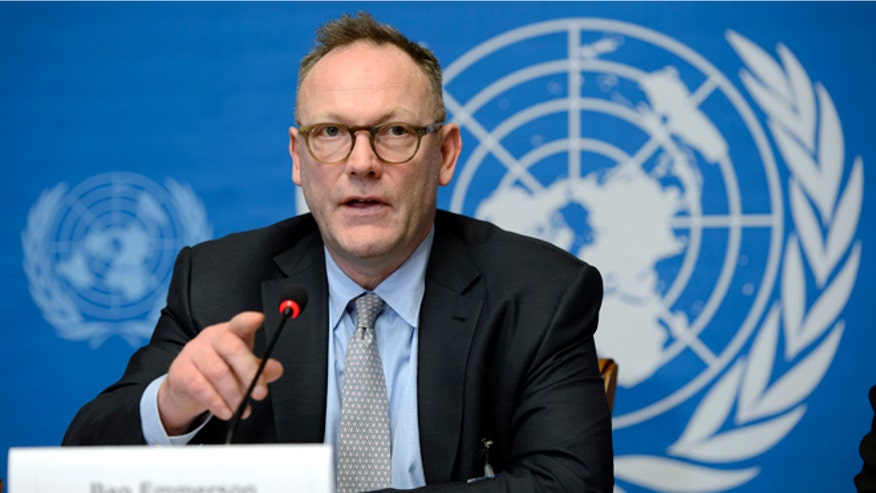
FILE — March 12, 2014: Ben Emmerson, UN Special Rapporteur on Counter Terrorism and Human Rights speaks during a press conference about his annual report to the Human Rights Council on the use of remotely piloted aircraft, or drones, in extraterritorial lethal counter-terrorism operations, at the European headquarters of the United Nations, in Geneva, Switzerland.
(AP Photo/Keystone,Martial Trezzini)
What country deserves more condemnation for violating human rights than any other nation on earth? According to the U.N.’s top human rights body, that would be Israel.
Last week, Israel was the U.N.’s number one women’s rights violator. This week it is the U.N.’s all-round human rights villain.
The U.N. Human Rights Council wrapped up its latest session in Geneva on Friday, March 27 by adopting four resolutions condemning Israel.  That’s four times more than any of the other 192 UN member states.
There were four resolutions on Israel. And one on North Korea — a country that is home to government policies of torture, starvation, enslavement, rape, disappearances, and murder – to name just some of its crimes against humanity.
Four resolutions on Israel. And one on Syria. Where the death toll of four years of war is 100,000 civilians, ten million people are displaced, and barrel bombs containing chemical agents like chlorine gas are back in action.
Four resolutions on Israel. And one on Iran. Where there is no rule of law, no free elections, no freedom of speech, corruption is endemic, protestors are jailed and tortured, religious minorities are persecuted, and pedophilia is state-run.  At last count, in 2012 Iranian courts ordered more than 30,000 girls ages 14 and under to be “married.”
And what did that one resolution on Iran say? Co-sponsored by the United States, it was labelled a “short procedural text,” consisting of just three operative paragraphs that contained not a single condemnation of Iran.
The Israel resolutions, on the other hand, were full of “demands,” “condemns,” “expresses grave concern,” and “deplores” – along with orders to “cease immediately” a long list of alleged human rights violations.
Ninety percent of states – inhabited by 6.6 billion people – got no mention at all. Countries like China, Qatar, Russia, and Saudi Arabia.  For the UN, there was not one human rights violation worthy of mention by any of these human rights horror shows.
Why not? For starters, China, Qatar, Russia and Saudi Arabia are all members of the UN Human Rights Council. Actually protecting human rights is not a condition of being elected to the Council, and thereby transforming into a UN authority on what counts as a human rights violation.
As a result, what counts fast becomes unrecognizable. Subverting human rights principles for all turns out to be the other side of the coin from subverting human rights for Jews.
Thus at this session, “death to America” Iran sponsored a Council resolution called “Enhancement of international cooperation in the field of human rights.” It was adopted by consensus – with U.S. blessing.  
The Cubans successfully engineered a Council resolution on protecting “cultural rights” – minus free expression.
The Palestinians – whose unity government includes the terrorist group Hamas – co-sponsored the resolution “effects of terrorism on the enjoyment of human rights.”  
The Organization of Islamic Cooperation – representing states where converting to Christianity is subject to the death penalty – sponsored a resolution called “combating intolerance of persons based on religion or belief.”
Playing at caring about human rights is the U.N. game. And no state does it better than Iran.
Iran’s human rights record happened to come up at the March session in the context of what the Council calls a “universal periodic review” (UPR). Touted as its leading human rights innovation, the same process is applied to every state every four years.  
That means Iran and Syria get treated the same way as, say, the United States and Canada.  At the end of the UPR, a report is summarily adopted containing a bunch of recommendations that the former cast of characters summarily dismiss.  
It was suggested to Iran, for instance, that it stop peddling little girls as sex slaves for old men. The recommendation received this reply:  “in light of Islamic teachings, a person that has reached the age of maturity and is of sound mind has the possibility of marrying.”
The Council created a human rights investigator on Iran, but Iran has never let him into the country.  Recommendations made to Iran during the UPR that it cooperate, were simply ignored.  
On March 19, 2014, the U.S. representative mustered all her courage and countered with this: “we note with disappointment that Iran has not addressed the issue of allowing the Special Rapporteur on the situation of human rights in Iran to visit the country…”
There is an alternative conclusion. We note with disappointment that the United States legitimizes this travesty and empowers the real enemies of human rights.
Anne Bayefsky is director of the Touro Institute on Human Rights and the Holocaust.

Friday, September 26, 2014

When You Disagree With The Ruling Mullahs In Iran, You Die Even If You Are An Ayatollah. Iran Is On The UN Human Rights Council!

Sunday, August 17, 2014

The Lack Of Human Rights In The UN


The United Nations “Human Rights” Council


When anyone tries to take the floor of the United Nations Human Rights Council and reveal the truth about abusive states, watch the abusers press their buzzers and demand that the truth-teller be stopped from speaking. Expecting the UNHRC to carry out a fair, balanced or accurate investigation of anything involving the State of Israel is rather like expecting the Organization of Islamic Cooperation to carry out investigations into persecution of Christians in Muslim countries.
The impact of the OIC and its many backers in Africa and elsewhere has led to a cynical failure on the part of the UN, the world leading human rights body, to address the greatest rights abuses of the modern age. North Korea, Iran, Saudi Arabia, Russia, China, Cuba, Nigeria or other of the world’s great tyrannies…are never criticized.
The United Nations Human Rights Council [UNHRC] convened an emergency session on July 23, 2014, to consider the plight of Palestinians in Gaza during the war between Israel and the terrorist organization, Hamas. The session was held at the request of the coordinators of the Group of Arab States, the Group of African States, the Organization of Islamic Cooperation, the Movement of Non-Aligned Countries and the “state of Palestine,” in a letter, dated July 18, to the UNHRC President. At that session, 29 out of 47 member states voted (1 against — USA — and 17 abstentions) to dispatch urgently “an independent, international commission of inquiry” to investigate “all violations of international human rights laws and international humanitarian law in the occupied Palestinian territory [sic], including East Jerusalem, particularly in the Gaza Strip.”
This may have seemed a reasonable thing to ask in a time of war, and no doubt gentlefolk around the world deem it a suitable and necessary thing to do, given the very high numbers of casualties and fatalities clocked up by that day. But expecting the UNHRC to carry out a fair, balanced or accurate investigation of anything involving the State of Israel is rather like asking the Organization of Islamic Cooperation [OIC] to carry out investigations into the persecution of Christians, Ahmadi Muslims, or Baha’is in Muslim countries.
Before the emergency session ended, Navi Pillay, the South African UN High Commissioner for Human Rights, who has her own office in New York, but supervises the Geneva-based UNHRC, warned the world that Israel may have committed war crimes by not doing enough to protect civilians. Pillay, however, has a long track record of demonizing Israel; it was she who was behind the infamous and totally discredited Goldstone Report of 2009, which accused Israel of deliberately targeting Gazan civilians — a finding that the report’s author, Richard Goldstone, later retracted, although Pillay did not.
Our lives are filled with contradictions and deceitful words. We may be wise to politicians, but terribly naïve when it comes to others. Politicians, churchmen and journalists proclaim that “Islam is a religion of peace,” while Islamists rampage across the globe, bringing “unpeace” everywhere. Which of us can forget George Orwell’s 1984, in which the Ministry of Truth is really concerned with lies, the Ministry of Peace is devoted to war, the Ministry of Love is dedicated to torture, and the Ministry of Plenty occupies itself with starvation?
BIN-OpEd-Experts-300x250(1)We are still living in 1984. The UNHRC works to defend and even promote countries that abuse those rights, and to condemn one of the most rights-observant countries in the world — Israel. When anyone tries to take the floor at the UNHRC and reveal the truth about abusive states, watch the abusers press their buzzers and demand that the truth-teller be stopped from speaking. How many times have the vigilant and dedicated human rights activists Anne Bayefsky of Human Rights Voices or Hillel Neuer of UN Watch been attacked for speaking truth?
The UNHRC was created in 2006 to replace the UN Commission on Human Rights, which had been widely condemned for its bias, especially towards Israel. Ironically, the United Nations had created the state of Israel in 1947 to implement the purposes of the League of Nations Mandate for Palestine. But rapidly, and increasingly as more non-Western states joined the UN, the UN became viciously anti-Israel, despising what it had itself brought into being; and nowhere is that hatred for Israel more deeply underscored than it was by the Commission and is now by the UNHRC. On its creation, the UNHRC resolved to make Israel the chief focus of its investigations, thereby subjecting one of the world’s few democracies to more intense criticism than any of the world’s most lawless dictatorships. At its first meeting in June 2006, the Council made a review of Israeli human rights abuses a permanent feature of every session in future. A Special Rapporteur was appointed to cover this conflict — the only expert mandate without a year of expiry.
John Dugard, the notorious “Special Rapporteur” on Israel and the Palestinian territories, who worked for the Commission from 2001 to 2008, was given a mandate “to investigate human rights violations by Israel only, not by Palestinians.” It should have been obvious that something was out of kilter. Human Rights Watch, seldom the friend of Israel, saw the imbalance and asked the UNHRC to cover Palestinian abuses as well; the request was ignored. The agenda had been set.
Dugard’s successor, the hardly impartial Richard Falk, took an even harder line against Israel, comparing Israelis to Nazis; justifying suicide bombings as a proper last resort for the Palestinians; calling Israel’s 2008 response to Hamas attacks “war crimes of the greatest magnitude,”[1] (as if he had never heard of the Nazis or the Japanese forces in World War II), and claiming that Israel practiced apartheid in the West Bank. Earlier, however, Falk had defended violence by anti-Vietnam War protesters; resisted U.S. action everywhere, and in 2013 blamed the Boston Marathon bombings on the U.S. and Israel. According to UN Watch, Falk “had endorsed the conspiracy theory that the 9/11 terrorist attacks were orchestrated by the US government and not by al-Qaida terrorists.” Even the Palestinian Authority called for his resignation because he sided so strongly with Hamas. For all that, he has exercised a powerful influence on the UNHRC’s policy towards Israel.
Between 2006 and 2014, the UNHRC had condemned Israel in 50 resolutions — more than the rest of the entire world. In twenty-one Special Sessions, resolutions have been made on the human rights situation in seven countries: Syria, Libya, Côte d’Ivoire, Sri Lanka, Congo, Myanmar, and Sudan (relating to Darfur) — eleven resolutions in all, five on Syria. None on Iran, Saudi Arabia, China or any other rights-abusing states. In those same sessions, a total of eight resolutions have been adopted against Israel.[2]
According to Freedom House, there are 88 free countries in the world, 59 partly free, and 48 not free. Israel is one of the free countries in respect of political, religious, and personal freedoms. The ten “worst of the worst” states are: Central African Republic, Equatorial Guinea, Eritrea, North Korea, Saudi Arabia, Somalia, Sudan, Syria, Turkmenistan, and Uzbekistan. The UNHRC has adopted resolutions against only two of those, Syria and Sudan, yet focuses in every session on one of the world’s freest states.
On a planet packed with countries that abuse human rights daily, and that execute, persecute, imprison and torture with impunity, if we are to talk of disproportion — as so many do when talking of Israel’s defensive measures against Hamas — then here is the real thing, paraded in public, packaged for media consumption, and sequestered behind a grinning mask of neutrality, non-partisanship, and self-congratulatory “justice.”
In 2001, UNESCO organized the third World Conference Against Racism. Held in Durban (and often labeled the “Durban Conference”), it became a platform for incendiary attacks on Israel, anti-Semitic demonstrations, and accusations that Zionism is a form of racism. A subsequent conference held in Geneva (the Durban Review Conference) featured a deeply anti-Semitic and anti-Israel speech by Iranian president Mahmoud Ahmadinejad. Ten countries boycotted it, and twenty-three EU countries sent only low-level delegations. Yet at its eleventh Special Session, the UNHRC passed resolution 11/12, which included the following decision:
Acknowledging with appreciation the outcome document of the Durban Review Conference, held in the framework of the General Assembly from 20 to 24 April 2009, including paragraph 124 thereof
1. Decides to extend the mandate of the Intergovernmental Working Group on the effective implementation of the Durban Declaration and Programme of Action for a period of three years
Over the years, it has become clear that the UNHRC is controlled by African and Middle Eastern countries, and is supported by China, Russia and Cuba. Currently, members include (each with a three-year term) 13 African states, 13 Asia-Pacific states, 8 Latin American and Caribbean states, and 8 Western European and other states (the “other” being the United States). Of the thirteen African states, two (Burkina Faso and Sierra Leone) have large majority Muslim populations, and two (Côte d’Ivoire and Ethiopia) have large Muslim minorities. Of the thirteen Asia-Pacific states, seven are fully Muslim entities.
When I was growing up, the UN looked as if it were the best thing to come out of the Second World War, a restoration of dignity to the human race after the enormities of the short-lived but destructive Nazi empire, and a guarantor of peace in the future. Then the Cold War set in hard with the specter of nuclear war. The Cuba crisis brought the West close to annihilation and the UN was powerless to do much more than watch as the drama unfolded.
But by then the UN itself had started to change. When it was founded in 1945, it had 51 members. Only ten were non-Western states, and the UN was driven by Western values. Now, there are 193 member states. 72 of those are (in rough terms) non-Western, and 56 of those are member states of the Organization of Islamic Cooperation (formerly the Organization of the Islamic Conference, which has 57 members in all). All of the OIC states are vehemently anti-Israel, and more than one has, at some point, actually engaged in wars with Israel, or supplied money and arms to Israel’s terrorist enemies, or advanced media lies against Israel and the West, or taught its populations hatred for Jews and Israel, or opposed democratic rights for its citizens.
The UNHRC is the successor to the discredited UN Commission on Human Rights, which started life well by creating the Universal Declaration of Human Rights in 1948. As we all know, the Declaration is the ideal of human rights values throughout the world, and even though it is more often observed in the breach than in practice, it constitutes a bulwark against infringements and a core text for the values it has introduced to the universal consciousness. But the Declaration is founded on Western values, most of them derived from Judaeo-Christian ethics, the standards developed during and after the Enlightenment, the Jewish Haskalah [Enlightenment] and the virtues promoted by secular humanism — and that does not go down well with countries that cling to other value systems. Thus, the Declaration, which most of us thought beyond reproach, has been much criticized exactly because it was inspired by Western points of view. Nowhere is this criticism more pronounced than in the Islamic world, a concatenation of some 1.6 billion people.
BookofBlessings-600WIDE
In 2013, in Conakry, the capital of the African state of Guinea, the OIC stated that Muslim foreign ministers should cut ties with any state that dared to recognize Jerusalem as the capital of Israel. And many countries follow its lead and refuse to acknowledge Jerusalem as Israel’s ancient, modern and indivisible capital. Of all the UN member states, only two — Guatemala and El Salvador — have been willing to extend recognition to a city that has been the focus of Jewish prayers for thousands of years. Not even the U.S., Canada, Australia, or the EU — possibly out of fear of offending the majority countries at the UN, most of which not only fail to share Western values but are only hostile to them — recognize Jerusalem as the capital of Israel. Such is the influence Muslim states and anti-democratic states exert even on the liberal democracies.
The introduction of so many Muslim states from Africa, Asia, and the Middle East has warped the manner in which the United Nations reaches its decisions and conducts its affairs. There is now a broad swathe of states that push an agenda of “post-colonialism,” “anti-Western-’imperialism,’” and hostility to liberal democracies and the original human rights agenda of the UN. Many of these countries are dictatorships like Iran, Syria, China, or Sudan, and many that are not are far from being democracies in any sense of the word. The OIC has not only attacked the Universal Declaration of Human Rights for being too Western.[3] In 1990, it helped create the Cairo Declaration of Human Rights in Islam, a revolutionary challenge to human rights standards everywhere and an ideological counterweight to the UN’s Universal Declaration.[4]
Are not human rights indivisible, constant, and beyond reproach? Not according to the OIC and its supporters round the world. Here is a statement from Article 24 of the Cairo Declaration: “[All] the rights and freedoms stipulated in this Declaration are subjected to the Islamic shari’a” [Islamic religious law].
And here is a passage from Article 25 of that same document: “The Islamic shari’a is the only source of reference for the explanation or clarification of any of the articles of this Declaration.”
This is the same shari’a that sanctions jihad against non-Muslims and regulates the Islamic version of international law, which sanctions attacks on Israel and the killing of Jews. It is the same shari’a that calls for amputation as a punishment for often minor crimes; stoning to death for alleged adultery; the subordination of women; execution for apostasy; capital punishment for homosexuality; the treatment of Jews and Christians as second-class citizens who must pay protection money to stay alive; that permits slavery; punishes, often with death, speech and writing it deems “blasphemous” — and more, until there seems to be not a single human right it does not contradict. According to the Cairo Declaration, whatever is inside shari’a law is a human right, whatever is outside shari’a law is not.
The OIC has made efforts to have the Cairo Declaration (and, through it, shari’a law) be officially adopted by the UNHRC.[5]
In particular, the United Nation Human Rights Council has introduced a resolution to “combat defamation of religions” — meaning internationally to criminalize, with punishment, all forms of speech regarding religion; chiefly any perceived criticism of Islam. It has been adopted by the UNHRC every year since 1999, and as Resolution 16/18, and promoted for three years in a row, in three-day closed-door meetings in Washington and London, by the United States under the leadership of then-Secretary of State Hillary Clinton. And within the UNHRC, OIC members, supported by dictatorships and politically radical countries, fight to shield themselves and their allied states from criticism. But never Israel, the only country they condemn at every opportunity. North Korea, Iran, Saudi Arabia, Russia, China, Cuba, Nigeria or other of the world’s great tyrannies which have appointed themselves to leadership positions in the UNHRC — the better to embody Orwell’s inversions — are never criticized.[6]
Israel has suffered in another Orwellian demarche of the OIC, namely its 1999 Convention on “Combating International Terrorism.” Claiming to base this document on all the principles of the UN, international law, etc., etc., the Convention is really intended to do quite the opposite. Here are two passages that rip off the veil of doublespeak:
Being committed to combating all forms and manifestations of terrorism and eliminating its objectives and causes which target the lives and properties of people;
Confirming the legitimacy of the right of peoples to struggle against foreign occupation and colonialist and racist regimes by all means, including armed struggle to liberate their territories and attain their rights to self-determination and independence in compliance with the purposes and principles of the Charter and resolutions of the United Nations.
This echoes a paragraph in the earlier (1998) League of Arab States Arab Convention on the Suppression of Terrorism, which begins by
Affirming the right of peoples to combat foreign occupation and aggression by whatever means, including armed struggle, in order to liberate their territories and secure their right to self-determination, and independence and to do so in such a manner as to preserve the territorial integrity of each Arab country, of the foregoing being in accordance with the purposes and principles of the Charter of the United Nations and with the Organization’s resolutions.
Human Rights Voices argues that the reason the UN itself does not have a proper definition of terrorism is because of a standoff between it and the OIC over the OIC and Arab League exclusions that have a single purpose: to justify attacks by terrorists on Israel and its citizens.
The impact of the OIC and its many backers in Africa and elsewhere has led to a cynical failure on the part of the UN, the world’s leading human rights body, to address the greatest rights abuses of the current age. More disturbingly, despite efforts from Western states to issue condemnations of serious abuses in Iran, China, Syria, Myanmar, Saudi Arabia, Libya, Zimbabwe, and many other countries, the UN network of brutal and dictatorial states has for the most part succeeded in neutralizing resolutions against them based on the Universal Declaration, in particular, in violation of the UN Charter, the continual genocidal calls from Iran to eradicate a fellow member-nation, Israel.
Most disturbingly, both the UN Security Council and the UN General Assembly, while pussy-footing with the world’s most ostentatious human rights violators, cannot get savage enough with one of the world’s most tolerant and free countries, Israel. Between its formation in 1947 and 1991, the UN General Assembly has adopted 300 resolutions against Israel. In the year 2006-7, it issued 22 such resolutions — but not one about the Sudanese genocide then continuing in Darfur. The year before, Israel had pulled out of Gaza entirely in an effort to make peace. Yet the General Assembly passes 19 resolutions per year against Israel and almost none on any other state.
No fewer than three UN entities exist that are dedicated to furtherance of the Palestinian cause (which is, in its simplest form, dedicated to destroying Israel). There are no UN entities to advance the Israeli cause, which has always been to make peace with its neighbors and to help its citizens — mainly Christians, Muslims and Jews — build good lives for themselves. Never in history has a human institution for goodwill and peace among men been so betrayed by those who seek to use it for their own ends.

[1] Richard Falk, “Slouching toward a Palestinian Holocaust,” Transnational Institute, June 29, 2007. “UN expert stands by Nazi comments”, BBC, April 8, 2008.
[2] Full list of resolutions and access to related documents, UNHRC website.
[3] See Michael Curtis, “Islam and Free Speech: OIC vs. the Universal Declaration of Human Rights“, Gatestone Institute, February 8, 2012.
[4] For a detailed and incisive analysis of the Cairo Declaration, see Ann Elizabeth Mayer, Islam and Human Rights, 4th ed., Cambridge MA, 2007.
[5] Anyone wanting to learn more about the UNHRC from a solid academic point of view can do no better than to read the considerable work of Dr. Rosa Freedman of Birmingham University (UK), who has researched extensively in this field. Her second full-length book on the subject is the recently published Failing to Protect: the UN and the politicisation of Human Rights. She previously wrote The United Nations Human Rights Council: A Critique and Early Assessment.
[6] For a lengthy and detailed critical analysis of the Declaration, the OIC and the UNHRC, see the 2008 Briefing of the International Humanist and Ethical Union.
Reprinted with author’s permission from the Gatestone Institute

Read more at http://www.breakingisraelnews.com/19802/united-nations-human-rights-council/#bBKAYVXe2d6bxm6j.99