Is Tolerance a One-Way Street?
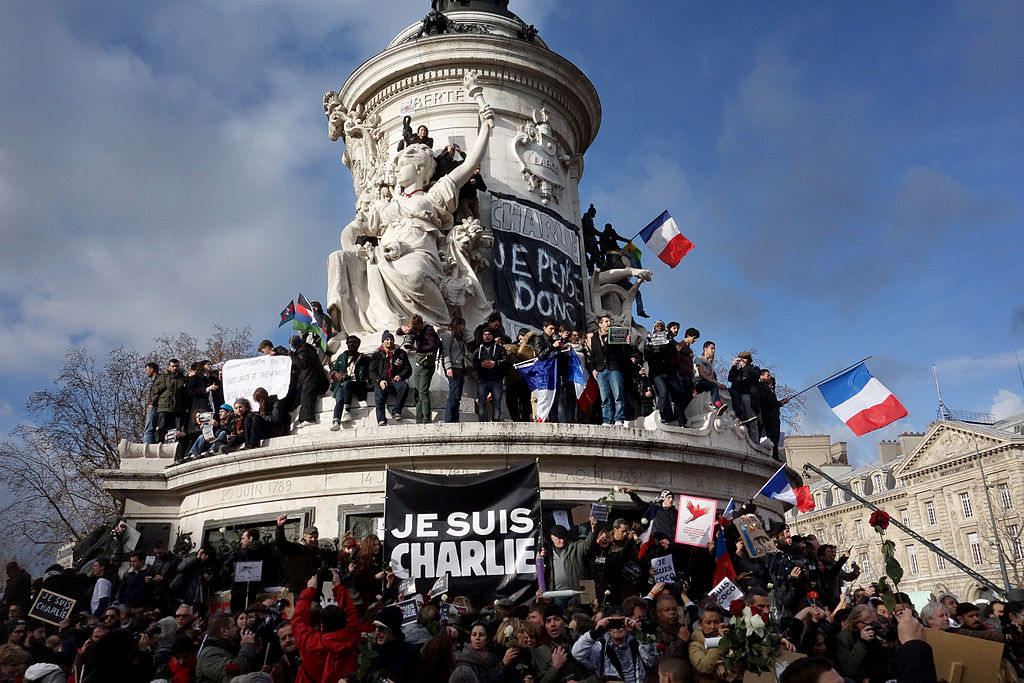
The 7th of this month marked two years to the day since two gunmen walked into the offices of the satirical magazine Charlie Hebdo in Paris and murdered twelve people. This period also therefore marks the second anniversary of the period of about an hour during which much of the free world proclaimed itself to be "Charlie" and attempted, by walking through the street, standing for moments of silence or re-tweeting the hashtag "Je Suis Charlie" to show the whole world that freedom cannot be suppressed and that the pen is mightier than the Kalashnikov.
So two years on is a good time to take stock of the situation. How did that go? Did all those "Je Suis" statements amount to anything more than a blip on the Twitter-sphere? Anyone trying to answer such a question might start by looking at the condition of the journal everyone was so concerned about. How has it fared in the two years since most of its senior editorial staff were gunned down by the blasphemy police?
Not well, if a test of the magazine's wellbeing is whether it would be willing to repeat the "crime" for which it was attacked. Six months after the slaughter, in July 2015, the new editor of the publication, Laurent Sourisseau, announced that Charlie Hebdo would no longer publish depictions of the Prophet of Islam. Charlie Hebdo had, he said, "done its job" and "defended the right to caricature." It had published more Muhammad cartoons in the issue immediately after the mass murder at their offices and since. But, he said, they did not need to keep on doing so. Few people could have berated him and his colleagues for such a decision. When just about every other magazine in the free world fails to uphold the values of free speech and the right to caricature and offend, who could expect a group of cartoonists and writers who have already paid such a high price to keep holding the line of such freedoms single-handed? Now, at the second anniversary of the atrocity, one of the magazine's most prominent figures, Zineb El Rhazoui, has announced that she is leaving the magazine. El Rhazoui, who has been described as "the most protected woman in France" because of the security detail she receives from the French state, has announced that Charlie Hebdo has gone "soft" on Islamic radicalism. She told Agence France-Presse that "Charlie Hebdo died on [7 January 2015]." The magazine had previously had a "capacity to carry the torch of irreverence and absolute liberty" she said. "Freedom at any cost is what I loved about Charlie Hebdo, where I worked through great adversity.' Of course, El Rhazoui is an unusual person. And a scarce one in twenty-first century Europe. Which is why she needs the security detail. Most of the people who said they cared about the right to say what they wanted when they wanted, about everything and anything -- including one particularly stern and unamused religion -- were willing to walk the walk: that is, they were willing to walk through Paris with a pencil in the air. Or they were willing to talk the talk, proclaiming "Je Suis Charlie." But almost no one really meant it. If they had, then -- as Mark Steyn pointed out -- those crowds in Paris would not have been parading through the streets holding pencils, but holding cartoons of Mohammed. "You're going to have to get us all" would have been the message. And ditto the leaders. If President François Hollande and Chancellor Angela Merkel had really believed in standing up for freedom of expression, then instead of walking arm-in-arm through Paris together with such an inappropriate figure as Palestinian Authority leader Mahmoud Abbas, they would have held up covers of Charlie Hebdo and said: "This is what a free society looks like and this is what we back: everyone, political leaders, gods, prophets, the lot can be satirised, and if you do not like it then you should hop off to whatever unenlightened hell-hole you dream of. But Europe is not the continent for you." Instead, in the two years since those gestures, European society went quiet. Of course, there have been regular opportunities to display the modern idea of virtue, often using Charlie Hebdo as the punching bag. Since being alerted to the existence of the magazine by the gunmen, the censorious types who now fill our societies (and who probably do not even buy or read magazines) nevertheless regularly send out social media messages objecting to things to which they have been alerted within the magazine. So it is that a rude and satirical magazine has found itself repeatedly judged by the humourless morality police of our day and often deemed to be insufficiently reverential about various world events. A Charlie Hebdo cartoon about the Cologne New Year's Eve sexual assaults was deemed in poor taste. Elsewhere, the publication's response to an earthquake in Italy failed to hit the single acceptable note in the eyes of some non-readers. Likewise the crash of a Russian jet and other stories that were considered to lack appropriate piety. Meantime, we are in a situation, as the British author Kenan Malik said of the period after the Satanic Verses affair, of having "internalised" the atrocity. The entire world press -- perhaps especially, in free countries -- has internalised what happened at Charlie Hebdo, and instead of standing united has decided, quietly and in the privacy of their own offices, never to risk something like that ever happening to them again. This new submission to Islamist terrorist demands is possibly why, in 2016, when an athlete with no involvement in politics, religion or satire was caught doing something that might have been seen as less than fully respectful of Islam, there was no one around to defend him. Even the British Prime Minister, Theresa May, asked in the House of Commons to stand up for the right of an athlete not to have his career destroyed because of one fleeting, drunken joke, equivocated: "This is a balance that we need to find. We value freedom of expression and freedom of speech in this country -- that is absolutely essential in underpinning our democracy.For the last two years, we have learned for certain that any such tolerance is a one-way street. Our societies had been walking up it. But from the other direction came the Kalashnikov brigade who only had to fire once; in the face of it, the whole civilised world chose to U-turn and run back the other way. Allah's blasphemy police would be foolish not to push the advantage that such capitulation gives their cause over the months and years ahead. Douglas Murray, British author, commentator and public affairs analyst, is based in London, England.
© 2017 Gatestone Institute. All rights reserved. The articles printed here do not necessarily reflect the views of the Editors or of Gatestone Institute. No part of the Gatestone website or any of its contents may be reproduced, copied or modified, without the prior written consent of Gatestone Institute.
|
Our goal is to have intelligent discussion of the topics of the day. We realize everyone has their opinion and they should be allowed to express it in a discussion forum without calling each other names. We learn from discussion and not from name calling or argument.We use cookies to personalise content and ads, to provide social media features and to analyse our traffic. We also share information about your use of our site with our social media, advertising and analytics partners. See details
Contact Form
Showing posts with label freedom of expression. Show all posts
Wednesday, January 18, 2017
Islam Does Not Allow Freedom Of Expression (For Those Who Do Not Agree) And World Leaders Are Feckless In Its Defense (Especially When It Comes To Islam)
Tuesday, June 21, 2016
When Freedom Of Expression Dies, The World Dies
How Much of our Culture Are We Surrendering to Islam?
It all occurred in the same week. A German judge banned a comedian, Jan Böhmermann, from repeating "obscene" verses of his famous poem about Turkish President Recep Tayyip Erdogan. A Danish theater apparently cancelled "The Satanic Verses" from its season, due to fear of "reprisals." Two French music festivals dropped Eagles of Death Metal -- the U.S. band that was performing at the Bataclan theater in Paris when the attack by ISIS terrorists (89 people murdered), took place there -- because of "Islamophobic" comments by Jesse Hughes, its lead singer. Hughes suggested that Muslims be subjected to greater scrutiny, saying "It's okay to be discerning when it comes to Muslims in this day and age," later adding:
"They know there's a whole group of white kids out there who are stupid and blind. You have these affluent white kids who have grown up in a liberal curriculum from the time they were in kindergarten, inundated with these lofty notions that are just hot air."As Brendan O'Neill wrote, "Western liberals are doing their dirty work for them; they're silencing the people Isis judged to be blasphemous; they're completing Isis's act of terror." A few weeks earlier, France's most important publishing house, Gallimard, fired its most famous editor, Richard Millet, who had penned an essay in which he wrote: "the decline of literature and the deep changes wrought in France and Europe by continuous and extensive immigration from outside Europe, with its intimidating elements of militant Salafism and of the political correctness at the heart of global capitalism; that is to say, the risk of the destruction of the Europe and its cultural humanism, or Christian humanism, in the name of 'humanism' in its 'multicultural' version."Kenneth Baker just published a new book, On the Burning of Books: How Flames Fail to Destroy the Written Word. It is a compendium of so called "bibliocaust," the burning of books from Caliph Omar to Hitler, and includes the fatwa on Salman Rushdie. When Nazis incinerated books in Berlin they declared that from the ashes of these novels would "arise the phoenix of a new spirit." The same hatred is coming from Islamists and their politically correct allies. We do not even have a vague idea of how much Western culture we have surrendered to Islam. Theo Van Gogh's movie, "Submission," for which he was murdered, disappeared from manyfilm festivals. Charlie Hebdo's drawings of the Islamic prophet Mohammed are concealed from the public sphere: after the massacre, very few media reprinted these cartoons. Raif Badawi's blog posts, which cost him 1,000 lashes and ten years in prison in Saudi Arabia, have been deleted by the Saudi authorities and now circulate like forbidden Samizdat literature was in the Soviet Union.
Molly Norris, the American cartoonist who in 2010 drew Mohammed and proclaimed "Everyone Draw Muhammad Day," is still in hiding and had to change her name and life. The Metropolitan Museum of Art in New York pulled images of Mohammed from an exhibition, while Yale Pressbanned images of Mohammed from a book about the cartoons. The Jewel of Medina, a novel about Mohammed's wife, was also pulled. In the Netherlands, an opera about Aisha, one of Mohammed's wives, was cancelled in Rotterdam after the work was boycotted by the theater company's Muslim actors, after it became evident that they would be a target for Islamists. The newspaper NRC Handelsbladheadlined its coverage "Tehran on the Meuse," the river that passes through the Dutch city. In England, the Victoria and Albert Museum took down Mohammed's image. "British museums and libraries hold dozens of these images, mostly miniatures in manuscripts several centuries old, but they have been kept largely out of public view," The Guardian explained. In Germany, the Deutsche Opera cancelled Mozart's opera Idomeneo in Berlin, because it depicted the severed head of Mohammed. Christopher Marlowe's "Tamburlaine the Great," which includes a reference to Mohammed being "not worthy to be worshipped," was rewritten at London's Barbican theater, while Cologne's Carnival cancelled Charlie Hebdo's float. In the Dutch town of Huizen, two nude paintings were removed from an exhibition after Muslims criticized them. The work of a Dutch Iranian artist, Sooreh Hera, was yanked from several Dutch museums because some of the photographs included the depictions of Mohammed and his son-in-law, Ali. According to this disposition, one day London's National Gallery, Florence's Uffizi, Paris' Louvre or Madrid's Prado might decide to censor Michelangelo, Raffaello, Bosch and Balthus because they offend the "sensibility" of Muslims. The English playwright Richard Bean has been forced to censor an adaptation of Aristophanes's comedy, "Lysistrata", in which the Greek women hold a "sex strike" to stop their men from going to war (in Bean's script, Muslim virgins go on strike to stop suicide bombers). Several Spanish villages stopped burning effigies of Mohammed in the commemoration ceremony celebrating the reconquest of the country in the Middle Ages. There is a video filmed in 2006, when the death threats against Charlie Hebdo became worrisome. Journalists and cartoonists are gathered around a table to decide on the next cover for magazine. They speak about Islam. Jean Cabu, one of the cartoonists later murdered by Islamists, puts the issue this way: "No one in the Soviet Union had the right to do satire about Brezhnev." Then another future victim, Georges Wolinski, says, "Cuba is full of cartoonists, but they don't make caricatures about Castro. So we are lucky. Yes, we are lucky, France is a paradise." Cabu and Wolinski were right. Democracies are, or at least should be, custodians of a perishable treasury: freedom of expression. This is the biggest difference between Paris and Havana, London and Riyadh, Berlin and Tehran, Rome and Beirut. Freedom of expression is what gives us the best of the Western culture. Thanks to the Islamists' campaign, and the fact that now only some "crazies" still venture in the exercise of freedom, are we now going to be just fearful? "Islamophobic" cartoonists, journalists and writers are the first Europeans since 1945 who have withdrawn from public life to protect their own lives. For the first time in Europe since Hitler ordered the burning of books in Berlin's Bebelplatz, movies, paintings, poems, novels, cartoons, articles and plays are literally and figuratively being burned at stake. The young French mathematician Jean Cavailles, to explain his fateful involvement in anti-Nazi Resistance, used to say: "We fight to read 'Paris Soir' rather than 'Völkischer Beobachter'." For this reason alone, it is self-defeating to quibble about the beauty of cartoons, poems or paintings. In the West, we have paid a high price for the freedom to do so. We should all therefore protest when a German judge bans "offensive" verses, when a French publisher fires an "Islamophobic" editor or when a music festival bans a politically incorrect band. Or is it already too late? Giulio Meotti, Cultural Editor for Il Foglio, is an Italian journalist and author. Related Video: Giulio Meotti on "The Death of Free Speech in Europe "
© 2016 Gatestone Institute. All rights reserved. The articles printed here do not necessarily reflect the views of the Editors or of Gatestone Institute. No part of the Gatestone website or any of its contents may be reproduced, copied or modified, without the prior written consent of Gatestone Institute.
|
Tuesday, May 12, 2015
Muslims Have No Problem Drawing Comics Of NON_Muslims But You Darn Better Not Draw One of Muhammad! A Bit Hypocritical?

This Cartoon
Sums Up the
Hypocrisy of
Muslims Being
Offended by
Drawings of
Mohammed
PERFECTLY
Like on Facebook
Ever since the Charlie Hebdo shooting —
and now with the incident that took place
in Garland, Texas over a week ago — it’s
become clear that the fastest way to make
a radical Islamist lose their mind is to draw
a picture of the prophet Mohammed, the
founder of their religion.
and now with the incident that took place
in Garland, Texas over a week ago — it’s
become clear that the fastest way to make
a radical Islamist lose their mind is to draw
a picture of the prophet Mohammed, the
founder of their religion.
People have been shot to death over these
drawings, with angry radicals claiming they
were just so darn mad by how “offensive”
these images were, they just couldn’t help
but slaughter innocent people for their
artistic expressions.
drawings, with angry radicals claiming they
were just so darn mad by how “offensive”
these images were, they just couldn’t help
but slaughter innocent people for their
artistic expressions.
Of course, the same courtesy and respect
Muslims demand is rarely — okay, practically
never — extends to anyone else’s religious
beliefs or iconic figures, particularly if you’re
a Jew or Christian.
Muslims demand is rarely — okay, practically
never — extends to anyone else’s religious
beliefs or iconic figures, particularly if you’re
a Jew or Christian.
In fact, this little cartoon here sums up the
hypocrisy perfectly.
That pretty much says it all doesn’t it?
It’s okay for angry radicals to misrepresent
and mischaracterize an entire group of people,
but heaven forbid if someone should draw a
picture of Mohammed.
and mischaracterize an entire group of people,
but heaven forbid if someone should draw a
picture of Mohammed.
How amazing is it that these nuts don’t seem
to see the inherent hypocrisy of their own
actions?
to see the inherent hypocrisy of their own
actions?
You truly have to be brainwashed and blinded
to reality not to see it, because buddy, it’s
glaringly obvious to anyone with a brain.
to reality not to see it, because buddy, it’s
glaringly obvious to anyone with a brain.
Freedom of expression is a bedrock principle
of a thriving society, and the fact Sharia law
stifles artistic endeavors is part of the reason
why societies under Islamic rule stop growing
and advancing.
of a thriving society, and the fact Sharia law
stifles artistic endeavors is part of the reason
why societies under Islamic rule stop growing
and advancing.
Maybe one day this fact will actually sink in
and cause people to abandon this system of
oppressive laws and principles, opting for
freedom and personal responsibility instead.
and cause people to abandon this system of
oppressive laws and principles, opting for
freedom and personal responsibility instead.
Thursday, June 5, 2014
If Reid Is So Concerned About Money In Politics, How Come He Only Talks About Republicans, Not Democrats?
Pay To Play: The Constitution Under Siege

PHOTOS.COM
I’d be well within my rights if I wanted to spend hundreds of thousands of dollars buying billboards, TV ads and mailers proclaiming so-called “global warming” to be the greatest threat to humanity since Josef Stalin and Mao Zedong battled for the genocide world title. In fact, I’d be well within my rights — and no less wildly off the mark — if I decided to blow a couple million dollars on a worldwide advertising campaign to warn people against the dangers of rabid Yetis.
It’s my money; who the hell are these so-called “progressives” to tell me how I should spend it? As far as I’m concerned, Senator Harry Reid’s opinion of my spending habits means as much to me as my opinion of his pathological mendacity, bid-rigging and nepotism means to him. And that’s as it should be. The Bill of Rights opens with the freedom of expression. And if I want to give millions — or even billions — of dollars to inexplicably tax-exempt, albeit un-audited, hate groups, then that’s my expressing myself. If I don’t have a pile of cash to throw at Moveon.org, then that’s my bad luck for not being George Soros.
According to the Democrats, they’ve had it with money in politics. In fact, they’re so tired of the undue influence wielded by the privileged few that they’ve taken to demanding a Constitutional amendment to overturn the Supreme Court’s decisions in Citizens United andMcCutcheon. In fact, the Democrat-dominated Senate Judiciary Committee held a hearing Wednesday on Senator Tom Udall’s (D-N.M.) proposed Constitutional amendment to give Congress control over campaign finance. Specifically, the Udall amendment states:
Congress shall have power to regulate the raising and spending of money and in-kind equivalents with respect to Federal elections, including through setting limits on–(1) the amount of contributions to candidates for nomination for election to, or for election to, Federal office; and(2) the amount of funds that may be spent by, in support of, or in opposition to such candidates. …
The guys who live cozy and warm in the pockets of big-money special interests are going to end the undue influence of big-money special interests by giving more power to the guys who live cozy and warm in the pockets of big-money special interests. I feel better already. And how about that Udall, man of the people? He’s a dedicated servant of the poor huddled masses, who are yearning to live just half as well as Udall does, who has managed to accumulate a personal net worth of somewhere in the neighborhood of $3 million without working outside the public sector for most of his adult life. And he’s mere pauper compared to some of his colleagues. The average personal net worth of a Democratic Senator is currently about $13 million.
Look, I’m as bothered as you are by the idea that our politicians are pretty much human motels whose “vacancy” signs are lit 24/7/365. But I’m just as bothered by the idea that I have to endure lectures on the topic of money in politics from people who have to lift their heads out of the trough to deliver the same. The only differences between common hookers and people like Reid are:
- Reid spends more on his clothing.
- You’re less likely to contract something itchy from a hooker.
- Also hookers leave when it’s over.
Note that Reid’s personal net worth has jumped into 8 figures despite collecting government paychecks since before I was born.
Let’s pretend for a moment that Reid actually cares about John Q. Public. Reid is a senior member of the Senate. He’s so well-entrenched in his seat that he could probably get caught with both the proverbial live boy and dead girl and still get re-elected with 60 percent of the vote. The same is true for Udall and most of the rest of the Democratic leadership. And that begs the question: If they’re serious about looking out for the little guy, then what’s stopping them? But if Reid is so worried about the plight of regular schmoes, then why should it matter to him whether they have enough money to arrest his attention? And why should they trust a guy who has yet to dent the influence of big money in politics despite 45 years in politics? Why should anyone?
Wednesday, April 2, 2014
Freedom Of The Internet Severely Restricted in Turkey. This Is That Government's Reaction To The Truth Being Told. They Join China, Iran, Syria, North Korea And Pakistan.
US Congress members call on Turkey to restore access to social media
RELATED NEWS
2 April 2014, Wednesday /TODAY'S ZAMAN, ANKARA
In a resolution introduced in the US House of Representatives on Tuesday, four members of Congress have stressed the critical role of Internet freedom in promoting democracy and called on the Turkish government to lift the recent restrictions on social media.
Representative Anna G. Eshoo, ranking member of the Communications and Technology Subcommittee and three key members of the Foreign Affairs Committee, Reps. Tom Marino, Joe Kennedy III and Bill Keating, stressed the importance of an independent, unfettered media and freedom of expression in the resolution.
The Turkish government blocked access to popular video sharing platform YouTube last week, hours after a leaked voice recording allegedly featuring the voices of Turkey's foreign minister, intelligence chief and a top army general discussing a possible intervention in neighboring war-torn Syria was uploaded onto the site. The ban came a week after Twitter was blocked.
The representatives mentioned that Twitter is blocked only by China, Iran, North Korea, Syria and Turkey and YouTube by China, Iran, Pakistan and Turkey, and underlined that technology and social media play a critical role in providing access to information and supporting accountability.
The four representatives expressed their views about the resolution in a press release on Tuesday. Eshoo said that Twitter and YouTube have enhanced freedom of expression and freedom of the press and noted that the resolution shows that the representatives stand united against actions that restrict Internet freedom in Turkey and around the world.
Marino emphasized that the resolution will send a strong message to Turkey, urging the country to protect its citizens' rights to express themselves, assemble peacefully and allow a free and fair press.
Foreign Minister Ahmet Davutoğlu defended the country's move to block access to YouTube, citing national security concerns. However, stressing that social media outlets play a critical role in providing millions of ordinary citizens with access to the political process, Kennedy said that Turkey's restrictions on basic freedoms are a threat to democracy.
Keating said the Turkish government needs to exert more effort to show the strength of its democratic institutions and noted that reversing the decision to ban social media would be a positive step to restore the trust of the Turkish population and the international business community. “Attempts by Prime Minister [Recep Tayyip] Erdoğan or other Turkish government officials to diminish rule of law or quell perceived challenges to their authority by banning social media is simply unacceptable,” Keating added.
Senator Chris Murphy, a Democrat from Connecticut and chairman of the US Senate Committee on Foreign Relations' Subcommittee on European Affairs, and Republican Senator from Wisconsin Ron Johnson, the ranking member on the subcommittee, introduced a resolution condemning the Turkish government for blocking social media sites like Twitter and YouTube, and restricting the free expression of Turkish citizens on March 27.
Murphy drew attention to Turkey's ambition of European Union membership, saying that Turkey needs to respect its citizens' right to exercise basic democratic freedoms if it wishes to be part of the union. “The Turkish shutdown of Twitter and YouTube for political purposes shows the danger of foreign governments gaining control over this incredible forum for liberty,” Johnson said.
Another criticism was raised with by 34 members of the House in a letter to US President Barack Obama on March 28. They expressed their concerns over recent anti-democratic moves by Erdoğan's government, such as blocking social media in the country and urged the White House to demand that Turkey promote democratic values and protect the ability of its citizens to exercise all of the freedoms that serve as the foundation of democratic societies.
Labels:
Ann Eshoo,
China,
conservative blogs,
conservative musings,
Conservative Tom,
Erdogan,
facebook,
freedom of expression,
House of representatives,
Iran,
North Korea,
Pakistan,
syria,
Turkey,
Twitter
Subscribe to:
Posts (Atom)