Contact Form

Name

Email *

Message *

Showing posts with label Arab league. Show all posts

Wednesday, April 26, 2017

It It Is Time For All People Stand Up Against BDS, Not Just Scientists

Share on FacebookTweet about this on TwitterShare on Google+Email this to someone
http://israel-commentary.org/scientists-take-…ycotts-of-israel/ ‎
By Professor Ruth R. Wisse
The Wall Street Journal
April 20, 2017
How can scholars reconcile opposition to the Trump travel ban with blacklists aimed at the Jewish state?
More than 100 Boston-area researchers in health care and life sciences released a statement April 13 in defense of “the liberal ideals which have shaped our democracy” and in support of “the free flow of ideas and information” that is central to their work.
Why affirm something so obvious? To stop academic blacklisting by the Boycott,
Sanctions and Divestment movement, which targets Israeli universities and scholars.
Attempts to isolate Israel and its educational institutions aren’t new. In 1945 the Arab League declared that all Arab institutions and individuals must “refuse to deal in, distribute, or consume Zionist products of manufactured goods.”
The original boycott soon extended to entities that traded with Israel. This did great economic and political damage until the U.S. Congress in 1977 prohibited American companies from cooperating with it, as some were doing. Only U.S. prohibition of the prohibition had the force to guarantee free international trade.
In 2002, a group of professors from Harvard and the Massachusetts Institute of Technology were among the first academics to advocate divesting from Israel.
Two years later the Palestinian Campaign for the Academic and Cultural Boycott of Israel was founded with the explicit purpose of isolating Israeli academics and institutions. Its goal was to deny Israeli scholars access to scholarly conferences, journals and employment opportunities. The boycott also includes keeping unwelcome speakers and information from campus to maintain Israel as the permanent object of blame.
The campaign’s efforts paid off in the U.S., where the American Studies Association and the National Women’s Studies Association approved boycotts in 2013 and 2015, respectively.
Academic associations that have so far voted such resolutions down—the American Anthropological Association, Modern Language Association and American Historical Association—introduce new ones every year.
Only through a concerted effort by school administration can universities remain free spaces. Jewish students should not be expected to bear the full brunt of attack by those who import the Arab-Muslim war against Israel into the American campus.
Researchers in science and medicine have a special interest in opposing a boycott that tries to destroy the benefits of shared ideas and knowledge. Although people in the sciences do not normally issue collective political statements, signatories of the recent letter cite the collaboration of Israeli scientists in lifesaving treatments as reason enough to protest the blacklist. Their statement condemns boycotts that contravene core democratic values and threaten “the free flow of information and ideas,” which functions as “the lifeblood of the academic world.”
The Boston group’s aim is similar to those of recent academic protests against President Trump’s temporary travel ban. A friend-of-the-court brief filed by 17 universities affirms that students from the six suspect countries could have much to contribute by “making scientific discoveries, starting businesses, and creating works of literature and art that redound to the benefit of others” far beyond university campuses.
If universities are willing to fight the government’s travel ban against students from Muslim-majority countries, why are members of their faculties fighting to prevent exchange with academic counterparts in the Jewish homeland?
American academics ought to entertain pluralistic and multicultural perspectives and refrain from cutting themselves off from those with whom they disagree. Universities cannot pretend to be protecting the free flow of information while their faculty members try to prevent interaction with the most dynamic academic center in the Middle East.
The restrictions the Trump administration placed on potentially hostile immigrants were intended to prevent attacks on America’s liberal democratic way of life.
Meantime, the goal of the BDS campaign is to attack the freest democracy in the Middle East. Not coincidentally, Iran and Syria, two countries singled out by the travel ban, are also dedicated to the destruction of Israel.
The repressive tactics of BDS proponents resemble the strategy and destructive aims of those who threaten the U.S.
Perhaps the academics who signed the statement in defense of liberal ideals can help stop the aggression against Israel in academia, a place that, in their words, promotes “the dialogue and cooperation essential to advancing knowledge, solving problems, and promoting understanding.”
The rest of the academic community and all who benefit from its labors would be grateful.

Tuesday, March 31, 2015

Arabs Setting Up Military Force, Not To Fight Israel, But To Stop Iran And ISIS. Will Wonders Ever Cease?

With Eye on Iran and ISIS, Arab Leaders Agree to Set Up Joint Military Force

March 30, 2015 - 4:16 AM


arab-leaders
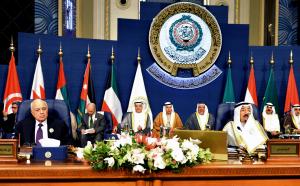
Saudi King Salman at the 26th Arab League summit in Sharm el-Sheikh, Egypt on Sunday, March 29, 2015. (Photo: SPA)
(CNSNews.com) – Sixty-five years after a group of Arab nations signed a mutual defense treaty whose primary target was the newly-reestablished state of Israel, Arab leaders agreed Sunday to activate it by setting up a joint military force.
The move comes amid spreading Islamic extremism and Iranian muscle-flexing in the region.
The in-principle decision was made at an Arab League summit in Sharm el-Sheikh, Egypt, where the leaders agreed the envisaged force should respond quickly to threats, including terror threats, facing any Arab state.
A final communique called for “coordination, efforts and steps to establish an unified Arab force,” and Arab League Secretary-General Nabil al-Arabi was tasked to confer with member states’ military chiefs within a month to work out details. In acknowledgement that not all members are equally eager, it was decided that individual countries’ participation will be voluntary.
The main impetus for the initiative has come from the two most powerful Arab nations, Egypt and Saudi Arabia.
Recent months have seen both Egypt and Saudi Arabia launch military action beyond their borders – in the former case targeting Islamist militia and Islamic State of Iraq and Syria (ISIS) terrorists in Libya; in the latter case, as head of a coalition which last week began airstrikes against Iranian-backed Shi’ite militia in Yemen.
How much support the two can draw from other members of the 22-nation Arab League remains to be seen, although Egyptian President Abdel Fattahel-Sisi has indicated that Jordan, the United Arab Emirates and Kuwait are keen.
Even before Sunday’s decision, the Saudi-led campaign against the Houthi militiamen who have sought to overrun Yemen succeeded in bringing together another eight Arab states – the UAE, Kuwait, Qatar, Bahrain, Jordan, Egypt, Morocco and Sudan – as well as Pakistan.
A communique issued by the leaders after the summit reflected the shifting priorities for many of them. Although the Israeli-Palestinian issue was discussed – as it invariably is when Arab leaders meet – the topics drawing the most attention were the joint military force proposal and the crises in Syria, Libya and Yemen, whose ousted President Abed Rabbo Mansour participated in the meeting.
Iran’s regional activities were also a focus. As an “external supporter” of the Houthis, Iran was accused of “arousing sedition,” dismantling Yemen’s social fabric, and threatening its security as well as the security of the wider region. Saudi King Salman called the Houthi rebellion “the biggest threat to the stability and security of the region.”
The leaders also slammed Iran’s conduct on three strategically-located Persian Gulf islands which Iran has controlled for 44 years in the face of UAE sovereignty claims.
On major reason for regional concerns about the anarchy in Yemen and perceived Iranian destabilization is the country’s location at the southern entrance to the Red Sea, triggering fears about the security of oil and other shipments through the Red Sea and Suez Canal.
Iran denies that it is supporting its fellow Shi’ites in Yemen but Saudi Arabia, Iran’s main regional rival, does not buy the denials.
“The Houthis are ideologically affiliated with Iran,” Saudi Ambassador to Washington Adel al-Jubeir told CBS’ “Face the Nation” on Sunday. “The Iranians have provided them with weapons. The Iranians have provided them with advisers and the Iranians have provided them with money.”
The mostly Sunni Arab states are also troubled by Iran’s support for Syrian President Bashar al-Assad, and the influence it enjoys in Lebanon and Iraq.
The Arab League decision to move ahead with the joint force proposal comes as the U.S. and other world powers are pushing to finalize a framework agreement over Iran’s nuclear program.
Most of the Arab nations are leery of Tehran’s regional ambitions (Shi’ite-majority Iraq is an exception, as is Syria’s Assad regime, which as a result of the civil war has been suspended from the Arab League since 2011) and some have expressed misgivings about the prospect of a less-than-watertight nuclear deal.
“I believe everybody wants a deal, but everybody wants a good deal,” al-Jubeir said on the CBS show.
“We have been assured by the United States, by Secretary [of State John] Kerry when he met with the foreign ministers of the GCC [Gulf Cooperation Council], that the deal that they intend to negotiate would prevent Iran from acquiring an atomic bomb,” he said.
“It would close all paths leading to an atomic bomb. It will limit substantially Iran’s ability to do research and enrich. And it will impose intrusive and continuous inspections on Iran in the future. Now, we hope this is – this will be the case. But we really will not know until we see the details. And I don’t believe the details have been worked out yet.”
In calling for a joint military force the Arab League is citing its Treaty of Joint Defense and Economic Cooperation, drawn up in 1950 with seven original signatories – Egypt, Saudi Arabia, Jordan, Syria, Iraq, Lebanon and Yemen. An attack on one would be regarded as an attack on all.
The original focus was on Israel, which two years earlier had defeated an attempt by forces from six of those countries to destroy the newly-declared Jewish state.
Over the ensuing decades conflicting interests and distrust prevented the initiative from taking off, and most Arab attempts at collective defense have been viewed as a failure.
But the instability resulting from the so-called “Arab spring” uprisings in Egypt, Libya, Syria and Yemen, the rise of ISIS, and concerns about Iran’s behavior and strategic aims have breathed new life into the notion of a joint military response to growing regional challenges.

Wednesday, July 9, 2014

Hamas Rockets Hit Israel Yet EU And Arab League Blame Israel For Retaliating! Up Truly Has Become Down!

IDF Strikes Major Blow to Gaza Terrorists as Rockets Reach Israel’s North

“For you bless the righteous, O Lord; you cover him with favor as with a shield.” (Psalm 5:12)
A little more than 24 hours in to Operation Protective Edge, the IDF on Tuesday struck 160 terror targets in Gaza, bringing the total number of targets struck to 435. The strikes were carried out by the Israeli Air Force and Israeli Navy.
On Tuesday, Red Alert sirens sent citizens along the coastal and southern region into bomb shelters, as well as residents of Tel Aviv, Herzliya, Beit Shemesh and Jerusalem. Tuesday evening, for the first time since Operation Pillar of Defense in 2012, the Iron Dome Missile Defense system shot down two rockets over the Tel Aviv.
idf m302 rocket iran gaza terrorHamas announced that it dedicated the rocket fire on Tel Aviv to 16 Egyptian soldiers who were killed in an August 2012 attack in which Palestinian terrorists used two Egyptian armored vehicles to infiltrate Israel.
Tuesday evening, four Hamas terrorists attempted to infiltrate Israel via an amphibious landing along the southern coast. The terrorists were intercepted and neutralized by an IAF helicopter. [To watch the real-time footage, click here.]
In one round of salvos late Tuesday evening, rockets hit as far north as Hadera, which is located 45 kilometers (28 miles) north of Tel Aviv and south of Haifa. Officials believe that the rockets used are most likely the M302, the same model which was infamously intercepted in March by the IDF in a secret shipment sent from Iran to Gaza. The M302 has a range of 200 kilometers (125 miles).
Wednesday afternoon, Red Alert sirens sounded in Zichron Ya’akov near the Carmel mountain range some 35 km (22 miles) south of Haifa. Zichron Ya’akov lies 120 km (75 miles) north of Gaza. A hit was reported, marking the northernmost point of attack by terrorists in the two day old operation.
Some 120 rockets were shot towards Israel on Tuesday alone. As of Wednesday morning, it is believed that 225 rockets have been shot into Israel by Gaza terrorists since the beginning of Operation Protective Edge.
On Wednesday, explosions could be heard when Iron Dome intercepted an additional five rockets over Tel Aviv Wednesday morning. Since the beginning of Operation Protective Edge, Iron Dome has intercepted 60 rockets fired by terrorists in the Strip aimed for Israeli civilian centers.
According to the IDF, targeted airstrikes overnight Tuesday took out a “senior commander” of the Al-Quds Brigades, the military wing of the Islamic Jihad terror organization. In a statement released by the IDF Spokesperson Unit, Hafaz Hamad, 37, was neutralized in the strike and was a major player in rocket fire on Israel.
The statement added that of the 160 terror targets hit on Tuesday, 10 were terror tunnels used for smuggling and six were Hamas command centers, including the terror groups internal security offices and national security offices.
The IDF confirmed that the strikes took out 118 concealed rocket launchers, including medium and long-range rockets. Significant damage has been inflicted to the rocket launching infrastructure of Hamas and Islamic Jihad.

Rocket attack in the middle of wedding in Israel, July 8, 2014

While Israel has offered Hamas a cease-fire agreement, the terror group has refused to stop its violence against the Jewish state. As a result, the Israeli Cabinet has approved an IDF request to call up as many as 40,000 reserve combat troops in anticipation of a sweeping ground assault on the Strip.
As of Tuesday afternoon, the IDF immediately called up 15,000 reservists to the Gaza border.
Israeli Prime Minister Benjamin Netanyahu has made clear that “the gloves are off” when it comes to Hamas.

Raw footage of missiles shot by Hamas militants

Deputy Defense Minister Danny Danon has called on Israel to “stop the supply of electricity and fuel to the Gaza Strip immediately. It cannot be that on the one hand we fight Hamas, and on the other hand we transfer electricity and fuel for the transport of missiles launched at Israeli cities.”
“In the campaign against Hamas, we need to use all the levers we have in our hands in order to make it ask for a ceasefire,” he added.
Black smoke rises following an Israeli air strike on the Gaza International Airport in Rafah, southern Gaza, on July 7, 2014. Israeli air strikes on Gaza killed eight Palestinian militants, after tunnels collapsed in Rafah. (Photo: Abed Rahim Khatib/Flash90)
Black smoke rises following an Israeli air strike on the Gaza International Airport in Rafah, southern Gaza, on July 7, 2014. (Photo: Abed Rahim Khatib/Flash90)
Of no surprise, however, is the outpouring of condemnation against Israel. The Arab League has called for an emergency UN Security Council session to discuss the “dangerous Israeli escalation” in Gaza.
Secretary General of the Arab League Nabil al-Arabi told AFP, “The continued attacks on Palestinian civilians by Israel is a flagrant violation of international humanitarian law, the Geneva Convention and international resolutions on occupied Palestine.”
The European Union’s Foreign Affairs Office issued a condemnation of rocket fire into Israel and the IDF’s retaliation against the ongoing rocket fire.
“We are following with grave concern the rapidly deteriorating situation in the South of Israel and the Gaza Strip,” an EU spokesperson stated. “The EU deplores the growing number of civilian casualties, reportedly among them children, caused by Israeli retaliatory fire.”

Read more at http://www.breakingisraelnews.com/17954/idf-strikes-major-blow-gaza-terrorists-rockets-reach-israels-north/#OPp62S7o88EDe62K.99

Thursday, March 27, 2014

Will Arab League Torpedo Of "Jewish Homeland" Effectively End Mideast Peace Negotiations? Nope Kerry Will Press Israel To Make The Impossible Decisions. Will He Cave?

Arab League rejects Israel as Jewish homeland

Associated Press 
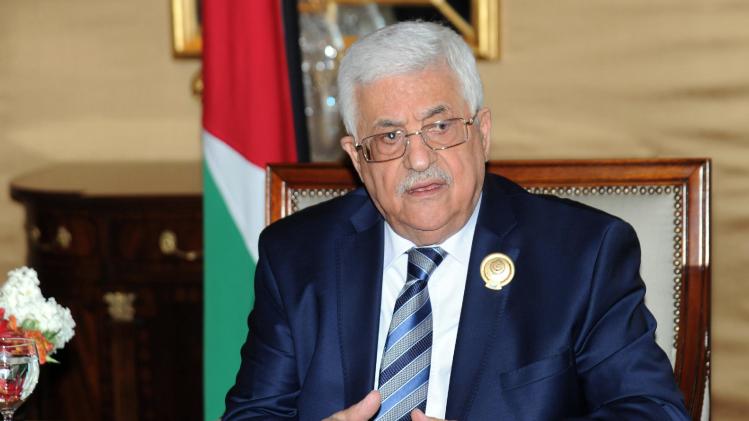
Palestinian President Mahmoud Abbas taks to journalists during a press conference on the sidelines of the Arab League Summit at Bayan Palace, Kuwait on Wednesday, March 26, 2014.(AP Photo/Nasser Waggi)
.
View gallery
  • .
  • .
  • .
  • .
KUWAIT CITY (AP) — Arab leaders said Wednesday they will never recognize Israel as a Jewish state, blaming it for a lack of progress in the Mideast peace process.
The announcement by the Arab League was a rejection of a key demand of Israeli Prime Minister Benjamin Netanyahu and a boost to Palestinian President Mahmoud Abbas in the faltering negotiations.
Netanyahu believes there can be no peace with the Palestinians without recognition of Israel as the homeland of the Jewish people. The Palestinians oppose this, saying it harms the rights of Palestinian refugees displaced from what is now Israel, as well as those of Israel's large Arab minority.
The statement, at the end of a two-day League summit in Kuwait, also rejected what it described as the continuation of Jewish settlement building in the West Bank and the "Judaization" of Jerusalem. Hundreds of thousands of Israelis now live in the West Bank and east Jerusalem, captured territories claimed by the Palestinians, and settlement construction has continued throughout the negotiations.
"We hold Israel entirely responsible for the lack of progress in the peace process and continuing tension in the Middle East," the communique said. "We express our absolute and decisive rejection to recognizing Israel as a Jewish state."
It said the League rejects what it said is the "the continuation of settlements, Judaization of Jerusalem, attacks on its Muslim and Christian shrines and changing its demographics and geography."
Wednesday's announcement set the stage for Abbas to take a tough line in talks later in the day with U.S. Secretary of State John Kerry in Jordan.
Kerry arrived in Jordan on Wednesday in hopes of jump-starting the foundering peace talks. He is meeting with King Abdullah II before a working dinner with Abbas. A State Department spokeswoman said Kerry also would talk with Netanyahu in the next few days.
In Kuwait, Abbas delivered scathing criticism of Israel in an address to the summit late on Tuesday, saying it was staging a "criminal offensive" to step up settlement building in Jerusalem and the West Bank.
"It is carrying out demolitions (of Palestinian homes), arrests, siege and strangling the Palestinian economy as a prelude to imposing a final settlement to the Palestinian issue that conforms with Israeli conditions and requirements," he said. He also accused Israel of deliberately trying to foil U.S. efforts to reach an agreement.
"And that is not all, it has come up with new conditions that had never been heard before like recognizing it as a Jewish state, something that we reject to even discuss," he said.
In Israel, a senior official said Abbas threatened to "torpedo the peace process" and paraded "rejectionism as a virtue."
"By reiterating his adversarial maximalist position, Abbas is undermining President (Barack) Obama's vision of peace and torpedoing Secretary Kerry's efforts to move the process forward," said the official, speaking on condition of anonymity because he was not authorized to discuss the matter with the media.
After a nearly five-year break, Israel and the Palestinians relaunched peace talks last July, agreeing to talk for nine months.
But the current round, brokered by Kerry, has faced daunting challenges as both sides spar over the drawing of future borders, the status of Palestinian refugees, security arrangements and Israel's demand that it be recognized as a Jewish state.
After months of deadlock, Kerry has given up hopes of brokering a deal and is scrambling to persuade the sides to agree to extend talks beyond his original April deadline.
The Palestinians seek the West Bank, east Jerusalem and the Gaza Strip — territories captured by Israel in the 1967 Mideast war — for a future state. They have demanded that a future border with Israel be based on the pre-1967 lines, allowing small changes through negotiated land swaps.
Netanyahu has refused to accept the 1967 lines as the basis for talks and says he will never relinquish east Jerusalem — home to the city's most sensitive holy sites.
___
Associated Press writer Josef Federman contributed to this report from Jerusalem.

Wednesday, May 1, 2013

Arab League Offers Smoke Screen

The naivete of the Obama Administration is so extreme that it is dangerous.  They are trying so hard to get a peace agreement that they will accept anything that the Arab League offers and then "force" Israel to agree.  The pressure that will be placed on Netanyahu will be tremendous. Will it be in the best interests of Israel, hardly. It will be all about Obama.

Conservative Tom

'No and no!!'

Arlene Kushner - Independent Journalist,  April 30th, 2013

It gets more and more awful.  More disgusting.  More distorted.

The Times of Israel has the following headline this morning:

“In sea change, Arab League backs land swaps in peace talks”

http://www.timesofisrael.com/in-sea-change-arab-league-backs-land-swaps-in-peace-talks/

A sea change is defined as a marked change or a transformation.  But what we're looking at here is nothing of the sort.

Members of the Arab League, representing seven Arab nations, met with top US officials yesterday in Washington.  The topic of discussion was the “peace process” and ways in which the Arab nations might advance it.

After the League delegation huddled for consultations at Blair House, Qatari Prime Minister Sheik Hamad Bin Jassem Al Thani announced “the possibility of 'comparable,' mutually agreed and 'minor' land swaps between the Israelis and the Palestinians.”

Note that “land swamps” are not agreed to firmly in principle.  There is a “possibility” of support for this, which means at the end of the day they might say, “Sorry, we won't do this after all.”  After all, only seven of 22 nations of the League were represented here.

And even if they were to agree, in any case it would be “minor” swaps only.  Piddling. Only piddling.

Most importantly, this entire notion is predicated upon an erroneous and unacceptable concept.

~~~~~~~~~~

Secretary of State Kerry, who seems to have staked his entire professional (sic) reputation on succeeding with the “peace process,” gushed:

“We’ve had a very positive, very constructive discussion over the course of the afternoon, with positive results…”

He praised the League for the “important role it is playing, and is determined to play, in bringing about a peace in the Middle East.”

~~~~~~~~~~

A bit of background is in order here:

The Arab League “Peace Plan” had originally been advanced by Saudi Arabia in 2002, then was adopted by the League, and subsequently “re-endorsed” by the League in 2007.  It was, and is, a horror:

If Israel will surrender all lands acquired in 1967, and provide for a “just” settlement of the Palestinian Arab refugee problem, based on UN General Assembly Resolution 194 — which the Arab world interprets as giving the “refugees” “right of return,” when in fact there is no such thing — then the Arab world will “normalize” relations with Israel.  No specification of what normalization means re: diplomatic, security, economic interaction and ties.

Translation: If you will surrender the Temple Mount, and the Kotel, and the Tomb of the Patriarchs in Hevron, and Shilo, and much more, including the Golan Heights.  And if you will return to the 1967 line [the Green Line], which, admittedly, was recognized by Security Council Resolution 242, passed after the Six Day War, as not providing a secure border.  And in addition, if you will take within your borders millions of so-called refugees, rendered radical and hostile by decades of UNRWA influence.  Then all 22 of the Arab states — and not just “Palestine” — will have some sort of ties with you.    

This was touted as a great opportunity for Israel, which would secure “normalization” with the whole Arab world in one fell blow.

There were to be no negotiations with this plan.  It was a take-it-or-leave-it deal.

~~~~~~~~~~

Israel rejected it out of hand.  Israel has legitimate rights to Judea and Samaria, based on a heritage that is more than 3,000 years old, as well as legally binding resolutions in the twentieth century, notably the Mandate for Palestine. Israel will never return to the '67 line — which, in addition to everything else, provides insufficient strategic depth for adequate security.  Resolution 242 says the final border of Israel must be determined by negotiations.  Agreeing to pull back without negotiations is not the way to go.

~~~~~~~~~~

For years now, the Palestinian Authority and its supporters have promoted the idea that the '67 line is Israel's “real” border, and that everything on the other side “belongs” to the Palestinian Arabs.  It is a crock. A myth.  But unfortunately — because successive Israeli governments have not been vigorous enough in countering this — it has become accepted thinking in many places.

It is this myth, this crock, upon which the Arab League fashioned its “peace proposal.”

And, more recently, it has been President Barack Obama who has advanced proposals based on the same myth.  Has he swallowed it whole, so that he really believes it?  There is no way to be certain, although there is ample reason to suspect so.  We only know what he says.

Obama's only deviation from the stipulation of return to the '67 line is the concept of “agreed-upon swaps” of land.  This means the principle of the '67 line as Israel's legitimate border is retained but if Israel wants to hold on to a community that, say, spreads over two square kilometers east of the line, then “Palestine” will be given two square kilometers of land west of the line, inside of Israel.  In the end, Israel will be defined by an area no greater than what rests within the '67 line.

No and no!!

~~~~~~~~~~

For the record, and this is terribly important: the '67 line, or Green Line, was, with very minor adjustments, the 1949 armistice line.  It is the line that was drawn when Israel and Jordan stopped fighting, at the end of the War of Independence: Israel fought that war defensively, having been attacked by the Arab nations on the day she declared independence.  It is referred to as the “'67 line” because Israel was behind that line until June 1967, when the Six Day war was fought.

The armistice agreement signed between Jordan and Israel stipulated that the line was temporary and that the permanent line would be determined by negotiations.  Actually, this stipulation was put in at Jordan's insistence.  And, please, note that it WAS Jordan on the other side of the line — the nation with which, it was presumed, Israel would ultimately negotiate. There was no talk of “Palestine” or a “Palestinian people” with whom Israel had to negotiate.  Whatever existed on the other side of the armistice line, it certainly wasn't a Palestinian state, or land defined as belonging to a Palestinian people.

How Israel could be required to “return” Judea and Samaria to the Palestinian Arabs is a genuine mystery.  The historical situation has been distorted:  It has morphed from the reality into what people of a certain political bent wish it to be.

You will be doing Israel an enormous service if you circulate this information — this historical clarification — as broadly as possible.

If you see reference in news sources to “Israel's '67 border,” send a correction: It was never a border, it was an armistice line, and it was temporary; both the armistice agreement with Jordan and the subsequent UN Security Council Resolution 242, called for negotiations to determine Israel's final eastern border.

~~~~~~~~~~

What I see is that Kerry went to these Arab League members and asked them for some flexibility so that he might move ahead with the infernal process. And, to his delight, they delivered.  Not only delivered, but stated themselves willing to go along with parameters outlined by the president.

At a press conference, Kerry declared:

“The US and Arab League delegation here this afternoon agreed that peace between Israelis and Palestinians would advance security, prosperity, and stability in the Middle East. And that is a common interest for the region and the whole world…”

Well, then, it's the Arab world that sees eye-to-eye with President Obama, yes? And Israel?

We can anticipate that the secretary will now turn to Israel with a request/a veiled demand for more “flexibility,” for the sake of stability in the Middle East.  But what has been tentatively proposed is no more acceptable to Israel than the previous formulation of the Arab League plan, or only very minutely so. (Now, presumably, there would be some negotiations to determine the “minor swaps.”)

The essential premises of the plan remain as unsatisfactory, and as faulty as a basis for peace, as ever.

(With this discussion we have left aside the fact that the entire notion of Israel striking a genuine peace agreement with the PA — a weak, totally corrupt, terrorist-supporting entity — is nonsense.  An issue to be re-visited on another day.)

I do not, for a moment, anticipate that Israel will agree to the terms tentatively outlined by the Arab League.  But I do anticipate a huge amount of pressure coming down the road.

It never hurts to communicate to Prime Minister Netanyahu very briefly to let him know you are with him and encourage him to stand strong.

E-mail: Memshala@pmo.gov.il and also pm_eng2@it.pmo.gov.il (underscore after pm) use both addresses
~~~~~~~~~~
The peace conference to be held in the US that Haaretz had issued a tentative report on recently — which I carried — is being denied by the US government. Maybe they thought better of it.  Maybe Haaretz was too eager. Whatever the case, that, at least is good news.
Next posting, hopefully on Syria.