Contact Form

Name

Email *

Message *

Showing posts with label Boycott. Show all posts

Wednesday, April 26, 2017

It It Is Time For All People Stand Up Against BDS, Not Just Scientists

Share on FacebookTweet about this on TwitterShare on Google+Email this to someone
http://israel-commentary.org/scientists-take-…ycotts-of-israel/ ‎
By Professor Ruth R. Wisse
The Wall Street Journal
April 20, 2017
How can scholars reconcile opposition to the Trump travel ban with blacklists aimed at the Jewish state?
More than 100 Boston-area researchers in health care and life sciences released a statement April 13 in defense of “the liberal ideals which have shaped our democracy” and in support of “the free flow of ideas and information” that is central to their work.
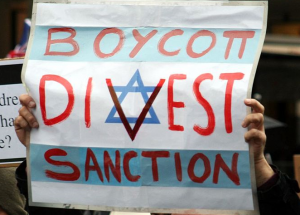
Why affirm something so obvious? To stop academic blacklisting by the Boycott,
Sanctions and Divestment movement, which targets Israeli universities and scholars.
Attempts to isolate Israel and its educational institutions aren’t new. In 1945 the Arab League declared that all Arab institutions and individuals must “refuse to deal in, distribute, or consume Zionist products of manufactured goods.”
The original boycott soon extended to entities that traded with Israel. This did great economic and political damage until the U.S. Congress in 1977 prohibited American companies from cooperating with it, as some were doing. Only U.S. prohibition of the prohibition had the force to guarantee free international trade.
In 2002, a group of professors from Harvard and the Massachusetts Institute of Technology were among the first academics to advocate divesting from Israel.
Two years later the Palestinian Campaign for the Academic and Cultural Boycott of Israel was founded with the explicit purpose of isolating Israeli academics and institutions. Its goal was to deny Israeli scholars access to scholarly conferences, journals and employment opportunities. The boycott also includes keeping unwelcome speakers and information from campus to maintain Israel as the permanent object of blame.
The campaign’s efforts paid off in the U.S., where the American Studies Association and the National Women’s Studies Association approved boycotts in 2013 and 2015, respectively.
Academic associations that have so far voted such resolutions down—the American Anthropological Association, Modern Language Association and American Historical Association—introduce new ones every year.
Only through a concerted effort by school administration can universities remain free spaces. Jewish students should not be expected to bear the full brunt of attack by those who import the Arab-Muslim war against Israel into the American campus.
Researchers in science and medicine have a special interest in opposing a boycott that tries to destroy the benefits of shared ideas and knowledge. Although people in the sciences do not normally issue collective political statements, signatories of the recent letter cite the collaboration of Israeli scientists in lifesaving treatments as reason enough to protest the blacklist. Their statement condemns boycotts that contravene core democratic values and threaten “the free flow of information and ideas,” which functions as “the lifeblood of the academic world.”
The Boston group’s aim is similar to those of recent academic protests against President Trump’s temporary travel ban. A friend-of-the-court brief filed by 17 universities affirms that students from the six suspect countries could have much to contribute by “making scientific discoveries, starting businesses, and creating works of literature and art that redound to the benefit of others” far beyond university campuses.
If universities are willing to fight the government’s travel ban against students from Muslim-majority countries, why are members of their faculties fighting to prevent exchange with academic counterparts in the Jewish homeland?
American academics ought to entertain pluralistic and multicultural perspectives and refrain from cutting themselves off from those with whom they disagree. Universities cannot pretend to be protecting the free flow of information while their faculty members try to prevent interaction with the most dynamic academic center in the Middle East.
The restrictions the Trump administration placed on potentially hostile immigrants were intended to prevent attacks on America’s liberal democratic way of life.
Meantime, the goal of the BDS campaign is to attack the freest democracy in the Middle East. Not coincidentally, Iran and Syria, two countries singled out by the travel ban, are also dedicated to the destruction of Israel.
The repressive tactics of BDS proponents resemble the strategy and destructive aims of those who threaten the U.S.
Perhaps the academics who signed the statement in defense of liberal ideals can help stop the aggression against Israel in academia, a place that, in their words, promotes “the dialogue and cooperation essential to advancing knowledge, solving problems, and promoting understanding.”
The rest of the academic community and all who benefit from its labors would be grateful.

Tuesday, April 4, 2017

American Jewry Is Becoming More Ant-Israel. Bad News!

The Fight for Zion

By April 4, 2017


BESA Center Perspectives Paper No. 439, April 4, 2017
EXECUTIVE SUMMARY: Fifty years after the Six Day War, the American Jewish community is sharply fragmented, with many Jews grappling with where Zionism fits into their Jewish identity. As the Boycott, Divestment and Sanctions (BDS) movement grows in popularity and attracts more Jewish advocates, the gap is growing even wider between American Jewry and Israel.
For American Jews, Zionism has become a source of debate, controversy, embarrassment, and guilt as they try to come to terms with the activities of the Jewish state and its elected officials. Consequently, many seek to detach themselves from what used to embody the core of Jewish identity. A case in point is Jewish Voice for Peace (JVP), a pro-BDS Jewish group that uses its “Jewishness” to validate its cause.
While JVP’s desire to persuade the Israeli government to change its policies is legitimate, the growing strength of the BDS movement at large makes the demise of the two-state solution ever more likely. JVP’s executive director, Rebecca Vilkomerson, is notorious for her hard leftist views, as illustrated in her Washington Post op-ed entitled “I’m Jewish, and I want people to boycott Israel.” So strong is JVP’s antipathy to Israel that the Anti-Defamation League (ADL) has called it “the largest and most influential Jewish anti-Zionist group” in the US.
Yet the true essence of Zionism lies in its ability to encapsulate both religious and secular Jewish identities. The current challenge is to identify the component of renewal. The Zionist enterprise did not end with the establishment of the State of Israel in 1948. Each generation must redefine Zionism as it is relevant to them.
Theodor Herzl famously wrote in his diary, “Were I to sum up the [1897] Basel Congress in a word – which I shall guard against pronouncing publicly – it would be this: ‘At Basel, I founded the Jewish State. If I said this out loud today, I would be answered by universal laughter. If not in five years, certainly in fifty, everyone will know it.’”
The difference between Herzl’s generation and post-1948 generations was a first-hand understanding of what the absence of a Jewish state means for Jewish survival. The state represents the difference between autonomy and servility, indeed between life and death. But today’s millennial generation has no memory of a time when Israel did not exist or was ever on the “right side of history.”
Given the wedge that has been pushed between Zionism and Judaism, one might even suggest that were Herzl to raise the question of a Jewish homeland today, he might not receive support. The irony is that what initially led Zionist leaders to bond over the idea of a homeland was the growing threat of antisemitism. Today, even as antisemitism is on the rise around the world, anti-Zionism is often viewed as legitimate criticism.
Abba Eban dispelled this notion eloquently, stating, “There is no difference whatever between antisemitism and the denial of Israel's statehood. Classical antisemitism denies the equal right of Jews as citizens within society. Anti-Zionism denies the equal rights of the Jewish people its lawful sovereignty within the community of nations. The common principle in the two cases is discrimination."
But with the popularity of the BDS movement’s crusade against Israel, some American Jews on the left have placed other Jews beyond the pale, as people who cannot be debated due to their abominable views. Moreover, an insidious double standard applies: Jewish organizations like Hillel must include anti-Israel voices or be deemed intolerant or racist. Jewish intellectuals must engage in dialogue with BDS representatives or other Palestinian advocates who demand the ethnic cleansing of Israel, lest they be called cowards and be subjected to insults. And now, leading American Jewish intellectuals have adopted the rhetoric and methods of BDS, to be applied to Jews only. Perhaps the next move will be to follow the Palestinian lead and charge Israelis in international courts.
Individuals like Peter Beinart, in his book The Crisis of Zionism, purport to offer so-called “tough love,” an approach that is supposedly required to curb the alleged expansion of the "occupation.” Driven by guilt, Beinart has embraced the left’s move to distance itself from Israel and the Zionist enterprise at large. For Beinart, the answer is a "Zionist" boycott of Israeli settlements and products.
Beinart, like many post-Zionists and revisionists, only opposes the "occupation," which leads him to place all the onus for the lingering Palestinian-Israeli problem on Israel. In this distorted narrative, Israel is largely to blame for the collapse of the Oslo/Camp David process of the 1990s-2000s and for the subsequent failures to revive the peace process. But the centrality of the “settlements” is an empty issue. It deflects from the core problem that truly obstructs a negotiated settlement: the Palestinians’ century-long rejection of a sovereign Jewish state.
There is little debate that there will be a redistribution of land in the event that a peace agreement is achieved. Most of the bargaining will be about whether these exchanges will take the shape of a total phased Israeli withdrawal, or an exchange of land annexing the more populous Israeli towns to Israel for other land in the Jordan Valley or Negev Desert. But this must be left to the parties to decide, not imposed by outside powers or guilt-ridden American Jews.
Anti-Zionist American Jews have found Israeli counterparts even in the Knesset. This was on display at the AIPAC Policy Conference in late March, at which Meretz MK Tamar Zandberg, whose trip to the conference had been paid by AIPAC, decided to join a protest outside the conference. At the protest, organized by the Jewish anti-establishment group IfNotNow, demonstrators held up signs reading “Reject AIPAC” and “Reject Occupation.” Zandberg justified her decision to participate by saying, “there is no greater deed of patriotism than opposing the occupation.”
Stronger Zionist anchors are needed within the Jewish community to overcome the guilt over Israel’s existence rather than its actions. Collective historical memory is absent from today’s discourse on Zionism, especially in America. While there are Zionists on the left and right who still appreciate Jewish history and believe in Jewish destiny, Zionist renewal outside Zion is needed. There is a serious need to teach and appreciate both Herzl’s Zionism and “Start-Up Zionism” if the dream is to be kept alive.
Dr. Asaf Romirowsky is the executive director of Scholars for Peace in the Middle East (SPME) and a Fellow at the Middle East Forum.

Monday, April 3, 2017

Great Move By Israel!


BDS Activists Banned From Israel


“Cast out the scorner, and contention will go out; yea, strife and shame will cease.” Proverbs 22:10 (The Israel Bible™)
On Monday night the Knesset passed a law empowering the Interior Ministry to ban known Boycott, Divestment and Sanctions (BDS) activists from entering the country. The law does not apply to Israelis active in BDS. The law passed its third and final reading by 46:28.
This law is one of several steps the government has taken since establishing an anti-BDS task force two years ago. Other steps include lobbying foreign governments to curtail BDS activities when they cross the line from anti-settlement to anti-Semitism.
BDS is a loosely organized coalition of dozens of pro-Palestinian activist groups. It is active on many US and other Western college campuses.
BDS claims to be anti-settlement, and promotes efforts to boycott produce from what they define as “illegal Israeli settlements in the West Bank.”
In reality, many of the groups operating under the BDS banner have morphed from legitimate anti-settlement organizations to overtly anti-Semitic ones. They regularly accuse Israel of being an illegitimate apartheid state that has no right to exist, and call for total South African-style sanctions on it until it collapses, just as the apartheid regime in SA did.
BDS holds a series of “Israel Apartheid Weeks” on dozens of campuses all over the US, Europe and South Africa. Campuses with active BDS chapters have become hotbeds of anti-Semitism, masquerading as merely anti-settlement. Jewish students at these campuses report a pervasive atmosphere of hostility and intimidation.
Knesset Interior Committee Chairman David Amsalem (Likud) said the law was a reasonable self-defense response. “We are not talking about banning activists who criticize Israeli policy, and think we should withdraw from Judea and Samaria and allow a Palestinian state to be established there, but those who have clearly crossed the line, and are clearly pursuing an anti-Semitic agenda aimed not at ending what they call the Israeli occupation, but Israel’s very existence.”
Bayit Yehudi (Jewish Homeland) MK Bezalel Smotrich, one of the MKs who initiated the law said that the law send a clear message that Israel will confront its enemies wherever they are. “The days of turning the other cheek are over, and Israel will act to neutralize the threat posed by this new age anti-Semitism.”
Joint List leader Ayman Odeh and other Arab MKs condemned the law as undemocratic and another sign of right-wing McCarthyism.

Read more at https://www.breakingisraelnews.com/84685/bds-activists-banned-israel/#TUXpGtu6XIePvI4a.99

Monday, February 13, 2017

BDS Supporters Get An Earful At UCLA

Ben Shapiro, a graduate of UCLA, blasts those who are supporting a BDS movement at the university.  He makes some very good points and his two minute speech is well worth listening to if you believe in the right of Israel to exist, to prosper and to be independent.

Conservative Tom


Here is the link:
https://youhttps://youtu.be/jwaP_Iq8-YMtu.be/jwaP_Iq8-YM

Wednesday, February 1, 2017

When Such Hate Is Expressed At A Major University, How Long Will It Take Before It Is Adopted By The Rioters And Protesters?

COLUMBIA PROF. SAYS ISRAEL ADVOCATES WILL 'INFEST' TRUMP ADMINISTRATION
BYDANIEL J. ROTH

 19 JANUARY 2017 17:14

For some in the Jewish community, "infest" posses an antisemitic connotation that hearkens back to the Nazi era, when Jews were described as "rats" or "vermin."


Columbia University Professor Rashid Khalidi
Columbia University Professor Rashid Khalidi. (photo credit:YOUTUBE SCREENSHOT)
A pro-Palestinian professor created controversy on Thursday after
 commenting that under the incoming Trump administration, advocates
 for Israel would come to "infest" the United States government.

During an interview with Chicago public radio station WBEZ, Columbia
 University Professor of Modern Arab Studies Rashid Khalidi surmised
 that supporters of Israel would have greater influence on incoming US
President Donald Trump, which would impose a new "vision" of the
Middle East disproportionately favoring the Israeli government.


Be the first to know - Join our Facebook page.


"So they have a vision whereby the occupied territories aren’t occupied,
they have a vision whereby there is no such thing as the Palestinians, they
 have a vision whereby international law doesn’t exist, they have a vision
whereby the United States can unilaterally cancel a decision in the United Nations," Khalidi said.

"And unfortunately, these people infest the Trump transition team, these
people are going to infest our government as of January 20. And they are
 hand in glove with a similar group of people in the Israeli government
and Israeli political life who think that whatever they think can be imposed
on reality," he added.

For some in the Jewish community, "infest" possesses an antisemitic 
connotation that hearkens back to the Nazi era, when Jews were 
described as "rats" or "vermin."

Khalidi, who has previously campaigned on behalf of the Boycott,
 Divestment and Sanctions Movement (BDS), has been credited as a
spokesperson for the Palestinian Liberation Organization in Beirut in the
1970's and 1980's, when Israel and the US considered the group a terrorist
 organization.

Khalidi, however, has denied ever working for the PLO, stating that he
 "often spoke to journalists in Beirut, who usually cited me without
attribution as a well-informed Palestinian source," according to The 
Washington Times. 

Last year, the Ivy league educator circled a petition demanding that
 Columbia University immediately divest from Israel, garnering the
 signatures of at least 40 colleagues, according to online publication
The Tower.

Columbia University said in response for comment that “Faculty have
 freedom to speak out on public issues. No one, however, represents
 the university when doing so.”

Professor Khalidi was not available for comment at the time of
publication of this article.