Palestinians: When Suicide Attacks Are Bad
The Palestinian Islamist movement Hamas is finally getting a dose of its own medicine -- in the form of a suicide bombing targeting its members in the Gaza Strip.
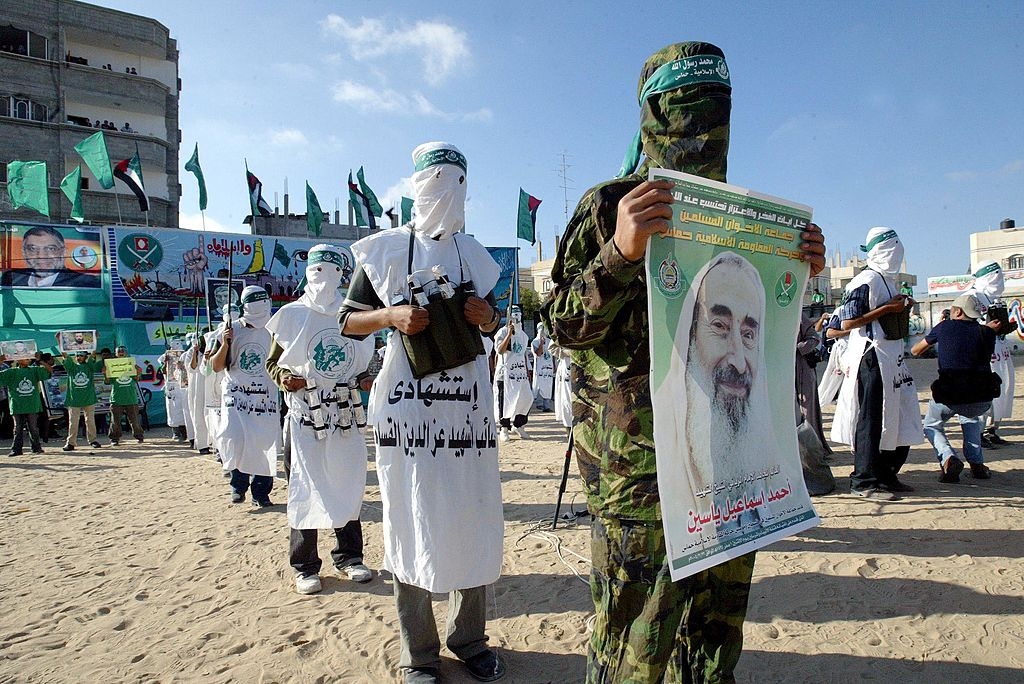
During the past two decades, Hamas was responsible for dozens of suicide attacks that maimed and killed hundreds of Israelis, particularly during the Second Intifada between 2000 and 2006. Hamas is famous for its suicide attacks and hails the perpetrators as "heroes" and "martyrs." For Hamas, suicide bombings are a noble deed when they are carried out by its members and the victims are Jews. In their own words, Hamas leaders and spokesmen continue to defend their suicide attacks against Israel as a "legitimate tool of resistance" against Israel.
Recent events, however, may have left a bad taste for suicide attacks in Hamas's mouth. On August 17, Nidal Al-Ja'fari, a member of Hamas's military wing, Ezaddin Al-Kassam, was killed when a suicide bomber blew himself up along the border between the Gaza Strip and Egypt. The suicide bomber was identified as Mustafa Kallab, a member of a jihadi group that is affiliated with the Islamic State (ISIS) terror group. According to Hamas, Kallab detonated the explosive belt he was wearing as he and another jihadi tried to cross from the Gaza Strip into Egypt. The slain Hamas security officer, Al-Ja'fari, was among a border security patrol that intercepted the jihadis and attempted to stop them from infiltrating into Egypt. It was the first time a suicide bomber had ever targeted Hamas members. Eyad Al-Bazm, a spokesman for Hamas, said the incident took place early August 17, when a Hamas unit noticed two suspects who were trying to cross the border from the Gaza Strip into the Egyptian Sinai Peninsula. When the Hamas soldiers approached the suspects, Kallab detonated an explosive belt wrapped around his body, killing Al-Ja'fari. Now that the shoe is on the other foot, things look a bit different. The Islamist movement, which is not used to being targeted by suicide bombers, has employed powerful rhetoric to condemn the terror attack and those behind it. This is the same Hamas that is used to applauding and glorifying suicide bombings and other terror attacks against Israel. Hamas spokesman Fawzi Barhoum denounced the suicide bomber as an "outlaw" and said that his movement will deal with force and firmness against "those who deviate from the values and traditions of the Palestinian people." Other Hamas leaders have described the suicide bomber as an "ideological deviant." Interestingly, several Palestinian factions, which regularly applaud stabbing and car-ramming attacks, as well suicide bombings, are now calling the August 17 attack along the border between the Gaza Strip and Egypt a "cowardly terror attack." ISIS has claimed responsibility for the suicide attack that killed the Hamas officer. But this statement has not stopped the Palestinian manipulation machines from pointing a finger at Israel -- completely without evidence. This false accusation is an excellent example of the Palestinian modus operandi -- at all cost, divert attention from a disturbing truth. In this case, Hamas is diverting attention from the fact that ISIS jihadis have long been operating under its rule in the Gaza Strip. Actually, many of the ISIS jihadis are former members of Hamas and Palestinian Islamic Jihad. The emergence of ISIS-inspired groups in the Gaza Strip has long been an open secret. This is the inconvenient truth that Hamas has been working hard to conceal for the past few years. Understandably, the presence of ISIS individuals and groups in the Gaza Strip is discomfiting for Hamas, especially in wake of its continued effort to win legitimacy and recognition by the international community. In the past few months, Hamas has been attempting to project itself as a "moderate" movement that accepts the two-state solution. To back its claim, Hamas recently published a "policy document" that states that the movement would be prepared to accept a Palestinian state along the pre-1967 lines. What it refrains from mentioning, however, is that this acceptance would in no way include an acceptance of Israel's right to exist. In other words, Hamas is saying that it will use a future Palestinian state in the West Bank, Gaza Strip and east Jerusalem as a launching pad to destroy Israel. Obstinately holding on to an imaginary dream, some political analysts and journalists have misinterpreted the Hamas document as a sign of "moderation" and "pragmatism," and argued falsely that the Islamist movement is ready to join a peace process with Israel. Nothing could be further from the truth. Hamas leader Mahmoud Zahar could not be clearer on this point -- he has repeatedly denied the claim that his movement has abandoned its ideology and dream to destroy Israel, explaining that the real goal remains to "liberate all of Palestine, from the (Mediterranean) sea to the (Jordan) river." Timing is everything -- and the timing of the August 17 suicide attack is particularly bad for Hamas. Hamas has been working overtime to improve its relations with Egypt in light of reports that jihadis from the Gaza Strip have been infiltrating Sinai to carry out attacks against the Egyptian army. Now, the truth is out: this suicide attack demonstrates rather convincingly that the Egyptian charges are not unfounded. Kallab was among a group of jihadis that was on its way to join ISIS and other Islamist terror groups in Sinai that have been waging a wave of terror attacks against the Egyptian army in the past few years. It is worth noting that Hamas has always denied the presence of ISIS in the Gaza Strip. Hamas has also denied that jihadis from the Gaza Strip were involved in terror attacks in Sinai. It now remains to be seen how the Egyptians will respond to the Hamas lies. The unprecedented suicide attack, which caught Hamas by surprise, showcases the Gaza Strip for what it is: a breeding ground for jihadis and other Islamist terrorists. And, Hamas's denunciation of the jihadis as "ideologically and religiously and morally deviants", is beyond the bounds of irony. On the other hand, Hamas may use the suicide bombing to try and persuade the Egyptians that it is serious in its effort to stop terrorists from crossing from the Gaza Strip into Egypt. Hamas and the ISIS-inspired groups and individuals in the Gaza Strip are birds of a feather. Each and every one promotes and preaches extremist Islamist teachings. Kallab and the ISIS jihadis in the Gaza Strip are sons of the Hamas school that has poisoned the hearts and minds of many Palestinians. Hamas, as we all know, is hardly opposed to suicide bombings. Yet when the boomerang returns, suddenly the attacks become "cowardly terror" actions perpetrated by "outlaws" and "intellectually and religiously and morally deviant" terrorists. Hamas, Islamic Jihad and ISIS may disagree on many issues, but targeting Jews and "infidels" is not one of them. On that point, they are in savage agreement. Khaled Abu Toameh, an award-winning journalist, is based in Jerusalem.
© 2017 Gatestone Institute. All rights reserved. The articles printed here do not necessarily reflect the views of the Editors or of Gatestone Institute. No part of the Gatestone website or any of its contents may be reproduced, copied or modified, without the prior written consent of Gatestone Institute.
|
Our goal is to have intelligent discussion of the topics of the day. We realize everyone has their opinion and they should be allowed to express it in a discussion forum without calling each other names. We learn from discussion and not from name calling or argument.We use cookies to personalise content and ads, to provide social media features and to analyse our traffic. We also share information about your use of our site with our social media, advertising and analytics partners. See details
Contact Form
Showing posts with label mahmoud Zahar. Show all posts
Tuesday, August 22, 2017
Hamas Getting Some Of Its Own Medicine
Monday, December 22, 2014
European Hate Of Israel (Or Anything Jewish) Shows Clearly In The Hamas Decision. Will Hamas Now Attack Israel And Overthrow Palestinian Authority? We Believe So!
EU Gives Hamas Green Light to Attack Israel
by Khaled Abu Toameh
December 22, 2014 at 5:00 am
Comment
|
The EU court's decision represents a "severe blow to the Palestinian Authority and Egypt," according to Palestinian political analyst Raed Abu Dayer.Less than 48 hours after a top European Union court ruled that Hamas should be removed from the bloc's list of terrorist groups, supporters of the Palestinian Islamist movement responded by firing a rocket at Israel. The attack, which did not cause any casualties or damage, did not come as a surprise.
Any victory for Hamas, albeit a small and symbolic one, is a victory for the Islamic State, Al-Qaeda, Islamic Jihad, the Muslim Brotherhood and other fundamentalist groups, and causes tremendous damage to those Muslims who are opposed to radical Islam.
Hours before the EU court's decision was made public, Hamas leader Mahmoud Zahar announced that his movement would never recognize Israel, and that Hamas seeks to overthrow the Palestinian Authority and seize control of the West Bank.
The EU court's decision also coincided with a rapprochement between Hamas and Iran. Now, the Iranians and other countries, such as Turkey and Qatar, are likely to interpret the EU court's decision as a green light to resume financial and military aid, including rockets and missiles, to Hamas — not only to Gaza but to the West Bank as well — to support those Palestinians whose aim it is to eliminate Israel.
Buoyed by the EU court's ruling, Hamas leaders and spokesmen see it as a "political and legal achievement" and a "big victory" for the "armed struggle" against Israel.
Musa Abu Marzouk, a top Hamas leader, issued a statement thanking the EU court for its decision. He hailed the decision to remove his movement from the terrorist list as a "victory for all those who support the Palestinian right to resistance."
When Hamas leaders talk about "resistance," they are referring to terrorist attacks, such as the launching of rockets and suicide bombings against Israel. In other words, Hamas has interpreted the court's decision as a green light to carry out fresh attacks as part of its ambition to destroy Israel.
The rocket that was fired from the Gaza Strip at Israel only days after the court decision is not likely to be the last.
Although the EU court has said that its controversial decision was "technical" and was not a reassessment of Hamas's classification as a terrorist group, leaders of the Islamist movement believe that the move will eventually earn them legitimacy in the international arena.
Ironically, the EU court's decision coincided with Hamas celebrations marking the 27thanniversary of its founding. Once again, Hamas used the celebrations to remind everyone that its real goal is to destroy Israel. And, of course, Hamas used the event to display its arsenal of weapons that include various types of rockets and missiles, as well as drones.
![]()
Thousands of armed Hamas troops showed off their military hardware at a Dec. 14, 2014 parade in Gaza, marking the organization's 27th anniversary. (Image source: PressTV video screenshot)
|
Hours before the EU court decision was made public, Hamas leader Mahmoud Zaharannounced that his movement would never recognize Israel. Zahar also made it clear that Hamas seeks to overthrow the Palestinian Authority [PA] regime and seize control over the West Bank.
The EU court's decision also coincided with increased efforts to achieve rapprochement between Hamas and Iran. Recently, a senior Hamas leadership delegation visited Tehran as part of efforts to mend fences between the two sides. The main purpose of the visit was to persuade the Iranians to resume military and financial aid to Hamas. The visit, according tosenior Hamas officials, appears to have been "successful."
"There are many signs that our relations are back on the right track," explained Hamas's Musa Abu Marzouk. "Hamas and Iran have repaired their relations, which were strong before the Syrian crisis." Relations between Hamas and Iran deteriorated due to the Islamist movement's refusal to support the regime of Syrian President Bashar Assad.
Now the Iranians are likely to interpret the EU court decision to remove Hamas from the list of terrorist groups as a green light to resume financial and military aid to the movement.
Iran's leaders recently announced that they intend to dispatch weapons not only to the Gaza Strip, but to the West Bank as well, as part of Tehran's effort to support those Palestinians who are fighting to eliminate Israel.
Moreover, the EU court's move will also embolden other countries that provide Hamas with political and financial aid, first and foremost Qatar and Turkey. Oil-rich Gulf countries such as Kuwait, Bahrain, Oman and Saudi Arabia will now face pressure from many Arabs and Muslims to join Qatar, Turkey and Iran in extending their support to Hamas.
The biggest losers, meanwhile, are Palestinian Authority President Mahmoud Abbas and Egypt's President Abdel Fattah el-Sisi. Over the past few months, the two men have been doing their utmost to undermine Hamas and end its rule over the Gaza Strip.
Abbas has been fighting Hamas by blocking financial and humanitarian aid and arresting its supporters in the West Bank, while Sisi continues to tighten the blockade on the Gaza Strip and destroy dozens of smuggling tunnels along the border with Egypt.
The EU court's decision represents a "severe blow to the Palestinian Authority and Egypt,"noted Palestinian political analyst Raed Abu Dayer. "As far is Abbas is concerned, the decision grants Hamas political legitimacy and challenges his claim to be the sole legitimate leader [of the Palestinians]. With regards to Egypt, the European court decision calls into question rulings by Egyptian courts that Hamas is a terrorist organization."
Even if the EU court decision is reversed in the future, there's no doubt that it has already caused tremendous damage, especially to those Muslims who are opposed to radical Islam.
Any victory for Hamas, albeit a small and symbolic one, is a victory for the Islamic State, Al-Qaeda, Islamic Jihad, the Muslim Brotherhood and other fundamentalist groups around the world.
The decision has left many Arabs and Muslims with the impression that Hamas, after all, is not a terrorist organization, especially if non-Muslims in Europe say so through one of their top courts. Even worse, the decision poses a real and immediate threat to Israel, as evident from the latest rocket attack.
If the Europeans have reached the conclusion that Hamas is not a terrorist organization, then why don't their governments openly invite tens of thousands of Hamas members and supporters to move to London, Paris and Rome? And they should not forget to ask the Hamas members to bring along with them their arsenal of weapons.
Monday, October 27, 2014
Jerusalem Violence Getting To Breaking Point. When Will Israel Start Taking Action Against Rioters? Is Government Afraid Of Stirring Up More Violence?
Violence in Jerusalem Has Dramatically Increased. Is It a New ‘Intifada’?
241
SHARES
Prime Minister Benjamin Netanyahu Sunday blamed “Islamic extremist elements” for the escalation of violence in Jerusalem, saying they were trying to ignite the holy city.
“[T]here are various radical Islamist forces at work here who are trying to burn down Israel’s capital,” Netanyahu said at his weekly cabinet meeting.
“We will not allow the reality of Jerusalem to become one of throwing stones and firebombs, and disturbances. This is not coincidental,” Netanyahu said according to a posting on Twitter by his staff.

A picture taken overnight on October 26, 2014 shows a Palestinian stone-throwing protester amid smoke during clashes with Israeli police in the east Jerusalem neighborhood of Silwan. At least five Palestinians were arrested during fresh clashes overnight Sunday in east Jerusalem, where hundreds of extra police have been deployed to tackle mounting unrest, authorities said. Photo : Ahnad Gharabli/AFP/Getty Images
The prime minister said Israeli police were bolstering their presence in the capital city by more than 1,000 officers following days of rioting by Palestinians.
Palestinians aim to establish east Jerusalem as the capital of a future Palestinian state.
Among the violent incidents in recent days: Wednesday’s terrorist attack by a Palestinian driver who rammed into a group of pedestrians killing a 3-month-old baby girl who was a U.S. citizen; Palestinian youths on the Mount of Olives who blocked roads with trash bins behind which they threw stones and Molotov cocktails; widespread rock throwing by Palestinians in other east Jerusalem neighborhoods, damaging the light rail system.
On Saturday, protesters in the Jerusalem neighborhood of Silwan threw rocks and firecrackers at a tractor deployed by the city to clear the roads of stones thrown at police a day earlier, the Times of Israel reported.
The unrest has sparked a debate among Israelis and Palestinians asking whether the violence marks the beginning of a third Palestinian intifada, or uprising.
Senior Hamas official Mahmoud Zahar on Saturday called it an “intifada,” a characterization disputed by Israeli officials.
“Escalating the resistance in the city is the solution to Israeli aggression,” Zahar told the Hamas-linked news outlet Al-Risala, Israel’s Arutz Sheva reported.
Zahar also criticized Palestinian Authority President Mahmoud Abbas’ security forces for coordinating activities with Israel.
“The people in the West Bank are fighting on two fronts: the first is the Israeli occupation and the second is the Palestinian Authority’s security forces,” Zahar said.
But a senior officer with the Israeli police said the violence did not mark an intifada, suggesting it would soon fizzle out.
“There is no intifada here,” Police Major General Aharon Eksol on Sunday told the Israeli website NRG, as translated by the Times of Israel. “There is primarily a weakening sense of security as the result of a few riots and small incidents in different places, that demand a police response in a few locations throughout the capital.”
Science and Technology Minister Yaakov Perry, former head of Israel’s Shin Bet internal security service, on Thursday called the volatile situation in Jerusalem a “ticking time bomb” that could spark a third intifada, even if it is not officially one now.
Police official Eksol said that the police force in Jerusalem was bolstered to 2,000 officers at all times.
Jerusalem Mayor Nir Barkat told the Times of Israel on Thursday that the violence had become intolerable.
Jerusalem officials on Sunday criticized the Tel Aviv school system for canceling middleschool trips to the capital in response to the violence, Israel’s Army Radio reported.
Hamas called on Palestinians to continue protesting in response to the killing Friday of 14-year-old Orwa Abd El-Wahab Hammad, who holds U.S. citizenship.
The Israel Defense Forces said the youth was shot as he was moving to throw a Molotov cocktail at cars driving on Highway 60 near Ramallah.
Arutz Sheva quoted a Shin Bet report on Jerusalem which concluded there had been a major increase of security-related incidents, “from 22 incidents in May and June to 152 in July and August, a whopping 509% increase,” Arutz Sheva observed.
Sunday, September 7, 2014
If Israel Gives Up Control Of West Bank, It Would Be Disastrous.
Hamas: Give Us West Bank So We Can Destroy Israel
by Khaled Abu Toameh
September 7, 2014 at 5:00 am
Comment
|
What Hamas and Iran are saying is that if and when Israel pulls back to the pre-1967 lines, they, together with other Palestinians, would bring weapons into the West Bank to achieve their goal of eliminating the "Zionist entity."If the West Bank had one quarter of the weapons that the Gaza Strip has, Israel would be eliminated in one day. This is what Hamas leader Mahmoud Zahar told worshippers during a sermon he delivered on September 5.
Abbas's initiative also ignores that Hamas could easily seize control of the West Bank through force or through the promised free and democratic elections, which recent polls show Hamas is assured of winning. Abbas is demanding something that would bring about his own demise.
Zahar, who, during Israel's Operation Protective Edge, spent his time in hiding, was speaking during Friday prayers at Martyr Abdullah Azzam Mosque in Gaza City.
Abdullah Azzam, by the way, was a Palestinian "scholar," teacher and mentor of Osama bin Laden, the slain leader of Al-Qaeda. Azzam was killed in Pakistan in 1989.
Back to Zahar, who delivered his first sermon since the Egypt-brokered cease-fire between Hamas and Israel was announced in late August: he chose to remind Palestinians and the rest of the world of his movement's dream to destroy Israel.
"If only the West Bank had one quarter of what Gaza has of resistance tools, the Israeli entity would end in one day," Zahar declared, reiterating the claim that Hamas had scored a "big victory" in the war.
The Hamas leader went on to criticize those who still have doubts as to whether Israel could be destroyed.
"Those who were skeptical as to whether Palestine could be liberated are no longer doubtful after the enemy was hit from the Gaza Strip," Zahar said. "Can you imagine what would happen if the enemy is targeted from the West Bank, which makes up 20% of the size of Palestine?"
Zahar's wish to see the West Bank flooded with rockets and mortars and other "tools of resistance" was echoed by other Hamas and Islamic Jihad leaders and spokesmen after the recent war in the Gaza Strip.
Zahar himself was quoted recently as saying that Hamas's goal now was to "move the Gaza example of resistance" to the West Bank.
Even the Iranians seem to think that the time has come to turn the West Bank into a launching pad for attacks on Israel.
During the war in the Gaza Strip, a senior Iranian commander of the Revolutionary Guard Corps, Mohamed Reza Naqdi, announced that Tehran had plans to "arm Palestinians in the West Bank" in order to destroy Israel.
Naqdi boasted that the weapons used by Hamas and other Palestinian groups during the recent war had been manufactured and supplied by Iran.
The threats by Hamas and Iran regarding the West Bank show why it is critically important for Israel (and the Palestinian Authority) to insist on the demilitarization of the Gaza Strip as part of any long-term cease-fire agreement.
Even more significantly, these threats underline the need to keep the West Bank a demilitarized area in any future peace agreement, especially one that would see the establishment of an independent and sovereign Palestinian state.
Moreover, these threats support Israel's insistence on maintaining permanent security control over the border with Jordan. Without such a presence, Iranian-made weapons would easily find their way into the West Bank.
What Hamas and Iran are saying is that if and when Israel pulls back to the pre-1967 lines, they, together with other Palestinians, would bring weapons into the West Bank to achieve their goal of eliminating the "Zionist entity."
Zahar does not even believe that there is a need for large amounts of weapons – just one fourth of what Hamas and Islamic Jihad already have in the Gaza Strip are sufficient, in his eyes, to destroy Israel in one day.
In the aftermath of Operation Protective Edge, it is not difficult to understand why flooding the West Bank with weapons poses an existential threat to Israel.
But this is also something that would wreak havoc on Palestinians in the West Bank.
Fortunately, Mahmoud Abbas and his Palestinian Authority are fully aware of attempts by Iran and Hamas to turn the West Bank into a base for terrorism and jihadis.
Thanks to Israel, they are also aware of Hamas's effort to topple the Palestinian Authority and replace it with an Islamist government.
Last month, Israel announced the arrest of more than 90 West Bank Hamas members who planned to stage a coup against Abbas and renew terror attacks against Israelis. Were it not for Israel's effort, Abbas and his top officials would have been either killed or imprisoned by Hamas.
That episode explains why Abbas has now ordered a massive crackdown on Hamas members and supporters in the West Bank. During the Gaza war, Abbas refrained from such measures against his Hamas rivals out of fear of being accused of "collaboration" with Israel.
![]()
Mahmoud Abbas (r) meets with the Hamas political bureau chief Khaled Mashaal in Qatar, July 20, 2014. (Image source: Handout from the Palestinian Authority President's Office/Thaer Ghanem)
|
Since the cease-fire went into effect, Abbas's security forces in the West Bank have detained more than 80 Hamas men. They have also stopped Hamas-affiliated preachers from delivering sermons during Friday prayers.
Abbas will be able to rein in Hamas in the West Bank only if he pursues security coordination with Israel.
However, it would be unrealistic to expect Abbas or any Palestinian government to disarm Hamas and its allies in the Gaza Strip.
Abbas and the Palestinian Authority would not be able to survive for one day in the West Bank without the presence of the IDF, especially given Hamas's rising popularity among Palestinians in the aftermath of the war.
Last week, Abbas sent two senior officials, Saeb Erekat and Majed Faraj, to Washington to present his "new peace initiative" to Secretary of State John Kerry.
Abbas's initiative envisages the establishment of a Palestinian state within three years either through negotiations or by having the UN Security Council impose a solution on Israel.
Abbas's initiative, however, ignores the threat from Hamas and Iran to use the West Bank as a launching pad for destroying Israel. It also ignores that Hamas could easily seize control over a future Palestinian state by force or through the promised free and democratic elections, as assured by a recent public opinion poll published by the Ramallah-based Palestinian Center for Policy and Survey Research.
Abbas is demanding a full Israeli withdrawal to the pre-1967 lines (including the border with Jordan). But he cannot offer any assurances that Hamas and Iran would not use this border to smuggle weapons into the West Bank.
In fact, Abbas is demanding from the Israelis and Americans something that would bring about his own demise. His only option for now is to hold onto power in the West Bank and continue to work with Israel against the common enemy – Hamas. The day Hamas agrees to lay down its weapons and abandon its dream of destroying Israel, he will then be able to go to the U.S. and Security Council and ask for an independent state next to Israel.
Thursday, August 28, 2014
The Gaza War Might Be In Cease Fire But The Hamas Goal Remains.
Is the Gaza War Really Over?
by Khaled Abu Toameh
August 28, 2014 at 5:00 am
Comment
|
It is important to note that these cease-fire demands are not part of Hamas's or Islamic Jihad's overall strategy, namely to have Israel wiped off the face of the earth.Statements made by Hamas and Islamic Jihad leaders and spokesmen following the announcement of the long-term cease-fire agreement with Israel this week serve as a reminder of their true intentions and strategy.
Many foreign journalists who came to cover the war in the Gaza trip were under the false impression that it was all about improving living conditions for the Palestinians by opening border crossings and building an airport and seaport. These journalists really believed that once the demands of Hamas and the Palestinian Islamic Jihad are accepted, this would pave the way for peace between the Israelis and the Palestinians.
To understand the true intention of Hamas and its allies, it is sufficient to follow the statements made by their leaders after the cease-fire announcement this week. To his credit, Ismail Haniyeh, Hamas's leader, has never concealed Hamas's desire to destroy Israel.
Hamas and its allies see the war in the Gaza Strip as part of there strategy to destroy Israel. What Hamas and its allies are actually saying is, "Give us open borders and an airport and seaport so we can use them to prepare for the next war against Israel."
Over the past two months, the two groups, together with several armed factions in the Gaza Strip, repeatedly announced that their main goal was to end the "siege" on the Gaza Strip and build their own airport and seaport.
During the cease-fire talks in Cairo, the Palestinian groups repeatedly and stubbornly insisted that complying with these demands, along with opening all the border crossings with the Gaza Strip, was the only way to end the violence and achieve a long-term cease-fire with Israel.
However, it is important to note that these cease-fire demands are not part of Hamas's or Islamic Jihad's overall strategy, namely to have Israel wiped off the face of the earth.
Hamas and its allies in the Gaza Strip are not only fighting for an airport and seaport. Nor are they fighting only for the reopening of all border crossings with Israel and Egypt.
During this war, many seem to have forgotten that Hamas and Islamic Jihad are actually fighting to "liberate Jerusalem and all Palestine." The two groups have never recognized Israel's right to exist and continue to oppose any attempt to make peace with the "Zionist entity."
Many foreign journalists who came to cover the war in the Gaza Strip were under the false impression that it was all about improving the living conditions of the Palestinians in the Gaza Strip by opening border crossings and building an airport and seaport. These journalists really believed that once the demands of Hamas and Islamic Jihad are accepted, this would pave the way for peace between Israel and the Palestinians.
Yet these journalists, like many others in the international community, failed to look at the bigger picture or take into consideration the context of conflict. Moreover, most of them did not even seem to be listening to what Hamas and Islamic Jihad have been stating before and after the war -- that their real goal is to "liberate all Palestine."
Operation Protective Edge may have ended, but the dream to destroy Israel is still alive. Even if Hamas and Islamic Jihad eventually get their own airport and seaport, it is obvious that the two groups are now more determined than ever to pursue their fight to eliminate Israel, especially in light of the fact that they feel they have emerged from the war triumphant.
![]()
Masked Hamas gunmen celebrate their "victory" over Israel before the international media this week. (Image source: Facebook/Palestinian Information Center)
|
The Egypt-brokered cease-fire may achieve some calm for Israelis and Palestinians in the foreseeable future, particularly in the aftermath of the severe blow Hamas and Islamic Jihad suffered as a result of Israel's massive military operation.
Indeed, Hamas and its allies will now be busy rebuilding the damage in the Gaza Strip. But they will also continue to raise new generations of Palestinians on glorification of terrorism and jihad, with the hope of achieving the destruction of Israel, which they view as an alien body planted by colonialist powers in the Middle East.
To understand the true intentions of Hamas and its allies, it is sufficient to follow the statements made by their leaders after the cease-fire announcement earlier this week. Evidently, these statements show that Hamas and Islamic Jihad see their "victory" in the Gaza Strip as a first step toward "liberating all Palestine." They also show that these groups intend to use the new cease-fire to continue preparations and amass more weapons for what they call "the mother of all battles - liberating Palestine."
Islamic Jihad leader Ramadan Shalah was one of the first figures to spell out his organization's real intentions. Hours after the cease-fire announcement, the Lebanon-based Shalah declared: "The war is not over. It will continue in other means and methods."
He went on to warn Palestinians against resuming negotiations with Israel, saying the Oslo Accords were now "buried under the rubble of the Gaza Strip" and Palestinians should as of now only endorse the "path of resistance."
The following day, Hamas leader Ismail Haniyeh crawled out of the bunker he had retreated to during the war to declare that "Gaza is now preparing for the battle of comprehensive liberation."
He told Hamas supporters during a "victory" rally in Gaza City that "Gaza has paved the way for reaching Jerusalem and Al-Aqsa Mosque."
To his credit, Haniyeh has never concealed Hamas's desire to destroy Israel. Only days before the war, he said in a speech before schoolchildren attending a Hamas summer camp that his movement's strategy "is to liberate the land of Palestine." He added: "Whether we are in the (Palestinian) government or outside, we will continue to educate and call for the liberation of all Palestine and the establishment of a Palestinian state on all the land of Palestine."
For those who do not know, Haniyeh is in fact just repeating Hamas's charter, which does not accept Israel's right to exist on any part of what is perceived as Muslim-owned land.
Another Hamas leader, Mahmoud Zahar, went even farther by calling for the establishment of a "Palestine Liberation Army" in wake of the "victory" scored by his movement and other Palestinian groups during the war.
Further evidence that this war was not about border crossings or improving living conditions of Palestinians in the Gaza Strip was also provided by a spokesman for Hamas and several Palestinian groups that participated in the fighting against Israel.
At a press conference one day after the cease-fire announcement, Abu Obaida, spokesman for Hamas's armed wing, Izaddin al-Qassam, declared: "Gaza won because it has revived the hopes of 1.5 billion Arabs and Muslims that the road to Jerusalem is now open and all we need is to be united and have a will."
So for Hamas and its allies, the war in the Gaza Strip is not just about the closure of border crossings or freedom of movement. Instead, they see the war in the Gaza Strip as part of their strategy to destroy Israel. What they are actually saying is, "Give us open borders and an airport and seaport so we can use them to prepare for the next war against Israel."
Subscribe to:
Posts (Atom)