Contact Form

Name

Email *

Message *

Showing posts with label metadata. Show all posts

Tuesday, March 6, 2018

Strzok Strikes Again


WATCH: FBI Told of Possible Breach 

of Clinton Email Server, NEVER

 Followed Up

  • 03/05/2018 
  • Source: Fox News 
  • by: Catherine Herridge, Pamela K. Browne, Cyd Upson
27 16 0  49
During the final months of the Clinton email investigation, FBI agent Peter Strzok was advised of an irregularity in the metadata of Hillary Clinton’s server that suggested a possible breach, but there was no significant follow up, according to two sources with knowledge of the matter.

Sources told Fox News that Strzok, who sent anti-Trump text messages that got him removed from the ongoing Special Counsel Robert Mueller’s Russia probe, was told about the metadata anomaly in 2016, but Strzok did not support a formal damage assessment.

One source said: “Nothing happened.”

Fox News is told the Justice Department Inspector General, Michael E. Horowitz, is aware of the allegations.

Read more at http://americanactionnews.com/articles/watch-fbi-told-of-possible-breach-of-clinton-email-server-never-followed-up#xHY5CfDilHJBDaSU.99

Friday, August 11, 2017

Oh Sugar, Even " The Nation" Has figured Out The Russia Meddling Is A Fraud. It Was Just A Way For The "Swamp" To Remove Trump

So… it was a leak?

If a bombshell report out from The Nation this week has any validity, the entire leftist fantasy involving Russian meddling in the 2016 presidential election is probably about to fall apart.
The Nation’s Patrick Lawrence on Thursday published a lengthy report based on information gathered by a bevy of computer experts and former National Security Agency insiders. The report in the publication not exactly known for its right-leaning sympathies reaches the conclusion that the Democratic establishment’s theory that Russia hacked servers at the Democratic National Committee is extremely implausible.
First, the report notes that the type of remote hack government agencies claim breached DNC servers would have been technologically impossible because the information was allegedly taken faster than any internet service provider would allow.
From the report:
The metadata established several facts in this regard with granular precision: On the evening of July 5, 2016, 1,976 megabytes of data were downloaded from the DNC’s server. The operation took 87 seconds. This yields a transfer rate of 22.7 megabytes per second.
These statistics are matters of record and essential to disproving the hack theory. No Internet service provider, such as a hacker would have had to use in mid-2016, was capable of downloading data at this speed.
Secondly, the report concludes that documents leaked online by Guccifer 2.0 have the appearance of poorly rendered fakes produced to frame Russia for the hacking.
Again, from Lawrence:
In addition, there is the adulteration of the documents Guccifer 2.0 posted on June 15, when he made his first appearance. This came to light when researchers penetrated what Folden calls Guccifer’s top layer of metadata and analyzed what was in the layers beneath. They found that the first five files Guccifer made public had each been run, via ordinary cut-and-paste, through a single template that effectively immersed them in what could plausibly be cast as Russian fingerprints. They were not: The Russian markings were artificially inserted prior to posting. “It’s clear,” another forensics investigator self-identified as HET, wrote in a report on this question, “that metadata was deliberately altered and documents were deliberately pasted into a Russianified [W]ord document with Russian language settings and style headings.”
To be noted in this connection: The list of the CIA’s cyber-tools WikiLeaks began to release in March and labeled Vault 7 includes one called Marble that is capable of obfuscating the origin of documents in false-flag operations and leaving markings that point to whatever the CIA wants to point to. (The tool can also “de-obfuscate” what it has obfuscated.) It is not known whether this tool was deployed in the Guccifer case, but it is there for such a use.
It’s also worth noting that the conclusions Lawrence reaches come from some pretty highly qualified experts:
Prominent among these is a group comprising former intelligence officers, almost all of whom previously occupied senior positions. Veteran Intelligence Professionals for Sanity (VIPS), founded in 2003, now has 30 members, including a few associates with backgrounds in national-security fields other than intelligence. The chief researchers active on the DNC case are four: William Binney, formerly the NSA’s technical director for world geopolitical and military analysis and designer of many agency programs now in use; Kirk Wiebe, formerly a senior analyst at the NSA’s SIGINT Automation Research Center; Edward Loomis, formerly technical director in the NSA’s Office of Signal Processing; and Ray McGovern, an intelligence analyst for nearly three decades and formerly chief of the CIA’s Soviet Foreign Policy Branch. Most of these men have decades of experience in matters concerning Russian intelligence and the related technologies. This article reflects numerous interviews with all of them conducted in person, via Skype, or by telephone.
And while the agencies that have told us all this was a Russian hack exist primarily to protect government at all cost, even when that means spreading disinformation, some of the aforementioned experts have all put themselves on the line before to give Americans the real story about its government’s actions.
They never got much attention in the past… but the government did its best to ruin their lives. 
The full story in The Nation is worth a read. And it’s worth passing around so the political and media establishment isn’t able to attempt to make it disappear.
Stay tuned, this ought to get good in the weeks ahead.

Tuesday, June 3, 2014

Documented Government Lies In The NSA Scandal

NSA Defenders Ought To Stop Making These Five Claims If They Wish To Remain Credible

June 3, 2014 by  
 12 5
 
 2 33

This post, written by EFF legal director Cindy Cohn and activist Nadia Kayyali, originally appeared on the foundation’s website on June 2.
Over the past year, as the Snowden revelations have rolled out, the government and its apologists have developed a set of talking points about mass spying that the public has now heard over and over again. From the President, to Hilary Clinton to Rep. Mike Rogers, Sen. Dianne Feinstein and many others, the arguments are often eerily similar.
But as we approach the one year anniversary, it’s time to call out the key claims that have been thoroughly debunked and insist that the NSA apologists retire them.
So if you hear any one of these in the future, you can tell yourself straight up: “this person isn’t credible,” and look elsewhere for current information about the NSA spying. And if these are still in your talking points (you know who you are) it’s time to retire them if you want to remain credible. And next time, the talking points should stand the test of time.
1.  The NSA has Stopped 54 Terrorist Attacks with Mass Spying
The discredited claim
NSA defenders have thrown out many claims about how NSA surveillance has protected us from terrorists, including repeatedly declaring that it has thwarted 54 plots.  Rep. Mike Rogerssays it often. Only weeks after the first Snowden leak, US President Barack Obama claimed:“We know of at least 50 threats that have been averted” because of the NSA’s spy powers. Former NSA Director Gen. Keith Alexander also repeatedly claimed that those programs thwarted 54 different attacks.
Others, including former Vice President Dick Cheney have claimed that had the bulk spying programs in place, the government could have stopped the 9/11 bombings, specifically noting that the government needed the program to locate Khalid al Mihdhar, a hijacker who was living in San Diego.
Why it’s not credible:
These claims have been thoroughly debunked.  First, the claim that the information stopped 54 terrorist plots fell completely apart.  In dramatic Congressional testimony, Sen. Leahy forced a formal retraction from NSA Director Alexander in October, 2013:
“Would you agree that the 54 cases that keep getting cited by the administration were not all plots, and of the 54, only 13 had some nexus to the U.S.?” Leahy said at the hearing. “Would you agree with that, yes or no?”
“Yes,” Alexander replied, without elaborating.
But that didn’t stop the apologists. We keep hearing the“54 plots” line to this day.
As for 9/11, sadly, the same is true.  The government did not need additional mass collection capabilities, like the mass phone records programs, to find al Mihdhar in San Diego.  AsProPublica noted, quoting Bob Graham, the former chair of the Senate Intelligence Committee:
U.S. intelligence agencies knew the identity of the hijacker in question, Saudi national Khalid al Mihdhar, long before 9/11 and had the ability find him, but they failed to do so.
“There were plenty of opportunities without having to rely on this metadata system for the FBI and intelligence agencies to have located Mihdhar,” says former Senator Bob Graham, the Florida Democrat who extensively investigated 9/11 as chairman of the Senate’s intelligence committee.
Moreover, Peter Bergen and a team at the New America Foundation dug into the government’s claims about plots in America, including studying over 225 individuals recruited by al Qaeda and similar groups in the United States and charged with terrorism,  andconcluded:
Our review of the government’s claims about the role that NSA “bulk” surveillance of phone and email communications records has had in keeping the United States safe from terrorism shows that these claims are overblown and even misleading…
When backed into a corner, the government’s apologists cite the capture of Zazi, the so-called New York subway bomber. However, in that case, the Associated Press reported that the government could have easily stopped the plot without the NSA program, under authorities that comply with the Constitution. Sens. Ron Wyden and Mark Udall have been saying this for a long time.
Both of the President’s hand-picked advisors on mass surveillance concur about the telephone records collection. The President’s Review Board issued a report in which it stated “the information contributed to terrorist investigations by the use of section 215 telephony meta-data was not essential to preventing attacks,” The Privacy and Civil Liberties Oversight Board (PCLOB) also issued a report in which it stated, “we have not identified a single instance involving a threat to the United States in which [bulk collection under Section 215 of the Patriot Act] made a concrete difference in the outcome of a counterterrorism investigation.”
And in an amicus brief in EFF’s case First Unitarian Church of Los Angeles v. the NSA case, Sens. Ron Wyden, Mark Udall, and Martin Heinrich stated that, while the administration has claimed that bulk collection is necessary to prevent terrorism, they “have reviewed the bulk-collection program extensively, and none of the claims appears to hold up to scrutiny.”
Even former top NSA official John Inglis admitted that the phone records program has not stopped any terrorist attacks aimed at the US and at most, helped catch one guy who shipped about $8,000 to a Somalian group that the US has designated as a terrorist group but that has never even remotely been involved in any attacks aimed at the US.
2. Just collecting call detail records isn’t a big deal.
The discredited claim
The argument goes like this: Metadata can’t be privacy invasive, isn’t very useful and therefore its collection isn’t dangerous—so the Constitution shouldn’t protect it.  Even thePresident said, “what the intelligence community is doing is looking at phone numbers and durations of calls. They are not looking at people’s names, and they’re not looking at content”—as if that means there is no privacy protection for this information.
Why it’s not credible:
As former director of the NSA and CIA Michael Hayden recently admitted: “We kill people based on metadata.”  And former NSA General Counsel Stu Baker said: “metadata absolutely tells you everything about somebody’s life. If you have enough metadata, you don’t really need content.”
In fact, a Stanford study this year demonstrated exactly what you can reconstruct using metadata: “We were able to infer medical conditions, firearm ownership, and more, using solely phone metadata.” Metadata can show what your religion is, if you went to get an abortion, and other incredibly private details of your life.
3.  There Have Been No Abuses of Power
The discredited claim
President Obama stated in an interview that “there are no allegations, and I am very confident —knowing the NSA and how they operate — that purposefully somebody is out there trying to abuse this program…” And General Alexander stated in a speech that “We get all these allegations of [abuses of power] but when people check… they find zero times that that’s happened. And that’s no bullshit. Those are facts.”
Why it’s not credible:
We already have evidence of abuses of power. We know that NSA analysts were using their surveillance powers to track their ex-wives and husbands, and other love interests. They even had a name for it, LOVEINT. The FISA court has also cited the NSA for violating or ignoring court orders for years at a time. And those are just self-reported abuses – the only oversight that occurs is that the NSA investigates itself and reports on the honor system to Congress or the FISC about what it finds. A real independent investigation might reveal even more. Unfortunately, until we get something like a new Church Committee, we are unlikely to see such details.
4. Invading Privacy is Okay Because It’s Done to Prevent Terrorist Attacks
The discredited claim
We keep hearing the same thing: Surveillance is a “critical tool in protecting the nation from terror threats.” When we reform the NSA, it must be done in a way that “protect[s] the operational capability of a critical counterterrorism tool.” The implication is that the stopping terrorist attacks is the government’s only goal.
Why it’s not credible:
We know that NSA surveillance is not used just for stopping terrorists and it’s not even just used for national security.
The Intercept recently revealed leaks detailing the NSA’s role in the “war on drugs,”—in particular, a 2004 memo detailing how the NSA has redefined narcotics trafficking as a national security issue. We also know that the NSA feeds data to the DEA, where it ends up playing a part in ordinary law enforcement investigations. And internationally, the NSA engages in economic espionage and diplomatic spying, something detailed in Glenn Greenwald’s recent book No Place to Hide.
5. There’s Plenty of Oversight From Congress, the Foreign Intelligence Surveillance Court, and Agency Watchdogs
The discredited claim
We’ve repeatedly heard from the President and from NSA defenders like Sen. Dianne Feinstein and Rep. Mike Rogers that Congress knows all about NSA spying. Right after the first Snowden leak, President Obama said: “your duly elected representatives have been consistently informed on exactly what we’re doing.” We’ve also heard that a court has approved these programs, so we shouldn’t be concerned.
Why it’s not credible:
EFF and others have long documented that Congress has an incredibly hard time getting information about NSA spying. And it’s not just Congress. We learned a few months ago that the Department of Defense’s deputy Inspector General, in charge of Intelligence and Special Program Assessments, was not aware of the call detail collection program.
What’s more, the secretive Foreign Intelligence Surveillance Court (FISC) is completely incomparable to an ordinary adversarial court. It makes decisions in a vacuum, and it doesn’t always have complete information, much less a second adversarial voice or technical help. Its chief judge has said that it’s not equipped to conduct oversight. EFF recently had to tell the court that its Jewel v. NSA case even existed – the government had apparently decided that it didn’t have to. We also know that the FISC isn’t much of a block, since in 11 years “the court has denied just 10 applications, and modified several dozen, while approving more than 15,000.”
So why are we giving up our rights?
It’s time for NSA and its supporters to admit what we all know is true: what is at stake in this debate is the simple ability for any of us—in the US or around the world—to be able to use the Internet without fear of surveillance. They continue to be willing to overstate their case in order to scare us into allowing them to continue to  “collect it all.”  But the American people are getting wise and the media are increasingly double-checking their claims. As a result, more Americans than ever now say that the NSA has gone too far and those tired old stories are starting to wear thin.
That’s why it’s time to tell Congress that these excuses won’t work anymore. Right now, Congress is considering legislation that could be a first step to reining in NSA mass spying. But there’s a contentious political battle taking place on Capitol Hill, with NSA defenders pushing a weaker version of the reform bill while civil liberties groups campaign for powerful reform. Please add your voice and call on the Senate to pass real NSA reform.

Nancy Pelosi Unscripted--Stammers, Studders And Lies!

Watch: Democrat Nancy Pelosi Fall Apart When Teen Asks Question About NSA Spying

June 3, 2014 by  
 36 19
 
 3 202

Senator Nancy Pelosi (D-Calif.) was taken aback when confronted with tough questions about her support of the National Security Agency’s spying activities as she posed for a photo-op with a group of teenagers.
As Pelosi posed with the group, Andrew Demeter, a young man representing the TeenTake YouTube channel, asked, “Why do you support the NSA’s illegal and ubiquitous data collection?”
The smile quickly retreated from the elderly lawmaker’s face as she stammered through an answer.
“Well I, I do not, I have questions about the metadata collection that they were, uh, collecting,” Pelosi said. “Unless they had a reason to do so.”
Pelosi went on to say that she didn’t support Representative Justin Amash’s (R-Mich.) legislation to limit the lengths to which the NSA is able to go in gathering telephone metadata on American citizens.
“You did vote for a bill to continue funding for the NSA, though,” Demeter followed up.
“Yeah, of course,” Pelosi said. “I don’t think we should not fund the National Security Agency; no, they do many, many things.”
Pelosi also claimed that some of her “biggest fights” as a lawmaker had been against the NSA’s leadership.
Watch, uh, the, uh, full exchange, uh:

Wednesday, December 18, 2013

Scary Stuff! Are We In A Totalitarian Police State? Former NSA Exec Says So!

‘We Are Now In A Police State’: Washington’s Blog Interviews Former Top NSA Official

December 18, 2013 by  
 84 36
 
1 392

This article was originally printed by Washington’s Blog. Visit the website here.
Bill Binney is the high-level NSA executive who created the agency’s mass surveillance program for digital information. A 32-year NSA veteran widely regarded as a “legend” within the agency, Binney was the senior technical director within the agency and managed thousands of NSA employees.
Binney has been interviewed by virtually all of the mainstream media, including CBSABC,CNNNew York TimesUSA TodayFox NewsPBS and many others.
Last year, Binney held his thumb and forefinger close together, and said:
We are, like, that far from a turnkey totalitarian state.
But today, Binney told Washington’s Blog that the U.S. has already become a police state.
By way of background, the government is spying on virtually everything we do.
All of the information gained by the NSA through spying is then shared with Federal, State and local agencies, and they are using that information to prosecute petty crimes such as drugs and taxes. The agencies are instructed to intentionally “launder” the information gained through spying, i.e. to pretend that they got the information in a more legitimate way … and to hide that from defense attorneys and judges.
This is a bigger deal than you may realize, as legal experts say that there are so many Federal and State laws in the United States, that no one can keep track of them all … and everyone violates laws every day without even knowing it.
The NSA also ships Americans’ most confidential, sensitive information to foreign countries like Israel (and here), the UK and other countries … so they can “unmask” the information and give it back to the NSA … or use it for their own purposes.
Binney told us today:
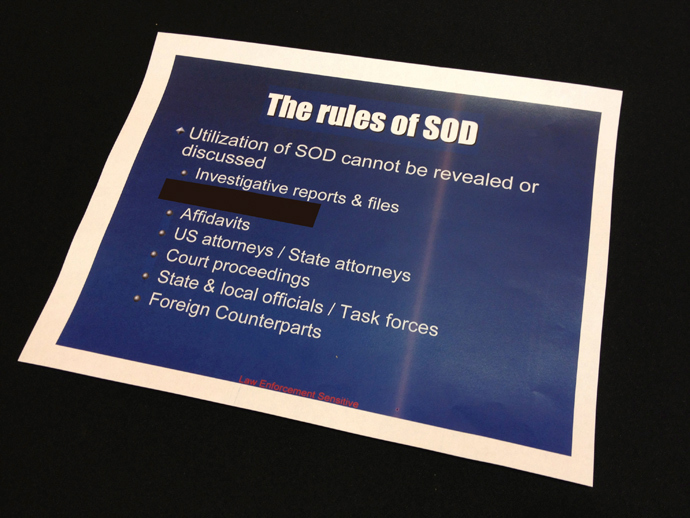
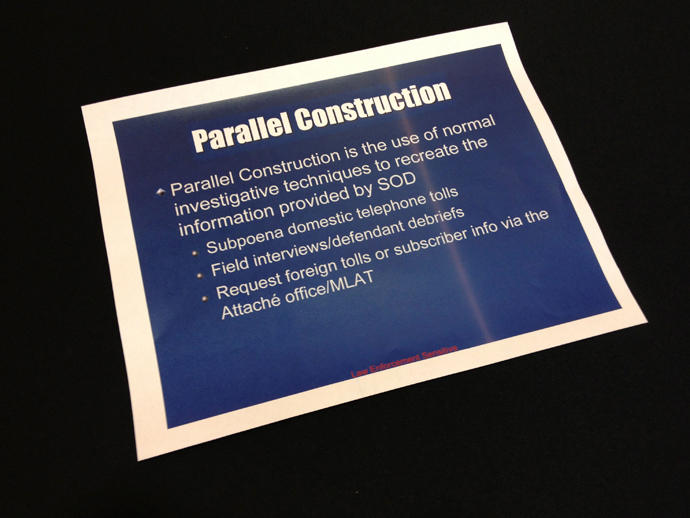
The main use of the collection from these [NSA spying] programs [is] for law enforcement. [See the 2 slides below].
These slides give the policy of the DOJ/FBI/DEA etc. on how to use the NSA data. In fact, they instruct that none of the NSA data is referred to in courts – cause it has been acquired without a warrant.
So, they have to do a “Parallel Construction” and not tell the courts or prosecution or defense the original data used to arrest people. This I call: a “planned programed perjury policy” directed by US law enforcement.
And, as the last line on one slide says, this also applies to “Foreign Counterparts.”
This is a total corruption of the justice system not only in our country but around the world. The source of the info is at the bottom of each slide. This is a totalitarian process – means we are now in a police state.
Here are the two slides which Binney pointed us to:
sod
_dea-5
(Source: Reuters via RT; SOD stands for “Special Operations Division,” a branch of a Federal government agency.)
We asked Binney a follow-up question:
You say “this also applies to ‘Foreign Counterparts.’” Does that mean that foreign agencies can also “launder” the info gained from NSA spying? Or that data gained through foreign agencies’ spying can be “laundered” and used by U.S. agencies?
Binney responded:
For countries like the five eyes (US, Canada, UK, Australia, New Zealand) and probably some others it probably works both ways. But for others that have relationships with FBI or DEA etc., they probably are given the data to used to arrest people but are not told the source or given copies of the data.
(See this for background on the five eyes.)
View past discussions between Washington’s Blog and Binney hereherehere and here