Contact Form

Name

Email *

Message *

Showing posts with label natanz. Show all posts

Thursday, July 16, 2015

If Iran's Victory Was Not As Clear Cut, We Suspect They Would Not Have Agreed To The Agreement


16 reasons nuke deal is an Iranian victory and a Western catastrophe – Excerpts


1. Was the Iranian regime required, as a condition for this deal, to disclose the previous military dimensions of its nuclear program — to come clean on its violations — in order both to ensure effective inspections of all relevant facilities and to shatter the Iranian-dispelled myth that it has never breached its non-proliferation obligations? No.
2. Has the Iranian regime been required to halt all uranium enrichment, including thousands of centrifuges spinning at its main Natanz enrichment facility? No.
3. Has the Iranian regime been required to shut down and dismantle its Arak heavy water reactor and plutonium production plant? No.
4. Has the Iranian regime been required to shut down and dismantle the underground uranium enrichment facility it built secretly at Fordo? No. (Convert, not dismantle.)
5. Has the Iranian regime been required to halt its ongoing missile development? No.
6. Has the Iranian regime been required to halt research and development of the faster centrifuges that will enable it to break out to the bomb far more rapidly than is currently the case? No.
7. Has the Iranian regime been required to submit to “anywhere, anytime” inspections of any and all facilities suspected of engaging in rogue nuclear-related activity? No.
8. Has the international community established procedures setting out how it will respond to different classes of Iranian violations, to ensure that the international community can act with sufficient speed and efficiency to thwart a breakout to the bomb? No.
9. Has the Iranian regime been required to halt its arming, financing and training of the Hezbollah terrorist army in south Lebanon? No.
10. Has the Iranian regime been required to surrender for trial the members of its leadership placed on an Interpol watch list for their alleged involvement in the bombing, by a Hezbollah suicide bomber, of the AMIA Jewish community center offices in Buenos Aires in 1994 that resulted in the deaths of 85 people? No.
11. Has the Iranian regime undertaken to close its 80 estimated “cultural centers” in South America from which it allegedly fosters terrorist networks? No.
12. Has the Iranian leadership agreed to stop inciting hatred among its people against Israel and the United States and to stop its relentless calls for the annihilation of Israel? No.
13. Has the Iranian regime agreed to halt executions, currently running at an average of some three a day, the highest rate for 20 years? No.
14. Does the nuclear deal shatter the painstakingly constructed sanctions regime that forced Iran to the negotiating table? Yes.
15. Will the deal usher in a new era of global commercial interaction with Iran, reviving the Iranian economy and releasing financial resources that Iran will use to bolster its military forces and terrorist networks? Yes.
16. Does the nuclear deal further cement Iran’s repressive and ideologically rapacious regime in power? Yes.

Inspection Regime Requires Inspectors Give 24 Day Notice. This Is Insane. In That Time, Everything Can Be Cleaned Up Or Concealed. Iran Has Won Big!

Israel: Inspection Mechanism of Iran’s Nuclear Sites “Worse than Worthless”

“It is better to take refuge in the Lord than to trust in man. It is better to take refuge in the Lord than to trust in princes.” (Psalm 118:8-9)
One of the main points of the nuclear agreement being hailed by Western powers as a victory is “worse than worthless,” a senior Israeli minister stated on Wednesday.
In a briefing in Jerusalem, the National Infrastructure, Energy and Water Minister Yuval Steinitz slammed the mechanism in place that gives Iran a 24 day advanced notice of inspections to its nuclear program.
“Actually, you have here a mechanism that instead of serving the inspection is serving the deception,” Steinitz stated.
According to the nuclear deal, Iran will have the ability to conceal any illicit nuclear activity before opening up its nuclear sites to inspectors. Steinitz charged that the advanced notice renders inspections, and therefore the agreement, useless.
Steinitz, a member of Israel’s security cabinet, is Israeli Prime Minister Benjamin Netanyahu’s unofficial point person on the Iran deal. While Israel is satisfied with surveillance measures to be put in place at uranium enrichment facilities Fordo and Natanz, the minister said inspections at top-secret Iranian military sites will not keep Iran in check.
“Unfortunately, when you examine the details, you discover that the inspection [mechanism for undeclared military sites] is actually just a mirage,” he said.
Should intelligence agencies produce evidence that Iran was violating the agreement, inspectors would be powerless to conduct surprise visits. Rather, according to Steinitz, inspectors will need to “provide Iran the basis for such concerns and request clarification.”
“This is not just a worthless inspection method — it serves the Iranians. It’s backfiring. It’s counterproductive. It’s better to have an agreement without it,” Steinitz said.
With Israel, Saudi Arabia and Gulf states vehemently opposed to the nuclear agreement, Steinitz called Western powers “naïve” in signing a deal with the world’s largest sponsor of international terrorism.
“Israel is like the little child that is pointing its finger and saying, ‘The king is naked, this agreement is naked,’” Steinitz said. “Those who think that giving Iran $150 billion will have no effect on the Middle East are naive,” he added. “It’s like pouring fuel on the burning Middle East.”
Echoing Steinitz’s comments, Netanyahu called the inspection mechanism “absurd.” During a speech to the Knesset, the prime minister states “It’s like giving a criminal organization that deals drugs a 24-day warning before inspecting its drug lab.”
“The agreement also requires the world powers to do something else — they must show Iran the very intelligence for which they want to conduct the inspections in the first place.”

Read more at http://www.breakingisraelnews.com/45303/israel-inspection-mechanism-irans-nuclear-sites-worse-than-worthless-jerusalem/#8mqxCp2lPhxGeDOi.99

Tuesday, January 14, 2014

Obama Administration Going Down The Road To Full Nuclearization Of Iran. US Won't Be Very Happy When A Nuke Explodes In A Major City!

Iran Permitted to Continue Advanced Nuclear Research

Washington Free Beacon Staff - Washington Free Beacon,  January 13th, 2014

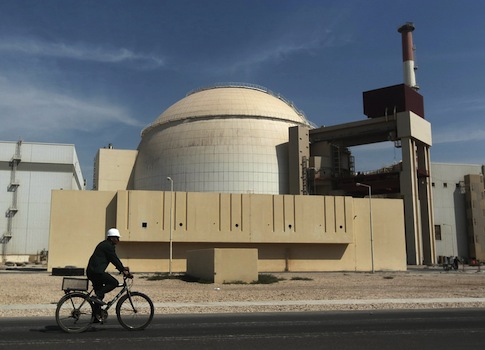
Iran's second nuclear reactor in the Bushehr province / AP
Iran will be permitted to continue advanced research and development work on its nuclear program under the interim nuclear deal reached over the weekend, according to senior Obama administration officials.
Nuclear talks were reported to have broken down late last year over the issue of whether Iran would be permitted to continue critical research and development in the nuclear arena.
The White House confirmed on Monday that Iran would be permitted to continue developing advanced nuclear centrifuges that will enable it to more quickly enrich uranium, the key component in a nuclear weapon.
Asked by a reporter on a conference call if the deal stops “Iran from designing new types of centrifuges,” a senior administration official admitted that the deal does not prohibit this activity.
“Well, designing is not, all I would say is the, what you would do with a piece of paper and designing, that’s not the sort of thing that the Joint Plan of Action—the Joint Plan of Action talks about research and development, R&D, and it mainly talks about what was going—practices at the Natanz power facility, which is the facility that the IAEA [International Atomic Energy Agency] has access to and where we have reporting on,” the official said.
“So what’s the practical effect of this R&D [research and development] clarification that you labored over so hard? What does it preclude them from doing?” the reporter asked.
“It—I mean, their commitment is to continue their current enrichment R&D practices, and those are the practices that are laid out in the November Director General’s report,” said one of two senior administration officials on the press briefing. “This—that’s been documented, and that’s what they were—that’s what they will continue to do.”
Reuters reported last week that nuclear talks temporarily fell apart over the issue of centrifuge research, which had been one of the principal sticking points in the deal.
Iran says that Western nations have given it the go ahead to continue with “the installation of new generation centrifuges.”
“The [use of] new generation of centrifuges for research purposes was the most important remaining issue in the talks between Iran and the G5+1 in recent months,” chairman of the parliament’s National Security and Foreign Policy Commission Alaeddin Boroujerdi said on Monday, according to Iran’s Fars News Agency.
“At last, the Group 5+1 accepted yesterday that Iran’s operating new generation of centrifuges for research does not run counter to the Geneva agreement,”Boroujerdi said.

Tuesday, November 26, 2013

The Ink On The Iranian Deal Is Not Even Dry And Obama Gives Billions

US Released $8 Billion in Nuke Deal With Iran

Monday, 25 Nov 2013 08:54 PM
By Cynthia Fagen
Share:
More . . .
A    A   |
   Email Us   |
   Print   |
The United States released $8 billion in frozen assets to Iran on Sunday in a move meant to ensure Tehran's compliance with a nuclear agreement signed over the weekend, say top Iranian officials, the Washington Free Beacon reported Monday.

Iranian government spokesman Mohammad Baqer Nobakht confirmed Monday that the U.S. government freed $8 billion in assets that had been blocked by the Obama administration.

In addition, Iran will get about $7 billion in sanctions relief, gold, and oil sales under the nuclear deal that was signed in Geneva with Western nations over the weekend.


Iranian officials have lauded the deal as a path to opening up greater trade relations with the West.

"The agreement will open a new path towards Iran," Alinaqi Khamoushi, former head of Iran's Chamber of Commerce, told the Islamic Republic News Agency.

"The agreement will ease the anti-Iran sanctions, which will have significant impacts on the Iranian economy," he said.

At least one senior Republican aide on Capitol Hill was disturbed by the reports.

"It's pretty clear the White House and State Department have been lying to the American people since the beginning of this process, so it wouldn't shock me to learn they are lying about how much sanctions relief they're giving Iran now," the aide, who was not identified, told The Beacon.

The State Department has denied that sanctions have been altered since an interim deal with Iran was announced.

"This report is false. Sanctions today are the same as they were last week," a senior State Department official said in response to a report by Far, an Iranian newspaper. "We will be forthcoming with guidance on how the technical terms of the relief package are worked out once all that is determined."

Iran announced on Sunday that its nuclear work would continue despite the deal, which is aimed at curbing Tehran's nuclear program and enrichment of uranium, the key to producing a nuclear weapon.

Iranian foreign minister Javad Zarif, who helped ink the deal, praised it for recognizing Iran’s right to enrich uranium, a key sticking point that had delayed the deal.

"The [nuclear] program has been recognized, and the Iranian people's right to use the peaceful nuclear technology based on the NPT [Non-Proliferation Treaty] and as an inalienable right has been recognized and countries are necessitated not to create any obstacle on its way," Zarif said.

"The program will continue, and all the sanctions and violations against the Iranian nation under the pretext of the nuclear program will be removed gradually," he said.

Iran's most well known nuclear sites will remain operational under the deal, said Zarif,who presented a very different version of the agreement than that described by the White House on Saturday.

Over the next six months, Iran will see "the full removal of all [United Nations] Security Council, unilateral and multilateral sanctions, while the country's enrichment program will be maintained," Zarif said, adding that the Fordo and Natanz nuclear sites will continue to run.

"None of the enrichment centers will be closed, and Fordo and Natanz will continue their work, and the Arak heavy water [nuclear reactor] program will continue in its present form, and no material [enriched uranium stockpiles] will be taken out of the country, and all the enriched materials will remain inside the country," Zarif said. "The current sanctions will move towards decrease, no sanctions will be imposed and Iran's financial resources will return."

The United States recognized Iran's right to enrich uranium up to 5 percent under the deal, say both the Iranians and a White House brief on the accord.

The United States agreed to suspend "certain sanctions on gold and precious metals, Iran's auto sector, and Iran's petrochemical exports, potentially providing Iran approximately $1.5 billion in revenue," says a fact sheet provided by the White House.

Iran could earn another $4.2 billion in oil revenue under the deal.

Another "$400 million in governmental tuition assistance" could also be "transferred from restricted Iranian funds directly to recognized educational institutions in third countries to defray the tuition costs of Iranian students," the White House said.


© 2013 Newsmax. All rights reserved.


Wednesday, August 7, 2013

Israel WILL Strike Nuke Plant WITHOUT US Help

Israel cannot depend on the US nor can it stand for Iran having a nuclear bomb. It must act, it has NO alernatives. Regardless of what the politicians say or the polite discussions that are occurring, this development cannot allowed to come on line.

If Iran were to get the bomb, it would use it and it would be used against Israel. The Iranian present and past administrations have made it clear, the Jewish state must go. When faced with this Sword of Damocles, Israel is left with no choices.

Conservative Tom

Official: Israel capable of unilateral strike on Iran, if US not committed

JPost.com Staff - The Jerusalem Post,  August 6th, 2013

Centrifuges unveiled in Natanz  (Photo: REUTERS)
Israel is capable of carrying out a unilateral military strike against Iran's nuclear facilities without operational support from the United States, a senior Israeli official said to Israel Radio on Tuesday morning.
Although, such a strike would render less effective than one conducted by America, the unidentified official said.
The diplomatic official doubted US intentions to prevent Iran from acquiring nuclear weapons at all costs.
American conduct regarding Syria, contrary to declarations by President Barack Obama, shows Israel that it cannot rely on US assurances, the Israeli source said.
Israel fears the development of direct negotiations between Washington and Tehran would ease sanctions on the Islamic Republic in exchange for concessions, and would not satisfy the requirements imposed by Israel, the unnamed official added.
Jerusalem and Washington differed on Sunday over the significance of Iranian President Hassan Rouhani’s inauguration, with Washington ready to work with Iran and Jerusalem warning that the new regime – like the old – is a threat to world peace.
The US hoped the new Iranian government would “heed the will of the voters by making choices that will lead to a better life for the Iranian people,” White House spokesman Jay Carney said in a statement shortly after Rouhani was sworn in.
This conciliatory tone was at odds with the tone coming from Jerusalem, where Prime Minister Binyamin Netanyahu again urged the world not to be “taken in” by Rouhani’s perceived moderation.
“On Friday, the Iranian president said that Israel ‘has been a wound on the body of the Islamic world,’” Netanyahu said at the opening of the weekly cabinet meeting.
“The president of Iran has been replaced, but the goal of the regime has not been replaced, it remains as it was,” he continued. “Iran’s intention is to develop a nuclear capability and nuclear weapons in order to destroy the State of Israel, and this constitutes a danger not only to us and the Middle East, but the entire world, and we are all committed to prevent this.”

Monday, September 26, 2011

Obama Gives Bombs to Israel


With the support of Obama rapidly falling among supporters of Israel, the following article has more than an interesting timing. Why would it be revealed at this time? Has Obama been more supportive than it has been apparent in the past? Are there more things going on now? Or is this a shot across the bow to Iran?  These are questions that come to mind.  What are you thinking?

I am sure that we will never know all the back and forth of diplomacy that have been occurring between Tel Aviv and Washington. If there has been more of this type of activity, why has it not been revealed. Has the Obama Administration been so concerned with appearing neutral that giving these big bomb to Israel would have looked like taking sides? Or was this a quid pro quo for stopping settlements or some other agreement?

The more I write, the more questions that come to mind. We need to watch future developments to determine which way the wind is blowing. The Palestinian Statehood issue will be a good indicator. If the US vetoes the application, we can confirm that for the time being the Administration is on Israel's side, however, if Washington finds some middle ground or a caveat toward the vote, it will also telegraph Obama's position.

We would hope that our government would favor Israel but, that has not been readily apparent over the past nearly three years. Time will tell.

Why did Obama give bunker-buster bombs to Israel?


By Laura Rozen | The Envoy – 8 hrs ago

Defense Secretary Bob Gates and Israeli Defense Minister Ehud Barak in Tel Aviv March 24, 2011. (Cherie Cullen/Defense …
In late 2009, the Obama administration transferred 55 so-called bunker-buster bombs to Israel. The 5,000-pound bombs conceivably put Israel in the position to attack Iran's buried nuclear facilities--or to target Hezbollah's buried bunkers in Lebanon.
The revelation, first reported by Newsweek's Eli Lake Friday, received independent confirmation via a sensitive U.S. diplomatic cable released by WikiLeaks last month.
In a November 2009 meeting among senior American and Israeli military and diplomatic officials, "both sides . . . discussed the upcoming delivery of GBU-28 bunker busting bombs to Israel, noting that the transfer should be handled quietly to avoid any allegations that the USG [U.S. government] is helping Israel prepare for a strike against Iran," the leaked Nov. 18, 2009 U.S. cable states. ThinkProgress's Ali Ghraib first reportedon the U.S. cable.
Israel had earlier requested the deep-penetrating bombs from the Bush administration, Lake reported. But according to Lake's report, Bush had deferred the Israeli request, not wanting to give Israel a "green light" to bomb Iran. (However, another leaked U.S. cable discusses Israeli media reports suggesting the Bush administration transferred an earlier shipment of GBU-28 bombs to Israel, in 2005. "All media continued coverage of the forthcoming arms sale by the U.S. of GBU-28 bombs to Israel," an unclassified April 2005 U.S. diplomatic states.)
American policymakers had--and indeed have--many reasons to be wary of Israel initiating a confrontation with Iran--chief among them the roughly 150,000 American troops the United States currently has deployed on either side of Iran in Iraq and Afghanistan, as well as other forces and assets assigned to bases in Qatar, Bahrain and elsewhere in the Persian Gulf region.
So why has the Obama administration seemingly reversed that call? After all, the Obama White House has sought to curtail Iran's nuclear program through diplomatic and economic measures--and the export of 5,000-pound bunker buster bombs to Israel would seem to severely test Israeli patience for that slow and frustrating effort. And, secondly, why is the information emerging now--nearly two years after the administration carried out the deal?
Some policy observers suggest that the U.S. military under Obama was trying to "hug Israel close," in order to increase its feeling of security and thus hopefully stave off the prospect that Israel might launch a surprise strike on Iran on its own, thereby wreaking all sorts of havoc with U.S. military and diplomatic initiatives in the region.
The reported transfer may have been a "gesture" by the Obama White House "to assure the Israelis we love them," one Washington Iran expert who insisted on anonymity told The Envoy via email. (Still, he confessed that he found the ultimate motivation behind the transfer mystifying.)
It's also worth noting that the pending U.S. transfer of the 5,000-lb. bunker buster bombs was discussed at a Nov. 18, 2009 meeting--approximately a week before Israeli Prime Minister Benjamin Netanyahu announced a ten-month partial freeze on Jewish settlement building in the West Bank that the Obama administration had sought. But there is no insinuation in the Nov. 18, 2009 cable of any sort of quid pro quo for the bunker buster deal. Rather, it was mentioned in the context of U.S.-Israeli discussions on approaches for dealing with Iran's nuclear program.
As to the timing of the revelation, while some observers have suggested that American officials may have leaked it in order to burnish Obama's pro-Israel credentials as he faces a tough 2012 presidential campaign, Lake himself, in an interview with NPR Saturday, discounted such a political motivation by his initial sources. Lake also said on Twitter that Obama White House officials were not among the U.S. and Israeli sources for his story. (Nevertheless, some Democratic Congressional staffers have eagerly circulated the Lake report, seemingly seeking to beat back the Republican narrative that Obama has not demonstrated sufficient support for the Jewish state.)
The simpler explanation may in this case be the more compelling one: American and Israeli officials initiated the disclosure of the information now to send a potent warning to Iran.
Such a message would be well timed, in view of other recent developments in the Iranian nuclear effort. Last month, Tehran announced that it had started moving nuclear centrifuges to a buried underground facility in Qom. American officials have been concerned that as Iran proceeds with transferring its enrichment program from its current Natanz facility to the underground Qom facility, Israel might choose to launch a preventive strike aimed at thwarting Iran's nuclear initiative before it becomes harder to target at the buried Fordo facility near Qom.
The Obama "administration is interested in sending message to the Iranians that we have lots of things we can do that are tougher, ... [that it] can ratchet up the pressure on Iran," suggested Patrick Clawson, an Iran expert at the Washington Institute for Near East Policy, in an interview with The Envoy Monday. "The administration may be lifting its skirt a little bit to show some ankle."
(And in actuality, Israel has received earlier shipments of U.S. bunker buster bombs, analysts said. For instance, the Bush Defense Department announced in 2008 plans to sell 1,000 GBU-39 smart bunker buster bombs to Israel, "to develop and maintain a strong and ready self-defense capability," according to an Associated Press report. However, Israeli analysts said at the time that the smaller, 250-pound, precision GBU-39 bombs were more useful against buried arsenals in Lebanon and Gaza--not Iran: "You would need something a lot heavier" for Iran, former Israeli military strategic planner Shlomo Brom told the AP. "The GBU-39 can penetrate 6 feet of concrete, and 6 feet is not enough" for targeting Iran's buried nuclear facilities, he said. By contrast, analysts note that the bunker busters reportedly transferred in the 2009 Obama deal are 5,000-pound bombs--e.g. twenty times heavier than the ones the Bush administration shipped in 2008.)
Could the disclosure now that Israel has the means to strike Iran's underground nuclear facilities change Iran's nuclear decision-making calculus? It's hard to know with any certainty, given that so many factors that might influence such a decision are still very much in play.
But in a meeting with journalists in New York last week, attended by The Envoy, Iran President Mahmoud Ahmadinejad did not discount the possibility of an Israeli strike--and he warned harshly against it.
"The Zionists are quite eager to be able to damage the security of Iran," Ahmadinejad said through a translator at the Sept. 22 lunch with journalists, using "Zionists" to refer to the Israeli government. "It's their ultimate dream to be able to transgress against Iran. Certainly know Iran's response will be quite hard and it will be regretful for them. We assure everyone we will defend ourselves. I hope they avoid that fatal mistake."
Message delivered--and received?