Contact Form

Name

Email *

Message *

Showing posts with label Ali Khamenei. Show all posts

Sunday, March 26, 2017

Trump's Impact Being Made Worldwide

Report: Iran Already Intimidated by Trump

An analysis by MEMRI (the Middle East Media Research Institute) finds that the Trump administration’s tough stance toward Iran is already having an effect.
Analyses of the very complex Middle Eastern chessboard abound, and assessments by knowledgeable people not infrequently contradict each other. What makes MEMRI’s investigations especially interesting, though, is that they’re based on very close observation of Middle Eastern countries themselves, including both their media and their actions (or inactions) on the ground.
The three authors of the analysis in question include Yigal Carmon, president of MEMRI and a former counterterrorism adviser to two Israeli prime ministers. These authors write that since the Trump administration took office, Tehran has come to feel “that it is besieged and under an emerging existential threat, in light of the crystallization of a comprehensive U.S.-Russia-Arab (including Israel) front against [it].”
Iran, MEMRI says, has been showing “considerable military restraint and a halt to long-range missile tests”—the latter in response to the administration’s warning to Iran, after its failed missile launch on January 29, that it had been “put on notice.”
image: https://www.breakingisraelnews.com/wp-content/uploads/2014/06/BIN-OpEd-Experts-300x2501.png
The MEMRI report gives satellite imagery showing that, by February 5, Iran had already deactivated its Semnan missile-launch site. It also gives quotes from Iranian media in which defense officials complain bitterly about having to suspend missile launches because of American threats.
MEMRI also points to other big changes: “a halt to provocations against U.S. Navy vessels” and “a halt to public threats to burn and sink U.S. Navy vessels in the Persian Gulf.”
There has been, in fact, “a near-total moratorium on hostile anti-U.S. statements: The slogan ‘death to America’ has disappeared almost entirely from the official discourse of regime spokesmen, including Iranian Supreme Leader Ali Khamenei himself, as have public burnings of the American flag.”
According to this evidence, then, Iran is scared—and it’s good news to Israel and the moderate Arab states that Iran has been trying to bully and threaten whether directly or through proxies.
Probably MEMRI’s most contentious claim in the report is that Russia, too—along with the U.S., Arab states, and Israel—is part of the “comprehensive front” taking shape against Iran. A previous report by MEMRI developed that claim in greater depth. Recent events in Syria may also indicate that it holds water.
At a stepped-up pace since Friday—possibly unprecedented so far—Israeli planes have reportedly been hitting Hizballah and Syrian targets in Syria.
Israel does not regard the militarily weak Assad regime as a significant adversary in itself. The aim has been to stop weblogs, apons deliveries—facilitated by Syria—to Hizballah, deliveries that emanate from Iran.
Iran is purportedly Russia’s ally, and when, after the first Israeli airstrike on Friday, Russia summoned the Israeli ambassador for a meeting, some claimed President Putin—until then notably lenient about Israeli strikes on his allies or purported allies in Syria—was finally warning that he’d had enough.
Since then, though, the strikes have reportedly (here and here) continued—without any known complaints or warnings issuing from Moscow.
Israeli prime minister Benjamin Netanyahu, in fact, explicitly denies that Putin is looking to stop Israeli military activity in Syria.
Meaning that, while Putin has his own perceived interests in Syria, smoothing a path for Iranian aggression increasingly does not appear to be one of them.
The Trump administration is not even 100 days old, but the Middle East is already feeling the change. The United States is once again taking an active role in the region, and more importantly, Washington is once again standing by the allies and friends it had abandoned. It is now abundantly clear that America can differentiate between the good guys and the bad guys in the region, and that it plans to act for the former and against the latter.
If MEMRI is right, then renewed American involvement is already swaying an actor like Putin away from Iran and toward the camp that seeks a stable, livable Middle East. If Iran is being weakened, intimidated, and pushed into a corner, it can hardly be an attractive ally to any but its most loyal and dependent proxies.
Reprinted with author’s permission from FrontPage Mag

Read more at https://www.frontpagemag.com/fpm/266194/report-iran-already-intimidated-trump-p-david-hornik#x8qmaMYwiSWJlpyC.99

Tuesday, February 21, 2017

If You Are A Woman, Would You Wear A Hijab? If You Are A Man, Would You Allow Your Wife To Wear A Hijab?

Are You Ready For The Battle of the Hijab? Well, Get Ready.

FEBRUARY 21, 2017
22713642 Comments21861
The hijab has been under fire for a little while now, with France
banning the face-covering veils worn by Muslim women way back
 in 2010.
But the whole hubbub died down fairly quickly. Until now.
Suddenly, the hijab -- and who does or does not wear it -- is back in
the headlines big time.
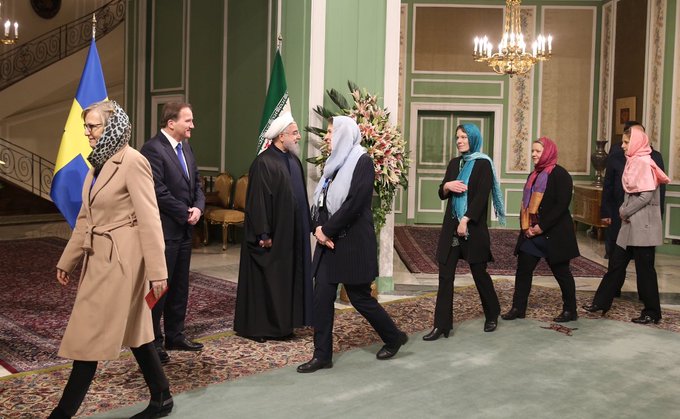
Earlier this month, the Swedish Prime Minister, Stefan Lofven, led a
delegation to Iran. Supreme Leader Ali Khamenei met him and the talks
 were warm and wonderful. But in Sweden, the headlines were all about
 the female government officials who went along on the trip and chose to
wear Islamic headscarves while in Iran.
The 11 women wore them "almost all the time," adhering to the laws of Iran.
This was big news because Lofven describes his government as “feminist."
This hit Twitter and exploded.
One official said she didn't want to wear it, but "it is law in Iran that women
 must wear the veil. One can hardly come here and break the laws,” she
told the Swedish Expressen newspaper. 
An opposition party member said that was no excuse, calling the
 headscarf “a symbol of oppression for women in Iran.” 
Now, two more incidents have occurred, igniting what will soon be a big,
fat fire.
Iran on Monday banned chess grandmaster Dorsa Derakhshani from the
 national team for not wearing a hijab. The head of Iran's Chess Federation,
 Mehrdad Pahlevanzadeh, said: "The first step in dealing with them would
 be to deprive them from every game that is played in Iran and in the name
of Iran, and they will not have the chance to be on the national team,"
according to India Today.
On Tuesday, French far-right National Front presidential candidate Marine
 Le Pen made headlines when she bailed on a Tuesday with Lebanon's
grand mufti. The reason: She didn't want to wear a headscarf.
"You can pass on my respects to the grand mufti, but I will not cover
myself up," she said.
Also this past weekend, the inaugural ‘Modest Fashion Week’ was held to
 pitch clothing to Muslim consumers. The event was "sponsored by a makeup
 brand who refuse to sell products to supporters of U.S. President Donald J.
Trump," Breitbart News reported.
So, the whole can of worms is open again -- and you can expect the debate
 to wash ashore in America pretty soon. But don't look for Melania Trump
to be donning a hijab any time soon. Not gonna' happen.

Thursday, November 10, 2016

State Department Appeasement--Dumb, Blind And Stuipid

  • Chants of "Death to America" and "Death to Israel" were heard across Iranian cities as thousands of Iranians marked the anniversary of the seizure of the U.S. Embassy in Tehran and the taking of 52 American hostages for 444 days by militant students.
  • The State Department's reaction is classic: ignoring these developments and continuing with appeasement policies.
  • These anti-American demonstrations are not rhetoric, but are the cornerstone of Iran's revolutionary principles and foreign policies, which manifest themselves in Iran's support for terrorist proxies, support for Assad's regime, and the scuttling of US and Israeli foreign policies in the region.
  • Many other Iranian officials who were engaged in attacks against the US currently serve in high positions. Hossein Salami, who enjoys one of these high-level positions, is the deputy commander in chief of the Islamic Revolutionary Guards Corps. He stated at the rally: "America should know that if they do not honor their agreement in the nuclear deal, we will resume uranium enrichment..."
After eight years of President Barack Obama's policies of appeasement, Iran's threats, such as "Death to America," and "Death to Israel," have grown even louder.
This week, the Iranian government orchestrated one the largest anti-American and anti-Israeli demonstrations, since 1979, echoing Iran Supreme Leader, Ayatollah Ali Khamenei's recent messages.
The government provided facilities for the protesters. Chants of "Death to America" and "Death to Israel" were heard across Iranian cities as thousands of Iranians marked the anniversary of the seizure of the U.S. Embassy in Tehran and the taking of 52 American hostages for 444 days by militant students.
According to the Tehran-based bureau of the Los Angeles Times,
"The demonstrators brought by buses to the former embassy complex included young and old, university students, military staff and employees of state-run companies who voiced opposition to the nuclear deal Iran signed with the United States and world powers... Many echoed Iran's Supreme Leader, Ayatollah Ali Khamenei.... Almost 1 in every 10 demonstrators at the former embassy -- now widely dubbed a "den of espionage" -- carried placards with Khamenei's words: 'We do not trust America.'"

Iranians protest outside the former US embassy in Tehran, on the anniversary of its storming by student protesters in 1979. (Image source: AFP video screenshot)

The chants were accompanied by burning American and Israeli flags, and Stars of David. This all is occurring in a country that is presided over by the so-called "moderate" president of Iran, Hassan Rouhani and his foreign minister, Javad Zarif; both continue to argue that Iran is a constructive state actor, does not hold hostility against any country, and that Tehran is looking to improve ties with the West and the international community -- so long as Iran's objectives are met.
The State Department's reaction is classic: ignoring these developments and continuing with appeasement policies. State Department spokesman Mark Toner stated that the White House is not going to change its policies towards Iran:
"Like any country, there's heated political rhetoric that comes out, and I'm just not going to respond to every instance of that in this case. No one likes to see this kind of hyper-charged rhetoric on the part of any government anywhere, and anti-American sentiments expressed. But again, we're not going to base our whole relationship going forward ... on these kind of heated political remarks."
However, these large-scale anti-American demonstrations are not rhetoric, but are the cornerstone of Iran's revolutionary principles and foreign policies, which manifest themselves in Iran's support for terrorist proxies, support for Assad's regime, and the scuttling of US and Israeli foreign policies in the region.
In fact, alleging crimes against the US plays very well within the political establishment of Iran. For example, one of the hostage takers who occupied the US embassy, Masoumeh Ebtekar, has climbed the political ladder remarkably. She was first the editor-in-chief of Keyhan International, an Iranian state-owned newspaper, and close advisor to the Supreme Leader. Later she was appointed as the head of the Environment Protection Organization of Iran during the "reformist" administration of President Mohammad Khatami. Afterwards the "moderate" President Rouhani appointed her as the Vice President of Iran, the first woman to serve such position.
The Agence France-Presse (AFP) news agency scored an interview with her during the "Death to America" rally. She boasted about taking US hostages and US documents from the embassy: "Revealing these documents was very similar to what WikiLeaks is doing these days. It was the WikiLeaks of that time." According to the AFP,
"She now regrets the diplomatic isolation that followed the embassy siege, but she is still proud of their work in releasing documents found in the CIA's files -- some painstakingly reassembled after embassy staff frantically shredded as many as possible when the students stormed the building."
Many other Iranian officials who were engaged in attacks against the US currently serve in high positions.
Hossein Salami, who enjoys one of these high-level positions, is the deputy commander in chief of the Islamic Revolutionary Guards Corps (IRGC). He stated at the rally, in reference to the role of the IRGC in the bombing of the U.S. Marines barracks in Lebanon, "In 1983, the flames of Islamic revolution flared among Lebanese youth for the first time, and in a courageous act, a young Muslim buried 260 United States Marines under the rebels east of Mediterranean Sea."
Last week, Ayatollah Ali Khamenei reasserted his stance against the US more firmly, saying, "The US system is far away from values of humanity, death to America means death to a system which has nothing to do with humanitarian values." Khamenei also dismissed diplomacy with the United States, arguing that these negotiations "will not resolve our problems... We should resolve the problems ourselves and with reliance on our capabilities and the young forces inside the country."
Iran's anti-American policies are buttressed and supported by Iran's powerful military institutions, domestic militia groups such as the Basij, Iran's proxies such as Hezbollah, and the hundreds of thousands of people who join these kinds of "Death to America" demonstrations. Iranian leaders evidently enjoy powerful loyalist employees and supporters.
As a passionate protestor told the Euronews, "We are here to chant slogans, and our slogans are a strong punch in the face of America. America can never touch our country, and as our leader said, America can't do a damn thing."
In addition, Hossain Salami, the acting commander of the IRGC, pointed out at the rally that: "America should know that if they do not honor their agreement in the nuclear deal, we will resume uranium enrichment and send the agreement ... to the museum."
Accordingly, "crowds chanted support for the Syrian government and other Shiite Muslim-led regimes in the Middle East, saying, "We will never give it up."
For eight years, Washington pursued total appeasement policies with Iran. The four rounds of crippling UN Security Council sanctions, which took decades to put in place, were lifted immediately. Iran's ballistic missile ambitions and test firings of missiles, in violation of the UN resolutions, were ignored. The expanding militaristic role of the Revolutionary Guard was taken lightly.
None of these appeasement policies changed the political calculations of Iranian leaders towards the US and Israel. In fact, based on these developments, Iranian leaders became more emboldened and empowered, to the extent that they repeatedly harass naval ships of the world's superpower without fearing any repercussions. Iran uses its proxies to attack US ships.
"Death to America" and Iran's anti-American policies will not change if the US continues to appease Iranian leaders. For Iran, appeasement policies do not mean diplomatic initiatives; concessions mean only weakness.
Dr. Majid Rafizadeh, political scientists and Harvard University scholar is president of the International American Council on the Middle East. He can be reached atDr.rafizadeh@post.harvard.edu.
  • Follow Majid Rafizadeh on Twitter
© 2016 Gatestone Institute. All rights reserved. The articles printed here do not necessarily reflect the views of the Editors or of Gatestone Institute. No part of the Gatestone website or any of its contents may be reproduced, copied or modified, without the prior written consent of Gatestone Institute.

Wednesday, August 12, 2015

Obama Has Been Lying About Iran Since (And Probably Before) 2011

Report: Talks on Iran’s Nuclear Program Began in 2011 with U.S. Acknowledging Tehran’s Right to Enrich Uranium


August 11, 2015 - 2:59 pm

A report from the Middle East Media Research Institute (MEMRI) offers some shocking revelations on when negotiations with Iran over its nuclear program began and the point at which we abandoned the long-time American policy that no talks would take place until Iran stopped enriching uranium.
The ostensible reason for beginning the P5+1 talks in 2013 was the election of Iranian President Hassan Rouhani — the supposed “moderate” leader. Instead, a letter sent in 2011 via Oman from the then-chairman of the Senate Foreign Relations Committee, Senator John Kerry, was directed to the government of former fanatical president Mahmoud Ahmadinejad. In it, the U.S. guaranteed the right of Iran to enrich uranium on its own soil.
In a speech he delivered on June 23, 2015, Iran’s Supreme Leader Ali Khamenei said that the American administration had initiated the nuclear talks with Iran during Ahmadinejad’s term in office, based on a U.S. recognition of a nuclear Iran: “The issue of negotiating with the Americans is related to the term of the previous [Ahmadinejad] government, and to the dispatching of a mediator to Tehran to request talks. At the time, a respected regional figure came to me as a mediator [referring to Omani Sultan Qaboos] and explicitly said that U.S. President [Obama] had asked him to come to Tehran and present an American request for negotiations. The Americans told this mediator: ‘We want to solve the nuclear issue and lift sanctions within six months, while recognizing Iran as a nuclear power.’ I told that mediator that I did not trust the Americans and their words, but after he insisted, I agreed to reexamine this topic, and negotiations began.”[2]
Hossein Sheikh Al-Islam: Kerry Sent Iran A Letter Via Oman Recognizing Iran’s Enrichment Rights
In an interview with the Tasnim news agency on July 7, 2015, Hossein Sheikh Al-Islam, an advisor to Majlis Speaker Ali Larijani, said that John Kerry had relayed a letter to Tehran recognizing Iran’s enrichment rights: “We came to the [secret] negotiations [with the U.S.] after Kerry wrote a letter and sent it to us via Oman, stating that America officially recognizes Iran’s rights regarding the [nuclear fuel] enrichment cycle. Then there were two meetings in Oman between the [Iranian and U.S.] deputy foreign ministers, and after those, Sultan Qaboos was dispatched by Obama to Khamenei with Kerry’s letter. Khamenei told him: ‘I don’t trust them.’ Sultan Qaboos said: ‘Trust them one more time.’ On this basis the negotiations began, and not on the basis of sanctions, as they [the Americans] claim in their propaganda.”[3]
Salehi: Obama Appointed Senator Kerry To Handle The Nuclear Dossier Vis-à-vis Iran; Later He Was Appointed Secretary Of   State
Iranian Vice President Ali Akbar Salehi and head of Iran’s Atomic Energy Organization, who was restored to the nuclear negotiation team this year, served as Iran’s foreign minister in 2010-2013. In interviews he has given on Iranian media since April 2014, he too claimed that the Americans initiated the secret talks with Iran in 2011-2012, and stressed his role in jumpstarting the process from the Iranian side.
If true, this explains a lot. Was Kerry really the best choice for secretary of State? I, and I’m sure many others, thought not. Kerry was not nominated by the president for his brains. He was nominated because his confirmation would be a snap.
But how many senators would have voted for him if they knew he was in secret negotiations with Iran over their nuclear program?
The secrecy behind the initiative is not surprising, given the depth of enmity between the two countries. But starting out negotiations by giving up your hole card is outrageously stupid. We had been telling Iran for 10 years or more that we would not begin talks to lift sanctions until they gave up their enrichment program. Instead of dangling that bait in front of Iranian noses, Obama tossed it into the pot without even thinking.
Indeed, as Andrew McCarthy p0ints out in NRO, the president constantly misled the public on this issue:
The Obama administration has repeatedly signaled to Congress and the public that it was holding the line against a right to enrichment. In fact, as Henry Sokolski and Greg Jones of the Nonproliferation Policy Education Center noted here at National Review when Obama announced the “interim agreement” with Iran in late 2013, the administration made a point of assuring that the interim agreement “does not concede that Iran has a right to enrich uranium.”
[...]
There is, moreover, good reason to conclude that the Iranians are a reliable source on this point. Since the “right to enrichment” has been their top agenda item from the start, it was undoubtedly a key consideration in the regime’s decision to engage in the negotiations Obama was so anxious to have. Furthermore, Iran has been consistent in its public statements about this issue, while the Obama administration has been slippery to the point of embarrassment.
Obama’s capitulation is a national-security disaster. Not only will it inexorably arm the world’s leading state sponsor of terrorism with nuclear weapons. There is no conceding Iran’s right to enrich uranium without conceding every nation’s right to enrich uranium.
As I’ve mentioned previously, I really hope President Obama’s first post-presidency job is as a used car salesman. Given his penchant to give the store away during negotiations, I might just walk off the lot with a free car.

Friday, May 29, 2015

Regardless Of His Verbal Protestations, Obama's Actions Are NOT One Who Loves Israel. We Judge People By Their Actions, Not Their Words!


Column One: Barack Obama’s anti-Semitism test

     
    Is US President Barack Obama an anti-Semite?

    This question has lingered in the air since his first presidential bid in 2008. It first arose due to the anti-Semitic sermons that Jeremiah Wright, his pastor for more than 20 years, made as Obama and his family sat in the pews.

    Throughout the six-and-a-half years of his presidency, Obama has laughed off the concerns.

    But he has not dispelled them. And this failure has hurt him.

    So last week, Obama went to significant lengths to answer the question about his feelings toward Israel and the Jewish people once and for all.

    The timing of his charm offensive wasn’t coincidental.

    Obama clearly believes he has to dispel doubts about his intentions toward Jews and Israel in order to implement the central policy of his second term in office. That policy of course is his nuclear deal with Iran.

    Obama’s agreement with the mullahs is supposed to be concluded by the end of next month.


    Obama argues that his deal will prevent Iran from becoming a nuclear power. But as Prime Minister Benjamin Netanyahu explained in his address before the joint houses of Congress in March, from what has already been revealed about the nuclear deal Obama seeks to conclude, far from preventing Iran from acquiring nuclear arms, the deal will provide several pathways for Iran to at a minimum become a threshold nuclear state, capable of developing nuclear weapons at the drop of a hat. If Iran cheats on the deal, it can develop nuclear weapons while the agreement is still in force. If it abides by the agreement, it can develop nuclear weapons as soon as the agreement expires.

    Beyond his desire to conclude a nuclear deal that will empower a regime that has pledged to destroy Israel, there are Obama’s reported plans for changing the way the US relates to Israel at the UN Security Council.

    For the past half-century, the US has used its veto power at the Security Council to prevent substantive anti-Israel draft resolutions from passing. But Obama and his top advisers have hinted and media reports have provided details about his intention to end this 50-year policy.

    Obama reportedly intends to enable the passage of a French draft resolution that would require Israel to withdraw to the indefensible 1949 armistice lines.

    As these two policies, which bear directly on Israel’s ability to defend itself and indeed, to survive, near implementation, Obama is faced with the fact that he has a credibility problem when it comes to issues related to the survival and existence of the Jewish state.

    In a bid to address this credibility problem, last week he invested significant time and effort in building up his credibility on Jewish issues. To this end, he gave an extensive interview to Jeffrey Goldberg at The Atlantic, and he gave a speech before Adas Israel, a large, liberal Conservative synagogue in Washington, DC.

    To a degree, Obama was successful. He did put to bed the question of whether or not he is anti-Semitic.

    In his interview with Goldberg, Obama gave a reasonable if incomplete definition of what anti-Semitism is. Obama said that an anti-Semite is someone who refuses to recognize the 3,000-year connection between the Jews and the Land of Israel. An anti-Semite is also someone who refuses to recognize the long history of persecution that the Jewish people suffered in the Diaspora.

    According to Obama, an anti-Semite is someone who refuses to understand that this history of persecution together with the Jews’ millennial connection to the Land of Israel is what justifies the existence of Israel in the Land of Israel.

    Moreover, according to Obama, anti-Semites refuse to understand that Israel remains in mortal danger due to the continued existence of anti-Semitic forces that seek its destruction.

    And that isn’t all. As he sees it, even if you do understand the legitimacy of Israel’s existence and recognize the continued threats to its survival, you could still be an anti-Semite.

    As Obama explained to Goldberg, there is still the problem of double standards.

    In his words, “If you acknowledge those things, then you should be able to align yourself with Israel where its security is at stake, you should be able to align yourself with Israel when it comes to making sure that it is not held to a double standard in international fora, you should align yourself with Israel when it comes to making sure that it is not isolated.”

    To his credit, Obama provided a clear, well-argued and constructive definition of anti-Semitism.

    But there’s a bit of a problem. Right after Obama provided us with his definition of anti-Semitism, he endorsed and indeed engaged in the very anti-Semitism he had just defined.

    As Goldberg, who is sympathetically inclined toward Obama, put it, Obama “holds Israel to a higher standard than he does other countries.”

    Both in his interview with Goldberg and in his speech at the synagogue, Obama judged Israel in accordance to what he defined as Jewish values.

    According to Obama, Jewish values require Jews to prefer the interests of others over their own interests in order to “repair the world.”

    As Obama reads Israeli history, the state’s founders didn’t only seek to build a Jewish state.

    They set out to build Utopia.

    Obama explained, “I care deeply about preserving that Jewish democracy, because when I think about how I came to know Israel, it was based on images of... kibbutzim, and Moshe Dayan, and Golda Meir, and the sense that not only are we creating a safe Jewish homeland, but also we are remaking the world. We’re repairing it. We are going to do it the right way. We are going to make sure that the lessons we’ve learned from our hardships and our persecutions are applied to how we govern and how we treat others. And it goes back to the values questions that we talked about earlier – those are the values that helped to nurture me and my political beliefs.”

    In his address at the synagogue, Obama made his expectations of Israel explicit. As he sees it, Israel’s concerns for Palestinians should outweigh its concerns for itself.

    “The rights of the Jewish people... compel me to think about a Palestinian child in Ramallah that feels trapped without opportunity. That’s what Jewish values teach me.”

    In other words, when Obama thinks about Israel, he cannot avoid blaming Israel for the feelings he assumes Palestinian children feel.

    It is important to mention that in neither of his attempts to address concerns about his perceived biases regarding Jews did Obama note the behavior of the Palestinian Authority. He ignored its endemic corruption and authoritarianism.

    He ignored the wild anti-Semitic incitement and indoctrination practiced at all levels of the Palestinian governing authority. He ignored the longstanding Palestinian refusal to accept an independent state that would peacefully coexist with the Jewish state.

    So in the end, Obama’s charm offensive did provide a clear answer to the question of whether he is anti-Semitic.

    It bears noting that the fact that Obama failed his own test of anti-Semitism doesn’t necessarily mean that he hates Jews. It is certainly possible that he likes Jews.

    But loving Jews and being an anti-Semite are not mutually exclusive.

    Consider anti-black bigots. Over the years, plenty of racists have professed, and perhaps even felt, love for black people.

    They discriminated against blacks not because they hated them but because they believed that blacks were inferior to whites. It was due to their “love” for blacks that they insisted on holding them to lower standards than whites, or on segregating them from whites, lest they be embarrassed or set up for failure.

    In other words, the fact of their “love” didn’t make them less bigoted.

    Likewise, the possibility that Obama loves Jews doesn’t make his compulsion to judge Israel by a separate standard from other states and nations, including the Palestinians, any less bigoted.

    On the other hand, both in his interview with Goldberg and in his speech at Adas Israel, Obama gave reason for concern that he harbors little goodwill for Jews or sensitivity to the unique dangers they face.

    Goldberg raised the concern that the anti-Semitism at the heart of the world view of Iran’s dictator Ali Khamenei makes him irrational. Obama didn’t merely reject the notion, while denying the long history of eliminationist anti-Semitism, Obama rejected the notion that anti-Semitism can outweigh rational interests like regime survival and economic prosperity.

    In his words, “Well the fact that you are anti-Semitic, or racist, doesn’t preclude you from being interested in survival. It doesn’t preclude you from being rational about the need to keep your economy afloat; it doesn’t preclude you from making strategic decisions about how you stay in power; and so the fact that the supreme leader is anti-Semitic doesn’t mean that this overrides all of his other considerations.”

    If that wasn’t enough to show that Obama rejects the notion that anti-Semitism can and often does serve as the deranged anchor of policy- making by anti-Semites, he proceeded to equate Iran’s annihilationist anti-Semitism with the country club anti-Semitism American Jews once were subjected to by their fellow Americans.

    “If you look at the history of anti-Semitism...there were deep strains of anti-Semitism in this country,” he said.

    By rejecting the policy significance of anti-Semitism for the Iranian regime, Obama exhibited yet another anti-Semitic behavior. Obama asserted that if you fail to recognize the danger that anti-Semitism constitutes for Israel’s survival, then you are an anti-Semite.

    Obama’s statements about the Palestinians also indicate that he feels little love for Jews. As has been his consistent practice since assuming office, in his charm offensive last week, Obama continued to ignore the fact that if the Palestinians were primarily interested in a state, rather than in the destruction of the Jewish state, they could have had one at almost any time since the release of the Peel Commission report in 1937 that first suggested partitioning the land west of the Jordan River between a Jewish and an Arab state. His consistent refusal to deal with this simple fact, and his insistence on blaming Israel for the Palestinians’ expressed misery despite Israel’s repeated offers to partition the land in exchange for peace raise serious questions about his intentions toward the Jewish state.

    As Obama rightly understands, in the coming months, as he tries to sell his nuclear deal with Iran and his anti-Israel positions at the UN to the American public, the question of whether or not he is an anti-Semite will become more salient than ever before.

    Now that he has answered the question, Israel needs to act in accordance with Jewish values, and choose life even at the expense of good relations with the Obama administration.

    www.CarolineGlick.com