Contact Form

Name

Email *

Message *

Showing posts with label future of the republican party. Show all posts

Friday, January 17, 2014

Do The Republicans Not Understand Who The Enemy Is? It Is NOT Other Republicans!

Roger Simon writes a piece about the self destruction of the Republican Party, how they don't know who their enemy (our "Principal Enemy") really is and identifies the person that we really need to focus on if we are going to win the Mid-term elections.

We have been screaming this same message from the rooftops to anyone who will listen. Unfortunately, the Republican leaders all seem to be in a circular firing squad and only want to shoot at other Republicans where are definitely are bigger targets.

Although this piece is dated, we believe it is still very much on point!

Conservative Tom

Our apologizes to Roger Simon, somehow his name was left off the header.  

The Principal Enemy

December 30th, 2013 - 9:32 pm
soviet_style_hillary_poster_12-30-13-1
Back in the seventies when I was a lefty and under the sway, like the new mayor of the city of New York, of various Central and South American marxists, we used to speak of “el enemigo principal,” the principal enemy. In fact, there was a rather graphic (and well made) Bolivian movie of that name by leftwing director Jorge Sanjines. (Clip here.)
Not surprisingly in those days the principal enemies of Sanjines’ film were los yanquis and their dreaded CIA — a bit of a cliché, one must admit, but the idea of having a principal enemy in itself is not bad, if you know who it really is. Identifying your enemy can make you more effective, whoever you are.
And, whether they know it or not, Republicans, conservatives, libertarians, center-right folks, all those who favor smaller government and increased freedom, do have a principal enemy. But, surprisingly, it’s no longer Barack Obama. He is over. He was already a lame duck when Obamacare plucked most of his remaining feathers. The damage he can do may still be serious, but most of it will be reparable.
The principal enemy for the right and the center-right is now Hillary Clinton, the vastly favored frontrunner for the 2016 Democratic presidential nomination. She is so far in front, in fact, that her competitors are not even in hailing distance. Hillary is the one who can consolidate and solidify the “gains” of the Obama era in a way Obama himself never could because she is much more politically savvy — Obama was only savvy about getting elected, not governing — and has the backing of her even more politically savvy husband. Hillary is the one who can fully remake the United States into some version of Western Europe or, yet more frighteningly, China, a permanently stratified state capitalism governed by quasi-totalitarian bureaucrats. (We can call this system Soros Marxism, meaning a ruling clique of increasingly rich corporate czars employing a propagandistic veneer of socialist equality to keep the power and wealth for themselves.)
As Roger Kimball pointed out, the New York Times (the very model of that propagandistic veneer) already knows their bread is buttered with Hillary, not Obama. They demonstrated that Saturday with their revisionist article on Benghazi, bent on taking that scandal (Hillary’s Achilles’ heel) off the table for the coming elections or at least seriously defusing it. Republicans would do well to redouble their efforts to make sure this particular obfuscation does not succeed by doing the proper research and communicating the results to the public — succinctly and repeatedly.
But to do this our group must concentrate on the principal enemy and not upon each other. My inbox is filled with emails on both sides of the inter-right wars (the Tea Partiers and the so-called RINOs) excoriating each other. What unmitigated idiocy — as if Lindsey Graham or Ted Cruz was the principal enemy and not Hillary Clinton. It’s a war between those who favor cutting government by seventy percent versus those who favor cutting it by fifty or sixty, ignoring those who want to expand it by a hundred. Although not nearly as violent, it’s in some weird way reminiscent of the party rectification campaigns practiced by Stalinists back in the 1940s.
Sensible? Obviously not. And monumentally self-defeating. It has the word “loser” written all over it — and at a time when the opposition is reeling. 2014 is a time for victory not defeat. We shouldn’t be wasting our ammunition on each other. Nobody has unlimited quantities. Concentrate on principal enemy Hillary. Even though she is a well-documented liar, she is still “most admired.” Tell the truth (well) and end this. And end the hostility toward each other before you destroy all of us and our children’s future

Tuesday, December 4, 2012

Repubs Must Find Themselves or Else

The Republicans must find what made them strong in the past. They cannot be Democrat Lite by giving away benefits, not repudiating any spending plan and refusing to cut spending. This will not work! 

The choice we give Americans must be a choice not just of candidate but of philosophy. We cannot switch from anti-abortion to pro-choice, from anti-Obamacare to RepublicanCare on steroids, from strong military to military cuts or from budget hawks to spending hawks. We must re-find our roots, what has made us strong in the past and then emphasize that.  Unless we do, the Republicans will become the Whigs of yesteryear.

On January 16, 2012, we wrote a blog entitled "The End of the Republican Party", and unless we get things straightened out, we will see the GOP go the way of other parties which failed to remain relevant. Could Romney be the last Republican candidate?  Time will tell but if party leadership does not come to understand the role the GOP must fill, it will be the end.

Conservative Tom


The Repudiation Of Mitt Romney

November 28, 2012 by  
The Repudiation Of Mitt Romney
UPI
Mitt Romney’s defeat may mark the neoconservatives’ last chance to win the U.S. Presidency. The re-election of Barack Obama, arguably one of the worst Presidents in decades, underscores how bad a candidate the GOP nominee was. The way in which conservatives have disavowed Romney in the past couple of weeks highlights the scorn for him and the neocon policies he wanted to implement in a world rife with war.
Perhaps Romney’s candidacy was doomed all along. What we are left to do in the next four years will be a test of America’s global influence.
Obama needs to avert a war and perhaps even a social uprising within the Nation’s boundaries. And in four years, the Republican Party needs to nominate a leader that will revitalize the United States.
As Conservatives, We Must Find Our Roots
Romney was big on what he was going to do his first day in the Oval Office had he been elected President. It would have turned out to be a very long day, because the Nation has a long list of things that must be done. And as bad as Obama has been, America decided that Romney was not the one to revive the Nation.
On Aug. 28, 2010, during Glenn Beck’s Restoring Honor rally at the Lincoln Memorial, Sarah Palin addressed the crowd. She spoke out against Obama’s expressed desire to be a “transformational” President.
“I must assume that you too know that we must not fundamentally transform America as some would want. We must restore America and restore her honor,” Palin said.
In New York Times bestseller Suicide of a Superpower: Will America Survive to 2025?, Conservative Patrick J. Buchanan writes of Palin’s message: “It is a contention of this book that America has been changed in our lifetimes, that a revolution has taken place, that though we appear to the world as the same country, we are a different nation on a course far off the one our fathers set.”
Buchanan’s book was written before Romney won the GOP nomination. Yet he speaks out against the very policies of U.S. imperialism that Romney embraced. Most important, warns Buchanan, is that America is further down the road to bankruptcy because of an ongoing expansionism that persists in Washington despite the cold truth that the Cold War is over. The Federal government has spent $1 trillion over the past dozen years in two wars. Yet instead of winning over enemies, we have created more of them.
Buchanan compares the United States to another superpower that imploded two decades ago: the Soviet Union. In his introduction he lays out his comparison:
“Will the Soviet Union Survive Until 1984?” was the title of a 1970 essay by Russian dissident Andrei Amalrik. Forced into exile, Amalrik died in a car crash in Spain in 1980. Few had taken him seriously. Yet, nine years after his death, the Soviet Empire had collapsed and the Soviet Union disintegrated.
What has this to do with us? More than we might imagine.
As did the Soviet Union, America commands an empire of allies, bases, and troops. America, too, is engaged in a seemingly endless war in Afghanistan. America, too, is an ideological nation. America, too, is a land of many races, tribes, cultures, creeds and languages. America, too, has reached imperial overstretch.
These are not the words of an anti-war liberal. They come from a staunch conservative. When words like these are not the rhetoric of the likes of Senator John Kerry, D-Mass, they are difficult to ignore.
Yet that is precisely what Romney was advocating: American involvement in Syria and other nations in the Mideast. It is getting harder and harder for America to be the world’s beat cop, especially with debts of $16 trillion. We are in effect borrowing money (by selling Treasury debts) from China to protect Taiwan from China, borrowing money from Japan to protect South Korea from North Korea and borrowing money from Russia to protect European nations from Russia.
Still, Romney announced that he planned to spend more to extend the global reach of America’s military, which is, by any estimation, huge. Defense spending took up $711 billion of the annual budget in 2011, according to the Peter G. Peterson Foundation. In fact, the United States “spent more on defense in 2011 than did the countries with the next 13 highest defense budgets combined.” Yet Romney wanted to add $2 trillion to the Pentagon budget over the next decade.
Many Republicans were not partial to Romney and his geopolitical ambitions. Romney should have brushed up on history. Fredrick the Great said: “He who defends everything defends nothing.”
This has been proven true for every empire from the Romans to the Soviet Union.
That Obama was able to defeat Romney underscores the problems within the Republican Party. Conservatives must repudiate not only Romney but also the neoconservatives in the GOP. President George W. Bush and the neocons in his inner sanctum cultivated America’s strategy in the Mideast and lead us nowhere but closer to a global war.
We have seen a decade-long abandonment of foreign policies of containment put down by Presidents Dwight D. Eisenhower, Richard Nixon, Ronald Reagan and George H.W. Bush. Those were sound policies. The Republican Party and the United States must return to that strategy. We can only hope that four years from now won’t be too late and that we will have a better candidate than Romney. Otherwise, another Clinton may be President.
Yours in good times and bad,

Friday, November 30, 2012

Obama's Goal--More Urbanization?

The following post is very interesting. If true, the urbanization of America will be its downfall. 
Tell us what you think.

Conservative Tom

The Real Republican Adversary? Population Density


The 2012 election demonstrated what many people could have guessed: rural states voted for Romney while densely populated states voted for Obama.
Many have offered explanations — everything from the presence of top universities in cities, to the prevalence of immigrant and African American populations. Perhaps the Republicans should consider running a Hispanic or African American candidate in 2016; but will that really help? Is identity the issue, or is it more about values?
Or is something more basic at work? Studying election results county by county, a stunning pattern emerges.

Population Density: the Key to Voting Behavior?

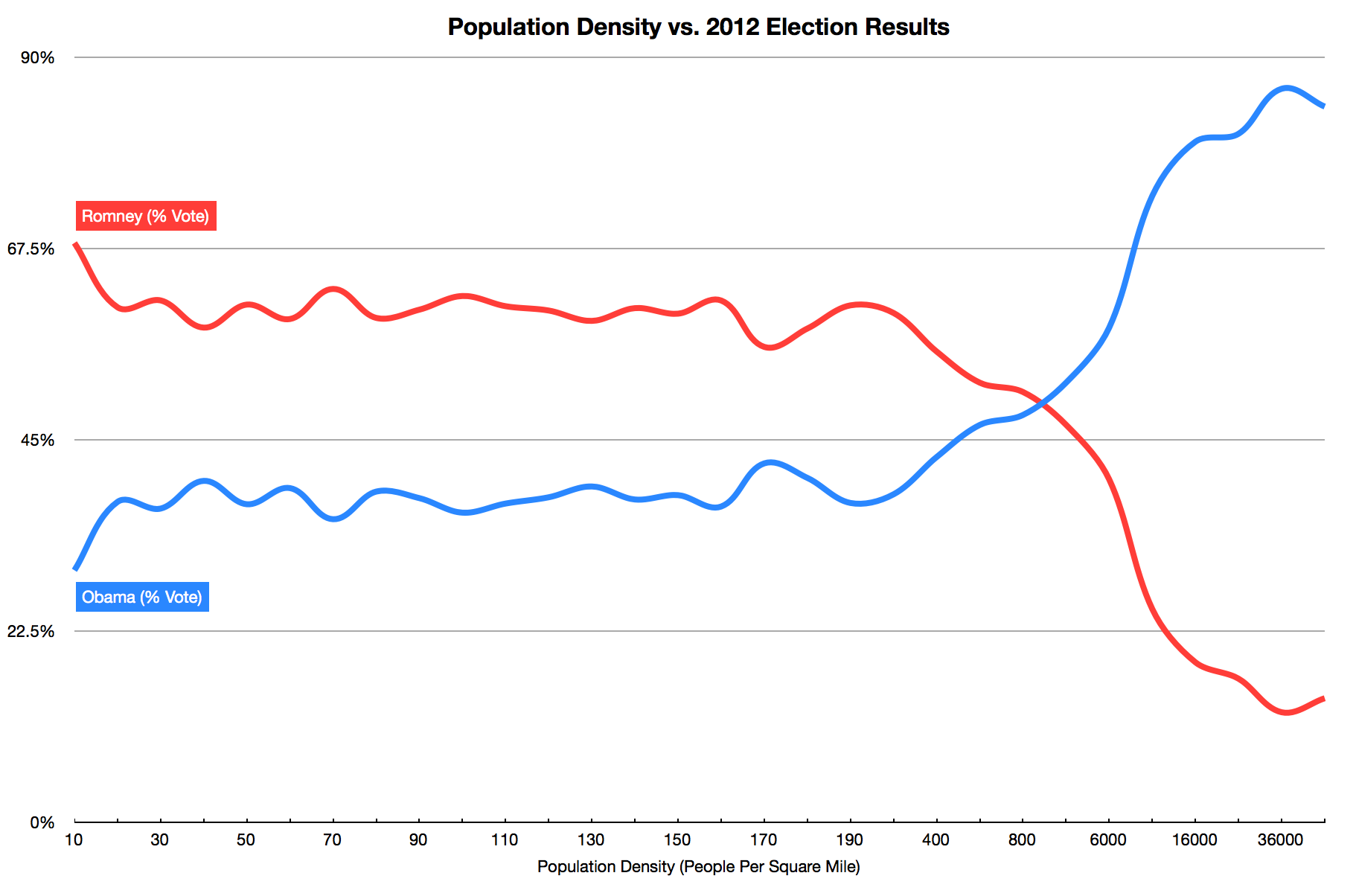
Curious about the correlation between population density and voting behavior, I began with analyzing the election results from the least and most dense counties and county equivalents. 98% of the 50 most dense counties voted Obama. 98% of the 50 least dense counties voted for Romney.
This could not be a coincidence. Furthermore, if the most dense places voted overwhelmingly for Obama, and the least dense places voted overwhelmingly for Romney, then there must be a crossover point: a population density above which Americans would switch from voting Republican to voting Democratic.
So I normalized and graphed the data, and there is a clear crossover point.
At about 800 people per square mile, people switch from voting primarily Republican to voting primarily Democratic. Put another way, below 800 people per square mile, there is a 66% chance that you voted Republican. Above 800 people per square mile, there is a 66% chance that you voted Democrat. A 66% preference is a clear, dominant majority.
So are progressive political attitudes a function of population density? And does the trend hold true in both red and blue states?

Red States and Blue States

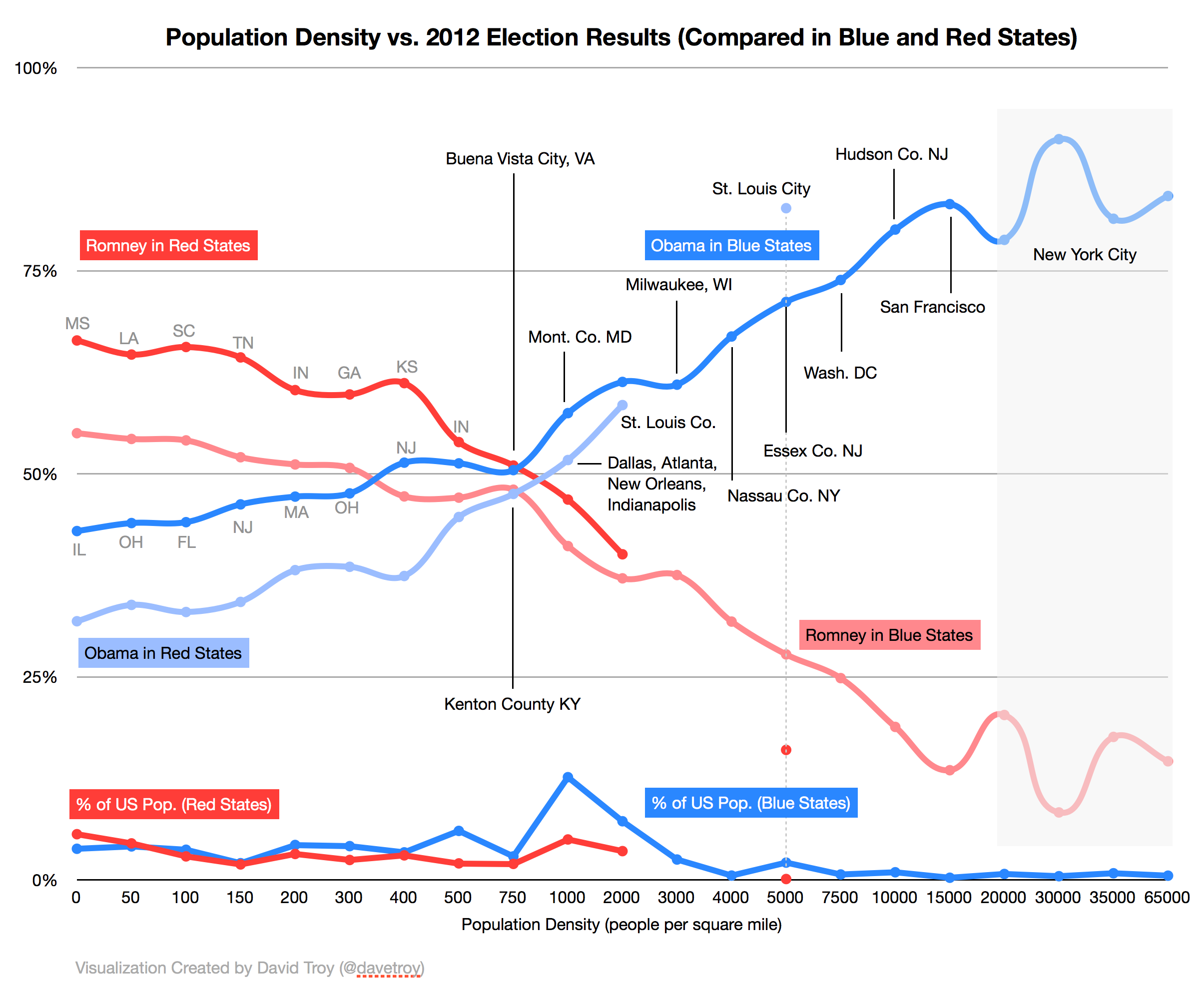
Separating the results from red states and blue states, we can see that while each has a slight preference for their ultimate candidate of choice, on a local level voting behavior is still directly correlated to population density.
Studying this graph, two important facts are revealed. First, there are very few cities in red states. Second, the few dense cities that do exist in red states voted overwhelmingly democratic.
Atlanta, New Orleans, St. Louis, Dallas, and Indianapolis are all in red states — and they all voted blue. And there are no true “cities” in red states that voted red. The only cities in red states that didn’t vote blue were Salt Lake City and Oklahoma City. And by global standards, they are not really cities — each has population density (about 1,000/sq. mi.) less than suburban Maryland (about 1,500/sq. mi.).
Historically, one can argue that red states have disproportionately affected election results by delivering a material number of electoral votes.
Red states simply run out of population at about 2,000 people per square mile. St. Louis is the only city that exceeds that density in a red state. It voted overwhelmingly Democratic (82.7%). In contrast, blue states contain all of the country’s biggest and densest cities: Washington DC, New York City, San Francisco, Baltimore, Milwaukee, Philadelphia, Boston, etc.

Red States Are Just Underdeveloped Blue States

As cities continue to grow in red states, those cities will become more blue, and ultimately, those states will become more purple, and then blue. The Republican party says it’s about growth and prosperity; the best way to achieve that in red states is through the growth of cities.
If you follow the red state trend lines, you can clearly see that any dense, fast-growing cities that might emerge in red states will be very likely to vote blue. The few that do already exist already vote blue. How would these new cities be different and cause them to vote red?
Red state voters generally prefer low-density housing, prefer to drive cars, and are sensitive to gas prices. Once population density gets to a certain level, behaviors switch: high-density housing is the norm, public transit becomes more common, and gas use (and price sensitivity) drops.
Red state values are simply incompatible with density.

Cities Are the Future

Globally, cities are growing rapidly as people move from rural to urban areas in search of opportunity. By 2030 it’s estimated that cities will grow by 590,000 square miles and add an additional 1.47 billion people.
Only subsidized suburban housing and fuel prices are insulating the United States from this global trend, and even with these artificial bulwarks, there is no good reason to think that America’s future lies in low-density development.
Density is efficient. Density produces maximum economic output. An America that is not built fundamentally on density and efficiency is not competitive or sustainable. And a Republican party that requires America to grow inefficiently will become extinct.
While the Republican party is retooling in the desert, it should carefully consider whether its primary issue is identity politics or whether its platform is simply not compatible with the global urban future. If that’s the case, an Hispanic candidate running on the same old Republican platform will simply not resonate. The Republican party must develop a city-friendly platform to survive.
Cities are the future and we need candidates from both parties that understand that reality.

The next question: why does population density produce these voting behaviors? Is the relationship causal or correlated? Probably both. I’ll explore this in my next post.

Data Source: US Census 2010 (population density by counties); Politico.com election 2012 results by County.